NDIS SEO services: Boost Visibility for Providers & NDIS Participants
So, what exactly are NDIS SEO services? Think of them as a specialised set of strategies built from the ground up to help National Disability Insurance Scheme providers connect with participants and their families online. This isn't your standard, run-of-the-mill marketing. It’s a thoughtful approach that tackles the unique compliance rules, language, and trust-building needed in the disability support sector, making sure you’re visible to the people who need you the most.
Why Generic SEO Fails NDIS Providers
Are you struggling to get noticed in the crowded NDIS space? You’re not alone. So many providers sink money into search engine optimisation, only to see their efforts completely miss the mark. The problem is simple: standard SEO strategies just don't cut it for the unique needs and sensitivities of the NDIS community.
Using a generic approach is like trying to find a specific, unmarked address with a general map of Australia—you might get into the right state, but you’ll never find the front door. Standard SEO often chases broad, high-volume keywords. This tactic fails because it ignores the very specific and local searches that participants, families, and support coordinators actually use. They aren’t just Googling "support services." They're looking for things like "NDIS occupational therapy for children in Parramatta" or "SIL housing vacancies near me."
The Compliance and Trust Barrier
Beyond just using the wrong keywords, generic SEO can’t navigate the sector's strict compliance and ethical guidelines. The NDIS world is built on a foundation of trust, dignity, and participant wellbeing—and every single piece of your online presence needs to reflect that.
A one-size-fits-all strategy often falls back on aggressive marketing language, making bold claims like "we're the best provider" or promising miraculous results. This kind of talk doesn't just breach the NDIS Code of Conduct; it shatters the trust of a community that values honesty and transparency above everything else. A strong online presence requires more than technical tweaks; it demands a genuine understanding of the sector's values. You can learn about general strategies in our guide to SEO for small business, but the NDIS demands a much deeper, more specialised focus.
Missing the Human Connection
Finally, and perhaps most importantly, generic SEO completely overlooks the human element. The journey to find the right NDIS provider is intensely personal and often a stressful time for families. Your website needs to be a source of clear, helpful, and empathetic information, not just another sales pitch.
Effective NDIS SEO services focus on creating content that answers real questions and addresses genuine concerns. This might look like:
Clear, simple explanations of different funding categories.
Helpful guides on how to prepare for a plan review meeting.
Stories that celebrate participant successes with dignity and respect.
Without this specialised focus on empathy, compliance, and local search, even the most technically perfect SEO campaign is set up to fail. It’s only when you align your digital strategy with the core values of the NDIS that you can build lasting connections and achieve real, meaningful growth.
The Pillars of a Successful NDIS SEO Strategy
So, we've established that generic, off-the-shelf SEO just doesn't cut it for NDIS providers. Now, let's flip the script and look at what actually works. A successful NDIS SEO strategy is built on four core pillars that work together to create a strong, visible, and trustworthy online presence.
Think of them as the foundational columns holding up your digital reputation. If one is weak, the whole structure gets wobbly. Getting to grips with these pillars demystifies the whole process, making it crystal clear how a specialised approach drives real, meaningful results.
Pillar 1: Local SEO
For most NDIS providers, your community is your lifeblood. It's geographically defined, and your clients are right there in your local area. Local SEO is all about optimising your online presence so you're the first name that pops up when participants and families search for services right where they live.
When someone in Bendigo searches for an "NDIS psychosocial recovery coach," local SEO is what gets your organisation on their screen.
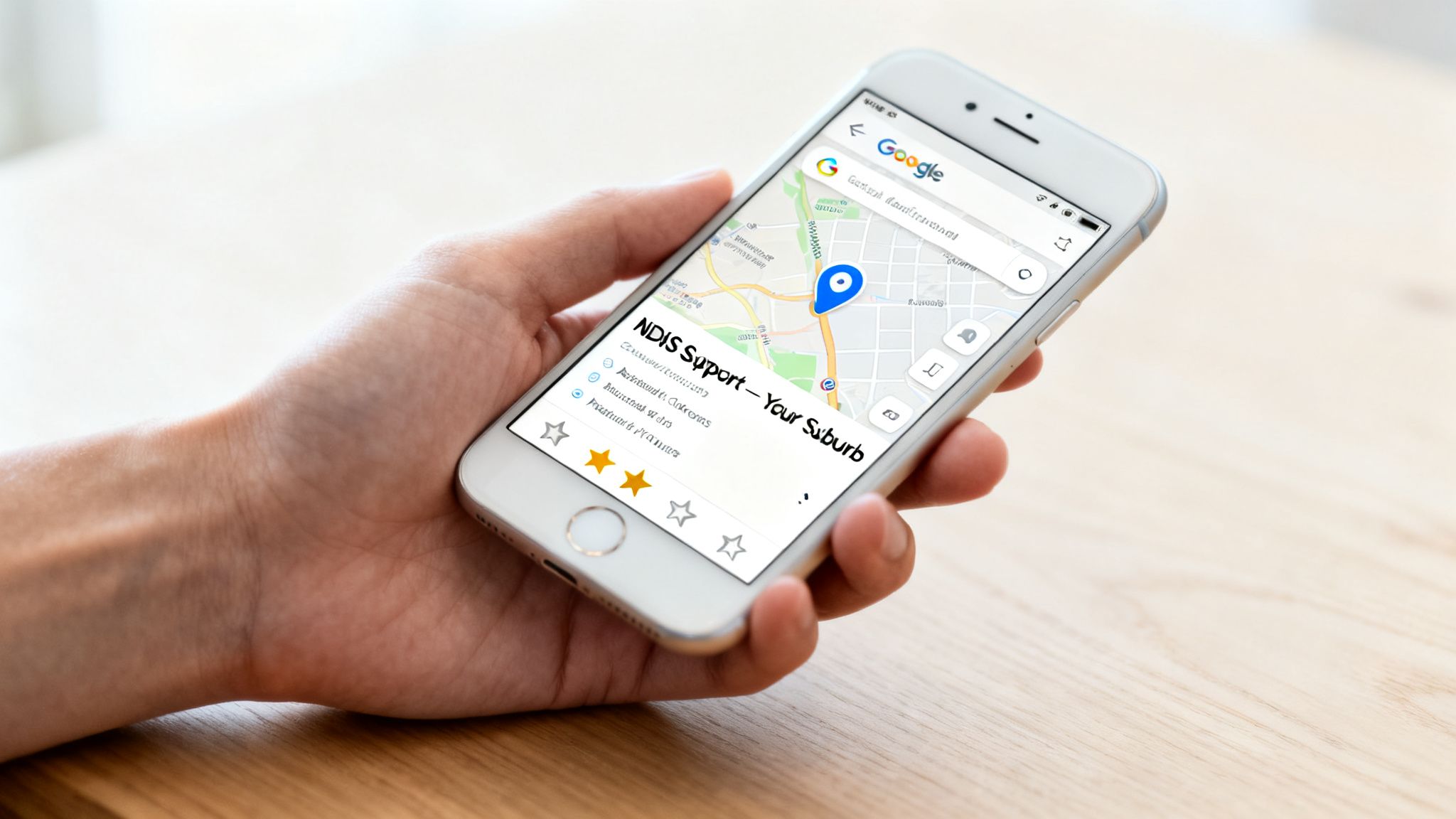
This goes way beyond just listing your address. It means taking meticulous care of your Google Business Profile—keeping your service details, operating hours, and accessibility information perfectly up-to-date. It's also about building a solid local reputation through genuine client reviews and creating service pages that speak directly to the people in specific suburbs or regions you serve.
Pillar 2: On-Page SEO
If Local SEO gets people to your door, On-Page SEO is what happens when they step inside your website. It's the art and science of optimising the actual content and structure of your web pages to connect with your audience. For an NDIS provider, this is where you weave in the language, empathy, and clarity that resonates.
It's about making sure every title, heading, and paragraph is perfectly aligned with the real-world questions and needs of participants.
This pillar focuses on:
Keyword Integration: Naturally weaving terms like "supported independent living vacancies" or "NDIS plan management" into your content so it reads smoothly.
Content Clarity: Structuring information so it’s easy to digest. That means ditching the jargon and using clear, simple headings.
User Experience: Ensuring your site is a breeze to navigate, helping visitors find exactly what they need without any frustration.
A crucial part of any effective NDIS SEO strategy is solid local SEO keyword research to pinpoint exactly what participants are typing into Google. This research is the blueprint for how you structure and write all your on-page content.
Pillar 3: Content Strategy
A powerful Content Strategy elevates you from being just another service provider to a genuinely helpful authority. In the NDIS world, trust is everything. Creating valuable, educational content is one of the single best ways to build it. This pillar is about moving beyond self-promotion to answer the tough questions that participants and their families are already asking.
For example, you could create:
A detailed guide explaining the difference between SIL and SDA housing.
A downloadable checklist to help families prepare for an NDIS plan review.
Blog posts that share de-identified success stories, showcasing participant achievements with dignity and respect.
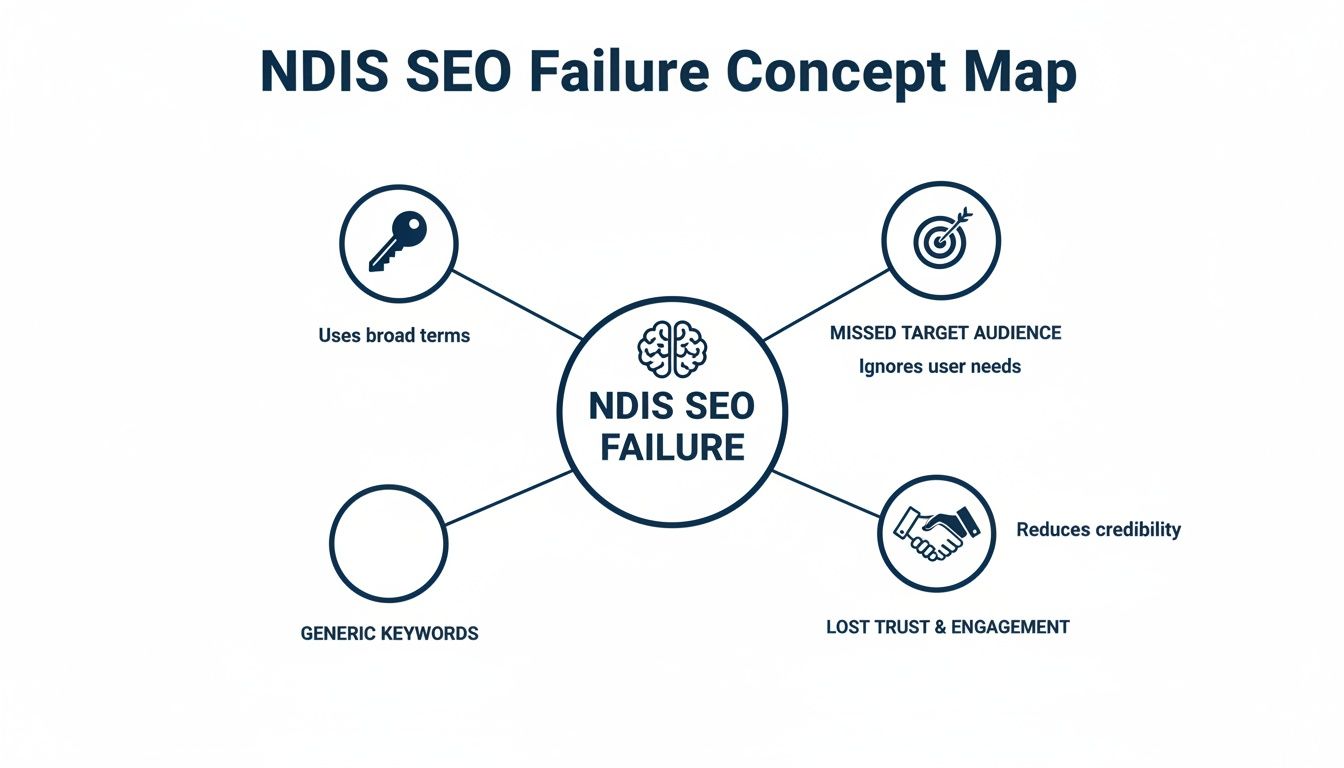
This is where generic strategies fall apart. This infographic shows how neglecting these specialised pillars leads to common failures like chasing broad keywords, completely missing the target audience, and ultimately, losing trust.
The image really drives home that failure isn't just a technical problem; it's a breakdown in understanding the unique needs and search habits of the NDIS community.
Pillar 4: Technical SEO
The final pillar, Technical SEO, is all the behind-the-scenes work that ensures your website's foundation is solid, secure, and accessible to everyone. This is the stuff your visitors might not see, but they’ll definitely feel it if it’s not done right. It's critical for both search engines and users, especially those who rely on assistive technologies like screen readers.
Key aspects of technical SEO include making sure your site loads quickly, is mobile-friendly, and is free of broken links or errors that cause frustration. For NDIS providers, a non-negotiable part of this is sticking to the Web Content Accessibility Guidelines (WCAG), which makes your site usable for people with a wide range of disabilities.
A technically sound website isn't just good for Google—it's a sign of professionalism and care. You can learn more about how these pillars fit into a larger plan by exploring our guide on https://titanblue.com.au/what-is-digital-marketing-strategy/.
Dominate Local Search and Connect with Your Community
For NDIS providers, your success isn’t just about being online; it’s about being found by the people right in your local community. Your services are fundamentally local, so your digital strategy has to be, too. This is where local search engine optimisation becomes your most powerful tool, turning your website into a beacon for local participants and families who are actively looking for support.
Winning at local search means becoming the go-to, trusted provider in your specific suburb or city. It’s about making sure that when a support coordinator in Geelong searches for specialised disability accommodation, your organisation shows up as a relevant, credible solution right on their screen.
Master Your Google Business Profile
Think of your Google Business Profile (GBP) as your digital front door. For local search, it's often the very first interaction a potential participant has with your organisation. Leaving it incomplete is like having a shop with no sign on the door—confusing and untrustworthy.
A fully optimised GBP for an NDIS provider is packed with detail. It goes way beyond just a name and address. To truly connect with your community, your profile must include:
Precise Service Details: List every single service you offer, from Support Coordination to Therapeutic Supports, using the language that participants actually use and understand.
Accurate Operating Hours: Keep your hours current at all times. This simple step prevents a lot of frustration for families trying to get in touch.
Crucial Accessibility Information: Detail features like wheelchair-accessible entrances, parking, and restrooms. This isn't just a helpful tip; it’s a powerful demonstration of your commitment to inclusivity.
This level of detail signals to both Google and users that you are a legitimate, active, and considerate provider in the local area.
Build Trust with Authentic Local Reviews
In the NDIS world, trust is everything. Families and participants rely heavily on the experiences of others to make informed, often life-changing decisions. Authentic reviews on your Google Business Profile are one of the most powerful forms of social proof you can have.
Encouraging satisfied participants and their families to leave feedback does more than just boost your star rating. Each positive review acts as a testament to the quality and compassion of your care, directly influencing others who are in that critical decision-making phase.
Responding thoughtfully to all reviews—both positive and negative—further shows your organisation's commitment to listening and always getting better.
Create Hyper-Local Service Pages
To capture highly motivated search traffic, you need to speak the language of local searchers. Generic service pages just won't cut it. The key is creating dedicated pages for each service in each specific location you serve.
Searches for NDIS services in Australia are incredibly location-driven. People constantly use queries like 'NDIS provider near me' and 'NDIS support services in [suburb]'. This geographic focus makes local SEO optimisation absolutely essential for providers.
This means instead of one single "Support Coordination" page, you should develop targeted pages like:
"NDIS Support Coordination in Newcastle"
"Specialist Disability Accommodation Vacancies in Logan"
"NDIS Occupational Therapy for Children in Chermside"
These hyper-local pages align perfectly with what real people are typing into Google. They signal to search engines that you are the most relevant authority for that specific service in that specific area, dramatically increasing your chances of ranking at the top.
For a deeper dive into how this can benefit your organisation, check out our detailed guide on local SEO for businesses. By taking these steps, you transform your website from a simple online brochure into a dynamic tool for genuine community connection and growth.
Building Trust and Authority with High-Value Content
In the NDIS world, trust isn’t just a nice-to-have. It’s the absolute foundation of your relationship with participants and their families. While all the technical SEO work gets your website seen, it’s your content and reputation that truly convinces people you’re the right choice. This is where you move from being just another name in a search result to a genuinely trusted resource.
The goal is to shift your mindset away from just hitting keywords. Instead, you need to create empathetic, valuable content that speaks directly to the real-world worries and questions people have. This is how you stop being a "service provider" and start becoming a compassionate authority they can rely on.
Crafting Content That Truly Connects
Put yourself in the shoes of a family starting their NDIS journey. It’s often a confusing and overwhelming time, filled with a desperate need for clear, simple answers. Your website can be a beacon of support by offering resources that actually help, not just sell.
Think about publishing content that provides genuine value, like:
Helpful Guides: Create easy-to-follow articles explaining how to navigate NDIS funding or what to expect in a plan review meeting. These are practical tools that solve real problems.
Clear Service Explanations: Break down complex offerings. For example, explain the difference between Supported Independent Living (SIL) and Specialist Disability Accommodation (SDA) in plain English.
Inspiring Participant Stories: With full consent and respect for privacy, share success stories that celebrate achievements and show the positive impact your services have made.
This approach builds a library of genuinely helpful resources that not only rank well in search engines but, more importantly, earn the trust of potential clients. When you answer their questions before they even have to ask, you establish credibility and goodwill from the very first click.
Why Your Online Reputation Matters
Your digital reputation is much bigger than just your website. What people say about you online—especially in Google reviews—heavily influences how participants and support coordinators see your organisation. Actively managing this feedback isn't optional; it's a core part of ethical NDIS SEO.
Every single review is a chance to show you’re committed to quality care. Responding thoughtfully and professionally to all feedback—the good and the bad—shows you’re listening, you care, and you’re dedicated to getting better.
Responding to reviews shows potential clients that you are engaged and value feedback. In fact, more than 90% of consumers say they are more likely to use a business that responds to all of its reviews.
This hands-on approach to managing your online reputation builds powerful social proof, reinforcing the trust you’ve established with your content. It completes the picture of a professional, caring, and reliable NDIS provider. A solid content plan is a huge part of this, and you can learn more about crafting one in our guide to content marketing services.
Ultimately, when you combine high-value resources with diligent reputation management, you create a powerful digital presence that doesn't just attract new participants—it makes them feel confident they’ve made the right choice.
How to Measure Real Growth from NDIS SEO
So, how can you be sure your investment in NDIS SEO services is actually making a difference? It’s easy to get lost in a sea of data, but real growth isn’t about vanity metrics like website traffic. Success is measured by the tangible outcomes that strengthen your organisation and expand your ability to support the community.
True measurement zeroes in on the key performance indicators (KPIs) that directly link back to your mission. Forget simply counting website visitors. Instead, let's focus on the actions that signal a genuine connection with a participant, family member, or support coordinator who needs your help.
Moving Beyond Vanity Metrics
A big spike in website traffic might look impressive on a report, but it means very little if those visitors aren't the right people or if they leave without taking any meaningful action. For an NDIS provider, real growth is found in the increase of genuine service enquiries and local visibility, not just clicks.
To gauge the real-world impact of your SEO, you need to track specific, high-value actions. These are the metrics that prove your digital presence is effectively connecting you with your community.
The most important KPIs for any NDIS provider are:
Increase in Direct Phone Calls: Tracking calls coming from your website or Google Business Profile shows you're reaching people who are ready to talk.
Rise in Submitted Service Enquiry Forms: This is a direct lead—a crystal-clear signal that your content and services are hitting the mark with prospective participants.
Higher Rankings for Local Keywords: Appearing at the top for searches like "NDIS support coordination in Geelong" means you are visible at the exact moment of need.
Improved Local Map Pack Visibility: Dominating the map results for local searches ensures you are the first choice for people in your immediate service area.
These metrics provide a clear, undeniable link between your SEO efforts and your organisation's growth. Each one represents a potential new participant you can support.
A Case Study in Real-World Impact
The power of a well-executed NDIS SEO strategy isn't just theoretical; it delivers concrete, game-changing results.
For example, one NDIS provider operating across Australia experienced enormous growth after implementing a focused SEO plan. The results show just how much strategic optimisation can reshape an organisation's ability to reach participants.
Through their targeted efforts, they achieved a remarkable 905.19% surge in organic traffic. More importantly, by March 2025, organic search had become their main acquisition channel, accounting for a massive 88.35% of the website's total traffic. This case study perfectly illustrates how specialised SEO moves beyond being an expense and becomes a primary driver of growth and community impact.
Tracking Conversions and Measuring ROI
To properly measure your return on investment (ROI), it’s crucial to set up conversion tracking. This is a technical process where your website analytics are configured to record every time a user completes a high-value action, like submitting a form or clicking a phone number.
Without it, you’re flying blind. Conversion tracking gives you the hard data to see which pages, keywords, and strategies are generating the most valuable enquiries.
This information allows you to:
Identify High-Performing Content: You can see exactly which articles or service pages are most effective at turning visitors into enquiries.
Optimise Underperforming Areas: If a page gets a lot of traffic but very few enquiries, you know it needs improvement.
Calculate a Clear ROI: By assigning a value to each enquiry, you can directly measure the financial return of your SEO investment.
This data-driven approach proves that a properly executed NDIS SEO services strategy is not just a marketing cost but a direct investment in your organisation's sustainability and mission. Understanding these timelines is important, and you can learn more by reading our article on how long it takes for SEO to work. It provides a realistic perspective on when you can expect to see these meaningful results start to appear.
Finding the Right NDIS SEO Partner
Choosing an agency to look after your digital growth isn't just another business decision—it's a massive one. The right partner will feel like an extension of your team, someone who genuinely gets your mission to support participants.
But get it wrong, and you could end up with a partner who wastes your budget, misrepresents your values online, and causes more harm than good. Your selection process needs to be sharp, focusing on expertise that goes way beyond generic marketing fluff.
Any agency you consider must have proven experience in the NDIS or similar healthcare sectors. This isn't just a nice-to-have; it's a non-negotiable. They need to show they have a deep understanding of the NDIS Code of Conduct, know how to communicate with sensitivity, and appreciate the critical importance of WCAG accessibility standards. Their whole approach should be built on a foundation of empathy and ethical strategy.
Key Questions to Ask Potential Agencies
To help you sort the experts from the pretenders, here are a few essential questions to ask any agency you're thinking of working with. Their answers will tell you everything you need to know about their experience and whether they’re cut out for the unique demands of the NDIS space.
How do you tailor your SEO strategy to comply with the NDIS Code of Conduct?
This question immediately tests their knowledge of the rules. A good partner will be able to talk about avoiding prohibited claims and focusing on ethical, value-driven marketing.
Can you share specific examples of how you've helped other NDIS providers grow?
They should be ready to show you case studies or anonymised data that proves they can deliver real results—think more service enquiries or better local rankings, not just vanity metrics.
What is your process for creating content that is both helpful and compliant?
Listen for an answer that prioritises creating genuinely useful resources for participants and their families. If they only talk about keywords, that’s a red flag.
How do you ensure our website remains accessible to people with disabilities?
A switched-on agency will immediately bring up the Web Content Accessibility Guidelines (WCAG) and explain their process for technical audits and on-page improvements.
When you're weighing up your options, it's also useful to have a grasp on what general professional SEO services involve. This gives you a baseline to make sure the provider can handle the fundamentals while also meeting your sector-specific needs.
Ultimately, the right agency will be committed to transparent reporting, showing you the metrics that actually matter—like phone calls and form submissions—not just a spike in website traffic. Finding that sweet spot between technical skill and genuine sector understanding is the key to a partnership that truly works.
Your NDIS SEO Questions, Answered
Stepping into the world of digital marketing can feel a bit overwhelming, especially with all the jargon out there. To clear things up and help you make decisions with confidence, we’ve put together some straightforward answers to the questions we hear most from NDIS providers.
How Long Does NDIS SEO Take to Show Real Results?
Unlike flicking a switch with paid ads, SEO is more like planting a garden—it’s a long-term strategy that builds sustainable growth over time. While you might see some small wins early on, you can generally expect to see a real shift in your rankings and a noticeable increase in organic enquiries within four to six months.
What happens during that time? It’s when all the foundational work gets done. We're talking about:
Running deep technical audits of your website to find and fix any issues.
Digging into local keyword research and seeing what your competitors are up to.
Creating and publishing high-quality, compliant content that speaks directly to participants.
Tuning up your Google Business Profile and building your local presence.
The secret ingredient here is consistency. Real SEO success comes from methodical, ongoing effort that slowly but surely builds your authority and trust—both with Google and your community.
What’s the Typical Cost for NDIS SEO Services?
The investment for NDIS SEO services can vary quite a bit, and it really depends on what you want to achieve, how competitive your local area is, and where your website is at right now. Most agencies, including us, work on a monthly retainer basis. That’s because SEO isn’t a one-and-done job; it needs constant attention and fine-tuning.
Things like the amount of content we create, how intensively we focus on your local SEO, and the technical complexity of your site all play a role in the cost. The best way to think about it isn't as a business cost, but as an investment in your organisation’s future—making sure you’re visible and easily found by the participants who need you most.
Is SEO a Better Investment Than Google Ads?
That's a great question, and the answer is: they're different tools for different jobs, and they actually work brilliantly together. SEO is all about building that organic, long-term visibility that you don’t have to pay for with every click. It creates a steady, reliable stream of enquiries and positions your organisation as a trusted leader in your field.
Google Ads, on the other hand, gives you that instant gratification. It can place you right at the top of the search results for specific keywords, which is perfect for promoting a new service or filling those last few SIL vacancies fast.
A smart approach often involves using SEO as your foundational strategy for steady, long-term growth, while sprinkling in Google Ads for those targeted, short-term campaigns when you need a quick boost.
Ready to connect with more participants and build a stronger, more visible online presence? At Titan Blue Australia, we create ethical and effective SEO strategies designed specifically for NDIS providers. Learn how our specialised services can help you grow.
Titan Blue is your go-to digital partner for smart, results-driven solutions. We blend strategy, creativity and tech to grow your brand and get real results fast.