Building a website for an NDIS provider in Australia is a completely different ball game than creating a standard business site. It’s not just about looking good; it needs to be a hard-working platform for participant acquisition and support. Your website has to prioritise accessibility, build trust instantly, and communicate with absolute clarity to connect with participants, families, and support coordinators.
Why Your NDIS Website Needs a Specialised Approach
Think of a generic business website like a general store. It has a bit of everything, but it's not the place you go for specialised equipment or expert advice. For NDIS providers, that approach just falls flat. Your website isn’t a digital brochure—it’s the front door for people seeking life-changing support, and it must be built entirely around their needs.
The NDIS sector is its own world, with unique rules, language, and expectations. A standard website simply doesn't speak this language, leaving potential participants and their support networks feeling confused or overlooked. Proper NDIS website design Australia transforms this digital space from a simple online presence into a purpose-built platform designed to welcome and guide users.
Catering to Multiple Audiences
Your website has to do the heavy lifting of speaking to several very different groups at once, each with their own priorities. A great design addresses them all without causing confusion.
Participants: They need to see, in seconds, if your services align with their NDIS plan goals. They’re looking for signs that you’re an accessible, trustworthy, and approachable provider.
Families and Carers: This group is searching for reassurance. They need detailed service information and simple, direct ways to get in touch on behalf of a loved one.
Support Coordinators: These are busy professionals looking for efficient and compliant partners. They want clear service details, straightforward referral processes, and proof of your NDIS registration and expertise to make confident recommendations.
Moving Beyond Aesthetics to Functionality
The NDIS market is growing fast, and a well-designed website is your most critical tool for standing out. It's no surprise the Australian web design market has hit a valuation of USD 679.51 million, with growth forecasts showing just how vital a digital presence has become. For NDIS providers, this means your website investment needs to focus on clarity and trust, not just flashy visuals that can confuse visitors looking for specific funding and service information.
This specialised focus isn't optional. It’s about building a digital front door that is not only welcoming but also exceptionally functional and compliant. The entire design must be rooted in a deep understanding of NDIS regulations and what your users truly need. It's the only way to genuinely connect with your community and drive real engagement. For more on creating effective digital platforms, you might find our guide on professional services website design useful.
Building a Foundation of Trust and Accessibility
For any website in the NDIS space, two things are non-negotiable: accessibility and trust. This isn't just about ticking boxes on a compliance sheet. It's about creating a digital front door that is genuinely welcoming, safe, and easy for every single person to walk through, no matter their ability.
Think of it like a physical building. If your front entrance only has stairs, you’re immediately shutting out anyone who uses a wheelchair. A website without proper accessibility features does the exact same thing in the digital world, unintentionally excluding a huge part of your community.
Decoding Web Content Accessibility Guidelines
The official roadmap for digital accessibility is the Web Content Accessibility Guidelines (WCAG). For any NDIS website design in Australia, hitting WCAG 2.1 AA compliance isn't just a goal; it's the baseline. This framework provides clear technical rules to make sure people with a whole range of needs—from vision and hearing impairments to motor and cognitive disabilities—can use your site without a hitch.
Getting to this standard involves making practical, meaningful adjustments. It’s about building inclusivity into every corner of your website from the very beginning. We dive deeper into this in our full guide to accessible website design.
So, what does AA compliance actually look like in practice?
Keyboard-Only Navigation: Some people can't use a mouse. Your site must be fully usable with just the tab, arrow, and enter keys, meaning every link, button, and form field can be reached without a click.
High-Contrast Colours: For someone with low vision, light grey text on a white background is practically invisible. AA standards set specific contrast ratios to make sure your text stands out and is easy to read.
Alternative Text for Images: Screen readers are used by people with visual impairments to have a webpage read aloud. "Alt text" is a simple description of an image that the screen reader voices, so no one misses out on important visual information.
Clear and Logical Structure: Proper headings (H1, H2, H3) create a logical outline of your page. This isn't just for looks—it allows screen reader users to understand the page structure and jump directly to the section they need.
Cultivating Trust from the First Click
Beyond the technical stuff, your website needs to immediately show that you're a credible and secure NDIS provider. Trust is everything, especially when you're handling sensitive personal information. When building an NDIS website, you have to nail the fundamentals like implementing robust form accessibility standards to ensure every participant can engage with you.
A few simple, clear signals can make all the difference in making a visitor feel safe and confident in your services.
Key Trust Signals to Display Prominently
NDIS Registration Details: Your NDIS registration number should be easy to find, usually in the website footer or on your 'About Us' page. It’s the quickest way for anyone to verify you’re a legitimate provider.
Genuine Participant Testimonials: Real stories from participants and their families are incredibly powerful. Share them ethically and with full permission, using real names (or first names) and photos where appropriate to build a genuine human connection.
Clear Privacy Policy: People need to know exactly how their data is being handled. A straightforward, easy-to-find privacy policy shows you’re committed to protecting their information and respecting Australian law.
Professional Contact Information: Offer multiple ways to get in touch—a phone number, a physical address, and a professional email. This demonstrates that you're an established, reachable, and real organisation.
Designing a Seamless Participant Journey
A truly effective NDIS website should feel like a friendly, knowledgeable guide, leading visitors from that first curious click right through to a confident enquiry. It’s about more than just laying out information; it’s about anticipating their questions, easing any anxieties, and making the path to getting support as smooth and straightforward as possible.
Think of it like walking into a big, unfamiliar building with zero signs. You'd feel lost and frustrated pretty quickly. Your website's structure—its navigation and the way information is organised—acts as that crucial signage. It makes sure no one ever feels overwhelmed or unsure of where to go next.
This user-first approach is absolutely critical in the NDIS space, which is getting more crowded by the day. Recent data shows a 15% growth in registered providers, while the average claims per provider actually dropped by 4%. In an environment like this, a superior NDIS website design in Australia that nails the participant journey and removes any hurdles to making an enquiry becomes a massive advantage. You can dig into these trends in the NDIS Annual Pricing Arrangements.
Crafting Jargon-Free Service Pages
Your service pages are where potential participants and their families make the call on whether you're the right fit. It's so important to ditch the clinical jargon and speak in plain, human terms. Someone looking for support isn't searching for "capacity building activities"; they're looking for help with "learning new skills" or "becoming more independent."
Frame your services around outcomes and what they help achieve within an NDIS plan. This simple shift changes the focus from what you do to what a participant can achieve with your help. A great service page should always include:
Clear Service Titles: Use simple language that participants would use themselves (e.g., "In-Home Support" instead of "Domestic Assistance Provision").
Benefit-Focused Descriptions: Explain how each service helps someone meet their goals, using real-world examples to bring it to life.
Simple 'Who It's For' Sections: Clearly state who the service is for, helping visitors quickly see if it's right for them.
Direct Calls-to-Action: Every single page needs a clear next step, like "Enquire About This Service" or "Speak to Our Team."
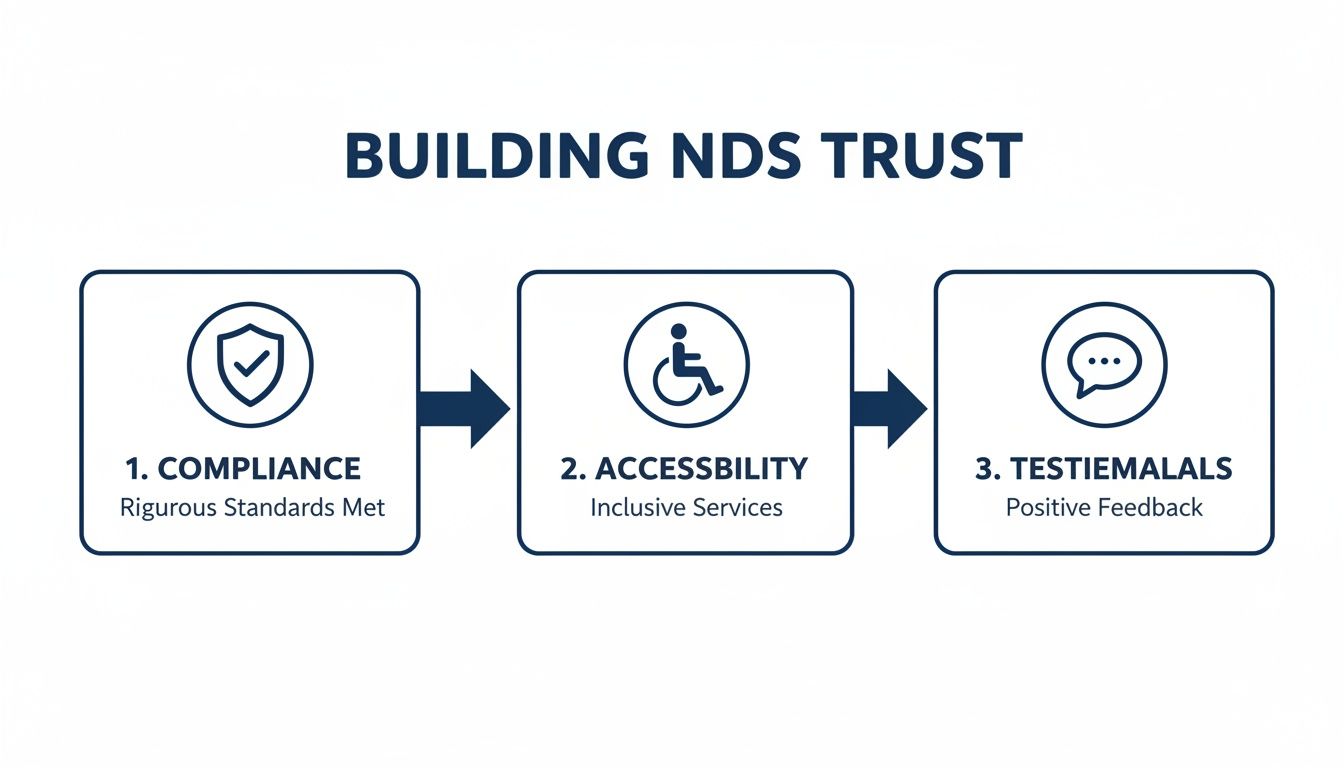
This visual breaks down the simple, foundational steps to building that essential connection online.
The process shows how starting with compliance and accessibility lays the groundwork for showcasing your value through real stories, building a digital presence people can trust.
Simplifying the Intake and Enquiry Process
The final step for a visitor is often filling out a contact or intake form. This is a make-or-break moment where so many websites get it wrong. A long, complicated form can feel like an interrogation, causing people to give up and leave.
Your goal here is to make this step as painless as possible. Only ask for the absolute essentials needed to start a conversation. You can always gather more details later on. For a deeper dive into mapping this out, check out our guide on what is customer journey mapping.
Tips for an Effective Intake Form
Keep it Short: Start with the basics: name, email, phone number, and a simple message box.
Use Clear Labels: Make sure every field is clearly labelled and easy to understand. No guesswork.
Break it Down: If you need more details, use a multi-step form that shows a progress bar. It feels much less intimidating.
Set Expectations: After someone hits 'submit', show a clear confirmation message that tells them what happens next (e.g., "Thanks for your enquiry! We'll be in touch within 24 hours.").
By carefully designing this journey, you create a website that not only informs but also empowers and supports visitors, turning their initial interest into a successful connection.
Ensuring Your NDIS Services Get Found Online
Having a beautifully designed, accessible website is a fantastic start, but it's only half the battle. If participants, families, and support coordinators can't find you when they search online, even the best website won't generate a single enquiry. This is where a smart online visibility strategy becomes non-negotiable.
For an NDIS provider, being found online isn’t about casting a wide net. It’s about being right there, at the exact moment someone in your local community is looking for the specific services you offer. The goal is simple: make your website show up as the most relevant, helpful answer to their search.
Mastering Local Search Optimisation
Let's be real—for the vast majority of NDIS providers, clients come from the local area. This makes local Search Engine Optimisation (SEO) your single most powerful tool. Local SEO is all about optimising your online presence to pull in more clients from relevant local searches on Google.
Think of it this way: people aren't just searching for "NDIS provider." They're searching for "NDIS occupational therapy in Perth" or "support coordination services near me." The more specific and location-focused your website is, the higher it will rank for these critical, high-intent searches.
An essential first step? Setting up and fully optimising your Google Business Profile. This free tool is what powers the local map listings you see in search results and is often the very first interaction a potential participant has with your organisation.
Your profile needs to be spot-on:
Accurate Business Name, Address, and Phone Number: Consistency across the web is absolutely crucial. It’s how you build trust with search engines.
Correct Service Categories: Choose the most relevant categories for NDIS and your specific allied health services. Don't be generic.
Detailed Service Descriptions: Use clear, keyword-rich language to explain exactly what support you offer and who you help.
High-Quality Photos: Showcase your facilities, your team, and the welcoming environment you’ve created.
By dialling in on these local signals, your NDIS website design Australia efforts start working much harder to bring qualified, relevant traffic directly to your digital doorstep. For a deeper dive, our guide on local SEO for businesses offers more actionable tips.
Preparing for the Future of AI Search
The way people find information is already changing. More and more, users are turning to voice assistants like Siri and Alexa or AI chatbots to ask direct questions. Instead of typing "NDIS speech pathology Brisbane," they might now ask, "Who provides speech therapy for children under the NDIS in Brisbane?"
This shift towards conversational, question-based searching demands a new approach to your website's content. To show up in these AI-driven answers, your site needs to provide clear, direct, and authoritative responses to the real questions your audience is asking.
This means structuring your content to answer those questions explicitly. Think about building out FAQ sections on your service pages or writing blog posts that tackle specific participant concerns head-on. A page titled "Understanding Your NDIS Plan for Therapeutic Supports," for instance, directly answers a user's need.
By anticipating these questions and providing the best answers, you position your website as a trusted authority. This doesn't just help with traditional SEO today; it ensures your services remain visible as AI continues to shape the future of search. It's a forward-thinking strategy that keeps you well ahead of the curve.
Choosing the Right Technology for a Secure Website
Picking the tech that runs your website is a bit like choosing the engine for a car. It determines how fast it goes, how reliable it is, and whether it can handle the journey ahead. For an NDIS provider, getting this technical foundation right is absolutely critical for protecting sensitive participant data and ensuring a smooth, dependable experience for everyone who visits.
The heart of this foundation is your Content Management System (CMS). Think of it as the dashboard for your website. It’s what lets you add a new service, post an update, or change a phone number without needing to call a developer. A flexible, well-supported platform like WordPress is often a fantastic choice, giving you the power to grow and adapt as your services evolve.
This technical backbone is essential in a sector that's growing rapidly. With NDIS scheme costs hitting $42 billion and projected to climb past $58 billion by 2028, the opportunity for providers is huge. A professionally built website—typically costing between AUD 12,000-20,000 for a custom job—isn't a luxury; it's a vital asset for connecting with participants and managing enquiries efficiently.
Core Technical Must-Haves
Beyond the CMS, a few other technical pieces are completely non-negotiable for a professional NDIS website design in Australia. These elements all work together to build a secure, trustworthy, and high-performing site that meets both regulatory standards and user expectations.
Secure Hosting: This is the plot of land on the internet where your website lives. Choosing a quality, Australian-based host means faster load times for local visitors and helps you stay on the right side of data sovereignty rules.
SSL Certificate: An SSL certificate encrypts the information that travels between a user's browser and your website. It’s what adds the 's' to 'https' and puts that little padlock icon in the address bar, telling visitors that any data they share, like in an enquiry form, is kept private and secure.
Mobile-Responsive Design: Most people will find you on their phone. It’s that simple. Your website must automatically adjust to look and work perfectly on any screen size, from a large desktop monitor to a small smartphone. If it’s clunky or hard to use on mobile, you’ll lose potential participants in seconds.
Integrating for Efficiency and Insight
A modern NDIS website shouldn't be an island. It needs to be the central hub that connects to your other essential tools, helping to streamline your day-to-day operations and give you a clearer picture of how people are using your site.
Because you're handling highly sensitive participant details, it's crucial to follow best practices for PII data compliance in analytics when setting up any integrations. The right connections can automate tedious tasks and arm you with the data to make smarter decisions.
Examples of Key Integrations:
CRM Integration: This is a game-changer. Linking your website's intake forms directly to a Customer Relationship Management (CRM) system automatically organises new enquiries. It saves a massive amount of admin time and makes sure no one ever falls through the cracks.
Analytics Tools: By installing a tool like Google Analytics, you can start to understand what people do when they land on your site. You can see which pages are the most popular, how people found you in the first place, and where they might be getting stuck. This information is gold for improving the user journey over time.
These technical decisions lay the groundwork for your site's long-term security and performance. But the initial build is only half the battle; ongoing maintenance is just as important. You can learn more about why professional website maintenance packages are so crucial for keeping your digital platform secure, fast, and up-to-date.
Your Essential NDIS Website Design Checklist
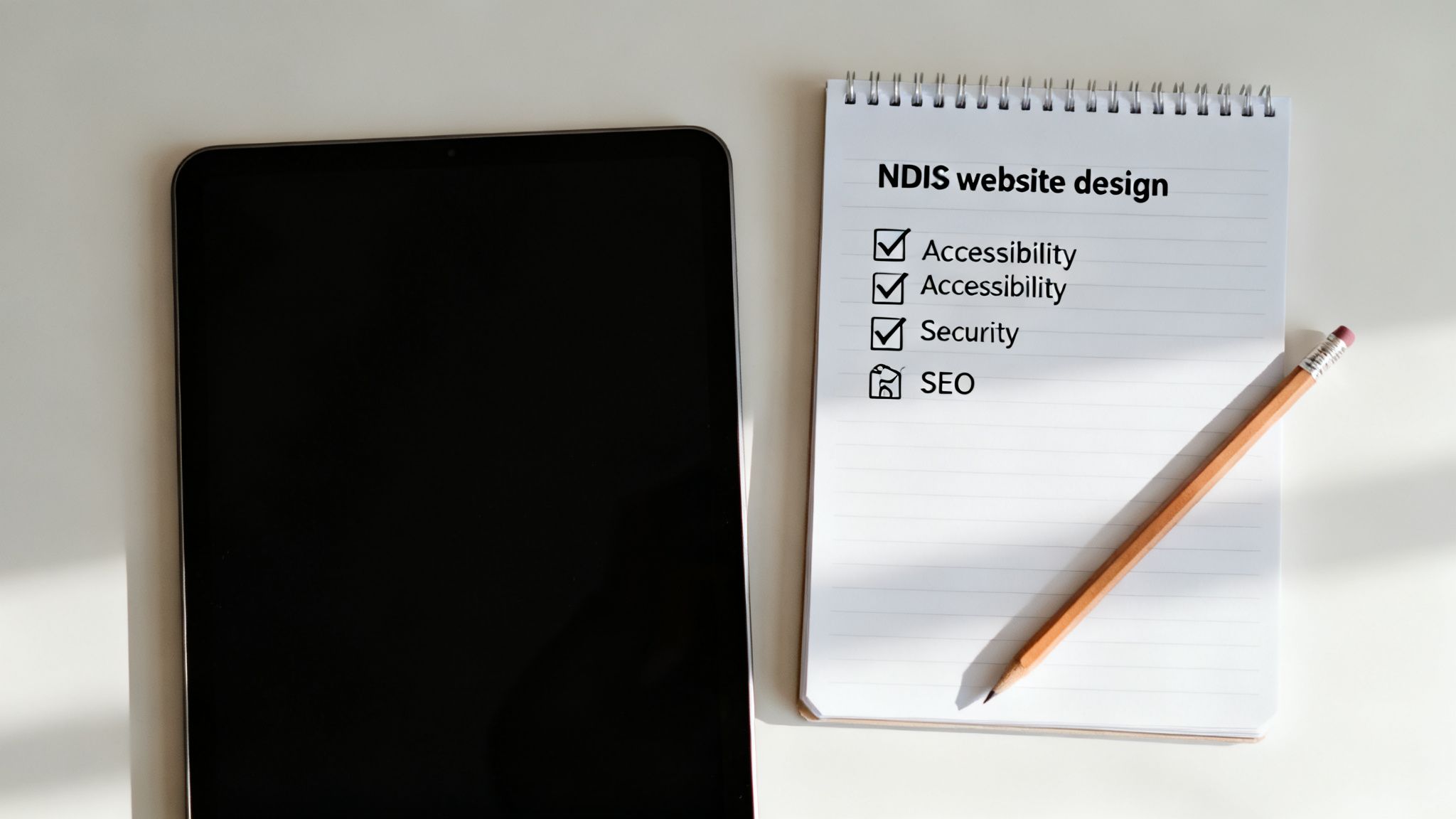
We’ve covered a lot of ground, so let’s pull all these critical elements together into a single, straightforward framework. Think of this checklist as your go-to guide for either building a new NDIS website from scratch or giving your current one a proper audit. It's the perfect tool to create a clear brief for a design agency or to methodically tick the boxes on your own site.
Accessibility and WCAG Compliance
Before anything else, your website has to be genuinely usable for everyone. This isn’t just a box to tick for compliance; it's a direct reflection of your organisation’s values. An accessible website is the digital equivalent of a building with ramps, automatic doors, and clear signage.
WCAG 2.1 AA Compliance: Is your website actually built to meet this benchmark standard?
Keyboard Navigation: Can someone navigate everything—menus, forms, buttons—using only a keyboard? No exceptions.
Colour Contrast: Is your text easy to read against its background? This is a must-have for people with visual impairments.
Image Alt Text: Do all important images have descriptive alternative text so screen readers can explain what's there?
Logical Heading Structure: Are your pages structured with a clear hierarchy of headings (H1, H2, H3)? This creates a navigable outline, not just a pretty layout.
User Journey and Intake Forms
A great user journey feels effortless. It guides visitors from the moment they land on your site right through to making an enquiry, without any confusion. The goal is to make the path to getting help as smooth as possible—a core part of effective NDIS website design in Australia.
Jargon-Free Content: Are your service descriptions written in plain English that participants and their families will actually understand? Focus on outcomes, not internal jargon.
Clear Calls-to-Action (CTAs): Does every single page give the user a clear, logical next step to take?
Simple Intake Forms: Are your enquiry forms short, sweet, and to the point? Only ask for what's absolutely necessary to start a conversation.
Intuitive Navigation: Is the main menu simple and organised logically? Visitors should be able to find what they need without having to think too hard.
Trust and Safety Signals
Trust isn't given; it's earned. From the very second someone lands on your site, you need to send clear signals that you are a legitimate, professional, and secure NDIS provider. When you're handling sensitive participant information, these elements are completely non-negotiable.
Prominent NDIS Registration: Is your NDIS registration number clearly visible? Pop it in the footer or on your About page where it’s easy to find.
Authentic Testimonials: Are you showing real feedback from participants and families to build social proof?
Clear Privacy Policy: Is your privacy policy easy to locate and written in simple terms anyone can understand?
Secure Connection (SSL): Does your website use HTTPS? That little padlock in the address bar is a huge trust signal.
SEO Readiness
Finally, what's the point of a brilliant website if no one can find it? You need to make sure your site is built to be discovered by potential participants searching on Google in your local area.
Local SEO Optimisation: Is your Google Business Profile claimed, verified, and filled out with accurate, up-to-date details?
Location-Specific Keywords: Does your website content naturally include the names of the suburbs or cities you serve alongside your service descriptions?
Mobile-First Design: Let's be honest, most people will find you on their phone. Does your website work flawlessly on smartphones and tablets?
Your NDIS Website Questions, Answered
Building a specialised website always brings up a few important questions. To clear things up, we’ve put together answers to the most common queries we hear from NDIS providers. Think of this as your cheat sheet for understanding what goes into a truly effective NDIS website design in Australia.
How Much Does a Professional NDIS Website Cost in Australia?
A professionally designed, compliant NDIS website in Australia typically falls in the range of AUD $12,000 to $20,000.
This isn't just for a pretty design. That figure reflects the highly specialised work involved—implementing full WCAG accessibility, building secure intake forms that protect participant data, and creating a local SEO strategy designed to attract participants. It’s a strategic investment in a long-term asset built for growth, not just another business expense.
What Is WCAG AA Compliance and Why Is It So Important?
WCAG stands for Web Content Accessibility Guidelines, and the 'AA' level is the global benchmark for making websites usable for people with diverse abilities. For any NDIS provider, this is non-negotiable.
It’s about practical things like ensuring your colour contrast is strong enough for someone with low vision, making sure the entire site can be navigated using only a keyboard, and providing descriptive text for images (alt-text) for screen readers. A compliant site is proof that you’re committed to inclusivity and guarantees everyone can access your services.
Can I Just Use a DIY Website Builder for My NDIS Practice?
While DIY platforms look tempting with their low upfront costs, they almost always fall short for a compliant NDIS website. They simply aren’t built for it.
Achieving proper WCAG accessibility, integrating secure and customised intake forms, and rolling out an effective local SEO strategy is incredibly difficult with generic, off-the-shelf templates. A professional build is designed from the ground up for participant acquisition and to scale with you—an investment that basic tools just can't match.
How Long Does It Take to Build a Custom NDIS Website?
From the first strategy session and design concepts right through to development, testing, and launch, a custom NDIS website project typically takes between 8 to 12 weeks.
This timeline gives us the room to do things properly. It covers a thorough discovery process to understand your needs, content creation, detailed accessibility implementation, and rigorous testing to make sure everything works perfectly. This ensures the final website not only meets all regulatory standards but actually serves the needs of participants, their families, and support coordinators.
Ready to build an NDIS website that connects with your community and drives growth? The team at Titan Blue Australia has over two decades of experience creating compliant, accessible, and high-performing digital platforms for Australian businesses. Let's talk about your project.
Titan Blue is your go-to digital partner for smart, results-driven solutions. We blend strategy, creativity and tech to grow your brand and get real results fast.