


Last updated:
You know your business brings value. The frustrating part is that Sydney customers don’t always see it when they need it most.
A plumber can be the fastest responder in the suburb and still lose work to a competitor who shows up first on Google. A restaurant can have a better menu, better service, and stronger repeat business, yet miss dinner bookings because its ads are broad, badly timed, or sending people to the wrong page. A builder can have a full pipeline one month and a quiet calendar the next because lead flow isn’t being managed with any consistency.
That gap is why so many owners start looking for a ppc agency sydney. They’re not chasing marketing jargon. They want the phone to ring, quote requests to come through, and bookings to land without wasting budget.
A big problem is that most PPC advice in Sydney is written for enterprise brands or pure eCommerce. That misses the reality that over 97% of Australian businesses are SMBs, and local operators such as trades and restaurants need hyper-local targeting and practical ROI expectations. In Australian home services, a 4:1 return is typical, which is a far more useful benchmark for a local owner than enterprise commentary about brand lift or channel synergy, as noted in this Sydney PPC agency guide for Australian businesses.
If you're trying to sort out what paid search should look like for your business, it helps to pair ads with stronger local search strategies for Sydney. That’s where a lot of small businesses get traction. Not by being everywhere, but by being visible in the moments that matter.
Your Sydney Business Deserves to Be Seen
Sydney is noisy online. Every suburb has competitors bidding on the same service terms, chasing the same urgent searches, and trying to win the same calls. If you run a restaurant, trade business, hospitality venue, construction firm, or solar company, you’re competing in a market where timing and relevance matter more than reach.
That’s why generic PPC advice tends to fall flat for local operators. A campaign built for a national eCommerce brand won’t help much when your real target is someone searching for a service near them, right now, on their phone.
Why local service businesses need a different playbook
A local services campaign has different pressure points:
- Location matters first. You don’t need clicks from the wrong side of the city if you can’t service them profitably.
- Intent matters more than traffic. A smaller number of high-intent searches often beats broad exposure.
- Speed matters after the click. If a visitor can’t call, book, or request a quote quickly, the budget leaks.
Most owners feel this instinctively. They’ve seen reports full of impressions and clicks that didn’t turn into much. The missing piece is a strategy built around suburb coverage, service profitability, business hours, and the jobs you want.
Practical rule: For a local service business, good PPC isn’t about getting seen by more people. It’s about getting seen by the right people in the right postcode at the right moment.
A solid ppc agency sydney partner should understand that from the start. If they talk more about platform features than booked work, they’re probably solving the wrong problem.
What a PPC Agency Actually Does for Your Business
A good PPC agency doesn’t just “run Google Ads”. It works more like a high-performance delivery driver for your lead flow. The job isn’t to drop off clicks and leave. The job is to find the fastest route to the right customer, avoid wasted detours, and make sure the delivery ends with an action that matters.
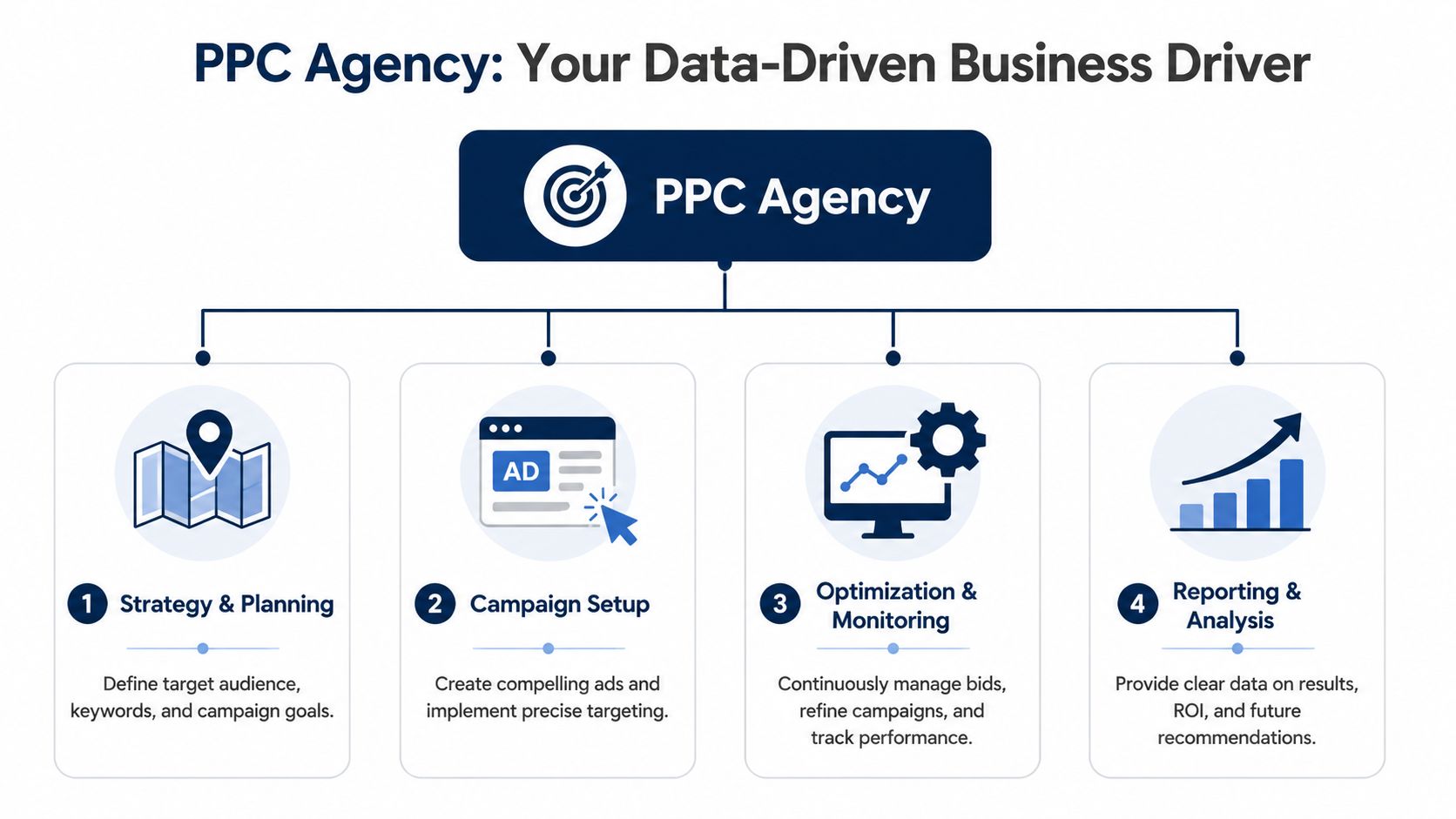
Strategy and planning comes first
Before any campaign goes live, the real work is deciding what should be advertised and what shouldn’t.
For a plumber, that may mean separating emergency call-out services from general maintenance. For a restaurant, it may mean splitting dine-in campaigns from takeaway or function enquiries. For a construction or solar business, it often means narrowing down to the services with better margins and shorter sales friction.
A capable agency should define:
- Service priorities based on revenue potential and sales quality
- Keyword themes that show genuine local intent
- Geographic targeting around serviceable suburbs and areas
- Campaign goals tied to calls, bookings, form leads, or sales
If that planning is skipped, everything after it gets messy. You end up bidding on terms that look relevant but don’t bring in valuable work.
Campaign setup is more than ads
Ad copy matters, but setup matters just as much. A lot of underperforming accounts break down at this point.
An agency should build a structure that keeps budget under control and matches the searcher’s intent. That usually includes separating campaigns by service, location, and often by device or audience type. Search ads need to match what people are looking for, and the landing page needs to continue that message without friction.
A local business should also expect help beyond the ad platform itself. If the page is confusing, slow, or aimed at the wrong action, no amount of media buying fixes that.
You can see how this fits into broader PPC advertising management for service businesses, where account structure, targeting, and landing page alignment all work together rather than as isolated tasks.
Ongoing optimisation is where value is created
Launching a campaign is the easy part. Keeping it efficient is where agencies earn their fee.
That means watching search terms, adjusting bids, testing headlines, refining location settings, excluding poor-quality traffic, and checking whether calls and forms are being recorded properly. A strong manager keeps tightening the account so more of the spend goes toward likely buyers.
Good PPC management looks boring from the outside. Inside the account, it’s constant decision-making.
Reporting should answer business questions
A useful report doesn’t hide behind platform language. It should tell you what happened, why it happened, and what changes are being made next.
You should be able to understand:
- Which services are generating leads
- Which suburbs are worth more budget
- Whether calls or form enquiries are improving
- What the next test is and why it matters
If an agency can’t explain performance in plain English, it usually means they don’t have enough control over it.
The Real-World Benefits for Sydney Restaurants and Trades
The reason local businesses invest in PPC is simple. It can create demand on a timetable you can control.
SEO is valuable, but it takes time. Referrals are important, but they’re inconsistent. Paid search gives you a way to show up when people are actively looking, whether that’s someone searching for a late dinner option, an urgent plumber, or a solar quote in a specific part of Sydney.

What this looks like for a restaurant
For a restaurant, PPC works best when the campaign is built around intent and timing.
Someone searching for a venue, takeaway option, or local dining choice is already close to making a decision. The ad’s job is to remove hesitation. Clear offers, location relevance, opening hours, and a booking or call action all matter more than clever wording.
The practical upside is better control over quieter periods. If weekday lunch is soft, campaigns can focus there. If private dining or functions are more profitable, the account can shift budget in that direction. PPC gives a restaurant owner levers to pull, rather than waiting for foot traffic to improve on its own.
If you run hospitality campaigns, it also helps to understand how paid media fits with broader restaurant digital marketing expertise, because bookings usually improve when ads, local presence, and on-site conversion points are aligned.
What this looks like for trades and service businesses
Trades see some of the clearest PPC value because many searches carry immediate intent. A person looking for a plumber, electrician, builder, or solar installer often needs action, not education.
That creates a direct commercial opportunity:
- Emergency services can target high-urgency searches and drive phone calls
- Quote-based services can focus on suburb-specific lead forms
- Higher-ticket jobs can be filtered with tighter messaging so poor-fit enquiries don’t consume time
For builders and contractors, service pages and ads should also reflect how clients search by job type. This is why resources on PPC strategies for remodelers can be useful reading. They reinforce an important point. Campaigns perform better when they’re built around specific services and buyer intent, not generic “contractor” visibility.
The upside is proven when the work is managed well
Sydney agencies have published strong performance outcomes when campaigns are structured properly. One example cited 43x revenue growth for an eCommerce client in three months, while other agency results showed ROAS increases from 1.6x to 7.2x. Those figures come from this Sydney PPC performance roundup, and while they aren’t a promise for every local service business, they do show how powerful paid search can be when strategy, tracking, and optimisation are handled well.
For a small business owner, the takeaway isn’t to chase headline numbers. It’s to recognise that properly run PPC can produce measurable growth quickly, especially when campaigns are built around local intent and commercial actions.
If a campaign brings more clicks but not more calls, quotes, or bookings, it isn’t working. Local businesses feel that gap fast.
Understanding PPC Service Models and Sydney Pricing
Pricing confuses a lot of business owners because proposals often bundle strategy, management, creative work, tracking, and reporting into one number. That’s why two agencies can sound similar on the phone and still be offering very different things.
The first thing to separate is ad spend from management fees. Ad spend goes to Google, Microsoft, or another platform. Management fees pay the agency to plan, build, monitor, and improve the campaigns.

Typical Sydney investment levels
For Sydney service businesses such as trades and restaurants, typical monthly ad spend ranges from $1,500 to $3,000, with management fees starting around $1,200, based on this Sydney PPC agency pricing reference.
That doesn’t mean every business should start there. It means this is a realistic benchmark for the market. Sydney is competitive, so budgets that are too low often produce patchy data, limited visibility, and inconsistent lead flow.
For larger accounts, especially multi-location or eCommerce campaigns, spending usually starts higher. Local service businesses should focus less on matching someone else’s budget and more on whether the spend is enough to support proper testing and consistent lead volume.
The main pricing models you’ll see
Most agencies use one of three approaches.
-
Percentage of ad spend
The agency charges a percentage based on what you spend on ads. This can work, but it can also create awkward incentives if fee growth depends mainly on pushing spend higher. -
Flat monthly fee
You pay a set amount for management. This is easier to budget for and often suits SMBs that want cost predictability. -
Hybrid pricing
Part retainer, part variable fee. This can make sense when campaigns are broad in scope or spread across multiple platforms.
The right model depends on your account complexity, not just the cheapest line item. A flat fee can be excellent for a focused local campaign. A more involved setup may justify a broader retainer if the work includes landing page testing, cross-platform management, and detailed reporting.
What to ask before you accept a quote
Before signing anything, get clarity on what the fee covers.
Ask whether the agency includes:
- Conversion tracking setup
- Landing page advice
- Call tracking review
- Regular ad testing
- Monthly reporting and strategy input
You should also check if they’re transparent about account ownership and whether you’ll retain access to the ad account.
For owners comparing budgets, this guide on how much Google Ads cost in Australia is useful context because it helps frame budget discussions in terms of competitiveness and business goals, not just platform minimums.
Budget check: Cheap PPC management often becomes expensive when poor setup burns spend for months before anyone fixes the account.
Accreditation matters, but only up to a point
Agency accreditations can be a positive signal. They suggest a level of platform engagement and capability. They shouldn’t be the deciding factor on their own.
For a Sydney local business, the better question is whether the agency can take that platform knowledge and apply it to suburb-level targeting, service priorities, and lead quality. That’s what turns a media account into a growth channel.
How to Evaluate and Choose the Right Sydney PPC Partner
Most agency websites sound similar. Everyone talks about data, optimisation, and results. The difference shows up when you ask direct questions about how they run accounts for local businesses.
A good ppc agency sydney partner should be able to explain its process without hiding behind jargon. If the answers stay vague, expect vague performance later.

Start with fit, not features
A local service business doesn’t need the same account model as a national retailer. You need a partner who understands service areas, phone-driven leads, booking behaviour, and uneven demand across the week or season.
Ask how they’d approach your business specifically. Not in theory. In practice.
Useful questions include:
- How would you split campaigns by service or suburb?
- What counts as a conversion for a business like ours?
- How do you handle wasted spend from irrelevant searches?
- What happens in the first month after launch?
The answers should sound operational. You want detail about targeting, search intent, exclusions, messaging, and tracking. If you get polished language without tactical specifics, keep looking.
One option in the Australian market is Titan Blue’s pay per click agency service, which sits alongside website, SEO, and AI search work. That kind of wider capability can matter when paid performance depends on landing pages and broader search visibility, not just ad settings.
Check whether they understand tracking properly
Tracking isn’t a technical extra. It’s the control system for the whole campaign.
If calls, form submissions, quote requests, or bookings aren’t tracked accurately, the agency can’t tell which keywords or ads are producing value. That usually leads to bad optimisation decisions.
Ask them:
- How do you track calls from ads and the website?
- How do you separate good leads from weak ones?
- Do you use UTM parameters and clear attribution rules?
- How do you report on lead quality, not just lead volume?
You don’t need a lecture on analytics. You need confidence that they can trace spend to outcomes.
Ask about landing pages and speed
Many underperforming campaigns are not ad problems. They’re landing page problems.
In Sydney’s market, Bing Ads can deliver 15-30% lower CPCs than Google due to less competition, and landing pages that load in under 3 seconds can improve conversion rates by 20-50%, according to this Sydney landing page optimisation analysis.
That matters because agency quality isn’t only about buying media well. It’s about recognising where conversions are being lost after the click. If an agency never reviews your page speed, mobile layout, call buttons, form friction, or headline clarity, they’re only doing part of the job.
A strong PPC partner treats the landing page as part of the campaign, not as someone else’s problem.
Here’s a useful overview to keep in mind while comparing options:
Reporting should be plain English
You shouldn’t need to decode a monthly report. Ask to see a sample before signing.
A strong report should show:
- What spend produced
- Which campaigns are improving
- Where waste is being cut
- What tests are running next
- What the business should expect over the coming period
If all you see are charts about clicks, impressions, and average positions without context, that’s a warning sign. Good agencies translate platform data into business decisions.
Look for discipline, not constant reinvention
Some owners get impressed by agencies that promise a brand-new tactic every week. That usually isn’t how profitable PPC works.
Good management is repetitive in the right way. Weekly checks. Structured testing. Clear exclusions. Honest reporting. Tightening what works. Cutting what doesn’t.
If an agency can explain those routines clearly, they’re usually more dependable than one that sells excitement.
Beyond Clicks Measuring What Truly Matters
Clicks don’t pay wages. Impressions don’t fill booking slots. Local businesses need reporting that connects ad spend to outcomes they can recognise in the business.
That means shifting attention away from vanity metrics and toward the numbers that reflect whether the campaign is commercially sound.
The KPIs that matter most
For a Sydney service business, the key questions are straightforward. How much did it cost to generate a lead? How many visitors turned into enquiries? Are returning visitors converting better than cold traffic? Is the campaign bringing in the right kind of work?
The most useful metrics usually include:
-
Cost per acquisition
What you’re paying for each lead, booking, or sale. -
Conversion rate
The share of visitors who take the action you care about. -
Return on ad spend
Whether the revenue generated is strong enough to justify the investment. -
Lead quality by source or campaign
Which campaigns produce jobs worth taking, not just enquiries.
These are the numbers that support decisions. They tell you where to push harder, where to pull back, and where the landing page or sales process needs attention.
Why bidding and remarketing matter in the report
A good report should also explain how the account is being improved, not just what happened last month.
Advanced bidding strategies such as Enhanced CPC can lift ROI by 25-40%, and effective remarketing can reduce cost per acquisition by 35% on average because previous site visitors are 2-3 times more likely to convert, based on this Sydney PPC management reference.
Those figures matter because they show where efficiency can come from. Not from spending blindly, but from using better bidding logic and re-engaging people who already showed intent.
What a healthy report sounds like
A useful monthly update should read more like a business review than a platform dump.
It should say things like:
- Search terms for one service improved, so budget is shifting there
- A landing page is leaking mobile users, so it needs revision
- Remarketing is producing cheaper enquiries, so the audience is being expanded
- One offer isn’t converting, so the ad message is being replaced
What to listen for: “We cut waste on weak search terms and improved the path to enquiry.” That’s far more valuable than “your clicks were up”.
Vanity metrics still have a place, but not the top place
Clicks and impressions aren’t useless. They help diagnose visibility and ad relevance. They just shouldn’t lead the conversation.
If your agency opens every meeting by celebrating traffic while your call volume is flat, they’re measuring comfort, not performance.
The Titan Blue Difference Future-Proofing Your Growth
Finding the right PPC partner isn’t only about who can launch ads. It’s about who can support growth as search behaviour changes.
That matters more now because customers don’t always move through a neat path of search, click, and conversion. They compare options across Google, maps, social platforms, review signals, and increasingly AI-driven search experiences. A business that wants steady lead flow needs a partner who sees the full picture.
Experience matters when the market gets messy
A long-standing agency has usually seen the same core problems repeat in different forms. Weak tracking. Broad targeting. Poor landing pages. Campaigns optimised for cheap clicks instead of profitable work.
Titan Blue Australia has 25+ years of digital expertise, which is relevant because local businesses don’t need trendy tactics so much as dependable judgement. The practical advantage of that experience is knowing which fixes move performance and which distractions waste time.
PPC should connect with the rest of your visibility
For many Sydney businesses, paid search performs better when it’s connected to website quality, SEO, content, and emerging AI search visibility. That’s where a broader digital strategy becomes useful.
A campaign may generate interest quickly, but long-term efficiency usually improves when your business also becomes easier to find organically and easier to trust once found. That is especially important for trades, hospitality, and construction businesses where customers often compare multiple providers before acting.
The future-proof approach isn’t replacing PPC. It’s making sure PPC works alongside the other ways customers discover and evaluate your business.
Titan Blue operates from Broadbeach and works with businesses across the Gold Coast and nationally, including service-based operators that need practical lead generation support rather than enterprise-style complexity. For Sydney owners, that means the conversation can stay focused on business outcomes, while still accounting for where search is heading next.
Frequently Asked Questions About Sydney PPC
How long does it take to see results from PPC
PPC can start generating visibility and enquiries soon after launch, but useful decision-making takes a little longer because the account needs data. The early period is usually about refining search terms, ad copy, location targeting, and landing pages. Fast activity doesn’t always mean efficient activity, so the first goal is stable lead quality, not just quick clicks.
Can I run Google Ads myself instead of hiring an agency
Yes, you can. Many owners do. The issue isn’t access to the platform. It’s whether you have the time and judgement to manage search terms, bids, exclusions, ad testing, tracking, and landing page performance consistently. If your campaigns are simple and you’re prepared to learn, self-management can work. If each missed lead has meaningful revenue attached to it, expert management often saves money by reducing waste.
Is PPC still worth it with a modest budget
It can be, if the targeting is tight. Small budgets usually fail when businesses go too broad, target too many services at once, or send traffic to weak pages. A narrower campaign focused on the right suburbs, high-intent services, and a strong call to action often performs better than a wider campaign trying to cover everything.
Which platform should a local service business start with
For most service businesses, Google Ads is the starting point because it captures people already searching. After that, the right mix depends on the business model. Hospitality may benefit from social support. Trade and quote-based services often stay more search-heavy. The best choice comes from customer behaviour, not platform hype.
What should I ask in the first meeting with an agency
Ask how they define success for your business, what they need to track properly, how they’d structure your campaigns, what reporting looks like, and who manages the account. Also ask what they’d avoid. Good agencies know where not to spend.
What’s a red flag when choosing a ppc agency sydney
Be cautious if the agency avoids specifics, won’t discuss tracking clearly, focuses on clicks more than leads, or makes performance sound guaranteed. Another concern is a proposal that says little about your services, locations, or sales process. Generic plans usually produce generic results.
If you want a clearer view of what paid search could look like for your business, Titan Blue Australia can help you assess the opportunity across PPC, SEO, website performance, and AI search visibility, so your marketing isn’t judged by traffic alone but by the work and revenue it brings in.
Make Titan Blue a preferred source in Google
One click tells Google to surface our articles more often in Top Stories, AI Overviews and AI Mode.

Best Dental Website Design Agencies in Australia: 7 Compared
Best dental website design agencies in Australia 2026: seven compared on dental proof, booking, AHPRA…

Childcare Centre Website Design Australia: The 2026 Guide
Childcare centre website design Australia: show hours, ages and enrolment as text so parents and…

Electrician Website Design Australia: The 2026 Guide
Electrician website design Australia: what to build, what we found on eight Gold Coast electrician…