


Last updated:
A lot of Melbourne business owners are in the same spot right now. The phone isn’t dead, but it’s not consistently ringing from the kind of customers you want. You know people are searching for what you sell, whether that’s emergency plumbing, lunch bookings, solar quotes, or commercial fit-out work, but your business doesn’t appear when it matters most.
That gap is where most wasted marketing spend starts. Not because the business is poor, and not because demand isn’t there, but because visibility and buying intent aren’t lining up. Good ppc management melbourne businesses can rely on isn’t about chasing vanity metrics. It’s about showing up for the right search, in the right suburb, with an offer and landing page built to turn attention into an enquiry, booking, or sale.
Winning Local Customers in a Crowded Melbourne Market
A café owner in Brunswick can serve better coffee than the place two streets over and still lose the morning rush online. A plumber in Dandenong can have tighter response times, sharper pricing, and better reviews, yet miss out on urgent callouts because their business isn’t in front of the searcher at the exact moment the job appears.
This is the nature of local search in Melbourne. Customers don’t browse patiently. They search, compare quickly, tap the first relevant option, and move on. If your business is invisible in that window, someone else gets the job.
In practice, the problem usually looks like this:
- Your website exists, but it isn’t producing leads: People can find you if they already know your name, but not when they search by service.
- Social media gets attention, not enough action: Likes don’t always translate into bookings or quote requests.
- SEO is valuable, but slower to build: If you need visibility now, waiting for rankings to mature can feel like standing still.
That’s why PPC matters. It places your business in front of people who are already showing intent. Someone searching for a same-day plumber, a dinner booking, or a solar installer isn’t asking for inspiration. They’re looking for a provider.
Australian businesses increased their reliance on PPC in 2024, with double-digit growth in PPC ad spend, reinforcing how central paid search has become for competitive markets like Melbourne according to industry reporting on PPC campaign management in Australia.
Practical rule: The best time to appear in search isn’t when people are vaguely interested. It’s when they’ve decided they need help and are choosing who gets paid.
For many small and mid-sized businesses, PPC is the shortest path between demand and revenue. It doesn’t replace everything else. It solves the visibility problem first.
What PPC Management Actually Involves
Most business owners hear “Google Ads” and think of one task. Pick some keywords, write a few ads, add a budget, and let it run. That’s not management. That’s setup.
Real PPC management works more like tuning a race car. Every part affects the others. Strong keywords with poor ads underperform. Good ads pointed at a weak landing page waste spend. Accurate tracking changes what bids make sense. The account has to work as a connected system.
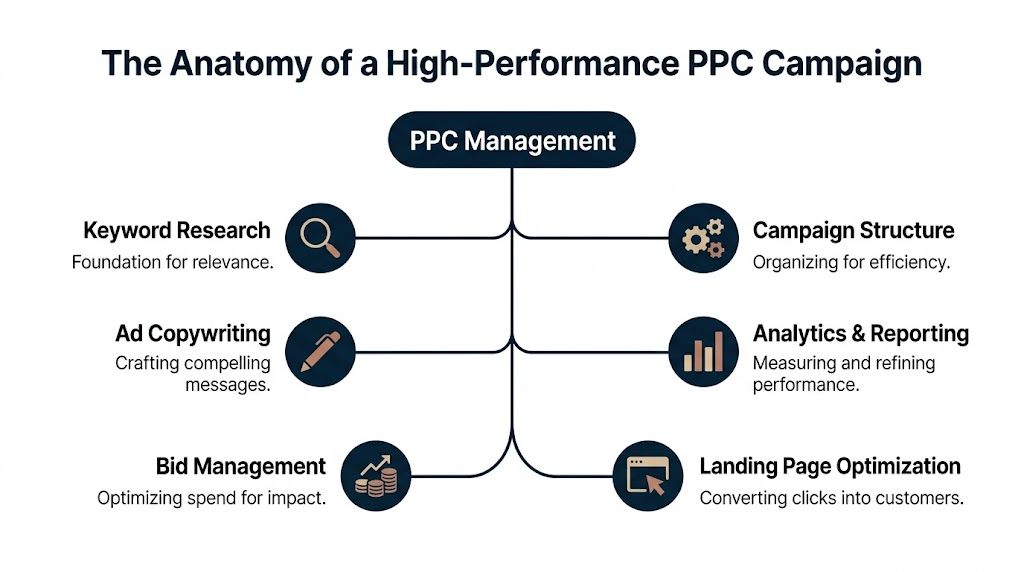
Businesses using professional PPC services in Melbourne generate 50% more conversions than businesses relying only on organic search, based on Melbourne PPC agency data and verified client outcomes. That result doesn’t come from pressing “go”. It comes from disciplined management.
Campaign structure comes first
Before keywords or bids, the account needs a clean structure. That means separating campaigns by service, location, and intent.
A plumber shouldn’t bundle blocked drains, hot water repairs, and commercial maintenance into one generic campaign. A restaurant shouldn’t send private dining searches and casual lunch searches to the same page. Different searches need different ads, budgets, and conversion paths.
Poor structure creates three problems at once:
- Budget leakage: High-value searches compete with low-value ones.
- Messy data: You can’t tell which service line is producing leads.
- Weak relevance: Ads and landing pages feel generic because the campaign is too broad.
Keywords, ads, and landing pages have to match
Keyword research isn’t just finding volume. It’s matching intent. “Emergency plumber Fitzroy” is not the same search as “plumbing services Melbourne.” One is urgent. One is broad. They shouldn’t trigger the same message.
Ad copy then needs to answer the search directly. If someone wants a same-day service, your ad should say that. If someone is comparing options for solar installation, the ad should reduce uncertainty and explain the next step clearly.
The landing page closes the loop. When the page repeats the promise, explains the service, and makes it simple to call, book, or enquire, campaign efficiency improves. If you want a clear look at how platforms connect campaign signals and lead outcomes, SharpMatter’s overview of Google Ads management is a useful reference.
A click is only valuable when the page after the click makes the decision easier.
Bidding, tracking, and refinement never stop
Bid management is where many campaigns go wrong. Owners either bid too cautiously and miss impression share, or bid too aggressively on traffic that looks busy but doesn’t convert.
Good management uses platform automation carefully, not blindly. It also depends on proper conversion tracking. If calls, forms, bookings, and quote requests aren’t tracked correctly, the algorithm learns from weak signals and pushes spend in the wrong direction.
That ongoing layer usually includes:
- Search term reviews: Cutting waste from irrelevant queries.
- Ad testing: Rotating messages to learn what improves response.
- Device and location adjustments: Some traffic converts better on mobile, some from tighter geographic areas.
- Budget reallocation: Moving spend toward services or campaigns producing real enquiries.
That’s why PPC management is never “set and forget”. The account either gets sharper over time, or it drifts.
Why Melbourne SMBs Need Hyper-Local PPC
A generic campaign aimed at “all of Australia” sounds efficient on paper. For a local business, it usually burns money. The closer your service area is to the customer’s real location and intent, the better the campaign tends to perform.
Melbourne is especially unforgiving of broad targeting because competition changes sharply by suburb, service type, and urgency. A South Yarra restaurant doesn’t need clicks from Perth. A Fitzroy emergency plumber doesn’t benefit from traffic outside the service zone. A construction business can’t afford to pay premium click prices for searches from users who were never going to enquire.
According to Victorian benchmarks cited by Farsiight’s Melbourne PPC analysis, construction CPC can range from $15-$45 AUD, while hospitality sits between $2-$8 AUD. That difference matters. If you run construction ads with loose targeting and weak negative keyword control, your budget disappears quickly. Hospitality has cheaper clicks, but often faces heavier local competition and shorter decision windows.
Local intent beats broad reach
The wrong way to run local PPC is to think bigger equals better. It doesn’t. More impressions don’t help if they come from people outside your catchment, outside your budget range, or outside the moment of need.
A tighter Melbourne strategy works better because it aligns with how real customers search:
- Restaurants search by convenience: Nearby, open now, cuisine, bookings, suburb.
- Trades search by urgency: Same day, emergency, local area, call now.
- Construction and solar search by trust: Specific service, service area, project type, credibility signals.
That’s also why PPC should sit alongside your local organic visibility. If your map presence, location pages, and suburb relevance are weak, paid campaigns carry more pressure than they should. A strong local foundation, including local SEO for businesses, gives PPC more support.
Relevance lowers waste
Hyper-local PPC isn’t only about geography. It’s about commercial relevance. Your ads should speak to the suburbs you serve, the service windows you offer, and the job types you want more of.
A few examples make the trade-off clear:
- A restaurant in Richmond: Better to advertise to people close enough to book and arrive than to drive broad city-wide clicks that never convert.
- A plumber servicing the inner north: Better to bid on service-specific suburb terms than generic plumbing searches with mixed intent.
- A solar installer covering select Melbourne corridors: Better to focus on eligible service areas and qualified project leads than broad statewide traffic.
Local PPC works best when the campaign matches how the business actually operates, not how the owner wishes the market behaved.
The businesses that usually struggle with paid search aren’t always under-spending. They’re often targeting too widely, saying too little, and asking the platform to solve a positioning problem that should’ve been handled in the strategy.
Key Local PPC Strategies for the Melbourne Market
The fastest gains in local PPC usually don’t come from flashy tactics. They come from tightening the basics around location, timing, message, and page experience. Melbourne businesses that treat those four levers seriously tend to waste less budget and attract better enquiries.

One of the clearest examples is keyword localisation. Targeting terms such as “plumber Melbourne CBD” can reduce CPA by 15-25%, and geo-fencing within a 50km radius can lift ad relevance scores from 6/10 to 9/10, according to Melbourne PPC campaign data on local targeting and bid management.
Build campaigns around service areas, not just services
A lot of accounts are organised by category alone. Plumbing. Solar. Restaurant bookings. That’s too broad for Melbourne.
Local campaigns often work better when geography is baked into the account structure. Separate campaigns or tightly controlled ad groups can reflect the areas you service, especially if customer value or competition differs by suburb cluster.
That lets you:
- Control budgets more precisely: Inner-city clicks may need different limits than outer-suburban ones.
- Tailor ad copy to local intent: A user searching in the CBD often behaves differently from one searching in a residential growth corridor.
- Send traffic to the right page: Suburb-specific or area-specific pages usually convert better than a generic homepage.
For businesses that want a managed setup rather than piecing this together internally, Google Ads management in Melbourne is one practical route.
Use ad scheduling to match buying windows
Timing changes lead quality. A café might care most about breakfast and lunch. A hospitality venue may need stronger weekend and evening visibility. An emergency trade service often sees its best opportunities outside standard office hours.
Scheduling isn’t about turning ads on and off randomly. It’s about aligning bids, message, and call-to-action with the customer’s decision moment.
A few useful patterns:
- Hospitality campaigns: Emphasise bookings, menus, or walk-ins during peak dining windows.
- Trades campaigns: Prioritise call-focused ads when urgent jobs are most likely.
- B2B and construction campaigns: Shift toward office-hour enquiry forms when decision-makers are available.
Write ads that sound local and useful
Most weak ads fail because they’re vague. “Professional service.” “Quality results.” “Trusted team.” None of that answers the search.
Better local ads are concrete. They reflect the service, area, and next step. If you’re targeting a suburb, mention the location naturally. If response time matters, say that. If your selling point is commercial experience, warranty support, after-hours help, or quick booking, lead with it.
Working rule: If the ad could belong to any business in any city, it’s probably too generic for Melbourne PPC.
Design for mobile decisions
A large share of local PPC traffic comes from people on phones. They aren’t looking for in-depth information. They want directions, a phone number, opening hours, booking options, or a fast answer.
That means your landing page should do a few things immediately:
- Show the service and location clearly
- Make the next action obvious
- Load cleanly on mobile
- Reduce friction for calls and forms
If you need inspiration, these examples of high-converting landing pages are useful for understanding layout, clarity, and conversion flow.
Match the message to the search
Not every local click deserves the same page or offer. Searchers comparing restaurants, searching for emergency repairs, and pricing commercial work are at different stages.
That’s why message matching matters:
- A user searching urgent repairs should land on speed, availability, and a direct call option.
- A user searching a restaurant should see menu, booking, location, and opening information quickly.
- A user researching solar or construction services should see trust markers, process clarity, and a low-friction quote path.
The practical edge in ppc management melbourne campaigns comes from that alignment. Not broader targeting. Not more ad variations for the sake of it. Better fit between search, ad, page, and local buying behaviour.
Understanding PPC Costs and Measuring Real ROI
The first question most owners ask is reasonable. What’s this going to cost? The better question is what the campaign needs to produce to justify the spend.

PPC costs have two parts. Media spend goes to the platform. Management fees go to the team running strategy, setup, testing, tracking, and optimisation. The exact split varies, but the mistake is focusing only on the fee and ignoring whether the campaign is producing profitable leads.
A cheap campaign that attracts poor-fit clicks is expensive. A well-managed campaign that produces booked jobs or qualified enquiries can be worth far more than its monthly line item suggests. If you want a practical breakdown of the moving parts, Titan Blue’s guide on how much Google Ads cost is a helpful starting point.
What to measure instead of vanity metrics
Clicks, impressions, and average position can tell you something. They don’t tell you enough. Most SMBs should care more about conversion quality than traffic volume.
The metrics that usually matter most are:
- Phone calls: Especially for plumbers, restaurants, and urgent service businesses.
- Form submissions: Useful when quote quality is reviewed properly, not just counted.
- Bookings: Strong for hospitality, clinics, and appointment-based services.
- Sales or closed revenue: The clearest signal when tracking and CRM follow-up are in place.
If the campaign produces leads but the business can’t see which ones turned into actual revenue, optimisation gets blurry. The account starts chasing easy conversions instead of profitable ones.
The right reporting should help you make decisions
Good PPC reporting answers operational questions. Which service lines are profitable. Which suburbs produce strong enquiries. Which campaigns generate calls that convert into booked work. Which ads attract low-quality traffic.
It shouldn’t bury you in dashboards no one uses.
This short explainer is useful if you want to understand how paid campaigns are assessed in a business context:
The clearest sign a PPC campaign is healthy isn’t activity. It’s whether the business can connect spend to real enquiries and real sales.
Cost discipline matters more in competitive categories
In higher-cost industries, one mistake compounds fast. Broad match without control. Weak negative keywords. Sending all traffic to a generic homepage. Optimising for form volume without checking lead quality. Those errors can make PPC look broken when the issue is campaign design.
For that reason, ROI measurement should always include a few business-side checks:
- Lead quality review: Are these the jobs you want?
- Sales follow-up speed: Good leads are often lost in slow response, not weak ads.
- Service-area fit: Are you paying for enquiries you can’t service?
- Page conversion friction: Can users call or enquire without hunting for the next step?
When those basics are in place, PPC becomes easier to evaluate properly. Not by how busy the dashboard looks, but by whether the campaign contributes to growth.
The Titan Blue Difference Future-Proofing with AI Search
A PPC strategy built only for yesterday’s search behaviour is going to lose efficiency. Search is changing. People still use Google in familiar ways, but they’re also seeing AI-generated summaries, asking longer conversational questions, and using answer engines that collapse several options into one response.

That shift matters for Melbourne SMBs because local intent and AI interpretation don’t always line up neatly. A business can still buy clicks, but if the campaign isn’t adapted to AI-shaped query behaviour, some of that spend starts leaking into searches that look relevant on the surface and convert poorly underneath.
According to Australian PPC reporting on AI search changes, Google’s AI Overviews affect 15% of search queries, there has been a 25% year-over-year rise in voice and generative search traffic in Australia, and businesses that ignore Answer Engine Optimisation risk wasting up to 30% of PPC budget on non-converting, LLM-skewed queries.
Traditional PPC logic still matters, but it’s no longer enough
The fundamentals remain. You still need clean structure, commercial keywords, strong ads, and disciplined tracking. But query patterns are broadening.
Instead of typing a tight commercial phrase, users increasingly ask layered questions. They compare, qualify, and seek recommendations in a more conversational way. That changes the search terms triggering ads, the intent signals in the query, and the content required on the landing page.
A future-ready PPC account does a few things differently:
- Filters AI-style low-intent noise more aggressively
- Builds landing pages around direct answers, not just service blurbs
- Uses search term reviews to separate research behaviour from buying behaviour
- Supports paid campaigns with content structured for answer engines
Answer visibility and ad performance are connected
This is where many SMBs get tripped up. They treat PPC and AI search as separate channels. In reality, they influence each other.
If your business becomes easier for search engines and AI systems to interpret, your ad traffic often lands on clearer pages. If your pages answer practical questions well, users are more likely to convert after the click. If your content only sells and never informs, both organic visibility and ad efficiency can suffer.
That’s the intersection Titan Blue focuses on. With more than 25 years in digital, the agency combines long-running search practice with newer AI visibility work so campaigns aren’t built on an outdated search model. For businesses trying to understand that shift, this guide to AI search for your business gives useful context.
Businesses don’t need to choose between traditional search and AI search. They need a strategy that recognises customers now move through both.
What this means for Melbourne businesses
For local trades, hospitality operators, construction firms, and solar providers, the practical takeaway is simple. PPC should no longer be managed as a stand-alone ad-buying exercise.
It needs to account for:
- How customers phrase questions in natural language
- Which queries indicate curiosity versus urgency
- Whether the landing page answers enough to earn trust
- How local authority is communicated across search surfaces
That doesn’t make classic paid search obsolete. It makes strategy more layered. The businesses that adapt early won’t just keep buying visibility. They’ll become easier to find, easier to trust, and easier to choose across both search ads and AI-mediated discovery.
Your Checklist for Choosing a PPC Agency in Melbourne
Choosing an agency isn’t only about credentials or presentation. You’re handing over budget, lead flow, and a slice of business growth. The right questions will tell you more than a polished sales deck.
Start with transparency. Ask how they report on calls, forms, bookings, and qualified leads. If the answer stays at the level of clicks and impressions, that’s a warning sign. A capable agency should be able to explain what they track, how they define a conversion, and how they separate low-quality leads from strong ones.
Questions worth asking directly
Use these in the first conversation:
-
How will you structure the account for my services and locations?
A serious operator should speak in specifics, not generic campaign language. -
How do you handle search term reviews and wasted spend?
You want to hear about exclusions, refinement, and ongoing query control. -
What happens after launch?
PPC needs active optimisation. If the process sounds mostly automated, ask harder questions. -
How do you judge lead quality?
That answer should involve business outcomes, not just platform metrics. -
How do you adapt campaigns for changing search behaviour?
That includes mobile behaviour, local intent, and AI-influenced query patterns.
What good agency behaviour looks like
The best agency relationships tend to share a few habits:
- Clear ownership: You know who’s responsible for strategy and who’s implementing changes.
- Direct reporting: They explain performance in plain English.
- Commercial thinking: They care about jobs booked and revenue opportunities, not dashboard theatre.
- Local understanding: They know the difference between broad metro visibility and suburb-level buying intent.
If you’re comparing providers, reviewing a dedicated PPC agency in Melbourne page can help you see whether the service model matches your business needs.
Agency selection test: If they can’t explain where your spend goes, why leads improved or declined, and what they’ll change next, they’re not managing the account deeply enough.
The right partner should make the campaign easier to understand, not more mysterious.
Frequently Asked Questions on PPC Management
How quickly can PPC start producing results
PPC can generate visibility as soon as campaigns are live, but useful performance data takes longer to build. Early clicks tell you whether targeting is active. Real optimisation comes from seeing which search terms, ads, devices, locations, and landing pages produce quality leads. Most businesses should expect an initial learning period before the account becomes consistently efficient.
Can I manage PPC myself
You can, especially if the account is small and your service range is narrow. The issue isn’t whether you can log in and create ads. It’s whether you have time to review search terms, adjust bids, test copy, improve landing pages, fix tracking, and interpret lead quality properly. Many DIY accounts don’t fail at setup. They fail in the ongoing maintenance.
Should I choose PPC or SEO
For most Melbourne SMBs, that’s the wrong choice. PPC is useful when you need immediate visibility and tighter control over target terms. SEO helps build longer-term authority and broader non-paid discovery. The strongest setup usually combines both, with PPC capturing demand now and SEO strengthening visibility over time.
If your business needs a clearer paid search strategy that reflects Melbourne buying behaviour and the rise of AI-driven search, Titan Blue Australia can help you assess what’s working, what’s wasting budget, and where your next growth opportunities sit.
Make Titan Blue a preferred source in Google
One click tells Google to surface our articles more often in Top Stories, AI Overviews and AI Mode.

Best Dental Website Design Agencies in Australia: 7 Compared
Best dental website design agencies in Australia 2026: seven compared on dental proof, booking, AHPRA…

Childcare Centre Website Design Australia: The 2026 Guide
Childcare centre website design Australia: show hours, ages and enrolment as text so parents and…

Electrician Website Design Australia: The 2026 Guide
Electrician website design Australia: what to build, what we found on eight Gold Coast electrician…