Discover search engine optimization packages in Australia
Search engine optimisation packages are essentially bundled strategies designed to get your website seen in search results. The whole point is to attract more of the right kind of traffic—people actually looking for what you offer—and turn that attention into real revenue. Think of it less like a product you buy off the shelf and more like an ongoing partnership focused purely on growing your online footprint.
Understanding Search Engine Optimisation Packages
For any Australian business, cutting through the online noise requires a structured, deliberate approach. That’s exactly what SEO packages are built for. Instead of randomly chipping away at isolated tasks, a package pulls all the essential services into one cohesive strategy. This ensures every effort, from content to technical fixes, works together towards a common goal.
It’s a far more potent approach than the sporadic, one-off SEO activities that, more often than not, deliver fleeting or negligible results. A well-designed package goes way beyond just chasing a few keywords; it integrates multiple disciplines to build a resilient online presence that can weather algorithm updates and shifts in what your customers are searching for.
The Essential Services in an SEO Package
While the bells and whistles might differ between agencies, any effective SEO package is built on a solid foundation of core services. You should expect to see:
Keyword Strategy and Research: This is ground zero. It’s all about digging in and identifying the high-value search terms your ideal customers are typing into Google every day.
On-Page Optimisation: This involves refining your individual web pages—the content, title tags, meta descriptions, and structure—to make them more appealing to both search engines and human visitors.
Technical SEO Health: This is the under-the-hood work. It ensures your website’s backend is solid, tackling things like site speed, mobile-friendliness, and crawlability so search engines can easily find and index your content.
Content Development: Creating genuinely useful, high-quality content is non-negotiable. It’s how you answer your audience’s questions and position your brand as the go-to authority in your field.
Authority Building: This is about earning trust, primarily by securing high-quality backlinks from other reputable websites. These act as votes of confidence that boost your site’s credibility with search engines.
As you can see, real SEO isn’t just one thing. It’s a blend of on-site content methods and off-site authority signals working in tandem to improve your rankings. The growing investment in these services speaks volumes about their importance.
In fact, Australian businesses are on track to spend over $1.5 billion on SEO in 2025 alone—a hefty 12% jump from 2024. Why? Because the data doesn't lie: organic results capture 85-90% of all clicks, and the coveted number one spot on Google gets an average click-through rate of 29.5%. You can learn more about Australian SEO trends and statistics to see just how critical this has become.
Comparing Different Levels of SEO Investment
Choosing the right SEO package can feel a bit like picking the right tool for a job. You wouldn't use a sledgehammer to hang a picture, and you don’t need an enterprise-level budget for a local cafe. The key is to match your investment to your business goals, especially in the competitive Australian market.
Instead of getting bogged down in vague labels like "basic" or "premium," let's break down what different investment levels actually deliver. This way, you can see how resources are allocated at each tier and what sort of outcomes you can realistically expect. It’s about making a strategic decision based on ambition, not just your budget.
Entry-Level Investment: The Foundation for Growth
An entry-level investment is the perfect starting point for new businesses or local companies in less crowded markets. Think of a local plumber in a regional town or a new boutique fashion store. The goal here isn't to take over the world overnight; it's to build a solid foundation and show up where it matters most.
The focus is sharp and targeted, zeroing in on core activities that deliver the most immediate local impact.
Core On-Page SEO: This is all about making sure Google understands exactly who you are and what you do. It involves optimising your main website pages with the right keywords, cleaning up your title tags, and ensuring your content accurately reflects your services.
Google Business Profile Management: For any local business, this is non-negotiable. It ensures your profile is fully optimised, accurate, and active, helping you pop up in local map searches when customers are nearby.
Basic Technical Health Check: At this level, an agency will sort out any major technical roadblocks preventing search engines from indexing your site properly, like broken links or missing sitemaps.
This investment is about nailing the essentials. It’s the first crucial step to ensure potential customers in your immediate area can find you online. You can find out more about these foundational strategies by exploring professional SEO services for small business designed to deliver maximum impact on a modest budget.
Mid-Level Investment: Expanding Your Digital Footprint
A mid-level investment is for established businesses ready to push beyond their local stronghold and capture a bigger slice of the market. This is for the company that has a stable footing but wants to become a recognised name across their city or state. The strategy shifts from just being found to actively building authority.
Here, the work expands to include proactive growth activities. You’re no longer just maintaining a presence; you're consistently working to expand it.
Key additions at this level usually include:
Consistent Content Creation: This often means a monthly blog post or article targeting specific customer questions and keywords. It positions your brand as a helpful expert and steadily grows your website's relevance over time.
Foundational Authority Building: This involves activities to earn your first high-quality backlinks from relevant local or industry websites, signalling to Google that your site is a credible resource worth ranking.
More In-Depth Analytics: Reporting moves beyond basic traffic numbers. It starts to analyse user behaviour, helping to refine the strategy based on what content truly resonates with your audience.
High-Level Investment: Aiming for National Leadership
A high-level investment is for businesses competing in highly aggressive national markets. We're talking about the national e-commerce retailer, the B2B firm targeting clients across Australia, or any brand aiming for the top spot in a crowded field. The strategy here is sophisticated, multi-faceted, and built for dominance.
At this tier, search engine optimization packages become comprehensive marketing engines. The goal is complete market saturation and brand leadership, which requires advanced tactics to outperform entrenched competitors.
Comprehensive Content Marketing: This goes way beyond a monthly blog. It includes creating high-value assets like industry guides, whitepapers, and videos, all part of a cohesive strategy designed to attract and nurture leads.
Digital PR and Advanced Link Building: This is about proactive outreach to journalists and major publications to earn high-authority backlinks that significantly boost your website's credibility and rankings.
Sophisticated Analytics and Conversion Rate Optimisation (CRO): At this level, it’s not just about traffic; it’s about revenue. The focus shifts to analysing the entire customer journey and making data-driven tweaks to your website to increase sales and leads.
The Core Components of a Modern SEO Strategy
The world of search engine optimisation packages has changed completely. Gone are the days when you could get by with simple keyword stuffing and collecting a bunch of low-quality links. Today's strategies are far more sophisticated, focusing on user experience, technical excellence, and genuine authority to keep up with intelligent, AI-driven search engines.
Understanding what goes into a modern SEO plan is key. It helps you look past a simple checklist of services and see the strategy behind each action. This way, you can be sure your investment is going towards activities that deliver lasting results, not just a temporary bump in rankings.
From Keywords to User Intent
Keyword research used to be about finding high-volume, standalone terms. The modern approach, however, is all about user intent. This means digging into the "why" behind a search—is someone looking to buy something, learn a new skill, or compare their options?
Effective SEO packages now build their strategies around topic clusters. Instead of chasing a single keyword, they focus on a central "pillar" topic and create supporting content that answers every related question a user might have. This approach signals deep expertise to search engines and gives visitors a much better experience.
Informational Intent: The user wants answers. This is where how-to guides or detailed explanations come in.
Navigational Intent: The user is looking for a specific website. Optimisation here focuses on making your brand name easy to find.
Transactional Intent: The user is ready to buy. Content is centred around product or service pages with clear calls-to-action.
The Rise of Content Authority
Content is no longer about filling pages with text. It's about building Content Authority—creating high-quality, expert-driven content that builds trust with your audience and establishes your brand as a credible source. Search engines are now smart enough to prioritise content that shows real-world experience and expertise.
This means any decent SEO package must include a solid content strategy, often involving in-depth articles, case studies, and guides that provide genuine value. A huge part of this is optimising for user experience; learning how to lower your bounce rate is critical for keeping visitors on your site and signalling quality to Google.
The Non-Negotiable Technical Foundation
While content gets a lot of the glory, it can't do its job without a rock-solid technical foundation. Technical SEO has moved beyond basic sitemaps and now forms the bedrock of any successful digital strategy. It’s all the behind-the-scenes work that makes your site fast, secure, and easy for search engine crawlers to understand.
A few technical elements are now considered non-negotiable:
Core Web Vitals: These metrics measure a user's real-world experience, looking at loading speed, interactivity, and visual stability. A poor score can directly tank your rankings.
Schema Markup: This is a type of code that helps search engines understand your content better, unlocking rich results like star ratings or event details right in the search results.
Site Architecture: A logical site structure makes it easy for both users and search engines to find their way around, distributing authority effectively to your most important pages.
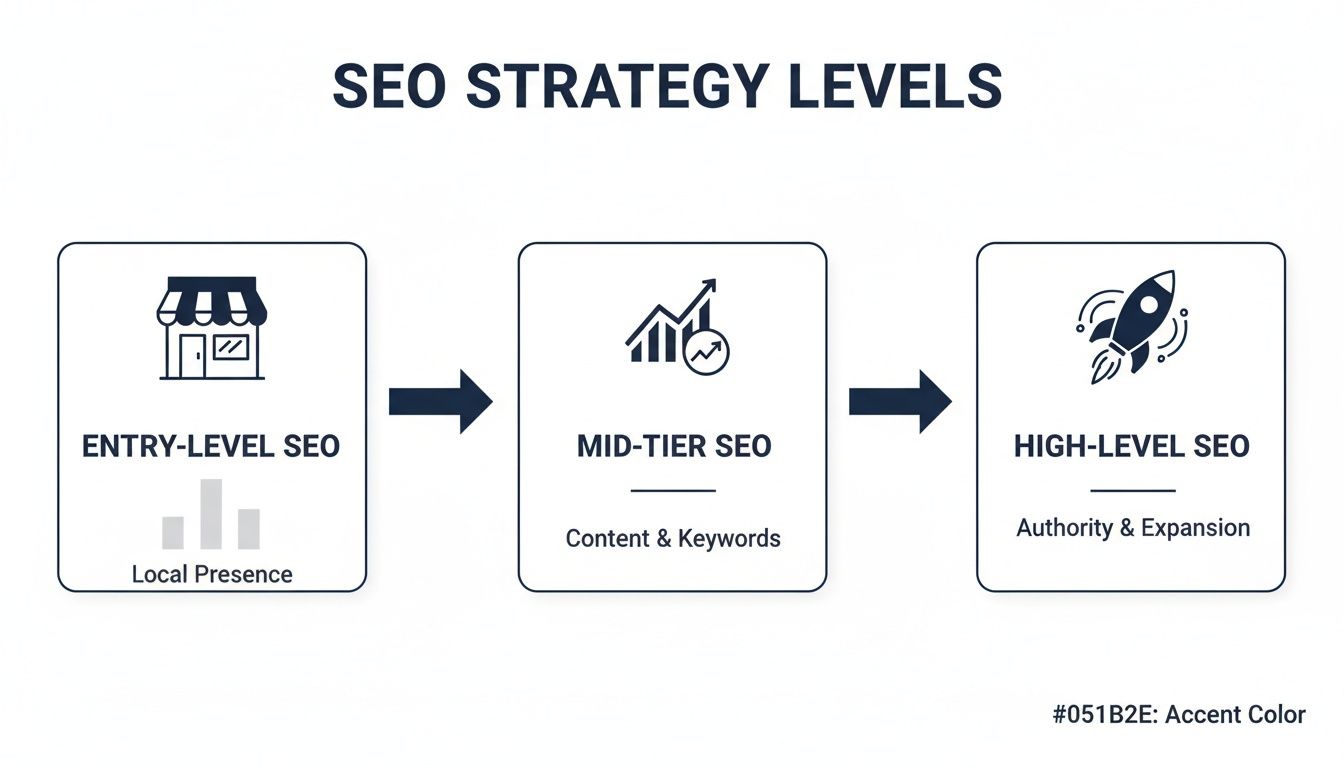
The diagram below shows how these components fit together at different strategic levels.
As you can see, while the basics are universal, more advanced strategies require a much bigger investment in content authority and technical sophistication.
Adapting to an AI-Driven Search Landscape
The search world is going through a massive shake-up, all thanks to AI and Large Language Models (LLMs). This is fundamentally changing how SEO packages need to be structured. The goal is no longer just to rank on a results page, but to become the source of truth that AI models use to generate direct answers.
We're already seeing a massive shift. By early 2025, we predict that traditional SEO tactics will make up just 45% of Australian search marketing budgets, a sharp drop from 75% in 2023. That money is being reallocated to AI/LLM optimisation (25%), content authority building (20%), and technical enhancements (10%).
This is a direct response to a startling trend: 65% of Australian searches now end without a click, as users get their answers directly from AI summaries. Millions of Aussies have already adopted AI tools, and this is only going to grow. Forward-thinking SEO providers are adapting their strategies to not only improve your Google rankings but also ensure your content is visible in this new, answer-driven environment.
Choosing the Right Package for Your Industry and Location
A generic, one-size-fits-all approach to SEO is a surefire way to waste your investment. The real value of any package is how well it matches the unique demands of your industry and the specific pressures of your Australian location. A strategy that works wonders for a national retailer will fall completely flat for a local tradie.
To get genuine results, you have to look past a simple feature list and evaluate the package's strategic fit. Everything from keyword targeting to the type of content you create must align with how your customers search for your products or services, right where they are.
Local Services vs. National E-Commerce
The difference between a local service business and a national e-commerce store is a perfect example of why this matters. They operate in entirely different competitive worlds, and each needs a highly specialised approach.
Think about a dental clinic in a busy Melbourne suburb. Its success is tied directly to its immediate geographic area. An effective search engine optimisation package for them would be intensely focused on:
Hyper-local Keyword Targeting: Hitting terms like "emergency dentist Malvern" or "teeth whitening near me" to capture people who are ready to book an appointment now.
Google Business Profile (GBP) Optimisation: Making sure their GBP is packed with photos, positive reviews, and accurate service info to dominate the local map pack.
Reputation Management: Actively encouraging and responding to patient reviews to build the trust and social proof that heavily influence local service rankings.
Now, compare that to a national e-commerce store selling boutique fashion. Their audience is spread across Australia, so their priorities are completely different. Their ideal package must include:
Broad Content Marketing: Creating style guides, trend reports, and lookbooks that attract a fashion-conscious audience from Sydney to Perth.
Advanced Technical SEO: A large inventory with thousands of product pages demands flawless site architecture, lightning-fast load speeds, and sophisticated schema markup to stand out.
High-Authority Backlink Building: Earning links from major fashion blogs and online magazines is critical for building the domain authority needed to compete on a national stage.
B2B Professional Firms vs. Local Trades
The same principle applies when you compare a B2B service firm with a local trade business. Their sales cycles, how their customers make decisions, and even the language they use are worlds apart.
A B2B law firm, for example, needs a package that builds deep expertise and credibility over a much longer sales cycle. The goal is to establish trust and authority to attract high-value corporate clients. This means creating in-depth whitepapers, hosting webinars, and targeting keywords related to complex legal challenges.
On the other hand, a local electrician needs to be found the moment a customer has an urgent problem. Their SEO package has to prioritise immediate visibility and quick contact. This means a heavy focus on mobile optimisation, click-to-call functionality, and service area pages targeting specific suburbs. You can see how the needs of these businesses are best met by dedicated local search engine optimization services that truly get these nuances.
The right SEO package isn’t about having the most features; it’s about having the right features. The strategic focus must shift from national brand-building to immediate local visibility depending entirely on the business model.
This local focus is becoming more critical by the day. An incredible 46% of all Google searches now have local intent, yet a surprising 44% of Australian businesses still haven't claimed their Google Business Profile as of 2025. This leaves a massive opportunity on the table, especially in a market where organic results drive the vast majority of clicks. You can find more insights about the Australian local SEO market on sixgun.com.au.
Choosing a partner to manage your search engine optimisation packages is a huge decision, one that goes way beyond a simple checklist of services. You're not just buying a service; you're entrusting a critical part of your business's future to their team. A proper vetting process is non-negotiable if you want a partner focused on real business outcomes, not just fluffy, surface-level reports.
The right agency isn’t a supplier; they're a strategic partner. They should be digging deep into your business, your industry, and your goals long before they ever mention a specific tactic. The first few conversations should feel less like a sales pitch and more like a workshop where they’re asking sharp, insightful questions about how your business actually works.
Key Questions to Ask Prospective Agencies
Before you even think about signing a contract, you need to get under the hood of an agency’s processes and their entire philosophy on SEO. How they answer will tell you everything you need to know about their strategic depth and transparency. Don’t be afraid to ask direct questions about how they operate.
Here are a few critical questions to kick things off:
Strategy Development: "Can you walk me through your process for building an SEO strategy for a business like mine?" A solid answer will cover detailed research, competitor analysis, and how they connect SEO activities directly to your main business objectives.
Communication and Reporting: "What does your communication and reporting cadence look like?" You’re looking for more than a monthly data dump. A great partner delivers analysis, insights, and a clear plan for what’s next.
Defining Success: "How do you define and measure success for your clients?" Their answer should be all about business-centric metrics—leads, conversions, and revenue—not just vanity metrics like rankings or impressions.
A good answer will sound structured and confident. If you get a vague, "it depends" kind of response, that’s a major red flag—it usually means they don’t have a defined process. It’s also smart to get a second opinion from a professional digital marketing consultant who can help you frame these questions and analyse the answers.
Common Red Flags to Watch Out For
While you’re looking for good signs, it’s just as important to spot the warnings of a subpar provider. Certain promises and practices are hallmarks of agencies that care more about locking in a sale than delivering long-term results. These red flags should make you hit the brakes immediately.
Be extremely wary of any agency that promises guaranteed #1 rankings. Nobody can guarantee specific rankings on Google. Making that claim is a dead giveaway of inexperience or, worse, dishonest marketing tactics.
Keep an eye out for these other warning signs:
A Focus on Vanity Metrics: If their entire pitch revolves around impressions or traffic without ever connecting those numbers to actual leads or sales, they’re not focused on what really matters to your bottom line.
Lack of Transparency: Reputable agencies are an open book about their methods. If they’re secretive, using vague terms like "our special sauce" to describe their strategy, it’s a massive concern.
Inflexible Long-Term Contracts: SEO absolutely takes time, but being forced into a rigid 12-month contract from day one is risky. Look for agencies that offer some flexibility or have performance-based clauses built in.
Finally, always, always ask for case studies and client references that are relevant to your industry. Verifiable proof of past success is the single strongest indicator of an agency’s capability. A confident, successful agency will have no problem connecting you with their happy clients.
Measuring Success and What to Expect from Your SEO Package
Investing in an SEO package isn't an overnight fix; it's a long-term strategy. The biggest mistake businesses make is expecting a huge jump in traffic right away. The reality is that SEO builds momentum gradually over several months. Think of it like planting a garden—the real growth happens after you've spent time preparing the soil.
It’s crucial to have realistic expectations about the timeline. The first few months are all about foundational work. This means technical audits, on-page optimisations, and fixing any underlying issues with your site. These steps are absolutely essential, but they won't always deliver an instant surge in visitors.
You can learn more about how long SEO takes to work in our detailed guide, where we break down exactly what happens in each phase of a campaign.
Leading Indicators Versus Business Metrics
Measuring real success goes way beyond just watching your keyword rankings. You need to know the difference between early signs of progress and the actual business outcomes you’re chasing.
Leading Indicators (Months 1-3): These are the first signals that your strategy is heading in the right direction. You'll see things like better keyword rankings for your target terms, improved website crawlability, and healthier organic click-through rates. These metrics prove the foundational work is paying off.
Lagging Business Metrics (Months 6-12+): This is where you see the results that directly impact your bottom line. We're talking about a noticeable increase in qualified organic traffic, a steady stream of inbound leads, and ultimately, measurable growth in sales and revenue driven by organic search.
Focusing only on rankings is a classic rookie mistake. A good SEO package connects every single activity back to tangible business goals.
What a Good Report Actually Contains
A monthly report shouldn't be a random data dump of charts and numbers. Its true value is in the analysis—the insights that explain what the data means for your business and what comes next.
A high-quality report will clearly lay out:
Performance Against KPIs: It measures progress against the goals we set at the start, like lead generation or growth in organic revenue. No fluff, just results.
Work Completed: You get a transparent summary of exactly what tasks we handled during the month, from content creation to technical fixes.
Analysis and Insights: This is the most important part. We explain why certain metrics moved up or down and what we learned from the month's performance.
Strategic Recommendations: The report always ends with a clear action plan for the next month. You’ll know our priorities and what steps we’re taking to keep the momentum going.
When you're evaluating your SEO package, make sure it aligns with your broader business goals. It should support proven lead generation best practices to ensure your investment isn't just boosting vanity metrics, but actively driving business growth. After all, that's the only measure of success that truly matters.
Common Questions About SEO Packages
It's completely normal to have questions when you're looking at search engine optimisation packages. Getting straight answers is the only way to feel confident you’re making the right call for your business. Here are a few of the most common questions we get from business owners across Australia.
How Long Until I See Results?
This is the big one, and the honest answer is that SEO is a long game, not a quick fix. You’ll usually start to see some early momentum in the first three to six months. This looks like improvements in your keyword rankings and better technical site health.
But the results that really move the needle—a serious jump in organic traffic, more leads, and a noticeable increase in sales—typically take between six and twelve months to really kick in. This timeframe gives the foundational work time to settle and lets search engines recognise and reward your site's authority.
Are Cheap SEO Packages Really Worth the Risk?
It's tempting to go for a low price, but cheap SEO packages often do more harm than good. These services are notorious for cutting corners with outdated or risky tactics, like building spammy, low-quality links or churning out thin, useless content.
Not only do these methods fail to deliver, but they can also land you a Google penalty, which is a nightmare to recover from. It’s far better to invest in a quality package from the start. That way, you're building on a solid, ethical foundation that delivers real, lasting value.
Can I Get a Customised SEO Package?
You absolutely should. In fact, if an agency only offers rigid, off-the-shelf options, that's a major red flag. A reputable SEO provider knows that every business is different, with its own unique goals, customers, and competitors.
A good agency will always sit down with you to build a strategy that’s a perfect fit for what you need—whether that's dominating local search results, driving e-commerce sales, or generating high-quality B2B leads. One size never fits all in SEO.
What's the Difference Between SEO and SEM?
It’s easy to get these two mixed up, but the difference is pretty simple.
SEO (Search Engine Optimisation) is all about earning traffic through unpaid, organic search results. It’s the process of improving your website's content, technical setup, and authority so it naturally ranks higher over time.
SEM (Search Engine Marketing), on the other hand, is a broader term. It includes SEO, but it also covers paid advertising like Pay-Per-Click (PPC) campaigns. Think of it this way: SEO is the organic half, while SEM covers both organic and paid tactics to get you seen on search engines.
Ready to invest in an SEO package that delivers real, measurable results for your business? At Titan Blue Australia, we build custom strategies based on over 25 years of industry experience. Let's start a conversation about your growth at https://titanblue.com.au.
Titan Blue is your go-to digital partner for smart, results-driven solutions. We blend strategy, creativity and tech to grow your brand and get real results fast.