Stay ahead with the latest tips, trends, and insights from the Titan Blue team , straight from the studio in Broadbeach.



As a small business owner, the digital world can feel like a maze. But what if your best tool for getting local customers was right under your nose? This guide breaks down SEO for a small business, showing you how it’s basically the digital version of nabbing the best shopfront on the busiest street in town.
Why SEO Is Your Strongest Local Marketing Tool
Think about the last time you needed a local service – a plumber for a leaking tap, or maybe the best coffee spot in your neighbourhood. You probably pulled out your phone and did a quick search. That simple habit is exactly why SEO (Search Engine Optimisation) isn't just a "nice-to-have" anymore. It's essential.
This isn’t about baffling code or being a tech wizard. At its heart, SEO is just about making your business the clearest, most trusted, and most relevant answer when a local customer searches for what you do. It’s the process of convincing Google that you're the go-to choice in your community.
Turning Searches into Customers
Every single day, people in your area are actively looking for the solutions you offer. They're not just browsing – they have a problem that needs solving right now. Good SEO puts your business directly in their line of sight at that exact moment.
This leads to real results that you can see in your bank account.
- Increased Foot Traffic: Higher local rankings mean more customers walking straight through your door.
- More Phone Enquiries: People searching on their phones can call you with a single tap, right from the search results.
- Greater Website Enquiries: A visible website brings in more visitors ready to fill out a contact form or book a service online.
The Undeniable Return on Investment
Putting money into SEO delivers a powerful return that leaves many old-school marketing methods in the dust. The numbers don't lie. Australian small businesses are catching on, with projected spending expected to hit $1.5 billion in 2025.
Why the surge? Because for every dollar spent, businesses can see a return of over $22 in revenue. Organic search drives a massive 53% of all website traffic for SMBs, and with "near me" searches blowing up by over 500% in recent years, being visible locally is everything. You can check out more digital marketing statistics for 2025 to see just how big these trends are.
This infographic breaks down just how compelling the return on investment from a solid SEO strategy can be.
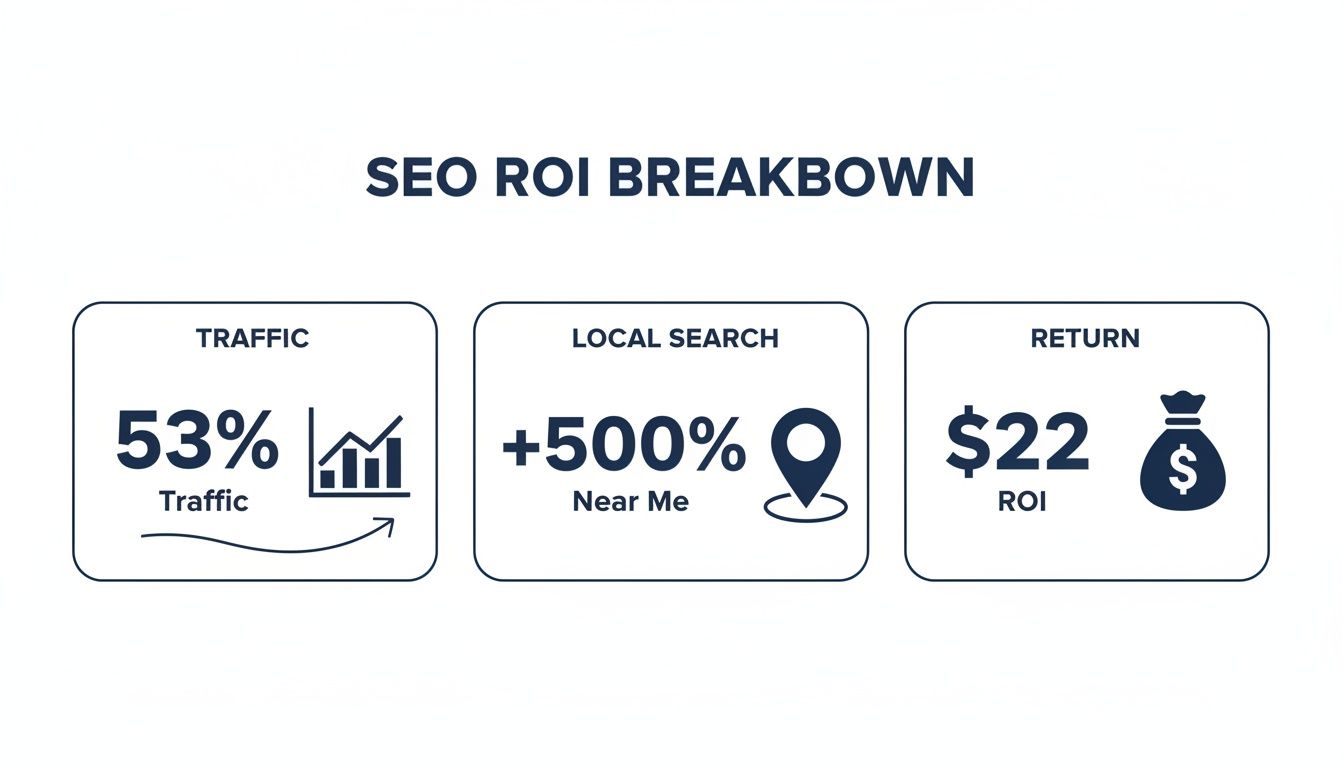
These figures prove it: optimising your website for search isn't just about traffic; it's about attracting customers who are ready to buy, delivering a serious financial return.
Mastering Your Local SEO Foundation
For any small business, the fastest way to see a real impact from SEO is to get your local presence sorted. Think of it as the digital version of putting a big, welcoming sign on your shopfront. It’s all about making it dead simple for nearby customers to find you the moment they need you.
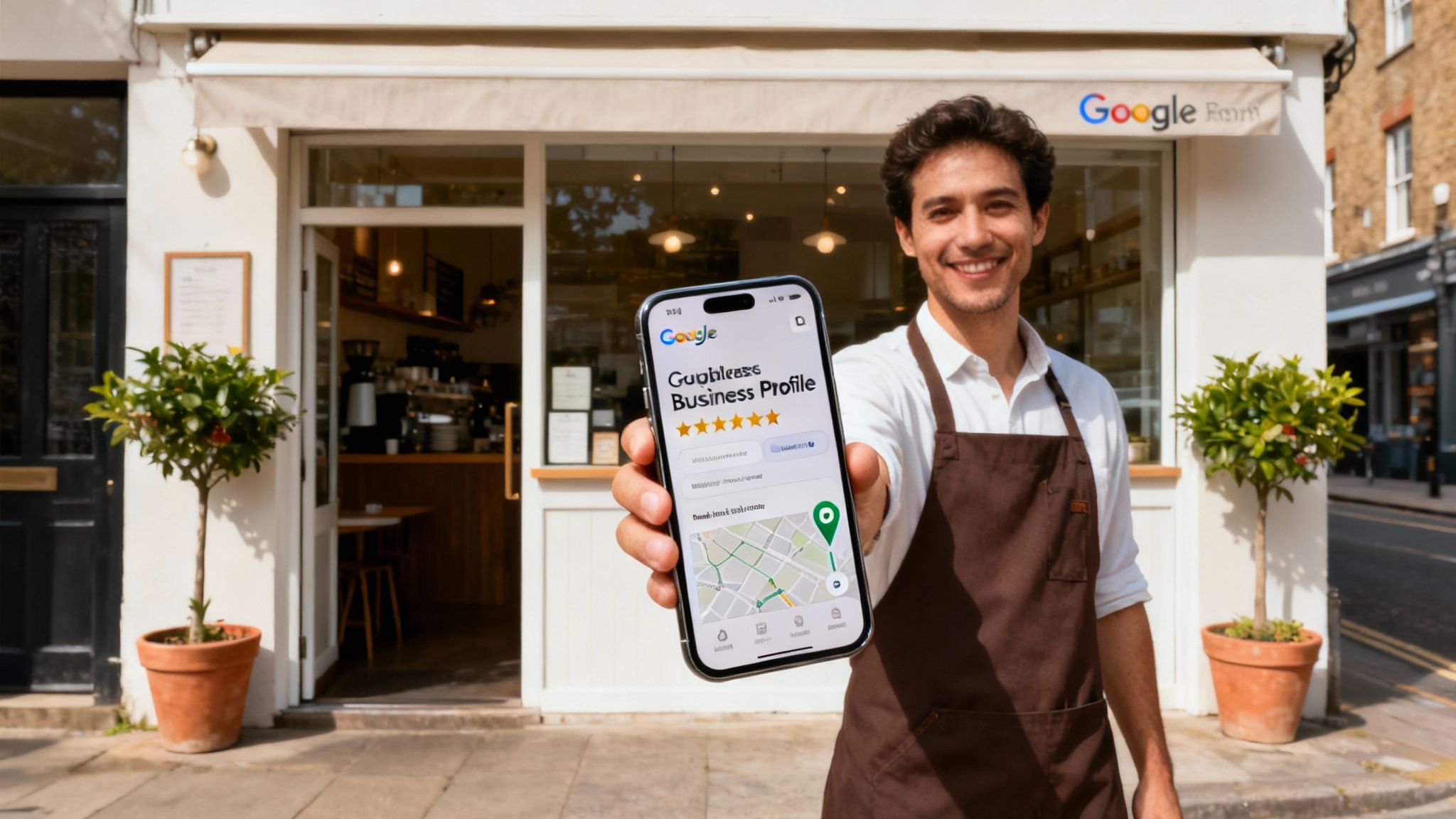
At the very heart of this is your Google Business Profile (GBP). This free tool is your most powerful local search asset, acting like a dynamic billboard that pops up directly in Google Search and Google Maps. It’s often the first—and sometimes only—interaction a potential customer has with your business online.
Nailing this is non-negotiable. It’s exactly where your SEO journey should begin.
Claiming Your Digital Territory
Before you can fine-tune anything, you have to claim and verify your business listing. This process proves to Google that you're the legitimate owner, handing you the keys to control all the information people see. If you haven't done this yet, make it your number one priority.
The reality for many Aussie businesses is pretty stark. Local SEO is the absolute lifeline for trades and hospitality, with a massive 78% of mobile searches for services like plumbers or cafes resulting in a call or visit within 24 hours. Yet, a shocking 56% of local businesses haven't even claimed their Google Business Profiles, leaving the door wide open for competitors to swoop in.
Once you’re verified, your profile becomes a central hub of information that you control, helping you build trust and attract customers who are actively looking for what you offer.
Optimising Your Google Business Profile for Maximum Impact
An incomplete profile is like a half-finished storefront—it just doesn’t inspire confidence. Meticulously filling out every single section is how you start outranking your local competitors.
Here’s how to turn your GBP into a customer-attracting machine:
- Choose the Right Categories: Get specific. Instead of just "Restaurant," pick "Italian Restaurant" or "Seafood Restaurant." Then, add secondary categories like "Cafe" or "Bar" if they apply. This helps you capture a wider net of relevant searches.
- Craft a Compelling Business Description: This is your elevator pitch. Use all 750 characters to explain what you do, who you help, and what makes you different. Weave in keywords naturally, like "emergency plumber in Broadbeach" or "family-friendly cafe Gold Coast."
- Upload High-Quality Photos and Videos: Show, don’t just tell. Add clear, professional shots of your work, your team, your location (inside and out), and happy customers. Google loves seeing new photos, as it signals that your business is active and current.
- Use GBP Posts: Think of these as a mini-blog right on your profile. Share special offers, announce new services, or post company news. These posts expire, so aim to add a new one each week to keep your profile looking fresh.
The Power of NAP Consistency
Beyond your Google profile, search engines are constantly looking for consistency across the web to verify that your business is legitimate. This is where the idea of NAP (Name, Address, Phone Number) becomes absolutely critical.
Imagine Google as a detective gathering clues about your business. If it finds your address listed differently across various online directories, it gets confused. That confusion erodes trust and can seriously tank your local search rankings.
Your business name, address, and phone number must be absolutely identical everywhere they appear online. This includes your website, social media profiles, and local business directories. Even tiny variations like "St." vs. "Street" can cause problems. This consistency is a fundamental trust signal for search engines. Making sure your NAP details are uniform across the web is a simple but powerful step in building a solid local SEO foundation. To truly master your online presence and ensure sustainable growth, it's essential to develop a robust and practical small business SEO strategy.
By focusing on these foundational elements—claiming and optimising your GBP and locking down your NAP consistency—you create a powerful base for all your other SEO efforts. For a deeper dive, check out our guide on how local SEO for businesses can drive significant growth and customer engagement. This is how you win the local search game and turn online visibility into real-world customers.
Creating Content That Builds Local Authority
With your local SEO foundations in place, it’s time to start proving you’re the expert in your area. Think of your website as much more than a digital business card; it needs to be the most helpful, knowledgeable resource for your customers. This is where great content and on-page SEO come together, turning your business from just another name in the phonebook into the go-to local authority.
Good content doesn’t just fill up space on a page. It answers the real-world questions your customers are typing into Google right now, building trust and naturally attracting people who are actively looking for your help. It’s a non-negotiable part of SEO for a small business because it’s all about meeting your customer where they are.
This whole strategy is about shifting from a salesperson to a trusted advisor.
Answering Customer Questions with Your Content
Honestly, the most powerful content ideas come directly from your customers. What are their biggest headaches? What questions do they ask over and over before they’re ready to buy? Answering these questions on your website is the secret to capturing incredibly valuable search traffic.
For example, a local sparky shouldn't just have a page that says "Our Services." They need to create genuinely helpful guides that solve the problems their customers are actually facing.
- A Guide to Choosing the Right Safety Switches: This targets homeowners already researching safety upgrades, immediately positioning the electrician as an expert.
- How to Prepare Your Home for a Switchboard Upgrade: This demystifies the process for potential customers, building their confidence and making them far more likely to pick up the phone.
- Common Electrical Hazards in Older Gold Coast Homes: This is super specific and locally relevant, capturing an audience with a pressing need.
This kind of content proves your expertise and helps your website show up for all those "how-to" and "what-is" searches, getting you in front of customers long before they're ready to make a decision. When you get it right, this kind of helpful content writing on your website becomes a 24/7 lead generation machine.
Dominating Local Searches with Service Pages
While blog posts build your authority, your service pages are where the magic happens for customers who are ready to buy now. The trick here is to create separate, ultra-specific pages for each service you offer in every major suburb you work in.
A generic "Roofing Services" page just won't cut it anymore. To really own the local search results, you need to be thinking more along the lines of:
- Roof Repairs Broadbeach
- Gutter Cleaning Surfers Paradise
- New Roof Installation Robina
Each of these pages should be treated like a mini-homepage for that exact service and location. It needs unique content that talks about your expertise, features testimonials from customers in that area, and has a crystal-clear call to action. This hyper-local approach sends a massive signal to Google that you are the most relevant result for someone searching "roof repairs near me" in Broadbeach. To get the best results, you need to know how to optimize your content for SEO, making sure it clicks with both your audience and search engines.
Simple On-Page SEO That Makes a Big Difference
On-page SEO is just the simple stuff you do directly on your website pages to help search engines figure out what they’re about. You don’t need to be a tech wizard to nail these, but they are absolutely critical for ranking.
Think of on-page SEO as the signposting for your website. It provides clear, simple clues that help Google correctly categorize your content and show it to the right people.
For every single page you create, focus on getting these three elements right:
- Title Tags: This is the main headline that shows up in Google search results and on the browser tab. It needs to be clear, snappy (keep it under 60 characters), and include your main keyword and location (e.g., "Emergency Plumber Gold Coast | 24/7 Service").
- Meta Descriptions: This is the little blurb of text under the title in the search results. While it’s not a direct ranking factor, a good meta description (under 160 characters) is your sales pitch—it convinces people to click on your link instead of your competitor’s.
- Clean Website Navigation: Your website menu should be dead simple for both people and search engines to follow. A customer looking for plumbing services shouldn't have to click more than once or twice from the homepage to find your "Plumbing" page.
By creating valuable, question-based content and dialling in your service pages with these simple on-page tweaks, you’ll build a powerful combination of authority and relevance that drives real local SEO success.
Building Your Reputation Across the Web
Great SEO for a small business doesn’t stop at the edges of your website. It’s about building a solid, trustworthy reputation right across your local online community. You need to send strong signals to Google that your business is a legitimate, respected player in your area.
This means we need to look beyond your own site to where your business is mentioned elsewhere online. Think of it as digital word-of-mouth. When Google sees other reputable sites talking about you, it starts to see you as a credible authority, which is a massive boost for your rankings.
Two core strategies are at the heart of building this off-site reputation: creating local citations and earning backlinks. Getting these right will cement your authority in Google's eyes.
Confirming Your Location with Local Citations
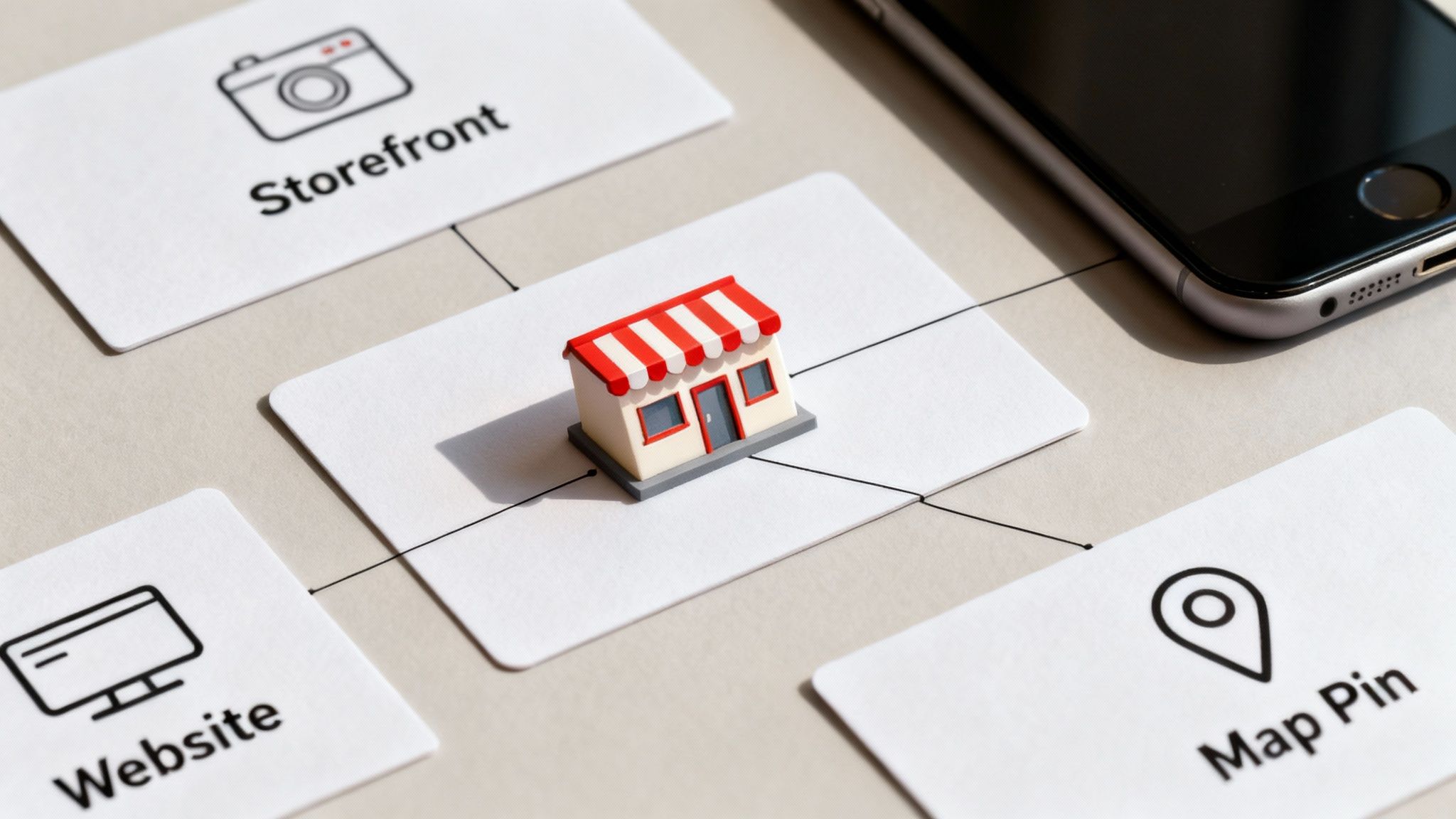
A local citation is simply any online mention of your business's Name, Address, and Phone number (NAP). Think of them as digital signposts scattered across the internet, all pointing back to your business and confirming your physical location.
The most common places you'll find these are online business directories, and you're probably already familiar with many of them.
- Major Directories: These are the essential first stops for any business.
- Industry-Specific Directories: A plumber might get listed on a trades-focused site, while a local cafe should be on a food and beverage platform.
- Local Directories: Your local chamber of commerce or a community business hub also provides fantastic, relevant citations.
Consistency is absolutely everything here. Just like with your Google Business Profile, the NAP information in every single citation must be identical. Conflicting details create confusion for search engines and can seriously hurt your local ranking potential.
Earning Votes of Confidence with Backlinks
If citations are the signposts, then backlinks are votes of confidence. A backlink is just a link from another website pointing to yours. When a reputable website links to you, they're essentially telling Google, "Hey, this business is the real deal and knows what they're talking about."
But not all backlinks are created equal. A link from a respected local news site or a major industry blog carries far more weight than a link from some random, low-quality directory. The goal is to earn quality links from relevant, authoritative sources.
This might sound a bit intimidating, but it doesn’t have to be. For a small business, earning powerful local backlinks is often a natural outcome of getting involved in your real-world community.
You should think of it this way: every backlink is another website vouching for your business. The more high-quality endorsements you have, the more Google will see you as a credible authority in your field. This off-page activity is what separates businesses that are just present online from those that truly dominate their local market. Imagine running a small plumbing business on the Gold Coast, competing against bigger players. Research tracking 36 Australian businesses shows that those targeting multiple locations drive 557% more organic traffic than single-location ones. The top performers in the study had 35x more backlinks (which had an 81.6% correlation with traffic), 5x more keyword rankings, and 8x more reviews than the laggards. Discover more insights about how off-page signals drive local SEO success at websitesthatsell.com.au.
Beginner-Friendly Ways to Earn Local Backlinks
You don’t need to be a marketing guru to start building valuable backlinks. The best approach is to focus on genuine community involvement and building real relationships.
- Sponsor a Local Team or Event: Getting behind a local kids' soccer team, a community fete, or a charity fun run will often get you a link from their website's sponsors page. This is a simple and highly effective way to get a super-relevant local link.
- Partner with a Complementary Business: Team up with a non-competing business that serves the same customers. For instance, a real estate agent could partner with a local plumber for a joint blog post on "Essential Plumbing Checks Before Buying a Home," with each business linking to the other.
- Get Featured by a Local Blogger or News Outlet: Are you celebrating a business milestone or launching a unique new service? Give local bloggers or community news websites a heads-up. A feature story about your business can result in a powerful, high-authority backlink.
These strategies don't just improve your SEO; they strengthen your community ties and get your brand name out there. By actively managing your citations and earning quality backlinks, you are building a robust digital reputation that will pay dividends in search rankings and customer trust.
And speaking of trust, don't forget it's also built on social proof. You can learn more about why customer reviews matter in our article.
Alright, let's get into it. You’ve been putting in the hours, tweaking your website, and writing content. But how do you actually know if any of it is working?
Good SEO for a small business isn’t about chasing fluffy numbers that look nice in a report but do nothing for your bank account. It’s about tracking the real-world results that actually lead to growth.
You need to know if your efforts are bringing more organic traffic to your website, getting you ranked for your key service keywords, and—most importantly—making the phone ring more often. Measuring success is what turns SEO from a guessing game into a predictable way to grow your business.
Introducing Your Essential SEO Tools
You don't need a heap of expensive software to get started. Google gives you two incredibly powerful—and completely free—tools that provide all the data you need to see what’s going on and make smarter decisions.
- Google Search Console: Think of this as your direct hotline to Google. It shows you exactly how the search engine sees your site, which search terms people are using to find you, any technical hiccups holding you back, and how often you’re showing up in search results.
- Google Analytics: This tool picks up where Search Console leaves off. It tells you what happens after someone clicks through to your website. You can see how many people are visiting, which pages they’re looking at, how long they stick around, and where they came from (Google, social media, etc.).
Getting them both set up is pretty straightforward; it usually just involves adding a small bit of code to your website. Honestly, this is a non-negotiable first step for any business that's serious about their online marketing.
What to Track in Google Search Console
Search Console is your go-to for understanding how visible you are on Google. It cuts through the jargon and shows you what’s really moving the needle.
The first place you'll want to live is the "Performance" report. This is where the gold is.
Pay close attention to two key metrics here: Impressions and Clicks. Impressions tell you how many times your site showed up in search results, while clicks tell you how many people actually visited. A ton of impressions but hardly any clicks could be a sign your page title isn't grabbing enough attention. This report also shows you the exact Queries (or keywords) that people are typing into Google to find you. Are you finally ranking for "emergency plumber Broadbeach" like you wanted? This is where you'll find out for sure.
Finding Meaningful Insights in Google Analytics
Once a visitor lands on your site, Google Analytics takes over the story. It helps you understand your audience and, crucially, whether your website is doing its job and turning those visitors into leads.
Here are the key things to keep an eye on:
- Organic Traffic: This is the pure gold of SEO. It shows you the number of visitors who found you through a search engine, not from paid ads or social media. If this number is steadily climbing month after month, you know your SEO efforts are paying off.
- Conversion Rate: Traffic is great, but leads are what pay the bills. You can set up "Goals" in Analytics to track important actions, like when someone fills out your contact form or clicks your phone number. The conversion rate tells you what percentage of visitors are taking that next step. A good conversion rate from organic search can hit 14.6%, which is significantly higher than the 1.7% from traditional outbound marketing.
- Bounce Rate: This metric shows you the percentage of people who land on a page and leave without clicking anywhere else. A high bounce rate could mean a few things: maybe the page content wasn't what they were looking for, or perhaps your site is just too slow to load.
By regularly checking these key numbers in both tools, you’ll get a crystal-clear picture of your return on investment. It allows you to stop guessing and start making data-backed decisions to keep your business growing.
Preparing Your Business for the Future of Search
The way your customers find information is changing, and it's happening fast. For years, we've all been obsessed with the simple list of ten blue links on Google. But with AI chatbots and voice assistants like Siri and Google Assistant becoming part of daily life, that list is no longer the only game in town.
This shift presents both a new challenge and a massive opportunity for savvy business owners.
To stay ahead of the curve, you need to start thinking beyond just traditional SEO. It's time to focus on Answer Engine Optimisation (AEO). This is all about structuring your website’s content so it becomes the direct, definitive source that AI tools rely on to answer questions.
Your new goal isn't just to rank on a results page—it's to be the answer.
Becoming the Go-To Answer
Think about the real-world questions your customers ask you every single day. "How much does it cost to fix a leaking tap?" or "What are the signs of a faulty switchboard?" When someone puts that question to an AI, you want your website to be the source it trusts for the response.
This means your content needs to be crystal clear, get straight to the point, and be written in natural, conversational language. It’s about proving your expertise in a way that's dead simple for both humans and machines to digest.
The core of future-proofing your SEO is to stop just chasing keywords and start directly answering your customers' questions. By making your website the most helpful and direct source of information in your industry, you position your business to be found not just in search results, but inside AI-generated answers.
Practical Steps for Answer Engine Optimisation
The good news is that optimising for answer engines doesn't mean throwing your whole strategy out the window. It’s really an evolution of the good habits we’ve already covered, just with a laser focus on clarity and structure.
- Use Question-Based Headings: Structure your blog posts and service pages around common customer questions. Instead of a generic heading, use something like, "How Do I Know If My Roof Needs Repairing?"
- Create Detailed FAQ Sections: Add a dedicated Frequently Asked Questions section to your most important service pages. Answer each question concisely, providing direct and helpful information that an AI can easily grab.
- Format for Readability: Break down complex information with bullet points and short, sharp paragraphs. This scannable format is perfect for both busy humans and AI crawlers looking for quick, authoritative answers.
Adopting these practices now will ensure your business stays visible as search technology continues to evolve. For a deeper dive into this area, learn more about how Generative Engine Optimisation is shaping the future of digital marketing. This forward-thinking approach helps future-proof your SEO for a small business and keeps you well ahead of the competition.
Your Top Small Business SEO Questions Answered
Diving into SEO can feel like opening a can of worms—lots of questions pop up straight away. Let's tackle the most common ones we hear from Australian business owners, so you can move forward with a clear plan.
How Long Does SEO Take to Show Results?
Think of SEO as a long-term investment, not a quick-win marketing tactic. While you might see some early movement from foundational fixes (like beefing up your Google Business Profile) within a few weeks, it realistically takes 4 to 6 months to see meaningful, lasting growth in your traffic and leads.
That timeframe gives Google a chance to crawl, understand, and start trusting the changes you’re making. It’s all about building authority over time, and consistency is the name of the game.
Can I Do SEO Myself or Should I Hire Someone?
You can absolutely make a huge difference doing SEO yourself. Getting the fundamentals right, especially mastering your Google Business Profile and creating helpful content for your local area, will put you streets ahead of many competitors. It’s a fantastic starting point.
However, once you get into the more technical side of things—like website audits, deep competitor analysis, and building quality links—it gets complex and seriously time-consuming. This is often where bringing in an agency can really accelerate your growth and free you up to do what you do best: run your business. The right choice really comes down to your available time, budget, and how quickly you want to grow.
Curious about how an agency can help? Check out our straightforward small business SEO packages to see what’s involved.
What Is a Realistic SEO Budget for a Small Business?
SEO budgets in Australia really depend on your industry, location, and just how fierce the competition is. For a local business targeting a specific service area, a sensible starting investment usually falls somewhere between $1,000 to $2,500 per month.
That figure typically covers the essential groundwork: creating content, making technical site improvements, managing your online listings, and tracking performance. It’s much healthier to see SEO as an investment in a long-term asset that generates a return, rather than just another monthly marketing expense.
What Is the Most Important Part of Local SEO?
If you run a local service business, your Google Business Profile (GBP) is, without a doubt, the most critical piece of the puzzle.
Why? Because a fully-fleshed-out GBP is what gets you into that all-important 'Map Pack' at the top of the search results. For a local customer, that map is often the first and only thing they look at. Nailing your profile information and getting a steady flow of great reviews is the fastest way to get your phone ringing.
Ready to turn your website into a machine that brings in customers? At Titan Blue Australia, we've been helping businesses grow for over 25 years with SEO strategies that just work. Let's build your digital future together.

AI SEO for Australian Small Business: The Budget-Friendly Guide for 2026
AI SEO for small business means optimising your website and online presence so AI engines…

AI SEO for Healthcare: How Australian Medical Practices Can Win in AI Search
AI SEO for healthcare means optimising your medical practice so AI engines like Google AI…

How to Write Content AI Engines Actually Cite: A 10-Step Framework for 2026
A practical 10-step writing framework that helps Australian businesses create content AI search engines like…