SEO for Accountancy Firms A Modern Playbook for Attracting Clients
When someone's looking for an accountant, they're not just browsing. They have a specific need – maybe a tax return, business advice, or help with their SMSF. And where do they go first? Google.
SEO for accountancy firms is all about making sure your practice shows up right when they’re searching. It’s a mix of smart technical work, the right content, and sharp local tactics to bring in clients who are actively looking for the exact services you offer.
Building Your Digital Foundation with Technical SEO
Before a potential client ever reads your insightful blog post or browses your service pages, search engines have to find and understand your website first. This is the nuts and bolts of technical SEO – the quiet, behind-the-scenes work that makes everything else possible.
Think of it like building a house. You wouldn't put up walls or a roof without solid foundations. For an accountancy firm, a technically sound website is non-negotiable. It’s the first step in building digital trust and getting seen online.
Why a Flawless Technical Setup Matters
A clean, technically healthy website sends strong positive signals to search engines. It tells them your site is high-quality, trustworthy, and gives people a good experience – all critical factors in a professional service industry where credibility is everything.
A few technical pieces directly impact how your firm shows up online:
Mobile Responsiveness: Your site has to work perfectly on any device, from a desktop computer to a smartphone. No exceptions.
Site Speed: How quickly do your pages load? Slow sites frustrate users, and Google penalises them for it.
HTTPS Security: An SSL certificate keeps your website secure, protects user data, and is a confirmed ranking factor.
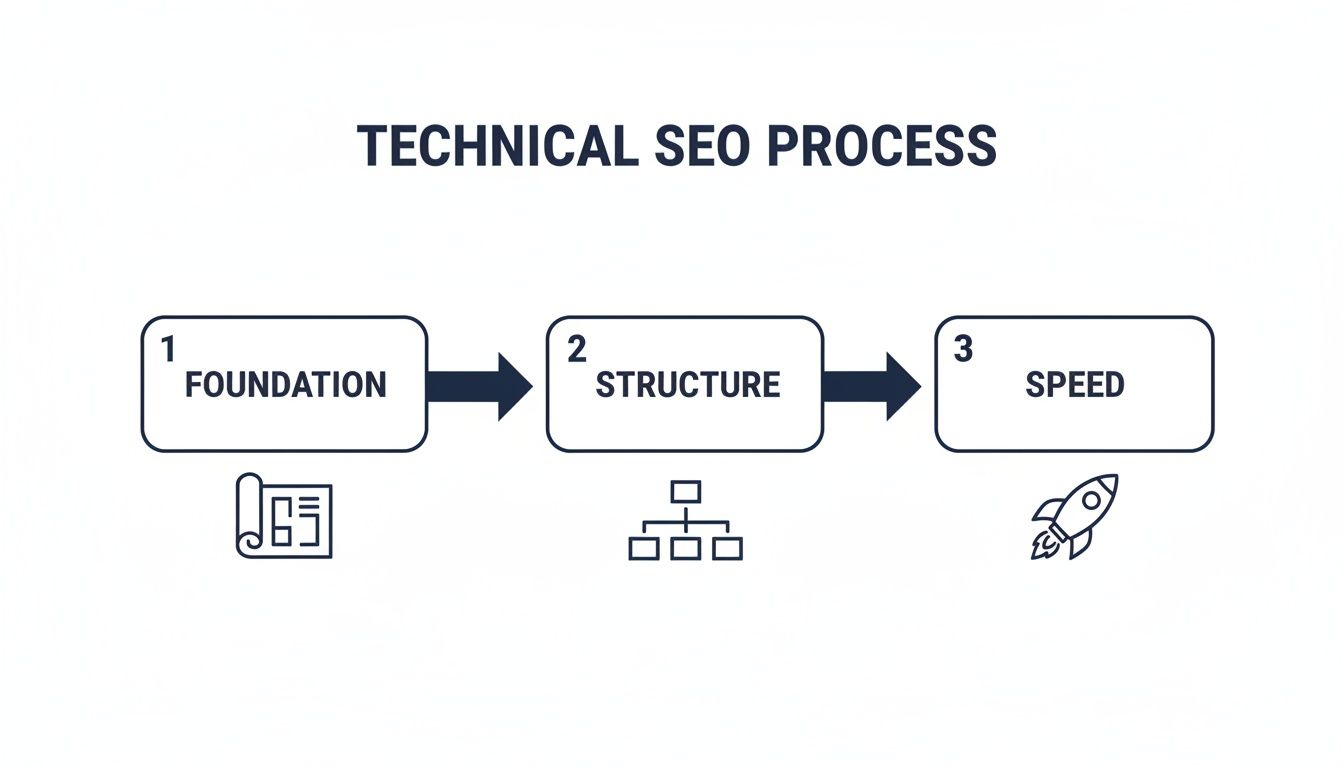
This groundwork is the blueprint for your entire SEO strategy. The process is pretty straightforward when you break it down.
As you can see, a solid technical SEO process starts with the foundational blueprint, moves to a logical site structure, and is topped off by optimising for speed.
Structuring Your Site for Search Engines and Clients
A clear site structure is crucial. It helps potential clients easily find the information they need, whether it's about business tax services, SMSF auditing, or bookkeeping.
This logical flow also lets search engine crawlers index your content efficiently, making sense of how all your different pages relate to each other. A well-organised site almost always leads to better rankings simply because it creates a better user experience. If you want to dig deeper, you can learn more about how to improve Google rankings with our detailed guide.
In Australia, there are over 34,000 accounting businesses competing online. SEO is an absolute game-changer for any firm that wants to stand out. With almost every one of them pushing for visibility, mastering SEO allows you to capture a massive share of high-intent searches like 'tax accountant near me' or 'small business accounting Gold Coast'.
Using Schema Markup to Stand Out
One of the most powerful (and often overlooked) technical tools is Schema markup.
This is a piece of code that helps search engines understand the context of your content. For an accountancy firm, you can add schema that identifies your business as a professional service, lists your opening hours, specifies your services, and even pulls in client reviews.
The payoff? It can generate "rich snippets" in search results. These are the enhanced listings you see with star ratings, service details, and FAQs right there on the search page. It makes your firm’s entry far more eye-catching and useful than a standard blue link.
Dominating Local Search and Google Business Profile
Now that your website’s technical foundations are solid, it’s time to shift focus to where most of your clients will actually come from: your local community.
For most accounting firms, mastering local search isn't just another marketing tactic; it's the most direct path to attracting high-quality clients who are actively looking for help. When a local business owner searches for "accountant near me" or "tax services in Brisbane," you need to be the first name they see.
This is the whole point of local SEO—a powerful set of practices designed to make your firm the obvious choice in your specific service area.
Transforming Your Google Business Profile
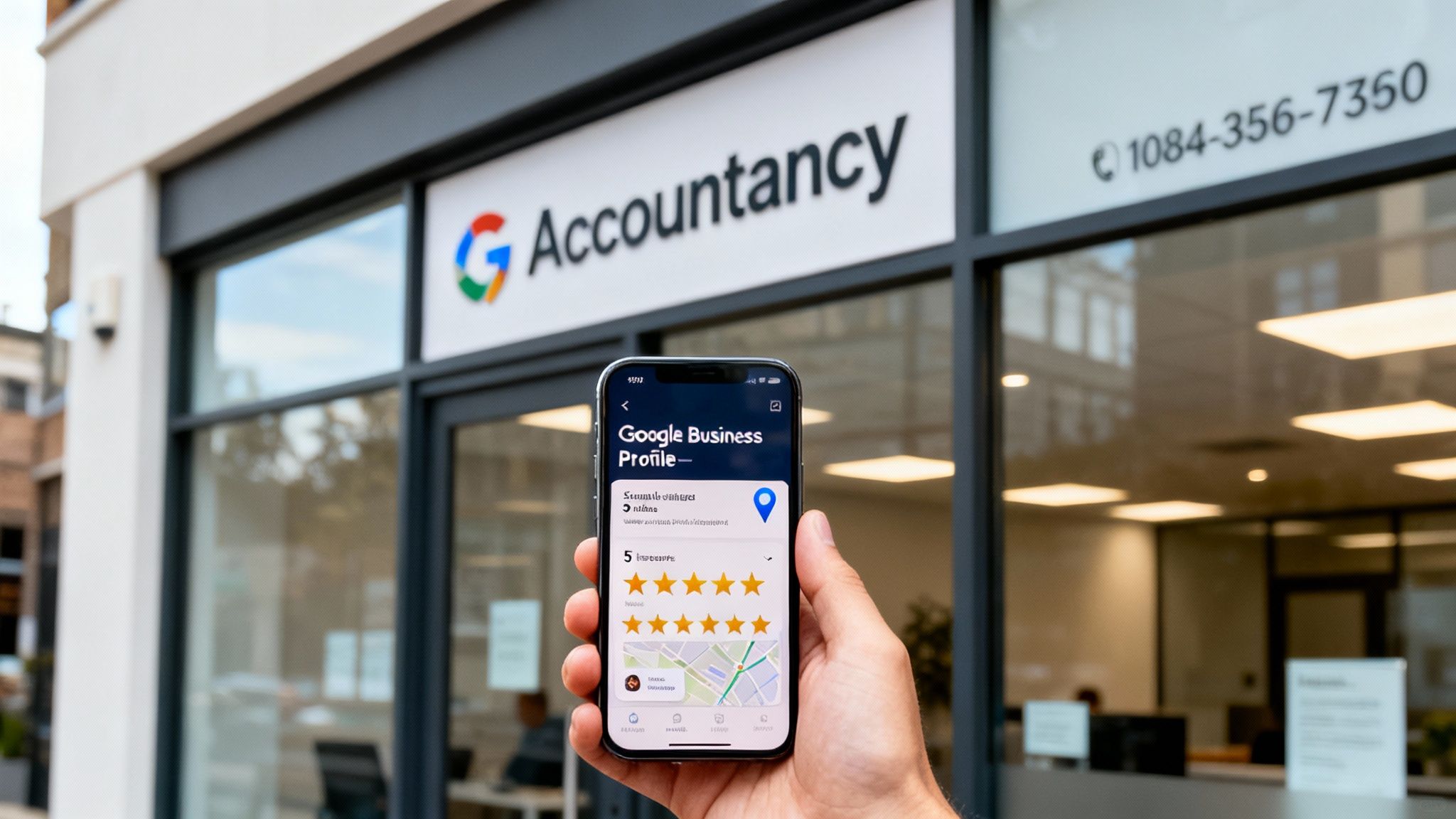
Think of your Google Business Profile (GBP) as your most valuable piece of digital real estate. It's often the very first interaction a potential client has with your firm, showing up in Google Maps and the highly visible "local pack" at the top of search results.
A half-finished profile is a massive missed opportunity. A fully optimised one, however, is a client-generating machine. Don't treat it like a simple listing; it's a dynamic digital storefront. To really make an impact, you need to implement these essential Google Business Profile tips.
Success here means going way beyond just your name and address.
Write Compelling Service Descriptions: Get specific. Instead of a generic "Accounting," detail your specialisations like "Small Business Tax Advisory," "SMSF Auditing," or "Bookkeeping for Trades."
Upload High-Quality, Professional Images: Add photos of your office (inside and out), your team, and professional headshots. This builds immediate trust and puts a human face to your firm.
Use Google Posts Regularly: Share timely updates like EOFY reminders, breakdowns of new tax laws, or articles from your blog. This signals to Google—and clients—that your firm is active and engaged.
The numbers don't lie. A staggering 46% of all Google searches have local intent. Well-optimised GBPs don't just get seen; they attract 7x more clicks, which leads to 32% higher conversion rates and a 27% boost in leads. It's an incredible return on investment.
The Critical Role of NAP Consistency
One of the absolute cornerstones of local SEO is maintaining consistent NAP details—that’s your Name, Address, and Phone number—across the entire web.
Even tiny inconsistencies, like using "St." on one directory and "Street" on another, can confuse search engines and weaken your local authority. Google cross-references this information from countless online sources to verify that your firm is legitimate and located where you say it is. When every signal matches, Google's confidence in your business grows, which is a massive factor for ranking in local map results.
Your business name, physical address, and primary phone number must be identical everywhere they appear online. This includes your website, your GBP, and every other online directory.
Securing Valuable Local Citations
Beyond your GBP, building local citations is a key step to cementing your local presence. A citation is simply any online mention of your firm's NAP details, usually in an online business directory. The goal is to get listed in reputable, high-quality Australian directories.
These listings act as third-party verifications of your business's existence and location. But remember, quality is far more important than quantity. Focus on getting profiles on well-regarded platforms relevant to accounting and your specific location.
This strategy not only builds powerful local ranking signals but also creates more pathways for potential clients to find you. For a deeper dive, check out our guide on how to implement local SEO for businesses.
By methodically optimising your GBP and ensuring your business information is consistent across key local directories, your accountancy firm will become impossible for both search engines and local clients to ignore.
Crafting Content That Builds Trust and Authority
With your website’s technical foundations sorted and your local presence established, it’s time to focus on the next layer: high-quality content. This isn't just about filling pages; it's the engine that drives visibility, proves your expertise, and builds a relationship with potential clients long before they even think about picking up the phone.
Content is how you show you understand their specific financial headaches. It means moving beyond generic service descriptions and creating genuinely useful resources that answer the exact questions your ideal clients are typing into Google. It's how you become the go-to authority in your niche, whether that’s for construction companies, retail businesses, or medical practices.
Uncovering What Your Clients Are Really Asking
Every great content strategy starts with knowing what your audience is searching for. We call this keyword research—the process of finding the specific phrases people use when they need accounting services or have a financial problem to solve.
Instead of just guessing, you need to use proper keyword research tools to see what small business owners, tradies, or cafe owners in your area are actually asking. Your aim is to find a healthy mix of two types of keywords.
Service-Based Keywords: These have high commercial intent, meaning the searcher is ready to hire someone. Think ‘business tax returns Melbourne’ or ‘SMSF auditing services Gold Coast’.
Question-Based Keywords: These attract potential clients who are earlier in their journey. They’re looking for information, not an accountant… yet. For example, ‘how to calculate BAS for a small business’ or ‘EOFY checklist for retailers’.
Targeting both means you capture leads at every stage, from the initial "what is…" query right through to the "I need to hire someone now" moment. This is the bedrock of a solid content plan.
Optimising Your Core Service Pages
Think of your service pages as your digital sales team. They need to be perfectly tuned to convert visitors who are ready to make a move. Every single service you offer—from tax planning and bookkeeping to business advisory—needs its own dedicated page.
This is a non-negotiable part of SEO for accountancy firms because it lets you target very specific keywords on each page. A single, generic 'Services' page just won't cut it anymore.
When a potential client lands on a page specifically for 'Business Advisory for Construction Companies', it sends a powerful signal: you get their industry. This targeted approach is far more relevant and converts at a much higher rate than a catch-all page.
To get these pages right, make sure each one includes its primary service keyword in the page title, the main heading (H1), and naturally within the text. Describe the service, clarify who it's for, and spell out the problems it solves. And don't forget a clear call-to-action to tell the visitor exactly what to do next. For firms looking to really nail their on-page messaging, professional website content writing can make a world of difference.
Creating Genuinely Helpful Blog Content
While service pages are for clients ready to buy, your blog is where you build authority and earn trust for the long haul. This is where you answer all those question-based keywords you found earlier. The mission is simple: create the absolute best, most helpful resource on the internet for that specific query.
Put yourself in your client's shoes. What financial jargon confuses them? What processes keep them up at night?
Here are a few real-world examples of blog topics that pull in the right kind of clients:
For a firm targeting tradies: "The Ultimate Guide to Claiming Vehicle Expenses for Tradies"
For a firm focusing on retail: "A Step-by-Step EOFY Checklist for Small Retail Businesses"
For a firm specialising in startups: "Choosing the Right Business Structure in Australia: Sole Trader vs Company"
Content like this does so much more than just rank on Google. It positions your firm as an essential resource. When a subcontractor finds your detailed guide on tax planning, they don’t just get an answer—they find a potential partner who truly understands their world. That’s how you turn readers into loyal, long-term clients.
Optimising for AI Search and Answer Engines
The way people get information online is going through a massive shake-up. We’re moving away from the classic list of blue links towards AI-powered summaries and direct answers from Large Language Models (LLMs) like those behind Google's SGE and ChatGPT.
This means the game is no longer just about ranking number one. It's about being the answer.
This new world is all about Answer Engine Optimisation (AEO). The idea is to structure your content so perfectly that AI models pick your firm’s information to use as the direct source for their generated answers. Getting this right is how you future-proof your SEO, ensuring you stay visible as search habits change for good.
Answering Questions Before They're Asked
At its core, AEO is about getting into your ideal client's head and answering their specific questions directly. AI search is conversational; it’s all about questions. So, your content needs to reflect that. It’s less about cramming in keywords and more about providing clear, definitive answers.
For instance, instead of a generic page called "Business Tax Services," you'll get much more traction with content that answers a direct question like, "What are the key tax deductions for a construction business in Australia?" That level of specificity is exactly what AI models hunt for when putting an answer together.
Structuring Content for AI to Read
An AI doesn't "read" a webpage like a person does. It scans and parses it for structure, clarity, and authority. To make your content a perfect meal for these algorithms, you need to be strategic with your formatting. The good news is, this also makes the page much easier for your human visitors to read.
Here are a few essential formatting tips:
Use Clear Headings: Break up your content into logical chunks with descriptive H2 and H3 headings that spell out what each section is about.
Embrace Lists: Bullet points and numbered lists are brilliant for simplifying complex accounting concepts. They’re scannable, easy to digest, and AI can pull information from them effortlessly.
Build FAQ Sections: This is a no-brainer. Add a Frequently Asked Questions section to your service pages and articles. It directly mirrors the question-and-answer format of AI search.
By organising your information this way, you're sending a strong signal to answer engines that your page contains well-structured, easy-to-grab information that’s perfect for a generated summary. It’s also worth getting familiar with the specific ChatGPT ranking factors these models use to prioritise information.
AI is already giving SEO a serious boost. Recent data shows AI tools can slash content creation time by 31% and lift click-through rates by 18%. This is vital, especially when an estimated 65% of searches now end without a click because users get their answer directly from an AI summary.
Write Like a Human
Your tone of voice is more important than ever. AI models are trained on billions of examples of conversational human text, so they naturally prefer content that sounds authentic and authoritative, not like it was written by a robot.
Write like you're explaining something to a client in your office.
Try to avoid dense financial jargon if you can. If you have to use a term like "Division 7A," quickly explain it in simple terms—for example, "the rules that apply when a company director borrows money from the business." That kind of conversational clarity works wonders for both AI and your potential clients.
This shift towards AI-powered search brings us to Generative Engine Optimisation, a specialised field focused on making sure your business shows up in these new platforms. You can find out more about how we help firms get ready with our Generative Engine Optimisation services.
Earning Authority with Link Building and Digital PR
While having great content and a technically solid website is the foundation of good SEO, Google still puts a huge amount of weight on one of its oldest and most powerful signals: backlinks.
Think of a high-quality backlink as a vote of confidence. When another reputable website links to yours, it’s basically telling Google, "Hey, these accountants know their stuff."
This process, known as link building, isn't about dodgy, old-school tactics like buying links. It’s a strategic effort to build your firm's online reputation, proving to search engines that you’re a trusted voice in the financial industry.
Becoming a Trusted Source for Financial News
One of the most powerful ways for accountants to earn incredible backlinks is by becoming a go-to source for journalists. Financial writers are always on the hunt for experts who can give a sharp quote or a bit of insight on tax law changes, the federal budget, or trends affecting small businesses.
By putting your hand up and offering your expert commentary, you can land mentions and links from high-authority news sites and industry publications. These are the kinds of links that can seriously move the needle on your rankings and cement your firm's position as a thought leader. It’s where digital PR and SEO meet, and the results can be fantastic.
Creating Link-Worthy Resources
Another brilliant strategy is to create genuinely useful resources that other businesses will want to link to. Forget writing just another blog post; think bigger. Develop a practical tool or an in-depth guide that solves a real problem for your ideal client.
Here are a few ideas for these "link-worthy" assets:
An Interactive Tax Calculator: Imagine a simple tool that helps small business owners estimate their quarterly BAS payments. It’s practical, shareable, and incredibly valuable.
An Industry-Specific Financial Guide: A comprehensive, downloadable PDF like "The Ultimate Financial Checklist for Construction Subcontractors." Niche, useful content like this gets shared.
Original Research or Data: A report on the financial health of local small businesses, using anonymised data to highlight interesting trends in your area.
These kinds of resources act like magnets for links because they’re useful and unique. They’re a cornerstone of any effective link building services.
High-quality, resource-based content acts like a magnet for backlinks. It positions your firm not just as a service provider, but as an indispensable industry resource that others are happy to endorse.
Engaging with Local Business Communities
Don't forget the power of your own backyard. Getting involved with local business associations, chambers of commerce, and community groups online can lead to some really valuable local backlinks.
Sponsoring a local charity event, speaking at a small business workshop, or simply getting featured in a local business directory can all result in links from trusted community websites. This approach builds both your digital authority and your real-world reputation at the same time.
It's a competitive space. The Australian accountancy sector is a key driver in a national SEO market expected to hit $1.5-1.75 billion by 2025. With organic results capturing a massive 85-90% of all clicks, earning these authoritative links is non-negotiable if you want to stand out. You can dig into more data on the state of SEO in Australia on searchscope.com.au.
Of course. Here is the rewritten section, crafted to sound like a human expert, following the specific tone, style, and formatting of the examples provided.
Common Questions on SEO for Accountancy Firms
Getting started with an SEO strategy always brings up a few questions. We get it. Below, we’ve answered some of the most common queries we hear from accounting professionals to give you a bit more clarity and confidence.
How Long Does SEO Take to Show Results?
It's natural to want immediate results, but SEO for accountancy firms is definitely a long game. You can often see some quick wins from local SEO tweaks, like an improved Google Business Profile, within 1-3 months.
However, for the bigger, more competitive keywords and foundational strategies to really take hold, you should expect to see significant, sustainable results within 6-12 months. Factors like how competitive your local area is, your website's current authority, and how consistently you work on it all play a huge role.
Can I Do SEO Myself or Should I Hire Someone?
Doing SEO yourself is certainly possible, especially if you have the time and dedication to learn the ropes—the technical side, the content, and the local strategies. There are plenty of free tools and guides out there to get you started on the right foot.
The reality for most firm partners, though, is that their time is far more valuable when spent on client work and actually growing the practice. Hiring a specialised agency that gets SEO for accountancy firms can fast-track your results, ensure best practices are followed, and help you dodge costly mistakes that could tank your rankings.
A well-executed SEO strategy isn't just another marketing expense; it's an investment in a predictable pipeline of qualified leads that builds your firm's value over time.
Is Local SEO or Content Marketing More Important?
This is a classic question, but the truth is, you can't really separate them—they're two sides of the same coin. A successful strategy needs both to work properly.
Here’s how they fit together:
Local SEO is all about capturing immediate demand. It makes your firm pop up for potential clients who are actively searching for an accountant in your specific area right now.
Content Marketing builds long-term trust and authority. It draws in clients who are researching financial issues but might not be ready to hire immediately, positioning you as the go-to expert they’ll remember when the time is right.
For accountants in Australia, blending these two is absolutely critical. In a market with over 34,000 competitors, you have to be visible locally. About 28% of search traffic for Australian SMBs comes from local SEO, which converts at 3x the rate of standard organic search. Optimising for your local area taps into the 46% of queries that have local intent—a strategy that can deliver some serious growth. You can discover more insights about the Australian SEO landscape on searchscope.com.au.
At Titan Blue Australia, we've spent over two decades helping professionals build a powerful online presence. If you're ready to turn your website into a consistent source of high-quality leads, let's talk about a strategy that works for you. https://titanblue.com.au
Titan Blue is your go-to digital partner for smart, results-driven solutions. We blend strategy, creativity and tech to grow your brand and get real results fast.