SEO for law firms is all about making sure your website shows up when potential clients are searching online for legal help. Think of it this way: when someone urgently needs a lawyer, they go straight to Google. The goal is to make sure your firm is one of the first names they see. A solid SEO strategy turns your website from a simple online brochure into a powerful, reliable source of new cases.
Why SEO Is a Non-Negotiable for Modern Law Firms
Not too long ago, law firms got by on word-of-mouth, a few print ads, and a solid local reputation. While those things still have their place, the game has completely changed. These days, your firm’s website is its front door. Potential clients aren’t flipping through the yellow pages; they’re using search engines to find solutions to their most pressing legal problems, right now.
A website without a good SEO strategy is like a brilliant barrister arguing a case in an empty courtroom. The expertise is there, but if no one can find you, it won't bring in a single client. This is where SEO stops being a "tech thing" and becomes an essential tool for business development. It’s the bridge that connects your firm's expertise directly to the people actively looking for it.
The Real Cost of Being Invisible Online
If you’re not on the first page of Google, you're practically invisible. That invisibility comes with a very real cost. Every single day, potential clients in your area are typing in searches like "family lawyer Sydney" or "commercial litigation expert". If your competitors show up and you don’t, you are literally handing them business.
And it’s not just about one missed lead. It’s about the entire lifetime value of that client and the referrals they might have sent your way. Effective SEO closes that gap, making sure your firm is front and centre the moment someone needs legal help. It also levels the playing field, allowing boutique firms to go toe-to-toe with bigger, more established names by showcasing their authority online.
A Significant Opportunity for Australian Firms
While the benefits are crystal clear, a surprising number of Australian law firms haven't caught on yet. Research shows that while 74% of law firms in Australia have a website, a tiny 28% invest in professional SEO support.
This gap is a massive opportunity for forward-thinking firms. You can learn more about these findings on Australian law firm marketing.
By putting a strategic SEO plan in place, you can capture a huge slice of the market your competitors are completely ignoring. It’s a direct path to boosting your online visibility, attracting more qualified leads, and growing your practice in a way that’s both measurable and predictable. The question isn't if your firm needs SEO anymore, but how quickly you can get started to win more clients online.
Building a Rock-Solid Technical SEO Foundation
Before a barrister can even think about presenting a compelling case, they need a solid foundation of evidence and procedure. It’s the same with your website. Before it can attract and win new clients, it has to be built on a strong technical SEO foundation.
This isn't about getting lost in complex code. It’s simply about making sure your digital office is accessible, trustworthy, and efficient for the people who need your help.
Think of technical SEO as the non-negotiable groundwork. It directly impacts how easily search engines can find, understand, and rank your content. More importantly, it shapes a potential client's first impression. If your site is slow, broken on their phone, or feels insecure, they won't stick around long enough to read about your legal expertise. They’ll just leave.
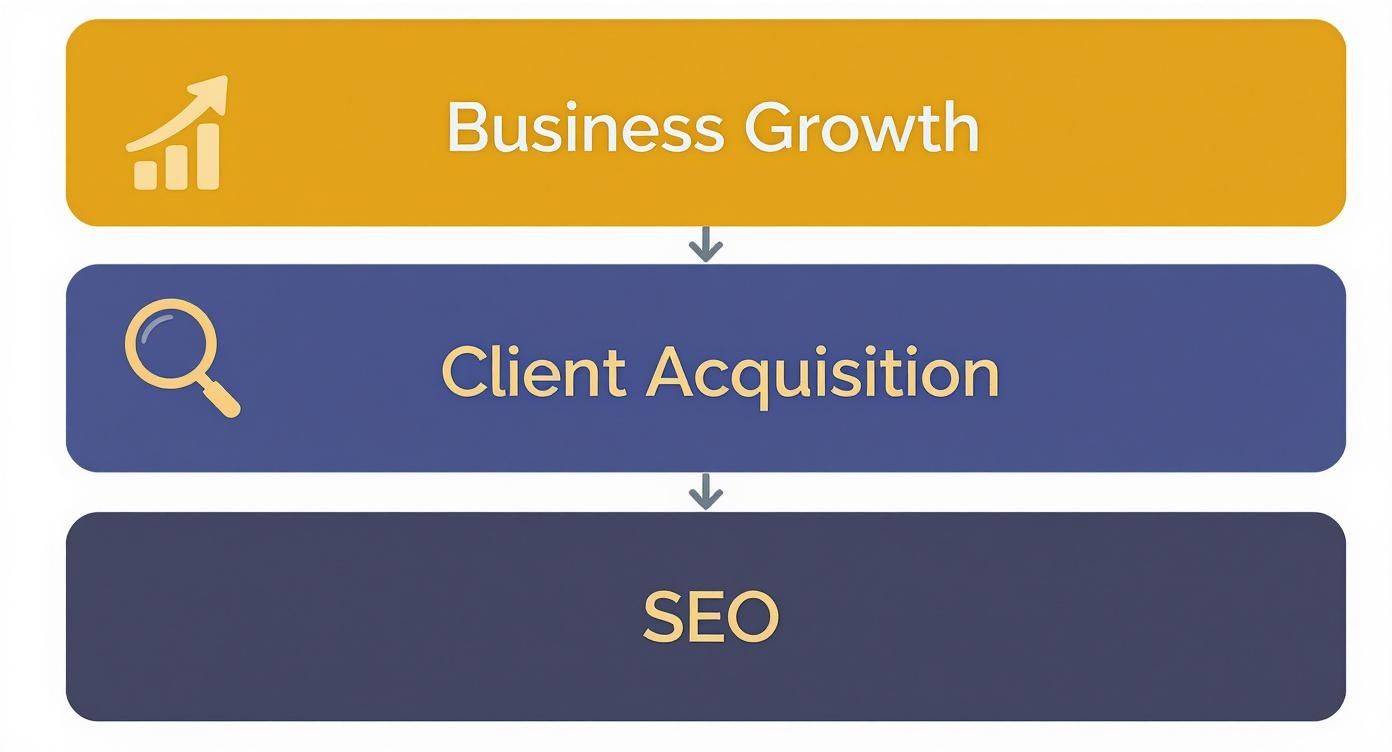
This diagram shows how these fundamental SEO practices are the base layer for getting new clients and growing your firm.
The key takeaway? SEO isn’t just another marketing task; it's a foundational business activity that directly fuels your client pipeline.
Core Pillars of Technical Health
A technically sound website sends powerful trust signals to both users and search engines. A potential client in distress needs information quickly and securely. Your website absolutely must deliver on that, without any friction. To build a strong SEO foundation, you first need to understand what your competitors are doing, and specialised AI competitor analysis tools can really streamline this process.
Here are the key elements to get right:
Site Speed: How fast your pages load is critical. A delay of just a few seconds is enough to send a potential client straight to a competitor’s site. Speed is a confirmed ranking factor, but it’s also just a huge part of good user experience.
Mobile-Friendliness: Let's face it, most clients will find your firm on their smartphone. Your website must offer a seamless, easy-to-navigate experience on a small screen. If they have to pinch and zoom just to read your content, you've already lost their confidence.
Secure Connection (HTTPS): An SSL certificate is non-negotiable. It encrypts the data between a user's browser and your website, displaying that little padlock icon in the address bar. It’s a vital, immediate signal of professionalism and security to anyone who lands on your site.
Performing a Basic Website Health Check
You don't need to be a developer to spot major technical problems. A quick health check can reveal critical issues that might be undermining all your other marketing efforts.
A good place to start is reviewing your site's performance against Google's core user experience metrics. You can learn more about this by catering for Google Core Web Vitals to ensure your site meets modern standards.
Here’s a straightforward checklist to kick off a basic technical audit of your law firm's website:
Check Mobile Usability: Use Google's Mobile-Friendly Test tool. Just enter your website's URL, and it will tell you flat out if your site meets the standard for mobile performance.
Verify HTTPS Security: Open your own website and look at the URL in the browser. Does it start with https:// and show a padlock icon? If not, your site is being flagged as "Not Secure," which is a massive deterrent for potential clients.
Analyse Your Site Speed: Use a tool like Google's PageSpeed Insights. It will give your site a performance score out of 100 and provide specific, actionable recommendations to improve your loading times.
Dominating Your Local Market with Local SEO
Let's be honest, for most law firms, the game-changing clients aren't on the other side of the country. They're right here, in your local community. This is where local SEO shifts from a "nice-to-have" into your most powerful tool for bringing clients through the door.
Local SEO is the art and science of making sure your firm pops up the moment a potential client searches for 'family lawyer near me' or 'commercial solicitor in Sydney'. Think of it as putting up a massive, well-lit sign on the digital main street of your city. While general SEO casts a wide net, local SEO is intensely focused on turning nearby online searches into actual, real-world consultations. It's how you become the go-to legal authority in your own backyard.
Why Local Search Is Critical for Law Firms
When someone is facing an urgent legal problem, their search is almost always local and immediate. They need a solicitor they can actually meet, someone who knows the local courts and understands the lay of the land.
This is exactly why getting into Google's "Map Pack" is so incredibly valuable. You know the one—the box with a map and three business listings that appears right at the top of local search results. Landing a spot there is like getting prime real estate.
Australian law firms are catching on fast. The average click-through rate for the top spot in local search is a massive 29.5%. More importantly, organic search results (the unpaid ones) pull in 85-90% of all clicks, completely overshadowing the 10-15% that paid ads get.
Your Google Business Profile Is Your Digital Front Door
If you take one thing away from this section, let it be this: your Google Business Profile (GBP) is the single most important piece of your local SEO puzzle. It’s the free, detailed listing that feeds information directly into Google Search and Google Maps.
A neglected profile is a huge missed opportunity. A fully optimised one, however, acts as a client-attracting magnet. For any firm aiming to win at local search, a meticulously managed GBP is non-negotiable. To get this right, you can explore a comprehensive Google My Business optimization guide to make sure your firm stands out.
A complete profile builds instant trust and gives potential clients everything they need to take that next step. Here's what to focus on:
Accurate and Detailed Information: Make sure your firm's name, address, phone number, and opening hours are precise and identical everywhere. No exceptions.
Select the Right Categories: Choose primary and secondary categories that perfectly match your practice areas, like 'Family Lawyer' or 'Criminal Justice Attorney'.
High-Quality Photos: Upload professional shots of your office (inside and out) and your team. It humanises your practice and builds immediate credibility.
Services List: Don't be vague. Clearly list all the specific legal services you offer. This helps Google connect you with highly relevant, detailed searches.
The Power of NAP Consistency
Beyond your GBP, Google is constantly looking for consistent signals across the web to verify your firm’s details. This is where NAP consistency comes in. It stands for Name, Address, and Phone number.
Think of it like building a case in court. The more credible witnesses you have telling the exact same story, the stronger your argument. It’s the same for Google. When it finds your exact NAP details listed consistently across reputable online directories—like legal-specific directories and local business listings—it validates your firm's legitimacy and location, giving your local ranking a serious boost.
Even tiny variations, like using 'St' instead of 'Street' or a slightly different phone number, can create confusion and weaken your authority. A systematic audit and cleanup of these listings is a fundamental step in any successful law firm SEO campaign. If you want to dive deeper, check out our guide on https://titanblue.com.au/local-seo-for-businesses/.
Building Trust Through Client Reviews
In the digital world, positive client reviews are the new word-of-mouth referrals. They send a massive trust signal to both potential clients and the search engines themselves.
A steady stream of recent, positive reviews on your Google Business Profile can dramatically improve your visibility in the local map pack. Don't leave it to chance. Develop a simple, systematic process for asking satisfied clients for a review. A follow-up email after a case wraps up, with a direct link to your GBP review page, makes it easy for them and incredibly effective for you.
Creating Content That Attracts and Converts Clients
Think of your website's content as your digital front door and consultation room, all rolled into one. It’s your first—and often best—chance to show a potential client you understand their problem, have the expertise to solve it, and can be trusted. A solid content strategy isn't about churning out generic blog posts; it's about turning your website into an engine that consistently brings in the right kind of clients.
Let's be honest, people searching for a lawyer are usually going through a stressful, vulnerable time. Your content needs to meet them right where they are, offering clear, authoritative, and empathetic answers.
This approach is the absolute core of effective SEO for law firms. Why? Because it aligns your website perfectly with what both potential clients and Google are looking for: genuinely helpful, expert information.
Authoritative Practice Area Pages
Your practice area pages are the pillars of your website. These aren't just glorified service lists. They need to be comprehensive, in-depth resources that spell out exactly what you do, who you help, and how you get results.
These pages have one job: establish immediate credibility. When a potential client lands on your "Family Law" page, they should instantly find everything they need—from the specific issues you handle (like divorce, child custody, or property settlements) to why you're the right choice to handle their case.
To get these pages working for you, they need to answer questions and build confidence from the get-go. Make sure you include:
A Clear Service Overview: Kick things off with a punchy summary of the practice area and the clients you typically assist.
Detailed Sub-Service Explanations: Don't just say "Commercial Law." Break it down into specifics like contract disputes, business formation, and intellectual property. Give each one its own clear section.
Your Firm's Unique Approach: What’s your process? Your philosophy? This is what sets you apart from the firm down the street and helps manage client expectations.
Relevant Case Studies or Success Stories: Nothing builds trust like proof. Share anonymised examples of how you've helped others. It’s powerful social proof that you can deliver.
The Power of Answering Client Questions
Beyond your core service pages, the single most effective way to attract qualified leads is to answer the exact questions they're typing into Google. This is the heart of the "They Ask, You Answer" philosophy. It flips the script from talking about yourself to addressing what your clients desperately need to know.
Your potential clients are asking very specific questions. They’re not just searching for a "personal injury lawyer." They’re asking, “How long do I have to file a personal injury claim in Queensland?” or “What are the first steps after a car accident?”
By creating blog posts and FAQ articles that answer these questions head-on, you position your firm as an indispensable resource. It's a hugely powerful strategy because it builds rock-solid trust and demonstrates your Experience, Expertise, Authoritativeness, and Trustworthiness (E-E-A-T)—all signals Google looks for when ranking content. A smart approach to content marketing for law firms is essential for building this kind of authority.
The numbers don't lie. In Australia, websites with a blog generate 67% more leads than those without. This makes sense when you realise that organic search drives over 53% of all web traffic, making it the most dominant way for law firms to find new clients.
When you create content that answers real-world questions, you're not just playing the SEO game. You're providing a genuine service to your community, and that naturally leads to more—and better—enquiries for your practice.
Building Authority Through Links and Digital PR
In the world of SEO, think of links pointing to your website as professional referrals. Much like a citation in a legal brief, every link from another reputable site tells search engines that your firm is a credible authority. This isn't about pulling technical tricks; it’s about earning a strong online reputation that Google can easily see and understand.
This kind of authority isn’t something you can build overnight. It’s the result of genuine relationship-building and positioning your firm as an invaluable resource, both within the legal community and in your local area. The more high-quality websites that point to yours, the more search engines will trust your content and reward you with higher rankings for the keywords your clients are searching for.
Earning Links Through Community and Expertise
For law firms, the best link-building strategies are almost always tied to real-world activities that naturally earn online mentions. These methods do more than just boost your SEO—they elevate your firm’s brand and visibility. It all comes down to showing your commitment to the community and proving your expertise in your field.
Here are a few practical and ethical ways to get it done:
Sponsor Local Events: Getting behind a local charity fun run, a community festival, or a kids' sports team is a brilliant move. It almost always results in a link back to your website from the event organiser’s page, creating a powerful local signal that connects your firm with positive community work.
Offer a Law Student Scholarship: Creating an annual scholarship for up-and-coming law students is a fantastic way to earn links from university websites. Educational institutions have incredibly high-authority domains, and a link from one of them is a massive vote of confidence in Google’s eyes.
Provide Expert Commentary: Journalists and legal bloggers are constantly on the lookout for expert opinions to add weight to their stories. By making your firm’s partners available for quotes on breaking legal news, you can earn valuable links from major news articles and respected industry publications.
Secure Legal Directory Listings: Getting listed in prestigious, well-vetted legal directories is non-negotiable. These platforms are trusted sources, and a listing provides not only a valuable link but also a direct stream of referrals from potential clients.
Digital PR as a Link-Building Engine
Digital Public Relations (PR) takes these ideas a step further by actively promoting your firm's knowledge and insights. Let's say you publish an in-depth analysis of a recent landmark case on your blog. A digital PR campaign would involve reaching out to legal news outlets and educational resources to let them know about your expert take.
This simple outreach transforms your content from a passive article into an active, authority-building asset. When another legal publication references your analysis and links back to it, that’s a powerful endorsement. This strategy also strengthens your firm’s overall online reputation, a critical asset you can learn more about in our guide to online reputation and Google My Business management.
Ultimately, building links is about proving your firm’s value in the digital space. It’s about turning your expertise into the currency that earns higher search rankings and brings more clients through your door.
Measuring SEO Success and Proving ROI
An SEO strategy is only as good as the actual results it brings to your practice. It's easy to drown in a sea of data, but a successful campaign cuts through the noise of vanity metrics to focus on what truly impacts your firm's bottom line. Proving the return on your investment (ROI) isn't about bragging about more website visitors; it's about connecting that online activity to new client consultations.
This means we need to move past broad numbers and zero in on Key Performance Indicators (KPIs) that directly reflect business growth. Think of it like building a legal case: you need clear, compelling evidence that your efforts are leading to the desired outcome. For law firms, this evidence is a steady stream of qualified leads and signed cases that started from your online presence.
Focusing on Metrics That Matter
To effectively measure the success of SEO for law firms, your focus must shift from general traffic to actionable outcomes. While seeing your organic traffic graph climb is encouraging, it's only one piece of the puzzle. The real story is found in the quality of that traffic and what those visitors do once they land on your site.
Here are the core metrics that actually show you're getting value:
Keyword Ranking Improvements: We need to track your position for high-intent, location-specific keywords like "divorce lawyer Melbourne" or "commercial litigation Sydney." Moving up in the rankings for these terms means you're becoming more visible to people actively looking for your exact services, right now.
Qualified Lead Generation: This is the most critical KPI. We measure the number of new enquiries coming through your website—specifically from contact form submissions and, most importantly, phone calls.
Conversion Rate: What percentage of your organic visitors take a valuable action, like filling out a form or calling your office? A rising conversion rate means your website is getting better at turning casual searchers into potential clients.
Connecting Online Activity to Real-World Results
The biggest challenge is often attributing new clients back to your SEO efforts, especially when they pick up the phone. This is where call tracking software becomes indispensable. By assigning a unique, trackable phone number to your website, you can definitively link incoming calls to users who found you through an organic search. No more guesswork.
This simple step bridges the gap between digital metrics and your firm’s revenue. When you can confidently say, "We received 15 qualified phone enquiries from our SEO campaign last month," you are proving its direct value. To get a comprehensive view of your website's performance and track these conversions, it's vital to understand the power of Google Analytics, as it provides the data needed to make informed decisions.
By creating a simple monthly report focused on these core KPIs—keyword movement, organic leads, and call volume—you can have clear, productive conversations about your marketing ROI. This framework transforms SEO from an abstract concept into a measurable, client-generating engine for your law firm.
Common Questions About Law Firm SEO
Diving into digital marketing for your practice can definitely bring up a lot of questions. And when it comes to something as vital as SEO for law firms, getting clear, straightforward answers is crucial for making smart decisions about your firm’s growth. Let's tackle some of the most common questions we hear from law firm partners.
How Long Does It Take for Law Firm SEO to Work?
This is the big one, and the honest answer is: it’s not an overnight fix. While you might see small improvements from technical tweaks in a few weeks, you should expect to see meaningful results within four to six months.
The first few months are all about building a solid foundation. We're talking about creating high-quality, authoritative content and establishing your firm’s credibility online. Think of it as laying the groundwork for a building – it has to be solid before you can build up.
Around the six-month mark, you should start seeing noticeable growth in organic traffic and, more importantly, qualified leads. From there, the results should continue to build on themselves. SEO is a long-term investment, not a short-term tactic; you're building a valuable asset for your firm that pays dividends for years.
Can We Do SEO In-House or Should We Hire an Agency?
It’s definitely possible to handle basic on-page SEO tasks and content writing internally, especially if you have a dedicated person with the time and willingness to learn the ropes. However, the legal space is one of the most competitive battlegrounds online.
Advanced technical SEO, strategic link building, and in-depth competitor analysis often require specialised expertise and professional tools that are hard to justify in-house. A specialist agency that lives and breathes SEO for law firms brings years of proven experience and an efficiency that's tough to replicate. This usually means better results, faster.
Is Google Ads a Better Investment Than SEO?
Google Ads and SEO aren't competitors; they're two different tools that work best together. Think of it like this:
Google Ads is like renting an audience. It gets you immediate visibility on a pay-per-click basis. The second you stop paying, that visibility vanishes. It's great for getting the phone ringing right away.
SEO is like owning your marketing channel. It takes time and effort to earn those top rankings, but once you get there, you get a consistent flow of high-quality organic traffic without paying for every single click.
The most effective strategies almost always use both. Ads can generate immediate leads while you build the more permanent, long-term SEO engine that will fuel your growth for years to come.
What Is the Difference Between Local SEO and General SEO?
Imagine general SEO as trying to become a national authority, like a legal journal aiming to rank for a broad topic like "principles of contract law." It's about building credibility on a massive scale.
Local SEO, on the other hand, is hyper-focused on making your firm pop up for potential clients right in your service area. It uses signals like your physical address, local phone number, and client reviews to get you featured in Google's map pack and for searches like "criminal lawyer near me." For virtually all service-based law firms, mastering local SEO is the absolute key to generating a steady stream of new client enquiries.
At Titan Blue Australia, we build digital strategies that deliver real-world results. With over two decades of experience, we help law firms across Australia grow by leveraging proven SEO and AI-driven content strategies. To learn how we can help your firm attract more clients, visit us at https://titanblue.com.au.
Titan Blue is your go-to digital partner for smart, results-driven solutions. We blend strategy, creativity and tech to grow your brand and get real results fast.