


Last updated:
At its core, SEO for legal firms is about making sure your website shows up when potential clients are actively searching online for the exact legal help you offer. The goal is to turn your website from a digital brochure into a powerful, reliable source of new business.
Building Your Law Firm's SEO Foundation
Let's be honest, standing out online is a massive challenge for any law practice. The digital space is incredibly crowded, and a generic, cookie-cutter approach to SEO just won't cut it in the legal market. It’s far too competitive.
Before you can even think about attracting the right kind of clients, you need a crystal-clear picture of your current digital footprint. This all starts with a thorough, practical SEO audit of your firm's website.
An audit isn't just about spotting mistakes. It’s about uncovering the hidden opportunities that are holding your firm back from its true growth potential. It gives you the baseline you need to build a strategy that delivers real, measurable results.
Performing a Practical SEO Audit
Think of an audit as a complete health check for your website. You'll be digging into your on-page elements, taking a hard look at your backlink profile, and getting a clear sense of your overall user experience. This isn't some complex task reserved only for big agencies; you can absolutely get this process started yourself.
The best place to begin is with your on-page SEO. These are the elements you have direct control over.
- Title Tags: Does every single page have a unique title tag that accurately describes its content and includes relevant keywords? For example, a page about property law shouldn't just be titled "Services." It needs to be something specific like "Expert Property Dispute Lawyers in Sydney."
- Meta Descriptions: Are your meta descriptions actually compelling? They are your mini-advertisements in the search results, so they need to convince someone to click. Keep them concise—around 155 characters—and make sure they summarise the value of the page.
- Header Tags (H1, H2, H3): Is your content logically structured with headers? Your H1 tag should be the main page title. Then, use H2s and H3s to break up subtopics, making the text easy to scan for both people and search engines.
- Website Content: Is your content original, genuinely informative, and focused on solving your clients' problems? High-quality content that answers common legal questions is the absolute bedrock of effective SEO for law firms.
Once you’ve reviewed your on-page basics, it's time to analyse the quality of your current backlinks. Backlinks are links from other websites pointing to yours, and Google sees them as votes of confidence. But not all links are created equal. A single link from a local bar association is worth infinitely more than dozens from irrelevant, low-quality directories.
This foundational process follows a simple, logical flow: audit where you are now, analyse what you find, and then build a targeted strategy based on that intelligence.
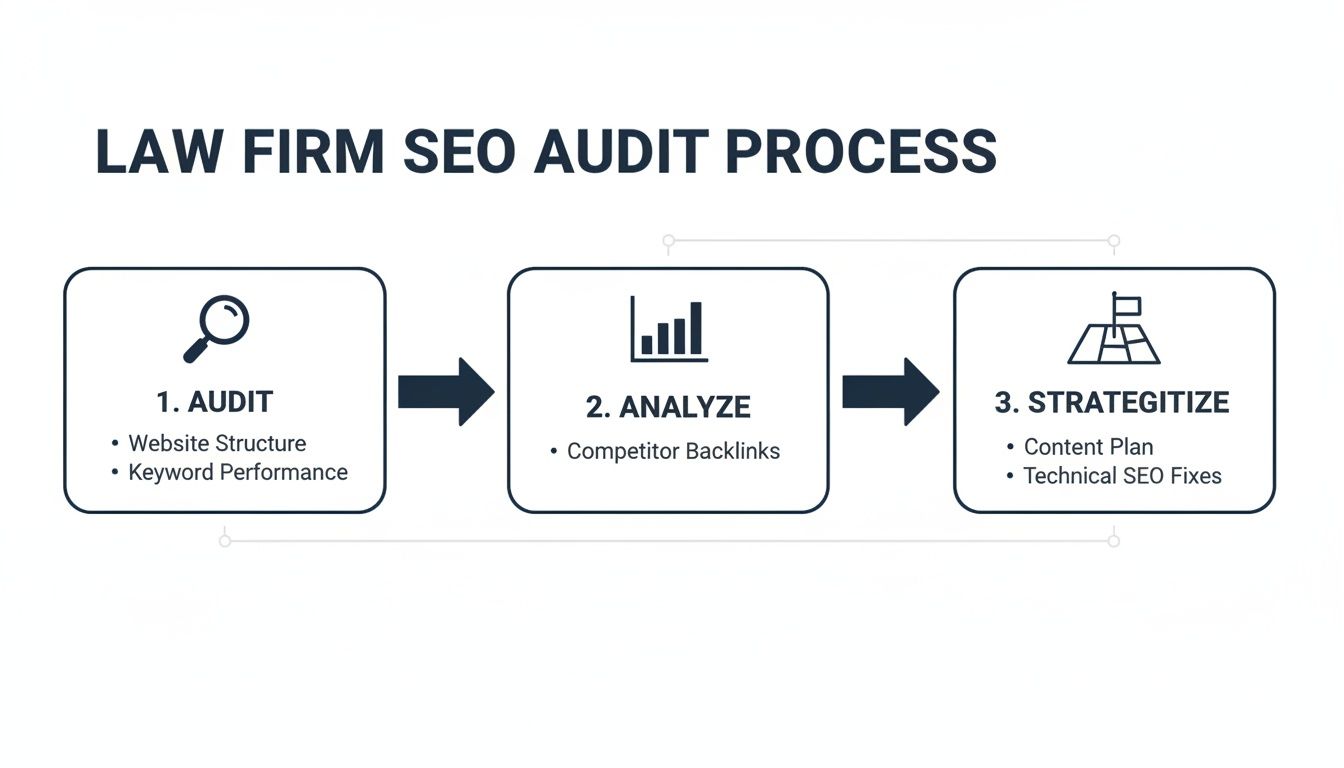
As you can see, a successful SEO campaign isn't a one-and-done fix. It's a continuous cycle of improvement.
Setting Meaningful Goals and Tracking What Matters
The final piece of your foundational audit is getting a handle on user experience and setting goals that actually mean something. Your website might look fantastic, but if it's slow to load or a nightmare to navigate on a mobile, potential clients will be gone in a flash. Tools like Google's PageSpeed Insights can quickly reveal technical issues that are hurting your user experience.
The structure and design of your site are also critical. For more on this, exploring best practices for website development for law firms can provide valuable context on creating a client-focused digital presence.
Ultimately, the entire point of SEO is to drive business growth. Forget chasing vanity metrics like overall website traffic and focus on what impacts your bottom line. Your goals have to be tied to tangible outcomes.
Key performance indicators you should actually be tracking include:
- Client Enquiry Form Submissions: How many potential clients are getting in touch through your website's contact forms?
- Phone Calls from Organic Search: Are you tracking the calls that come directly from users who found you on Google?
- Keyword Rankings for High-Intent Terms: Are you visible for phrases that signal someone is ready to hire a lawyer? Think terms like "criminal defence lawyer Gold Coast."
By establishing this solid foundation through a detailed audit and setting clear, business-oriented goals, you set the stage for a successful and measurable SEO strategy.
Finding the Right Clients with Smarter Keyword Research
Effective SEO for a law firm isn’t about getting more traffic; it's about getting the right traffic. To do that, we need to stop chasing broad, ego-boosting keywords and start thinking about the exact phrases clients type when they genuinely need legal help. This is where smart keyword research becomes your most powerful client-generation tool.

There's a huge difference between a vague search and one with real intent. Someone searching for "family lawyer" is probably just starting their research. But a person searching for "divorce lawyer for contested property Sydney" has a specific, urgent problem and is much closer to picking up the phone.
These longer, more detailed phrases are what we call long-tail keywords. They might have lower search volumes, but they convert at a much higher rate because they capture people with a clear and immediate need. Nailing these is the first real step to building a content strategy that speaks directly to your ideal clients.
Uncovering High-Intent Legal Keywords
Finding these high-value keywords requires you to step into your potential clients' shoes. What are the specific questions running through their minds? What language are they using to describe their situation? The sweet spot is where your legal expertise meets real-world search behaviour.
A good starting point is to brainstorm the core problems your clients face for each of your practice areas. If you’re a personal injury firm, for example, you can start with a base term and then layer on specific modifiers.
- Location-Based: "workers compensation lawyer Brisbane" or "car accident solicitor Parramatta"
- Problem-Specific: "medical negligence claim for birth injury" or "TPD claim rejected"
- Urgency-Driven: "emergency intervention order Victoria" or "urgent child custody advice"
This process is absolutely fundamental to connecting with the right people. For a deeper look into the mechanics, our guide on effective keyword research for small businesses breaks down more strategies that are perfectly suited for law firms.
The market is certainly catching on to this targeted approach. Australian businesses, including law firms, are projected to pour $1.5 billion into SEO services in 2025 alone. That’s a 12% jump from 2024, showing a massive shift in recognising organic search as the number one client acquisition channel—especially when most clicks go to organic results, not paid ads.
Building Content That Demonstrates E-E-A-T
Once you have your list of high-intent keywords, the next job is to create content that both Google and your potential clients will trust. For the legal profession, this isn't optional. Google's quality guidelines, known as E-E-A-T (Experience, Expertise, Authoritativeness, Trustworthiness), are incredibly strict for topics that impact someone's life, finances, or well-being—a category where law sits squarely.
Creating content that nails E-E-A-T means you have to go way beyond generic service pages. It's about showcasing your firm’s deep knowledge and proven track record in a way that builds unshakable confidence in your audience.
Here are a few practical ways to get this done:
-
Develop In-Depth Legal Guides: Don't just tell people you can help; show them. Write comprehensive articles that walk potential clients through complex legal processes. A detailed guide on "The Steps of Conveyancing in Queensland," for example, doesn't just target valuable keywords—it immediately positions your firm as a credible authority.
-
Publish Anonymised Case Studies: Nothing proves your worth like results. Detail the challenges of a past case (with all identifying information removed, of course), the strategy you used, and the positive outcome you secured. This offers tangible proof of your experience and expertise.
-
Create Practice Area FAQs: Get ahead of your clients' questions. Build out dedicated FAQ sections answering the most common queries you hear every day. Addressing things like "How is property divided in a de facto separation in NSW?" helps you rank for those valuable long-tail keywords and shows you genuinely understand what’s on your clients' minds.
When you build your content strategy around specific, high-intent keywords and weave E-E-A-T principles into every page, you create a powerful system. This approach doesn't just boost your search rankings; it transforms your website into a trusted resource that turns informed visitors into loyal clients.
Mastering Your Technical and Local SEO Presence
Even the most persuasive, well-written content on your firm's website will fall flat if the technical foundation is shaky. A slow, clunky, or confusing website experience is one of the fastest ways to lose a potential client before they ever read a single word. This is where mastering the technical and local aspects of SEO becomes a non-negotiable part of your strategy.

Many firms overlook these critical behind-the-scenes elements, assuming they don't directly impact client acquisition. But the reality is that site speed, mobile-friendliness, and local visibility are powerful signals to Google that determine whether your firm shows up when and where it matters most.
Why Google's Core Web Vitals Matter
Let’s start with the engine room of your website. Google's Core Web Vitals are a set of specific metrics that measure the real-world user experience of your website. Put simply, they assess how quickly your pages load, how responsive they are when someone clicks, and how stable the content is as it appears on screen. A poor score here can directly harm your search rankings.
Unfortunately, many Australian law firms are falling behind. In a detailed audit of 54 leading Australian law firm websites, a staggering 28% of them completely failed Google's Core Web Vitals performance tests. This highlights a massive opportunity for firms that prioritise a smooth user experience to get ahead.
A fast-loading, mobile-friendly website isn't just a "nice-to-have" feature; it's a direct reflection of your firm's professionalism and respect for a potential client's time. In their moment of need, a frustrating website experience is the last thing they want.
Use this practical list to evaluate your site's performance and identify key areas for technical improvement, ensuring a better user experience and stronger search rankings.
- Largest Contentful Paint (LCP): This measures how long it takes for the largest piece of content, like an image or text block, to become visible. An ideal score is under 2.5 seconds. You can improve this by optimising images, boosting server response times, and removing unnecessary scripts.
- First Input Delay (FID): This shows how quickly your site responds when a user first interacts with it, such as clicking a link. You should aim for under 100 milliseconds by minimising JavaScript, using a modern web framework, and breaking up long tasks.
- Cumulative Layout Shift (CLS): This tracks how much the content on your page moves around unexpectedly as it loads. A score below 0.1 is best. To fix this, specify dimensions for images and ads and avoid inserting new content above existing content.
Getting these vitals into the "Good" range isn't just about pleasing Google; it's about providing a seamless experience that keeps potential clients on your site long enough to see your value.
Maximising Your Local Visibility with Google Business Profile
For nearly every law firm, clients come from the local community. This makes optimising your Google Business Profile (GBP) one of the highest-impact activities you can undertake. Your GBP is that crucial information box that appears in Google Maps and on the right side of search results. It's often the very first interaction a potential client has with your firm.
Getting this right involves more than just listing your address. A fully optimised profile is a powerful magnet for local clients.
- Choose the Right Categories: Be specific. Don't just list "Lawyer." Your primary category should be your main focus, like "Family Law Attorney" or "Criminal Justice Attorney," and then add secondary ones for all your other practice areas.
- Leverage Client Reviews: Actively encourage satisfied clients to leave reviews. Positive reviews are a major local ranking factor and build immense social proof. Make sure you respond professionally to every review, both positive and negative.
- Use Posts and Q&A: Regularly use the Google Posts feature to share firm news, helpful articles, or case updates. You can also proactively populate the Q&A section with common questions and your expert answers.
A well-managed GBP ensures you appear for searches like "wills, trusts, and estates attorney near me" and other critical local queries. If you're serious about dominating your service area, digging deeper into strategies for local SEO for businesses is an essential next step.
Helping Search Engines Understand Your Firm with Schema Markup
The final piece of this technical puzzle is implementing structured data, also known as Schema markup. Think of it as a special translator for search engines. It's a small piece of code added to your website that helps Google, Bing, and others understand the context of your content more deeply.
For a law firm, specific types of Schema are incredibly valuable. You can explicitly tell Google:
- Your Practice Areas: Clearly define the specific legal services you offer.
- Your Location: Reinforce your physical address and service area.
- Your Operating Hours: Ensure clients have accurate, up-to-date information.
- Attorney Information: Showcase the credentials, expertise, and background of your legal team.
By implementing this markup, you give Google the structured information it needs to display rich results for your firm, like star ratings from reviews or a more detailed business listing. This gives you a distinct advantage in a competitive local market, ensuring your technical setup actively works to attract the right clients.
Building Digital Authority and Trust
In the legal world, your reputation is everything. It’s the foundation of your practice. That same principle holds true online. Building digital authority is how you prove to potential clients—and to Google—that your firm is a credible, trustworthy source of legal expertise.

A huge part of this authority comes from ethical link-building, which is really about earning links from other reputable websites. Think of every quality backlink as a professional referral or a vote of confidence. The more you have, the higher your firm’s standing in search results.
But let's be clear: not all links are created equal. You need to know the difference between valuable backlinks that build your credibility and toxic links from spammy sites that can actively damage your rankings. The goal here is to build a profile that reflects genuine authority, not one that’s just trying to game the system.
Earning High-Quality Backlinks
Real, effective link-building isn't about blasting out hundreds of emails asking for links. It’s about creating assets that other people naturally want to reference and share. The best links are always earned, not bought. This approach not only aligns with the professional standards of the legal industry but also delivers SEO results that actually last.
Here are a few practical strategies for earning these valuable digital referrals:
- Create Indispensable Legal Guides: Develop comprehensive, in-depth resources on your core practice areas. A detailed guide on "Navigating Commercial Leases in Victoria," for example, can become the go-to resource for business publications and industry blogs, earning you natural links without you even asking. Building out this kind of pillar content is fundamental, and you can dive deeper into this by reviewing insights on content marketing for law firms.
- Contribute Expert Insights: Offer your legal expertise to journalists and industry publications. Your unique perspective on a recent court ruling or new legislation can lead to valuable mentions and backlinks from high-authority news sites.
- Sponsor Local Events and Charities: Getting involved in your community by sponsoring a local event, sporting team, or charity often results in a link from their website. This is a fantastic way to build a quality backlink while strengthening your firm's local reputation.
To protect your firm's credibility and attract new clients, a solid grasp of online reputation management for lawyers is essential. It goes hand-in-hand with building a clean, authoritative backlink profile.
The Critical Role of NAP Consistency
While backlinks build your firm’s broader authority, another piece of the puzzle is absolutely vital for establishing local trust: your NAP information. This is your firm's Name, Address, and Phone number.
Absolute consistency of this data across the web is non-negotiable. Google uses this information from various online directories and platforms to verify that your firm is a legitimate, established local business.
When your NAP is identical everywhere—from your website to your Google Business Profile and local directories—it sends a powerful signal of trustworthiness. Inconsistencies, like an old address or a slightly different firm name, create confusion and erode that trust.
Think of it like this: if different sources give conflicting details about your firm, how can Google be confident in recommending you to someone searching locally? Making sure every online mention of your firm is accurate and uniform is a foundational piece of local SEO for law firms.
This means you need to audit your presence on key directories and citation sites. Hunt down and correct any discrepancies in:
- Business Name: Is it listed as "Smith & Jones Law" in one place and "Smith and Jones Lawyers" in another? Pick one and stick to it everywhere.
- Address: Does every listing include the correct street name, suite number, and postcode? Even tiny variations can cause issues.
- Phone Number: Ensure the main contact number is the same across all platforms.
Maintaining this digital consistency is a simple but incredibly effective way to reinforce your local authority. It builds trust with search engines, making them more likely to feature your firm prominently, and it ensures potential clients can always find and contact you without any confusion.
Measuring Your SEO Impact and Embracing AI
Pouring time and money into search engine optimisation is one thing, but proving it’s actually delivering a return is a whole other challenge. Effective SEO for a law practice isn't just about ticking boxes; it demands a clear system for tracking performance. You need to show that your efforts are leading to tangible business growth, not just vanity metrics.
Without proper measurement, you're essentially flying blind. It's impossible to know which activities are driving genuine client enquiries and which ones are just noise. This insight allows you to double down on what works and refine your approach, ensuring your marketing budget is spent wisely, not wasted.
Key Performance Indicators That Actually Matter
To get a real sense of your SEO's impact, you have to look beyond broad numbers like total website traffic. The focus should be on Key Performance Indicators (KPIs) that directly connect to your firm’s bottom line. These are the numbers that truly tell the story of your client acquisition.
Your best friends here are tools like Google Analytics 4 and Google Search Console. They provide the raw data you need to see what’s really happening.
Here are the critical metrics your firm should be watching like a hawk:
- Organic Traffic to Practice Area Pages: Forget overall traffic for a moment. Is your "Commercial Litigation" page seeing a spike in visitors from Google? That’s a powerful sign that your targeted content is hitting the mark.
- Keyword Ranking Improvements: Keep a close eye on your position for high-intent keywords like "property dispute lawyer Melbourne." A jump from page two into the top three results for a term like that can dramatically increase qualified leads.
- Conversion Rate from Organic Search: What percentage of visitors who find you via a search engine actually pick up the phone or fill out a form? This metric reveals how well your website turns prospects into potential clients.
- Number of Leads Generated: This is the ultimate proof. Track the exact number of phone calls and form submissions originating from organic search each month. This is your SEO ROI, plain and simple.
Tracking these specific KPIs gives you a clear, data-backed answer to the question, "Is our SEO working?" It transforms your marketing from a cost centre into a predictable engine for new business.
Navigating the Future with AI in Search
Beyond the usual tracking, the very way people find information is changing, and AI is at the wheel. Search engines are increasingly using artificial intelligence and large language models (LLMs) to serve up direct, summarised answers, which can sometimes bypass website clicks altogether. This isn't something to panic about, but it does mean law firms need to adapt.
This emerging field is often called Generative Engine Optimisation. At its core, it's about making sure your firm’s expertise is visible and accurately represented within these AI-driven results. The good news is that the fundamentals of solid SEO—creating high-quality, authoritative, and well-structured content—are more critical than ever. AI models feed on this kind of content to formulate their answers. You can get a better handle on this by exploring the fundamentals of Generative Engine Optimisation and how it will shape search.
AI also brings some fantastic opportunities to make your SEO work more efficient. Your firm can use AI-powered tools to streamline a lot of the grunt work, freeing you up to focus on high-level strategy and client service.
Here are a few practical ways to do it:
- More Efficient Keyword Research: AI can crunch huge amounts of search data to uncover long-tail keywords and topic clusters you might have overlooked, giving you a much deeper understanding of client intent.
- Content Ideation and Outlines: Stuck for ideas? AI can help brainstorm blog topics, generate questions for FAQ pages, and create structured outlines for in-depth legal guides. It dramatically speeds up the content creation process.
- Technical SEO Audits: Some modern tools use AI to rapidly scan your website for technical gremlins like broken links or slow page speeds, spitting out a clear, actionable list of fixes.
By embracing these tools, you can sharpen your SEO strategy, ensuring your firm stays effective and competitive. It’s a proactive approach that lets you measure today's success while getting your practice ready for the future of search.
Got Questions About Law Firm SEO?
Even with a clear strategy, it's natural for partners and marketing managers to have a few pressing questions before investing in search engine optimisation. Let's tackle some of the most common ones we hear, so you can make an informed decision for your firm's growth.
How Long Does SEO Actually Take to Show Results?
This is always the first question, and the answer is all about managing expectations. SEO isn’t like flicking a switch on a paid ad campaign where you see instant visibility. It’s a long-term investment in building a valuable digital asset for your firm.
You can expect to see some initial positive movement—like improved rankings for certain keywords—within 3 to 6 months. But the real, business-driving results, like a consistent stream of high-quality client enquiries from organic search, typically take somewhere between 6 and 12 months of dedicated, focused effort.
What influences this timeline? A few key things:
- The competition. Are you a family lawyer in a small regional town or a commercial litigator in Melbourne CBD? The more competitive your practice area and location, the longer it can take.
- Your website's current state. A site with a clean bill of technical health will get moving faster than one riddled with underlying issues.
- Consistency is key. The quality and regularity of your content and link-building efforts will directly impact how quickly you gain traction.
Think of it like building a strong legal case. It demands meticulous preparation, gathering evidence (your content and links), and persistent effort over time. There are no overnight victories, but the final verdict is far more sustainable and valuable than a quick settlement.
What’s a Realistic SEO Budget for a Law Firm?
SEO budgets can vary wildly, but it's vital to see it as an investment in your firm's future, not just another line item expense. Your budget will really depend on your firm's size, how competitive your market is, and the scope of work needed to get you to the top.
For a small to medium-sized Australian firm in a competitive metro market like Sydney or Melbourne, a realistic monthly investment usually starts from a few thousand dollars. For more aggressive campaigns in highly sought-after practice areas, this can scale up.
This investment typically covers the essentials that drive real results:
- Technical SEO audits and ongoing site maintenance
- Deep-dive keyword research and strategy
- Creation of high-quality, expert-led content (think service pages and insightful blog posts)
- Ethical link-building and digital PR outreach
- Detailed monthly reporting and strategy refinement
A word of caution: be wary of providers promising the world for just a few hundred dollars a month. Proper SEO for legal firms requires specialised expertise and significant resources. Rock-bottom prices often mean they're cutting corners with low-quality tactics that can do more harm than good in the long run.
Can We Just Do SEO In-House?
Bringing your SEO in-house is definitely an option, but it comes with a steep learning curve and a serious time commitment. For some tasks, though, it can be a really practical way forward.
For example, your internal team is perfectly placed to create blog posts answering common client questions or to keep your Google Business Profile updated with fresh photos and posts. They have the subject matter expertise that no agency can replicate.
However, the more technical side of things—like implementing schema markup, optimising site speed, and executing a strategic link-building campaign—really needs specialised knowledge. Getting it wrong can lead to costly mistakes that set you back months.
Often, a hybrid approach works best. Your internal team provides the legal expertise and handles the foundational content, while an external specialist or agency manages the technical heavy lifting and the overarching strategy. It’s the best of both worlds, ensuring your efforts are both authentic and technically sound.
At Titan Blue Australia, we understand the unique challenges and opportunities of the legal sector. With over 25 years of experience, we build SEO strategies that deliver measurable growth and a tangible return on investment for law firms across Australia. To see how we can help your practice attract the right clients, visit us at titanblue.com.au.
Make Titan Blue a preferred source in Google
One click tells Google to surface our articles more often in Top Stories, AI Overviews and AI Mode.

Best AEO and GEO Agencies in Australia (2026): 7 Compared
Best AEO agency and GEO agency in Australia, compared: seven agencies, what their own pages…

Aged Care Website Design Australia: The 2026 Guide
Aged care website design Australia: what families need to see, how to structure pages, and…

Wedding Vendor Website Design Australia: The 2026 Guide
Wedding vendor website design Australia: what couples need to see, how to structure your site,…