


TL;DR:
- SEO drives approximately 33% of hospitality revenue and yields higher net profits than OTAs.
- Implementing foundational strategies like Google profiles, local pages, and reviews boosts visibility rapidly.
- Future search dominance depends on combining traditional SEO with Generative Engine Optimisation (GEO).
Organic search is quietly one of the most powerful revenue drivers in hospitality, yet many Gold Coast operators hand that advantage straight to the big Online Travel Agencies (OTAs). Organic search drives ~33% of hotel revenue, and direct bookings yield 18 to 28% higher net revenue than OTA bookings. That margin difference is significant. If your restaurant, hotel, or accommodation business is not actively investing in search engine optimisation (SEO), you are essentially paying a commission to platforms that should be your competitors. This guide breaks down what actually works in hospitality SEO on the Gold Coast, from foundational tactics to the emerging world of Generative Engine Optimisation (GEO), so you can start winning more direct business today.
Table of Contents
- Why SEO matters for Gold Coast hospitality businesses
- Core SEO strategies tailored for hospitality
- From SEO to GEO: Preparing for the future of search
- Measuring and maximising your SEO impact
- Our view: Why most hospitality SEO advice falls short
- Ready to grow? Expert SEO solutions for Gold Coast hospitality
- Frequently asked questions
Key Takeaways
| Point | Details |
|---|---|
| SEO drives direct revenue | Relying on organic search can increase your direct bookings and profit margins while reducing third-party fees. |
| Mobile-first and reviews matter most | Fast mobile experiences and authentic user reviews are proven to boost search rankings for hospitality businesses. |
| Future-ready means GEO-ready | Combining traditional SEO with GEO positions your business for visibility in both classic and AI-driven search. |
| Measure and adapt | Focus on the right benchmarks and continually refine your tactics to stay ahead in Gold Coast hospitality. |
Why SEO matters for Gold Coast hospitality businesses
SEO is the practice of improving your website so it appears higher in search results when potential guests look for places to stay, eat, or visit. For hospitality businesses, this is not just about traffic. It is about who controls your bookings and how much profit you keep.
The Gold Coast is one of Australia’s most competitive tourism markets. Millions of visitors arrive each year, and the vast majority begin their search online. When your business does not appear prominently in those searches, travellers default to OTA platforms like Booking.com or Expedia. Those platforms charge commissions of 15 to 25% per booking. That is revenue leaving your business every single time.
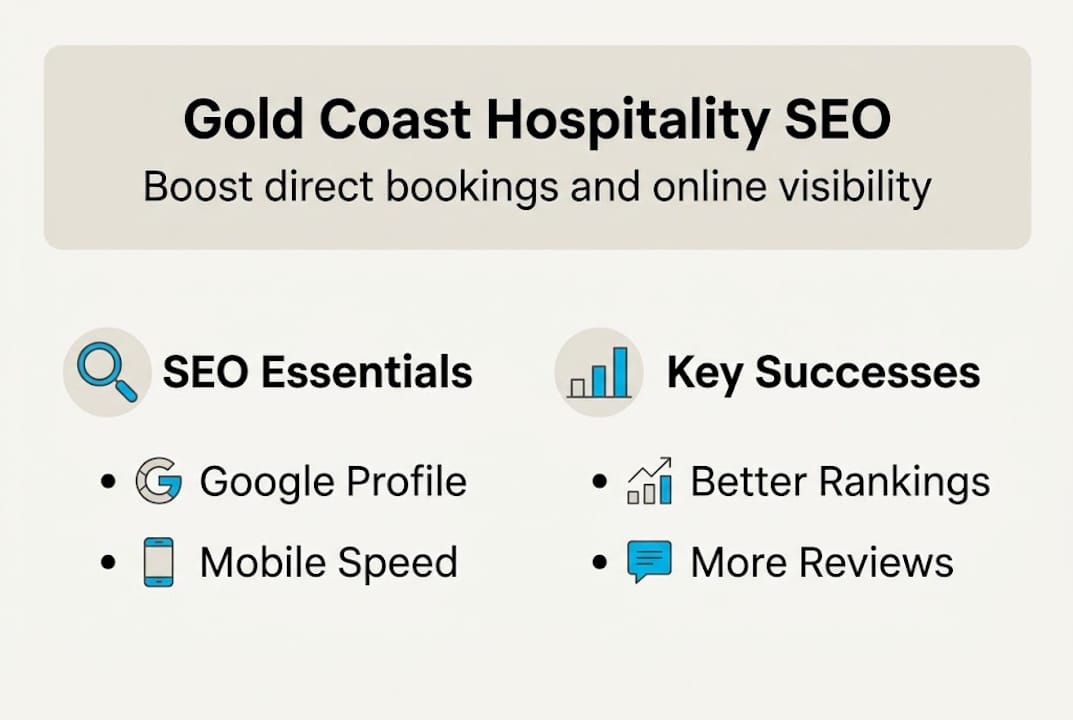
The numbers make a compelling case for investing in SEO directly:
| Metric | With strong SEO | Without SEO |
|---|---|---|
| Direct booking rate | Higher, lower commission | Lower, OTA dependent |
| Net revenue per booking | 18 to 28% more | Reduced by OTA fees |
| Organic traffic growth | Up to 922% in 8 months | Stagnant or declining |
| Keyword visibility | Up to 758% growth | Minimal search presence |
“A well-executed SEO strategy in hospitality is not a marketing expense. It is a margin recovery tool. Every direct booking you win back from an OTA goes straight to your bottom line.”
The Gold Coast market also experiences strong seasonal fluctuations. School holidays, the Schoolies period, and summer beach season all create surges in search demand. Businesses that have built strong SEO foundations capture those surges. Businesses that have not miss them entirely or pay OTAs to capture them on their behalf.
For a broader look at how hospitality digital marketing fits into your overall growth strategy, it helps to understand that SEO is the long-term engine, while paid advertising fills short-term gaps.
Core SEO strategies tailored for hospitality
Knowing SEO matters is one thing. Knowing what to actually do is another. Here are the strategies that deliver real results for hospitality businesses on the Gold Coast.
1. Optimise your Google Business Profile
Your Google Business Profile (formerly Google My Business) is often the first thing a potential guest sees. Make sure your listing has accurate hours, high-quality photos, a compelling description, and your correct address. Respond to every review, positive or negative.
2. Build location-specific pages
If you operate multiple venues or offer different experiences, create dedicated pages for each. A page targeting “Gold Coast beachfront dining” will perform far better than a generic homepage trying to rank for everything.
3. Prioritise mobile performance
70% of travel bookings are now made on mobile devices. Google’s Core Web Vitals (CWV), which measure page speed, visual stability, and responsiveness, are ranking signals. A slow or clunky mobile experience will cost you rankings and bookings simultaneously. Review mobile-friendly website best practices to ensure your site meets current standards.

4. Use structured data for accommodations
Structured data (also called schema markup) tells search engines exactly what your business offers. For hotels and restaurants, this can trigger rich results in Google, including star ratings, price ranges, and booking links directly in the search results page.
5. Generate and manage reviews actively
Review velocity matters more than total review count for search rankings. Getting five new reviews this week is more valuable than having 200 old ones. Encourage guests to leave reviews immediately after their visit or stay.
Here is a quick comparison of high-impact versus low-impact SEO activities for hospitality:
| Activity | Impact level | Time to results |
|---|---|---|
| Google Business Profile optimisation | Very high | 2 to 4 weeks |
| Mobile performance improvements | Very high | Immediate |
| Location-specific content pages | High | 2 to 4 months |
| Structured data implementation | High | 4 to 8 weeks |
| Generic blog posts without local focus | Low | Slow or none |
Pro Tip: When building your restaurant marketing strategy, integrate your SEO review requests into your post-dining email or SMS follow-up. Timing matters. A guest is most likely to leave a review within 24 hours of a positive experience.
User-generated content, such as guest photos, reviews, and social mentions, also feeds into your SEO performance. Platforms like Google factor in the freshness and volume of this content when ranking your business. Encourage it actively rather than waiting for it to happen organically.
From SEO to GEO: Preparing for the future of search
The search landscape is changing fast. Traditional SEO focused on getting your website to appear in a list of blue links. That model is still relevant, but a new layer is emerging: Generative Engine Optimisation, or GEO.
GEO is the practice of optimising your content so it gets cited or featured in AI-generated search answers. When someone asks Google’s AI Overview or a tool like ChatGPT “best restaurants on the Gold Coast,” GEO determines whether your business gets mentioned in that answer.
This shift matters enormously for hospitality. Zero-click searches now account for 65% of all searches, meaning users get their answer directly from the search results page without clicking through to any website. If your business is not being cited in those AI-generated answers, you are invisible to a growing share of potential guests.
Key differences between traditional SEO and GEO:
- Traditional SEO focuses on ranking for keywords and earning click-throughs to your website
- GEO focuses on being cited as a credible source in AI-generated answers
- Backlinks remain important for SEO, but citations and user-generated content carry more weight in GEO
- Review quality and authenticity are critical signals for AI systems evaluating your business
- Structured, factual content is more likely to be cited by AI than vague or promotional copy
For Gold Coast hospitality businesses, this means your review strategy, your Google Business Profile content, and your on-site descriptions all need to be accurate, detailed, and genuinely useful. AI systems pull from trusted, well-cited sources.
The practical approach is a hybrid one. Keep building your traditional SEO foundations, because they feed directly into GEO readiness. Work on improving your local search rankings while simultaneously making your content more citation-worthy for AI engines. Strategies to boost your business in local search and local SEO for customer growth remain foundational to both approaches.
The businesses that will win in 2026 and beyond are those treating SEO and GEO as complementary, not competing, disciplines.
Measuring and maximising your SEO impact
Running SEO activity without measuring results is like running a kitchen without checking orders. You need clear metrics to know what is working and where to focus next.
Here are the key metrics every Gold Coast hospitality operator should track:
- Direct bookings from organic search: The clearest measure of SEO success. Track this in Google Analytics by setting up conversion goals tied to your booking confirmation page.
- Organic traffic volume: How many visitors are arriving via search engines each month? Look for consistent upward trends over 3 to 6 month periods.
- Local pack visibility: Are you appearing in the map results when people search for hospitality businesses in your area? Tools like Google Search Console show you which queries trigger your listing.
- Review velocity: How many new reviews are you receiving each week or month? This directly correlates with both rankings and guest trust.
- Keyword ranking improvements: Track specific terms relevant to your business, such as “Gold Coast boutique hotel” or “Surfers Paradise restaurant,” and monitor movement over time.
Real-world benchmarks give you a sense of what is achievable. Hospitality businesses using focused SEO have recorded a 30% increase in direct bookings, 922% organic traffic growth, and 758% keyword growth within 8 months. These are not outliers. They reflect what consistent, well-directed SEO effort can produce.
Common pitfalls to avoid:
- Chasing high-volume keywords that do not convert to bookings
- Ignoring review quality in favour of review quantity
- Measuring traffic without connecting it to actual revenue outcomes
- Treating SEO as a one-time setup rather than an ongoing process
Pro Tip: Start with a small business SEO audit focused on your Google Business Profile and mobile performance. These two areas often deliver the fastest revenue wins for hospitality businesses with minimal technical complexity. Once those are solid, move into content and local SEO mastery for longer-term gains.
Regular monthly reviews of your analytics keep you focused on what is actually moving the needle rather than vanity metrics.
Our view: Why most hospitality SEO advice falls short
Most generic SEO guides treat hospitality businesses the same as any other local business. That is a mistake. Hospitality operates on seasonality, emotional decision-making, and trust signals that are entirely different from, say, a plumbing company.
The biggest missed opportunity we see is the lack of a genuine review strategy. Businesses collect reviews passively and hope for the best. A proactive, timed, and guest-specific review request process can transform your local visibility within months.
The second missed opportunity is hyper-local content. A page targeting “family-friendly accommodation near Dreamworld” will outperform a generic “Gold Coast hotel” page almost every time, because the intent is specific and the competition is lower.
Finally, very few businesses are preparing for zero-click search. If your content is not structured to be cited by AI systems, you are already behind. The operators who treat hospitality marketing expertise as an evolving discipline rather than a fixed checklist are the ones pulling ahead. SEO is not a project you finish. It is a practice you maintain and adapt.
Ready to grow? Expert SEO solutions for Gold Coast hospitality
If this article has made one thing clear, it is that effective SEO for hospitality is specific, ongoing, and increasingly complex. Generic advice will not cut it in a market as competitive as the Gold Coast.
At Titan Blue, we specialise in SEO services built for hospitality businesses that want to grow direct bookings and reduce reliance on costly OTAs. From technical audits to content strategy and GEO readiness, our team delivers measurable results. As a hospitality digital marketing agency based right here on the Gold Coast, we understand the local market, the seasonal pressures, and what it takes to stand out. Get in touch now to request your Gold Coast SEO audit and start converting more searches into bookings.
Frequently asked questions
How soon can SEO improve bookings for a hospitality business?
Results can start appearing in as little as 3 to 6 months, but major gains and steady growth typically take 6 to 12 months. Hospitality businesses have recorded 30% direct booking increases within 8 months of focused SEO activity.
What are the most important SEO signals for hotels and restaurants?
Fast mobile performance, review velocity, quality local citations, and detailed content are the top signals. Review velocity outweighs total count for rankings, and mobile Core Web Vitals are critical given that 70% of bookings happen on mobile.
Should I focus more on GEO or traditional SEO?
A hybrid approach is best. Zero-click searches now represent 65% of all searches, so GEO readiness is essential, but traditional SEO remains the foundation that supports your GEO performance.
How do I measure the real business impact of my SEO efforts?
Track growth in direct website bookings, organic traffic, and local search visibility. Benchmarks from the hospitality sector show 922% organic traffic growth and 758% keyword growth are achievable with consistent, focused effort.
Recommended
- Top Search Engine Optimisation Gold Coast – Boost Your Rankings Today – Titan Blue Australia
- Mastering search engine optimization gold coast to boost local visibility
- Local SEO Gold Coast: Boost Your Business Today – Titan Blue Australia
- 6 Examples of SEO Strategies for Gold Coast Businesses
Make Titan Blue a preferred source in Google
One click tells Google to surface our articles more often in Top Stories, AI Overviews and AI Mode.

How to Make Your Website AI Friendly: The 2026 Step-by-Step Guide
How to make your website AI friendly: a step-by-step 2026 guide to getting crawled, structured…

Web Design for AI Search Optimisation: The 2026 Build Guide
Web design for AI search optimisation: crawlable HTML, clear architecture, accessible UX and trustworthy content…

AEO Web Design: How to Build Websites AI Can Cite
AEO web design creates websites that AI systems can find, understand and cite through clear…