


Last updated:
For any business on the Gold Coast, getting noticed in a sea of competitors isn't easy. It's about being the first result for a tourist looking for a holiday treat and the trusted go-to for a local needing your services. A tailored SEO strategy is what makes sure your business doesn't just survive, but thrives all year round.
Why Your Gold Coast Business Needs Local SEO Experts

The Gold Coast isn’t just another city. Its economy has a unique rhythm, dancing between the massive influx of tourists and the steady needs of its vibrant local community. This means a generic, one-size-fits-all SEO strategy just won't cut it. Success here demands a deep, practical understanding of how the local market actually works.
Think about a café in Burleigh Heads. In summer, it needs to pop up for tourists searching for the best coffee near the beach. But come the quieter months, its survival hinges on attracting loyal locals. A standard SEO plan might completely miss this nuance, but specialised SEO services on the Gold Coast know exactly how to pivot between these two very different audiences.
Navigating Market Volatility
The biggest headache for many Gold Coast businesses is navigating those seasonal peaks and troughs. A local tradie in Southport can't just rely on the tourist boom; they need a consistent stream of jobs all year to keep the lights on. This is where a targeted approach becomes non-negotiable.
An agency that genuinely gets the Gold Coast can build a resilient digital strategy that smooths out this volatility. It's not magic; it’s a smart, dual-pronged approach.
- Targeting Tourist Keywords: During peak season, the focus shifts to terms like "best restaurants near Surfers Paradise" or "family activities Broadbeach" to capture that high-spending holiday crowd.
- Capturing Local Intent: In the off-season, the strategy pivots to keywords like "emergency plumber Robina" or "weekly coffee specials Mermaid Beach" to engage residents and build a local following.
This dual focus is what keeps your business visible and profitable, no matter what time of year it is. The best SEO firms on the Gold Coast create hyper-targeted campaigns designed to dominate search results during the tourist rush while maintaining a strong, steady presence in the off-peak months. You can see how our specialised search engine optimisation services on the Gold Coast are built to strike this exact balance.
Building Local Trust and Authority
Great SEO goes way beyond keywords. It’s about cementing your business as a credible, trusted name within the local community. To really succeed here, you need to be seen as the go-to provider by Gold Coast residents. This means meticulously optimising your Google Business Profile, managing your listings in local directories, and actively encouraging reviews from your local customers.
An expert local agency knows which online directories actually matter to Gold Coasters and how to build a powerful online reputation that resonates with them. To get a better sense of just how critical this is, it's worth reading up on the importance of Google reviews for local SEO.
Ultimately, investing in local expertise means you're not just hiring an agency; you're partnering with a team that understands how to get you the leads and sales needed to flourish in this unique economic landscape. It’s about building a sustainable online presence that works for your Gold Coast business 365 days a year.
Defining Your SEO Goals and Realistic Budget
Before you even think about looking for an SEO agency, you need to know what you're aiming for. Throwing money at a vague goal like "more website traffic" is a fast track to disappointment. Real success begins with concrete, measurable goals that are directly tied to your business's bottom line.
This is about shifting from wishful thinking to specific, actionable objectives. If you run a restaurant on the Gold Coast, a solid goal isn't just "more customers." It's increasing online bookings through your website by 25%. For a local tradie, it might be landing on the first page of Google for "best plumber in Robina." These are tangible targets that give your SEO campaign a clear purpose and a way to measure success.
Setting Specific, Measurable Objectives
So, what does a "win" actually look like for your business? Is it the phone ringing more often? More people walking through your doors in Broadbeach? Or a steady stream of quote requests hitting your inbox? You have to get specific.
Here are a few real-world examples to get you thinking:
- For a Retail Store in Pacific Fair: Increase local organic traffic by 40% in six months to drive more in-store visitors.
- For a Law Firm in Southport: Generate 15 new qualified leads per month from organic search for "family law Gold Coast".
- For a Tour Operator: Secure a top-three ranking for "Gold Coast whale watching tours" to capture peak season tourist bookings.
Having these specifics transforms the conversation with a potential agency. It moves from a generic sales pitch to a strategic planning session where everyone is aligned on what you're trying to achieve. You can dive deeper into this concept in our guide to local search marketing for your business.
The infographic below shows just how powerful a well-defined local SEO strategy can be for Gold Coast businesses.
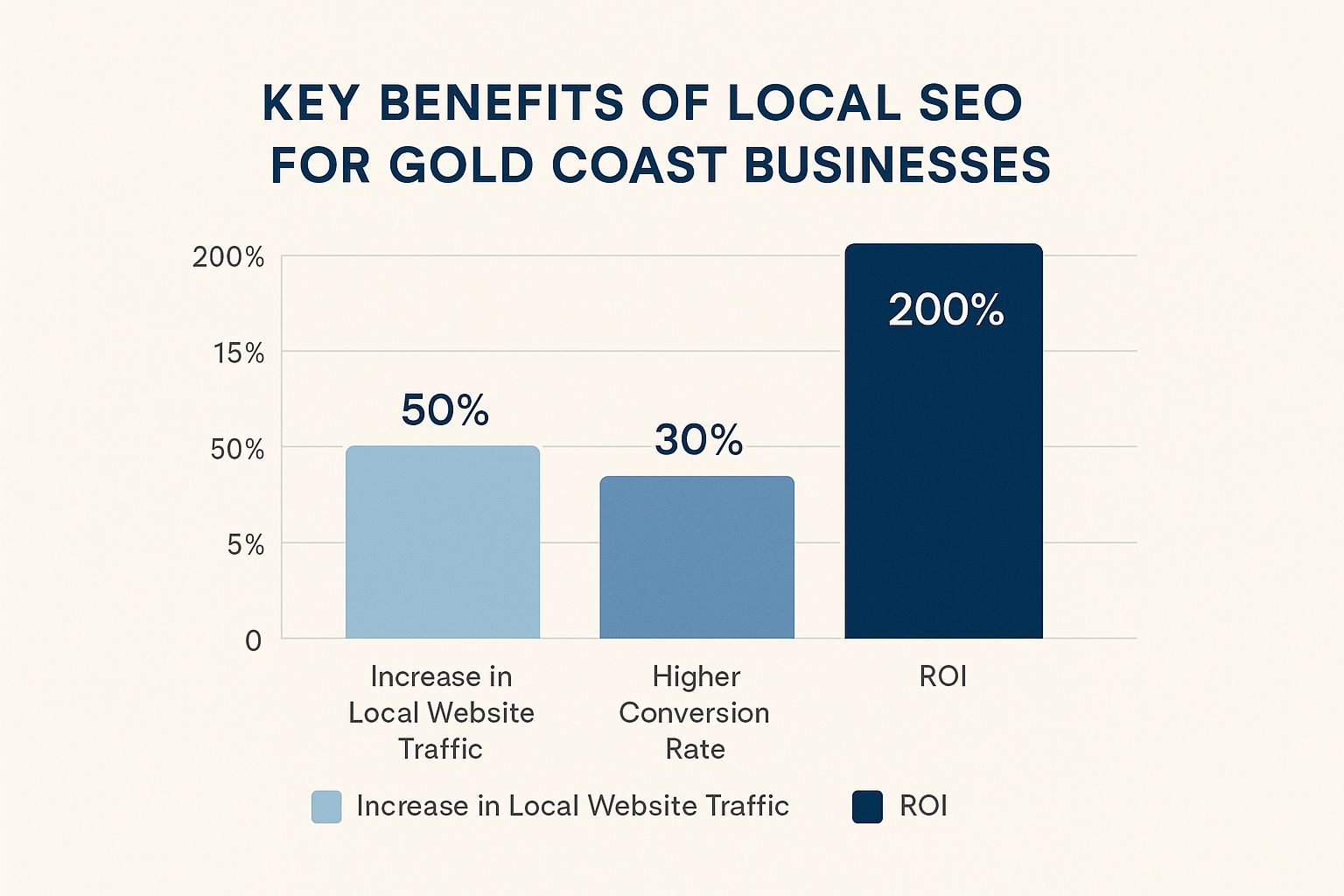
As you can see, a targeted campaign does more than just bring in traffic; it seriously improves your conversion rates and delivers a strong return on your investment.
Aligning Your Budget with Your Ambitions
Once you've defined your goals, it's time for the money talk. The cost of SEO services on the Gold Coast varies significantly, and it’s crucial to understand why. Your investment will almost always reflect the intensity of the campaign and how competitive your market is. A small local bakery has completely different needs—and a different budget—than a large real estate agency battling for high-value keywords.
Thankfully, pricing for SEO in our region caters to a wide range of businesses. A typical monthly campaign on the Gold Coast can run anywhere from $277+GST to over $3,000+GST. Some businesses with seriously aggressive growth targets invest much more, with some spending $5,940+GST per month to completely dominate their niche.
Knowing your numbers gives you power. When you can walk into a meeting with an agency and clearly state both your goals and your budget, you're in the perfect position to find a partner whose services are a genuine match for your financial reality and growth ambitions.
How to Find and Vet Top Gold Coast SEO Agencies

Finding the right SEO partner on the Gold Coast is about more than just a quick Google search. You need a solid game plan to sift through the noise and find an agency that delivers real, measurable results—not just empty promises. The goal here is to build a strong shortlist of 3-5 agencies that genuinely know their stuff and have the track record to prove it.
Of course, you’ll find plenty of agencies that rank well themselves, and that's a decent starting point. But the real gold is often found through word-of-mouth and trusted recommendations from your own network.
Where to Look for Proven Talent
Your first move should be to tap into industry directories and local business communities. These are the places where you can find honest reviews and agencies that have already proven their worth for other Gold Coast businesses. After all, a recommendation from a fellow business owner is often the most reliable you can get.
Here are a few places to start your search:
- Trusted Directories: Platforms like Clutch.co are fantastic for vetting agencies. They offer verified client reviews, portfolios, and detailed service breakdowns, which makes it much easier to gauge an agency's credibility right from the get-go.
- Local Business Chambers: Get involved with the Gold Coast's local chambers of commerce or other professional groups. Don’t be afraid to ask other business owners directly: "Who are you using for your SEO services on the Gold Coast, and are they any good?"
- Industry-Specific Forums: If your business is in a specific niche like tourism, construction, or retail, jump into industry forums or Facebook groups. A referral from someone who understands the unique challenges of your field is incredibly valuable.
The Gold Coast is home to some seriously talented agencies, some of which are even recognised on the world stage. It just goes to show the level of expertise right here in our backyard. For instance, one prominent Gold Coast agency, with a team of over 20 experts, has snagged more than 100 industry awards. They even ranked 260th globally out of over 262,000 agencies on Clutch.co and were finalists in major APAC and Global Search Awards. If you want to dig deeper into the local talent pool, you can find out more about top-performing Gold Coast agencies here.
Analysing an Agency's Website for Proof
Once you have a list of potential candidates, it’s time to put on your detective hat and dive into their websites. Think of an agency's own website as their digital handshake—it should immediately tell you if they practise what they preach. You’re looking for hard evidence of local success, not just slick marketing copy.
Pay close attention to their case studies. Are they showcasing results for businesses like yours, either in the same industry or facing similar hurdles? A truly great case study tells a clear story: here was the problem, this was our strategy, and these were the tangible business outcomes we achieved. This is especially critical for e-commerce, where tiny optimisations can lead to massive revenue gains. To see what a results-focused approach looks like, check out these 7 tips for your e-commerce checkout—this is the kind of detailed, strategic thinking you should expect from a top-tier partner.
Finally, take a good look at their client testimonials and team page. Do you recognise any of the Gold Coast businesses giving testimonials? Do they feel genuine? An agency that’s proud of its work will also be proud of its team, openly showcasing the experts who will actually be managing your account. Doing this homework is what turns a long list of maybes into a solid shortlist of real contenders.
So, you’ve got your shortlist of potential SEO agencies. Now for the most important part: the consultation.
This is your chance to get past the slick sales pitch and see who you're really dealing with. Asking the right questions is how you separate the genuine pros from the service sellers who just talk a big game.
Forget basic questions like "what do you do?". You need to dig in and uncover their real-world experience and strategic thinking. A great agency won't flinch; they'll welcome the scrutiny and give you straight, detailed answers.
Gauging Local Experience and Strategic Fit
The first thing you need to lock down is their hands-on experience with businesses like yours, right here on the Gold Coast. A strategy that worked wonders for a cafe in Melbourne might completely miss the mark in our unique local market. You need proof they get the local vibe, the competition, and the opportunities.
Try asking something direct, such as, "Can you tell me about a campaign you ran for a Gold Coast business in a similar industry to mine? What was their biggest challenge, and what specific steps did you take to solve it?"
Their answer will tell you everything. A confident, specific response will break down the client's business, the problem they were facing, the custom strategy they built, and—most importantly—the measurable results they delivered. If they get vague or start talking about clients in other cities, that’s a red flag.
Having a deep understanding of our local market is non-negotiable for effective local SEO, which you can learn more about here.
Understanding Communication and Reporting
Clear, honest communication is the bedrock of any good partnership. You need to know exactly how they'll report on progress and what metrics they actually care about. This is where you find out if they focus on vanity metrics or on things that actually grow your bottom line.
Here are a few essential questions to get the conversation started:
- How will you report on progress? A solid answer involves regular, easy-to-digest reports that tie their SEO work directly to your goals, like getting more phone calls or online sales.
- What metrics matter most to you? Look for answers that go beyond just "more traffic." They should be talking about ranking improvements for keywords that make you money, conversion rates, and the quality of the leads coming through.
- Who will be my main point of contact? You need to know who you’ll be talking to week in and week out. Ask about their role and how long they've been doing this.
A transparent partner providing SEO services on the Gold Coast will have a clear, structured way of keeping you in the loop. They should be able to explain their reporting without hiding behind confusing jargon.
This initial chat is your best tool for finding an agency that’s genuinely invested in seeing your business succeed.
How to Evaluate Proposals and Make Your Choice

Alright, you've done the hard yards and now you have a few proposals from promising agencies sitting in your inbox. This is where the real analysis begins. Trying to compare SEO proposals can feel a bit like comparing apples and oranges—every agency has its own way of presenting strategies and pricing. Your job is to look past the monthly fee and figure out where the real value is.
A great proposal is much more than a price list. Think of it as a strategic blueprint, one that's been customised specifically for your Gold Coast business. It should clearly connect the work they’re proposing to the goals you actually talked about. If it feels generic or like a copy-paste template, it probably is. That’s a massive red flag.
Scrutinising the Deliverables
The heart of any proposal is the "what you actually get" section. Don't just skim this part; you need to dissect it. A vague promise of "on-page optimisation" simply isn't good enough. A solid proposal will break this down into specific, tangible actions.
You should be looking for a clear breakdown of services, which ought to include:
- Technical SEO Audit: Specifics on what they’ll be checking. Are they looking at site speed, mobile-friendliness, crawlability, and schema markup? They should tell you.
- Content Strategy: Details on the type of content they’ll create. Will it be blog posts, local landing pages, or service pages? How does this content actually target your specific audience?
- Link Building: An explanation of their approach to earning high-quality, relevant backlinks. It's not about a random number of links; it’s about the quality and relevance to your Gold Coast market.
If an agency is hesitant to provide this level of detail, you should be cautious. True experts are more than happy to explain their process because they’re confident in the value it delivers.
Timelines and Reporting Clarity
Let's be clear: SEO is a long-term strategy. Any professional agency knows this and won't promise you the world overnight. A realistic timeline is actually a sign of an honest partner. The proposal should offer a general roadmap for the first few months, outlining key milestones and what to expect.
Be extremely wary of any agency that "guarantees" #1 rankings. Not even Google can guarantee that. Reputable providers of SEO services on the Gold Coast focus on sustainable growth and transparent progress, not impossible promises.
The proposal must also spell out exactly how success will be measured and reported. Will you get a monthly report? What Key Performance Indicators (KPIs) will it track? You want to see metrics tied to real business outcomes—like an increase in organic leads or better rankings for your most valuable keywords—not just vanity metrics like a general traffic spike.
Ultimately, you’re choosing a strategic partner, not just hiring a service provider. Weigh each proposal based on how well its strategy fits your goals, the clarity of its promises, and the overall value it offers. To make it easier, you could even create a simple checklist to score each proposal on things like customisation, transparency, and strategic depth. This will help you confidently pick the agency that’s truly equipped to help your business win on the Gold Coast.
Common Questions About Gold Coast SEO
Even with a solid plan, pulling the trigger on professional SEO can feel like a massive step. It’s completely normal to have a few lingering questions before you commit.
Here are some of the most common queries we hear from Gold Coast business owners just like you. We'll give you straight, no-fluff answers to help you move forward with confidence.
How Long Until I See SEO Results on the Gold Coast?
This is always the first question, and the honest answer is: it takes time. SEO is a long game, not a quick fix.
You might start to see some small wins within the first 3 months, like ranking for a few less-competitive keywords. But for the kind of significant, lasting results that truly impact your bottom line, you're typically looking at 6 to 12 months.
Why so long? Well, factors like how competitive your industry is, the current health of your website, and your domain's authority all play a massive role. Real SEO is about building sustainable growth and becoming a trusted authority in your space—not chasing overnight hacks.
Any agency offering SEO services on the Gold Coast that promises instant, page-one rankings is waving a major red flag. A trustworthy partner will be upfront about the timeline from your very first conversation.
Is Local SEO Different From Regular SEO?
Absolutely, and for a Gold Coast business, the difference is critical.
General SEO casts a wide net, trying to attract a national or even global audience. Local SEO, on the other hand, is laser-focused on bringing in customers who are right here in your service area. Think of it as the difference between a billboard on the M1 and a sign right outside your shop.
Here’s what makes local SEO a completely different beast:
- Geographic Keywords: It’s all about targeting terms people actually use here, like ‘cafe in Coolangatta’ or ‘electrician in Burleigh Heads’.
- Google Business Profile: This is your digital storefront. A huge chunk of local SEO involves optimising your Google Business Profile to dominate the local map pack.
- Building Local Trust: It means getting your name out there in local directories, building citations, and encouraging reviews from your Gold Coast customers to prove you're a legitimate local player.
For any business with a physical address or a defined service area, a specialised local SEO approach is what drives real foot traffic and phone calls from people ready to buy. For a deeper dive, check out our guide on how to improve local search visibility.
Can I Just Do My Own SEO?
You can, and honestly, learning the basics is a fantastic way to understand what drives your online visibility. But there's a big difference between DIY basics and professional execution.
Partnering with a specialist Gold Coast agency gives you a serious advantage. These teams live and breathe the local market every single day.
They come armed with expensive professional software for deep analytics and research that a small business typically can't afford. They also have the deep technical expertise to fix complex website problems and established processes for building authority that would take you years to develop on your own.
Ultimately, hiring experts lets you focus on what you do best—running your business—while they handle the intricate, time-consuming work of getting you found online.
Ready to see how a professional strategy can transform your business? The team at Titan Blue Australia has over 25 years of experience delivering custom SEO solutions that get real results for Gold Coast businesses. Let's build a plan that helps you grow. Find out how we can help at https://titanblue.com.au.
Make Titan Blue a preferred source in Google
One click tells Google to surface our articles more often in Top Stories, AI Overviews and AI Mode.

Best Medical Practice Website Design Agencies in Australia: 7 Compared
Best medical practice website design agencies in Australia, compared: seven picks, what each page shows,…

Shopify Website Design Australia: The 2026 Guide
Shopify website design Australia: product pages, collections, delivery info and product data that win sales,…

Cleaning Company Website Design Australia: The 2026 Guide
Cleaning company website design Australia: the pages, quote forms and schema that win jobs, plus…