

Last updated:
SEO, AEO, and GEO are three distinct but complementary disciplines that together determine how visible your business is across all modern search surfaces — from Google’s blue links to AI-generated answers in ChatGPT, Perplexity, and Google AI Overviews. SEO (Search Engine Optimisation) focuses on ranking your web pages in traditional search results. AEO (Answer Engine Optimisation) structures your content so AI assistants and search engines can extract and display direct answers. GEO (Generative Engine Optimisation) goes further, building the entity trust and citation signals that cause AI systems to recommend your brand when generating responses from scratch. Australian businesses in 2026 need all three — and understanding the differences tells you where to invest first.
The Three-Layer Model: How SEO, AEO, and GEO Stack
Think of SEO, AEO, and GEO not as competing strategies, but as a three-layer architecture for digital visibility. Each layer builds on the one below it — you can’t skip to GEO without a solid SEO foundation, and AEO without SEO is a house with no floor.
- SEO (Layer 1 — Foundation): Gets your pages discovered, crawled, and ranked in traditional search results. It covers technical health, keyword targeting, backlinks, and page authority.
- AEO (Layer 2 — Answer Extraction): Structures your content so that when an AI system or search engine needs to answer a question, it can pull a clean, concise, authoritative response from your page.
- GEO (Layer 3 — AI Recommendation): Builds the entity authority and brand signals that cause AI engines to cite or recommend your business when generating original, synthesised responses to user queries.
The reason this matters is that search behaviour has fractured. In 2026, roughly 25% of Google searches now trigger an AI Overview — a generated summary that often satisfies the query without a single click to a website. Meanwhile, 38 million AI-powered searches happen in Australia every day, and 49% of Australians used generative AI tools in the past year. Each of these search surfaces has a different ranking mechanism — and different optimisation requirements.

What Is SEO? The Foundation That Never Goes Away
Search Engine Optimisation is the practice of improving your website so it ranks higher in traditional search engine results pages (SERPs). It covers three core pillars: technical SEO (site speed, crawlability, mobile responsiveness, Core Web Vitals), on-page SEO (keyword research, content structure, internal linking, metadata), and off-page SEO (backlinks, brand mentions, domain authority).
Despite the rise of AI search, SEO is not dying. It remains the foundation for everything else. Here’s why: AI engines like ChatGPT and Google AI Overviews pull from indexed web content. If your pages aren’t indexed, don’t rank, and don’t have authority, they will not be cited by AI systems. SEO is the prerequisite, not the alternative.
What SEO Optimises For
- Ranking positions in Google, Bing, and other search engines
- Organic traffic volume and click-through rates
- Page authority and domain trust signals
- Technical performance signals (speed, mobile, structured data)
- Local search visibility via Google Business Profile
SEO’s Blind Spots in 2026
Traditional SEO was built for a world where ranking #1 guaranteed clicks. That world is changing. When Google AI Overviews appear, the top organic result loses up to 30% of its clicks to the AI-generated summary. Ranking well is still valuable — but it’s no longer sufficient if you want to be the source AI cites in its answer.
What Is AEO? Structuring Content for Direct Answers
Answer Engine Optimisation is the practice of formatting your content so AI assistants, search engines, and voice interfaces can extract a clear, standalone answer from your page and surface it directly — as a featured snippet, voice response, AI Overview source, or structured answer panel.
AEO emerged from the reality that users increasingly want instant answers rather than lists of links to explore. When someone asks Google “What is a fixed-rate mortgage?”, they don’t want to read five articles. They want the answer right there. AEO is about making your content the source of that answer.
Core AEO Techniques
- Answer-first content structure: Lead every section with a direct answer to the question implied by the heading. The first 1-2 sentences of each section must stand alone as a complete answer.
- FAQ sections with concise answers: Each H3 question paired with a 2-4 sentence answer that AI can extract without context from the surrounding text.
- Schema markup: FAQ schema, HowTo schema, and Article schema signal to search engines the precise type of content on each page.
- Question-format headings: H2/H3 headings phrased as the exact questions users type into search and AI engines.
- Short, declarative paragraphs: 2-4 sentences maximum per paragraph, with no preamble before the key information.
You can learn more about Titan Blue’s approach to AEO services for Australian businesses or explore how to check whether your website is AI-ready.
Where AEO Shows Up
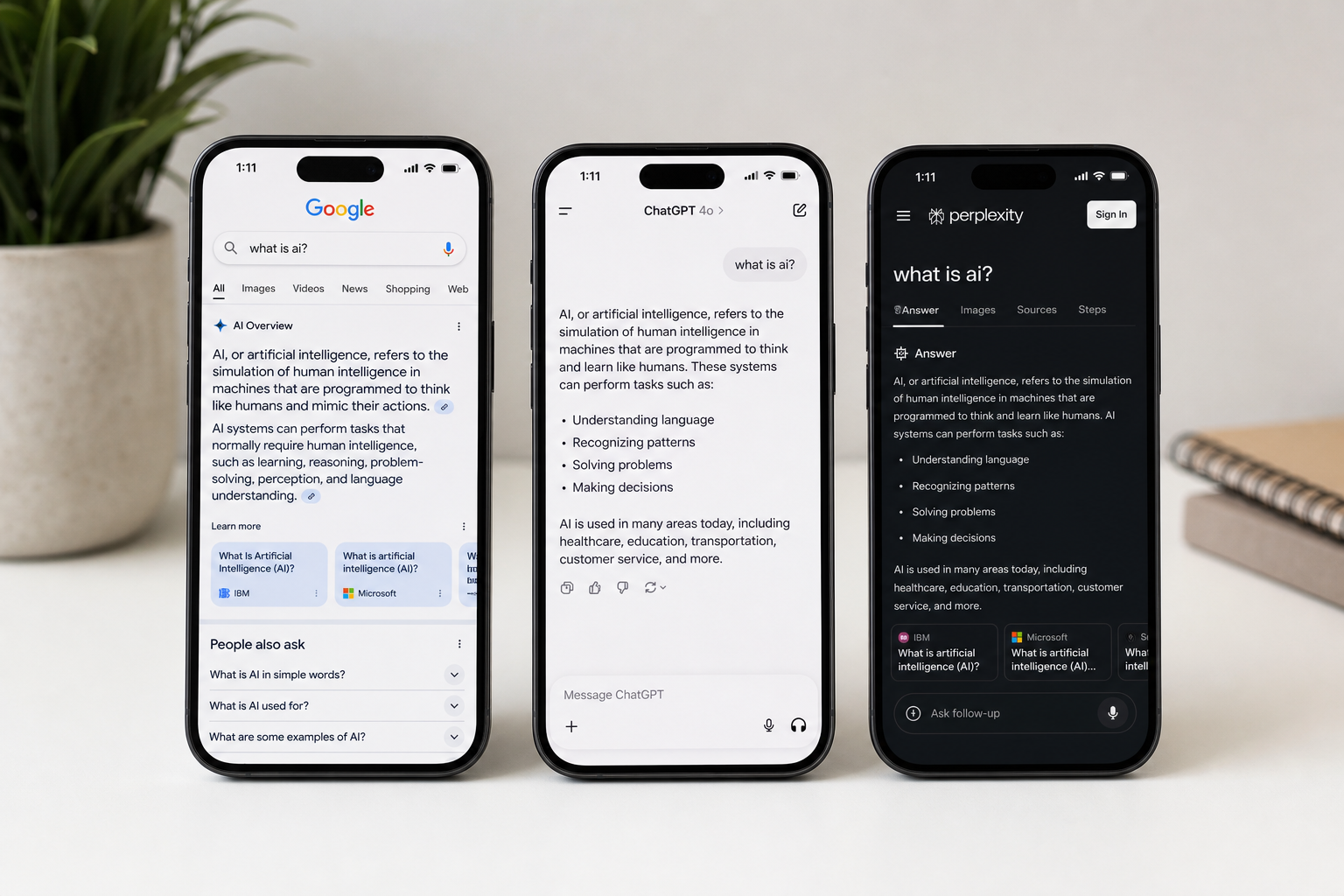
AEO wins manifest as: featured snippets in Google, voice assistant responses (Siri, Google Assistant, Alexa), People Also Ask boxes, AI Overviews citations, and direct answer panels in Bing and Perplexity. Each of these surfaces extracts a passage from your page — AEO is the discipline of making that passage extractable.
💡 Not sure which layer your business is missing?
We audit websites for SEO, AEO, and GEO readiness every week. In 15 minutes, we can tell you exactly where the gaps are and what to fix first — at no cost.
What Is GEO? Getting Cited by AI That Writes Its Own Answers
Generative Engine Optimisation is the practice of building the entity authority, source trust, and brand consistency that causes AI systems to cite or recommend your business when generating synthesised, original responses — not just extracting text from a single page.
This distinction is critical. AEO targets extraction — AI pulls a passage from your page. GEO targets generation — AI chooses your brand as an authoritative source to reference when writing its own answer from multiple inputs. The two optimisation paths are meaningfully different, and both matter.
How GEO Differs From AEO
| Dimension | AEO | GEO |
|---|---|---|
| What AI does | Extracts a passage from your page | Cites or recommends your brand in a synthesised response |
| Where it appears | Featured snippets, AI Overviews, voice responses | ChatGPT answers, Perplexity reports, Google AI Mode responses |
| Primary signal | Content structure and schema | Entity authority, brand trust, topical expertise |
| Speed to results | Faster (weeks to months with good SEO base) | Slower, compounding (3-12 months) |
| Content focus | Individual page, individual question | Entire digital presence, entire brand entity |
| Example result | “According to [Your Page]…” | “Leading agencies like [Your Brand] recommend…” |
Core GEO Techniques
- Entity consistency: Your business name, address, phone number (NAP), and industry descriptions must be consistent across your website, Google Business Profile, LinkedIn, directories, and any site that mentions you.
- Topical authority: Publishing comprehensive, expert-level content across every sub-topic in your niche signals to AI systems that your brand is a go-to source for an entire topic area — not just one page.
- Third-party brand mentions: Reviews, press mentions, industry citations, and references from authoritative websites all feed the entity graph that AI models use to evaluate trust.
- Authoritative source attribution: Citing your own original research, data, and unique perspectives that other sites reference creates citation loops that reinforce your brand as a primary source.
- Semantic clarity: Using consistent language, terminology, and structured data (including Organisation schema) to help AI clearly understand what your brand does and for whom.
Titan Blue’s GEO services are built around this three-layer model — establishing the authority signals that make your brand the natural citation choice for AI systems researching your industry.
How SEO, AEO, and GEO Overlap (and Where They Diverge)
One of the most important things to understand is that these three disciplines share a large common foundation. Research published in 2024 by Princeton, Georgia Tech, and IIT Delhi — which formally established GEO as an academic discipline — found that the underlying ranking signals for traditional SEO, answer optimisation, and generative AI citation overlap by roughly 70–80%. This means most of the work you do for one discipline benefits the others.
What They Share
- High-quality, accurate, well-researched content
- Fast, mobile-optimised, technically sound websites
- Strong internal linking and site architecture
- Relevant, authoritative backlinks
- Consistent entity information across the web
Where They Diverge
The differences emerge at the edges. SEO cares deeply about keyword density, title tag optimisation, and click-through rates — metrics that are largely irrelevant to GEO. AEO cares about how cleanly a passage can be extracted in isolation. GEO cares about whether your brand appears in training data, has consistent entity definitions, and gets referenced by sources AI systems trust as authoritative.
The 20% That Separates Them
The remaining 20% of effort that’s unique to each discipline:
- SEO-specific: Title tag and meta description optimisation for click-through, Core Web Vitals, crawl budget management, canonical tags, redirect chains
- AEO-specific: Answer-first paragraph structure, FAQ schema, section-level extractability, question-format headings
- GEO-specific: Brand entity consistency, topical authority breadth, third-party citation building, original data and research production
Which Should You Prioritise? The Australian Business Decision Framework
The right investment sequence depends on your business type, audience, and current digital maturity. Here’s how to think through the decision:
Start With SEO — Always
Regardless of your industry or ambition, SEO is the prerequisite layer. If your website isn’t indexed, isn’t technically sound, and doesn’t have topical authority, neither AEO nor GEO will deliver results. AI systems can only cite pages that are discoverable and trusted. Fix the foundation first.
Add AEO Next — Especially for Service Businesses
Once your SEO foundation is solid, AEO structuring is the fastest path to additional AI visibility. It requires primarily a content reformatting effort — not new content creation. Adding answer-first openings, FAQ sections, and schema markup to existing well-ranked pages can generate quick wins in AI Overviews and featured snippets. For Gold Coast service businesses — tradies, professional services, hospitality, health — AEO is where the next significant visibility lift comes from.
Build GEO in Parallel — For Long-Term Brand Authority
GEO is the long game. The entities that AI systems like ChatGPT and Perplexity associate with your industry were largely formed from training data collected over years. Building the brand signals that influence GEO visibility is a 6–12 month effort that starts compounding. Businesses that start now gain a significant first-mover advantage — Australian businesses adapting their content strategy early are establishing citation authority that compounds over time.
The Priority Matrix by Business Type
| Business Type | Priority 1 | Priority 2 | Priority 3 |
|---|---|---|---|
| Local service business (tradie, clinic, restaurant) | Local SEO + GBP | AEO (FAQ pages, service questions) | GEO (review signals, local citations) |
| Professional services (law, accounting, finance) | SEO + AEO (trust-building content) | GEO (authority citations, research) | AEO advanced (schema, FAQ depth) |
| B2B / services with long sales cycles | GEO (AI researches vendors before contact) | SEO (topical authority content) | AEO (answer key objections) |
| eCommerce | SEO (product, category, intent) | AEO (product FAQ, buying guides) | GEO (brand trust for AI-assisted shopping) |
| SME with limited budget | SEO fundamentals | AEO (reformat existing content first) | GEO (entity consistency cleanup) |
The Australian Context: Why This Matters Now
Australia has one of the highest AI search adoption rates in the world. Less than 15% of Australian businesses currently have a formal AEO or GEO strategy, according to Titan Blue’s own market analysis — despite AI tool adoption rates above 69% among SMEs. This gap represents a significant competitive window.
For Gold Coast and Queensland businesses specifically, the search landscape looks like this: local search still drives the majority of service business enquiries, but AI-assisted research is increasingly the first touchpoint before a call or form submission. A prospect might ask ChatGPT “who are the best digital marketing agencies on the Gold Coast?” before they ever visit a website. If your brand doesn’t appear in that answer, you don’t exist to that prospect.
The Compounding Advantage
One more reason to act now: AI search authority compounds over time in ways traditional SEO never did. When AI systems like ChatGPT learn from new content via Bing’s index and other data pipelines, early-established brand authority creates a self-reinforcing loop. Brands that are cited early get cited more as that data feeds future model training runs. The first-mover advantage in GEO is genuinely structural, not just tactical.
Building Your Three-Layer Strategy: A Practical Starting Point
You don’t need to overhaul everything at once. Here’s a practical starting point for Australian businesses ready to implement all three disciplines:
Month 1: SEO Health Check
- Technical audit: fix crawl errors, Core Web Vitals issues, and broken links
- Keyword gap analysis: identify high-intent queries you’re not ranking for
- Google Business Profile optimisation (especially for local businesses)
- Internal linking audit and improvement
Month 2–3: AEO Content Restructuring
- Identify your top 10–15 ranking pages and rewrite openings to answer-first format
- Add FAQ sections with structured question-and-answer pairs to every service page
- Implement FAQ schema markup across the site
- Restructure blog headings as questions that real users ask
Month 3–6: GEO Authority Building
- Audit entity consistency: ensure your brand name, services, location, and expertise descriptions are identical across every online presence
- Commission or produce original research, data, or surveys your industry references
- Build topical authority: publish comprehensive content covering every sub-question in your topic cluster
- Pursue digital PR: get your brand mentioned in industry publications, local news, and authoritative directories
Need a shortcut? Our AI readiness assessment gives you a clear picture of where you stand across all three layers and what to fix first.
Ready to Own Every Search Surface?
Titan Blue has helped Gold Coast businesses grow their digital presence since 2001.
If you’re only optimising for traditional SEO, you’re invisible to AI search. Let’s build your three-layer visibility strategy — SEO, AEO, and GEO — starting with a free website audit.
Frequently Asked Questions
What is the difference between SEO, AEO, and GEO in simple terms?
SEO helps search engines find and rank your website pages in traditional search results. AEO structures your content so AI and search engines can extract a direct answer from it and display it without a click. GEO builds the brand authority and entity trust signals that cause AI systems like ChatGPT and Perplexity to recommend or cite your business when generating their own synthesised responses.
Do I need all three — SEO, AEO, and GEO?
In 2026, yes. Each targets a different search surface: SEO for traditional Google rankings, AEO for featured snippets and AI Overviews, GEO for ChatGPT, Perplexity, and AI Mode responses. Businesses that only focus on SEO are invisible in the AI search layer, which now accounts for a significant and growing share of search activity in Australia.
Which should I focus on first — SEO, AEO, or GEO?
Always start with SEO — it is the foundational layer that AEO and GEO build on. Once your technical SEO and content quality are solid, layer on AEO (which is largely a content restructuring effort). Then build GEO in parallel as a longer-term brand authority project.
Is AEO just SEO with a different name?
No. AEO and SEO share a common foundation — quality content, good structure, authoritative links — but AEO goes further by requiring content to be extractable at the section level. An AEO-optimised page is specifically structured so an AI can read a single paragraph and use it as a standalone answer, without needing the context of the whole article. Traditional SEO content rarely meets this bar without revision.
How long does it take to see results from GEO?
GEO is slower than AEO. While AEO improvements can show results in Google AI Overviews within weeks of a page re-index, GEO visibility in ChatGPT and other generative AI systems typically takes 3–12 months to build, because it requires AI systems to encounter your brand across multiple trusted sources before integrating it into responses. The compounding nature of GEO means starting earlier produces disproportionately better results.
What does an Australian business need to implement GEO?
The core requirements are: entity consistency across your website, Google Business Profile, LinkedIn, and major directories; a topical authority content strategy that covers your subject area comprehensively; third-party brand mentions from authoritative Australian sources; and clear structured data (Organisation schema) on your website so AI systems can precisely understand what your business does and where you operate.
Can I do SEO, AEO, and GEO with a small budget?
Yes, with sequenced priorities. Start with technical SEO fixes (mostly one-off costs). Then reformat your highest-traffic existing pages for AEO — this is primarily editing work, not new content. GEO’s most accessible first step is entity consistency: auditing and standardising your NAP data across the web costs little and has an outsized impact on how AI systems understand your brand. Budget-constrained businesses should prioritise in this order and build from there.
Does Titan Blue offer SEO, AEO, and GEO services in one package?
Yes. Titan Blue Australia has been helping Gold Coast and Australian businesses with digital visibility since 2001. Our integrated approach covers all three layers — traditional SEO, answer engine optimisation, and generative engine optimisation — tailored to your business type, budget, and market. Contact us to discuss a strategy built for your specific situation.
Conclusion
SEO, AEO, and GEO are not competing strategies — they’re a stacked architecture for comprehensive search visibility in 2026 and beyond. SEO builds the foundation. AEO structures the content for direct extraction. GEO builds the brand trust that causes AI systems to recommend you unprompted. Australian businesses that master all three layers will own not just Google’s first page, but the AI-generated answers that increasingly come before it.
The competitive window is narrow and closing. Less than 15% of Australian businesses have a formal AEO or GEO strategy today. That is an opportunity — but it won’t last. Businesses that act now will establish the authority signals that compound over time and become increasingly difficult for late movers to replicate.
Ready to implement all three layers for your business? Our team at Titan Blue specialises in exactly this. Get in touch to book your free strategy session.
Make Titan Blue a preferred source in Google
One click tells Google to surface our articles more often in Top Stories, AI Overviews and AI Mode.

Best Dental Website Design Agencies in Australia: 7 Compared
Best dental website design agencies in Australia 2026: seven compared on dental proof, booking, AHPRA…

Childcare Centre Website Design Australia: The 2026 Guide
Childcare centre website design Australia: show hours, ages and enrolment as text so parents and…

Electrician Website Design Australia: The 2026 Guide
Electrician website design Australia: what to build, what we found on eight Gold Coast electrician…