


Last updated:
Investing in a small business SEO package isn't just an option anymore; it's a fundamental part of growing a business. These packages bundle all the essential services—like technical fixes, local optimisation, and content creation—into a strategic plan designed to get you noticed by customers who are actively searching on Google.
Why SEO Is a Critical Investment for SMBs
For small and medium-sized businesses across Australia, treating Search Engine Optimisation (SEO) as a core investment rather than a cost is the secret to sustainable growth. It's hands-down the most effective way to connect with customers at the exact moment they need what you offer, building a reliable stream of traffic and leads that you actually own.
A generic, one-size-fits-all approach just doesn't cut it. A properly structured package ensures every bit of effort is focused on tangible business results.
The online marketplace is crowded, and without a deliberate strategy, even the best businesses can stay invisible. This is where a planned package makes all the difference. It shifts your marketing from reactive to proactive, ensuring every dollar is spent on activities that directly boost your online visibility and your bottom line.
The Shift from Optional to Essential
Gone are the days when SEO was a "nice to have." For any competitive business, it’s now a primary budget item. In Australia, we're seeing a sharp rise in national SEO spending, with small business SEO packages being prioritised like never before. Projections show Australian businesses will invest $1.5 billion in SEO services in 2025, a 12% jump from 2024.
This shows that smaller operators now see organic visibility as essential. It makes sense, given that SMBs—which make up about 97% of the Australian economy—generate roughly 53% of all website traffic from organic search. That’s far more than social media or email combined.
This shift highlights a crucial reality: if you're not investing in being found on search engines, you can bet your competitors are.
What a Comprehensive SEO Package Delivers
A well-structured SEO package is more than just a checklist of tasks. It’s a complete system designed to build your digital presence methodically. Instead of tackling individual jobs in isolation, a package ensures everything works together toward a common goal. For a deeper look at what’s involved, explore our detailed guide on SEO for small businesses.
A quality package typically includes:
- Foundational Technical SEO to make sure search engines can crawl and index your site without any roadblocks.
- Local SEO Optimisation, including managing your Google Business Profile to capture all those "near me" searches.
- Strategic Content Creation that answers your customers' questions and positions you as an authority.
- Authoritative Link Building to build trust and credibility with search engines.
- Transparent Reporting to track progress and measure your return on investment.
Ultimately, investing in a professional SEO package prepares your business for the future, ensuring you stay visible in an ever-changing search world that now includes AI and answer engines.
Comparing Different Tiers of SEO Packages
Choosing the right small business SEO package can feel like you're staring at a restaurant menu with a hundred different options. You’ve got everything from basic entry-level plans to complex, multi-faceted campaigns, and it's easy to get lost. The key is to stop thinking about it as a checklist of services and start matching the plan to your specific business goals.
Let's be real: a local plumber just starting out in Perth has completely different needs than an established e-commerce store chasing national market share. The right package gives you the exact tools you need for the business stage you're in, making sure every dollar you spend is pulling its weight.
Let’s break down what you should actually expect from a foundational, growth, and advanced SEO package.
Foundational SEO Packages: Building Your Base
A foundational package is exactly what it sounds like—it’s the concrete slab for your digital presence. This is the absolute starting point for any new or local business. Its main job is to get your digital footprint set up correctly so you're visible to customers in your immediate area. Without this, anything else you try to build on top will be unstable.
This tier is all about the non-negotiables. It’s perfect for a local cafe in Brisbane, a new tradie on the Gold Coast, or a small law firm that’s never touched SEO before. The goal is simple: get on the map and start bringing in local customers who are ready to buy.
Here’s what’s typically included:
- Comprehensive Technical SEO Audit and Fixes: This is the clean-up crew. They make sure search engines can crawl and understand your website without tripping over things like broken links or slow pages.
- On-Page Content and Keyword Optimisation: This aligns your main website pages—like your homepage and core service pages—with the exact search terms your local customers are typing into Google.
- Google Business Profile Setup and Management: For any local business, this is your most important digital asset, hands down. This service fully optimises your profile so you show up in Google Maps and the local search results.
- Core Local Citation Building: This involves creating and tidying up your business listings in key online directories, ensuring your name, address, and phone number are consistent everywhere. Consistency is king for local SEO.
- Basic Monthly Performance Reporting: You’ll get reports that track the essentials, like your local visibility, website traffic, and how many calls you're getting from your Google Business Profile.
This diagram shows how investing in SEO creates a powerful hierarchy for business success, starting with traffic and building up to overall growth and visibility.
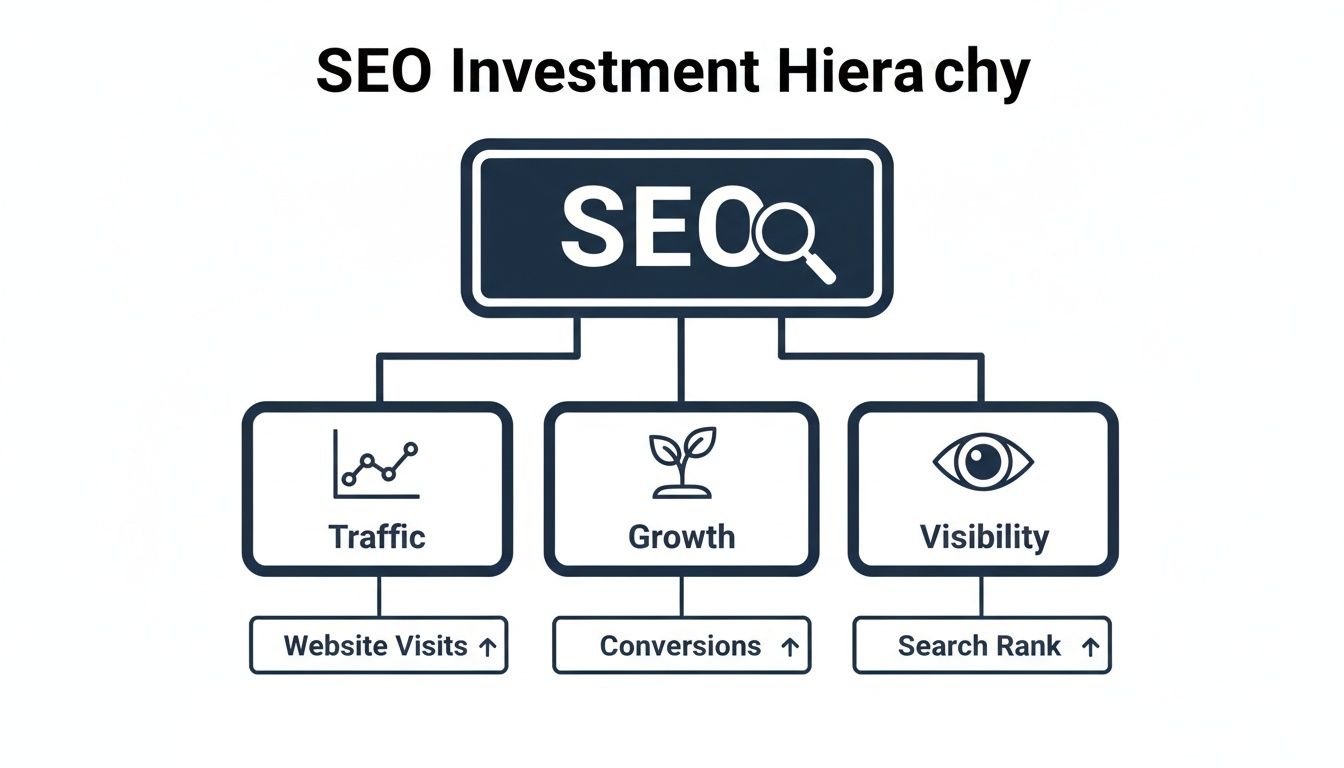
As you can see, strategic SEO isn't just an expense; it's the foundation upon which more traffic, sustainable growth, and dominant market visibility are built.
Growth SEO Packages: Expanding Your Reach
Once your foundation is solid, it's time to start building upwards. A growth package is the next logical step, designed for businesses that have some visibility but are ready to expand their territory, build authority, and grab a bigger piece of the market. It shifts from the basics to more proactive, content-driven strategies.
This package is ideal for a growing retail store looking to compete more aggressively online or a service business that wants to become the go-to expert in its region. To get a real sense of what's out there, it pays to check out detailed SEO package pricing from different providers to see how the value stacks up.
A growth-focused package flips your SEO from a defensive move to an offensive one. You’re no longer just trying to be found; you’re actively shaping what customers think and establishing your brand as an authority.
On top of everything in the foundational plan, a growth package usually adds:
- Ongoing Blog Content Creation: This means regularly publishing high-quality articles that answer your customers' biggest questions. It targets valuable keywords and positions your business as the expert.
- Strategic Local and Niche Link Building: This service is focused on earning backlinks from reputable local and industry-specific websites. These links act as "votes of confidence" that build your site's authority with Google.
- Service Page Optimisation and Creation: As your business expands, you'll need dedicated, highly-optimised landing pages to target new services or customer segments.
- Advanced Performance Analytics and Insights: Reporting gets a lot smarter here. It starts connecting the dots between SEO performance and real business outcomes, like the quality of leads and conversion rates.
Advanced SEO Packages: Dominating Your Market
An advanced package is for established businesses playing in highly competitive arenas. The goal here isn't just to show up; it's to dominate. This tier involves an aggressive, data-driven strategy that integrates multiple marketing channels and focuses on stealing market share from your top competitors. It's a significant investment, often connected to the initial cost for website creation and your broader digital expansion plans.
This is the right fit for national e-commerce brands, B2B companies in cutthroat industries, or any business aiming to be the undisputed leader in its field. The approach is deeply customised and relentless, requiring a true partnership between your business and your SEO agency.
This top-tier plan includes everything from the growth package, plus:
- Aggressive National or E-commerce SEO Strategy: This involves targeting broad, high-volume keywords and optimising for the complexities of large-scale e-commerce platforms.
- High-Authority Digital PR and Link Acquisition: This goes way beyond standard link building. We're talking about securing media mentions and high-value links that give your authority a massive boost.
- Conversion Rate Optimisation (CRO) Analysis: SEO gets the traffic to your door; CRO makes sure they come inside and buy something. It involves analysing user behaviour and tweaking your site to maximise sales.
- Customised Reporting and Strategic Consulting: At this level, you get executive-level reporting and regular strategy sessions to ensure SEO is perfectly aligned with your overarching business objectives.
How SEO Strategy Changes by Industry
A one-size-fits-all approach to SEO is a recipe for wasted marketing spend. A small business SEO package isn't some generic product you pull off a shelf; it has to be a strategic plan that’s moulded to your specific industry, business model, and how your customers behave. The tactics that deliver incredible results for a local plumber in Cairns are worlds apart from what a national e-commerce store in Melbourne needs to succeed.
Getting these distinctions right is everything. While the ultimate goal of SEO is always to connect with customers, how and where those customers are searching for solutions changes dramatically from one sector to another. A strategy that understands your world ensures every dollar is spent wisely, maximising your return.

Local Services and Trades
For businesses like electricians, plumbers, and home service providers, SEO is hyper-local and all about immediacy. Customers are often in a rush, searching on their phones for urgent help.
- Primary Goal: Generate immediate, high-quality leads through phone calls and form submissions. Simple as that.
- Key Strategy: The whole game is built around dominating the Google Map Pack. This means aggressive Google Business Profile (GBP) optimisation, a steady flow of positive reviews, and building local citations to cement your service areas.
- What Matters Most: Keywords are intensely local (think "emergency plumber Gold Coast"), and success isn't measured by website traffic. It’s measured by the phone ringing and appointment bookings.
E-commerce and Retail
Online stores are fighting in a completely different arena. Their battleground is often national, and success hinges on product visibility and a flawless user experience.
- Primary Goal: Drive direct product sales and bump up the average order value.
- Key Strategy: Product SEO is king. This involves optimising potentially thousands of product pages, using structured data (schema markup) to create eye-catching rich snippets in search results, and wrangling complex site structures. Technical SEO for site speed and mobile usability is completely non-negotiable. For a deeper look into this specialisation, you can explore our guide to e-commerce SEO services.
- What Matters Most: Forget vanity metrics. The true indicators of success are things like organic conversion rate, cart abandonment, and keyword rankings for specific product categories.
Professional Services Like Law and Healthcare
For professions like law firms, financial advisors, and healthcare providers, trust and authority are the currency of the realm. Potential clients are making high-stakes decisions and need absolute confidence in your expertise.
- Primary Goal: Build unwavering credibility and generate qualified, high-value client consultations.
- Key Strategy: The focus is on demonstrating expertise, authoritativeness, and trustworthiness (E-E-A-T). You achieve this by creating in-depth, authoritative content like articles and guides, earning high-quality backlinks from reputable industry sources, and proudly showcasing professional credentials and client testimonials.
- What Matters Most: Building a rock-solid digital reputation and ranking for very specific, problem-aware keywords (e.g., "commercial litigation lawyer Sydney") are the key objectives. Success is measured by the quality of client enquiries, not just the raw number.
B2B and Manufacturing
Business-to-business (B2B) companies, including those in mining and manufacturing, face a much longer sales cycle and a more discerning audience of professional buyers.
- Primary Goal: Attract and nurture corporate leads while establishing a reputation as an industry thought leader.
- Key Strategy: SEO here is less about instant transactions and more about education and building relationships. The strategy revolves around content marketing that tackles complex technical problems—think white papers, case studies, and detailed technical guides.
- What Matters Most: Ranking for highly technical, solution-focused keywords is vital. Performance is measured by tracking things like white paper downloads, demo requests, and newsletter sign-ups.
Choosing the right small business SEO package means finding a provider who gets these nuances and can craft a strategy that speaks your industry's language.
How to Measure the Real ROI of Your SEO Package
Measuring the success of a small business SEO package goes way beyond just watching your website traffic numbers climb. Sure, more visitors is a nice start, but it’s a vanity metric if it doesn't translate into actual business growth. The real return on investment (ROI) isn't found in clicks; it’s measured in qualified leads, appointment bookings, phone calls, and—ultimately—more revenue in your bank account.
Focusing on tangible business outcomes is the only way to truly justify your SEO spend. A successful campaign doesn't just pull in a crowd; it attracts the right crowd—people who are actively looking for what you offer and are ready to take the next step. Shifting your perspective this way helps you set clear, realistic expectations with your SEO provider and understand the genuine value they bring to the table.

Key Performance Indicators That Actually Matter
To get a clear picture of your ROI, you need to track the right Key Performance Indicators (KPIs). These are the metrics that connect your SEO efforts directly to your bottom line, showing you exactly how organic search is helping your business grow.
It's time to move past generic traffic reports and zero in on these critical KPIs:
- Organic Conversion Rate: This is the big one. It’s the percentage of visitors from search engines who actually do something valuable, like filling out a contact form or buying a product. A rising conversion rate means your SEO isn't just bringing more people, it's bringing better, more motivated customers. Seeing how your SEO is contributing to goals like improving e-commerce conversion rates is a direct measure of its impact on revenue.
- Lead Quality and Volume: Are you getting more phone calls and form submissions? Great. But more importantly, are they the right kind of enquiries? A solid SEO strategy will boost both the number and the quality of inbound leads.
- Growth in Non-Branded Search Visibility: It's fantastic when people can find you by your business name. But real growth comes from capturing customers who don’t even know you exist yet. Tracking how visible you are for non-branded, high-intent keywords (think "emergency plumber Brisbane") shows that your SEO is genuinely expanding your market reach.
- Keyword Ranking for High-Intent Terms: Keep a close eye on your rankings for keywords that signal a strong intent to buy. Ranking on page one for "commercial electrician near me" is infinitely more valuable than ranking for a broad, informational term that just attracts tyre-kickers.
The Compounding Value of SEO
Here’s something that sets SEO apart from paid advertising: it builds a long-term digital asset for your business. Unlike ads that disappear the second you stop paying, every piece of content you create and every backlink you earn continues to work for you, compounding in value over time.
This creates a sustainable and predictable stream of leads, reducing your reliance on expensive ad spend. Performance data from Australian local SEO studies shows just how effective well-designed small business SEO packages can be. An analysis of 36 Australian businesses revealed that those targeting multiple locations generated a staggering 557% more organic traffic on average than single-location businesses. This highlights the powerful, scalable nature of a strong local SEO foundation.
SEO is the only marketing channel that builds an asset with compounding returns. Each month, you're not just renting visibility like you do with ads; you're building a foundation that will generate leads for years to come.
Understanding this long-term value is crucial. It helps you see that the real ROI of SEO isn't just measured in the first few months but over the entire lifetime of your online presence. For anyone wondering about that initial timeline, our article on how long SEO takes to work provides some valuable context. By focusing on the right metrics and recognising its compounding power, you can confidently measure the true, lasting impact of your SEO investment.
Choosing the Right Australian SEO Provider
Picking a partner to handle your small business SEO is one of an essential marketing decisions you’ll make. Get it right, and they become an extension of your team, driving real growth. Get it wrong, and you can waste your budget and even hurt your website's reputation. It’s so important to look past the monthly fee and properly vet agencies on their strategy, transparency, and ability to actually deliver results.
This whole process is about finding a partner, not just another supplier. A true SEO partner digs in to understand your business goals, the specific challenges in your industry, and what success genuinely looks like for you. They won't just follow a generic checklist; they’ll build a plan focused on hitting your specific targets.
Verifying Experience and Track Record
An agency’s history says a lot. A provider with a long track record in the Australian market gets the local nuances and has survived countless Google algorithm updates. Don't be shy about digging into their background and making them prove their claims.
Start by asking for case studies relevant to your industry. While no two businesses are the same, seeing success stories from companies similar to yours gives you powerful proof of their expertise. Look for case studies that show you the how—the strategy behind the results—not just the final numbers.
Next, it’s time to do your own homework.
- Check Online Reviews: Jump onto third-party platforms like Google and see what past and current clients are saying. You're looking for comments about communication, reporting, and whether the agency actually did what they said they would.
- Request Client References: Ask if you can have a chat with one of their current clients. This is your chance to get an honest, unfiltered view of what the day-to-day relationship is like and how happy they really are.
Understanding Their Strategic Approach
A reputable agency will be an open book about how they work. If a provider is vague, hides behind jargon, or talks about some kind of "secret sauce," that’s a massive red flag. Real SEO expertise isn't about secrets; it's about a clear, logical strategy.
When you're talking to them, ask direct questions about their process.
- How do you actually do keyword research?
- What's your approach to building links?
- How will you measure whether this campaign is successful?
- What do you need from my team to make this work?
Their answers should be straightforward, make sense, and be tied to your business goals. They should be talking about earning high-quality links with valuable content, not just "building" them. And success should be measured in leads and revenue, not just a bump in traffic. For more on what to look for, our guide on the best SEO services in Australia breaks it down even further.
True SEO is a partnership. A good agency will ask you as many questions as you ask them because they need your industry knowledge to build a strategy that actually works.
Reporting and Communication Standards
Clear and consistent communication is the absolute foundation of a successful SEO partnership. You have to know what work is being done, how it’s performing, and what the plan is for the next few months. Before you sign anything, get complete clarity on their reporting and communication standards.
Ask to see a sample monthly report. It should be easy to follow and focused on the Key Performance Indicators (KPIs) that actually matter—things like organic traffic, ranking improvements for keywords that show buying intent, and most importantly, conversions like leads or sales.
Set a clear communication schedule from day one. Will you have a dedicated person to talk to? How often will you have strategy calls? Nailing this down upfront stops frustration later and makes sure you always feel like you’re in control of your investment. A transparent, results-focused provider will welcome this kind of scrutiny.
Common Questions About SEO Packages
Jumping into an SEO package for your small business is a big move, and it’s perfectly normal to have a few questions rattling around. This last section clears up some of the most common queries we get from business owners, giving you straight, simple answers so you can feel confident about the road ahead.
How Long Does It Take to See Results From an SEO Package?
This is the big one, isn't it? Everyone wants to know when they'll see a return. SEO is a long game—it’s all about building sustainable growth, not flipping a switch for overnight traffic.
You can usually expect to see some positive signs, like movement in your rankings and a bit more traffic, within 3 to 6 months. This is when the foundational technical work gets done and the first round of optimisations starts to kick in.
But the results that really impact your bottom line—a steady stream of qualified leads and a noticeable lift in revenue—tend to show up between 6 and 12 months. The exact timing depends on how competitive your industry is, your website's history, and the intensity of the package you've chosen. Patience and consistency are your best friends here.
What Is the Difference Between Local and National SEO?
Getting your head around the difference between local and national SEO is crucial for picking the right strategy. It really just comes down to the geographic scope of your target audience.
A local SEO strategy is non-negotiable for businesses with a physical location or a set service area—think plumbers, cafes, or local law firms. The focus is laser-sharp:
- Owning the Google Map Pack.
- Keeping your Google Business Profile in top shape.
- Building listings in local directories (citations).
- Targeting those "near me" and location-based searches.
On the other hand, a national SEO strategy is built for businesses that serve customers all over Australia, like e-commerce stores or software companies. This approach is a different beast entirely:
- It targets broader, more competitive keywords without a city or suburb attached.
- It demands a much larger volume of content to build authority on a national scale.
- It involves large-scale link-building and digital PR campaigns to get noticed.
Choosing the right focus makes sure your marketing dollars are spent reaching the people most likely to become customers.
Are Long-Term SEO Contracts Always Necessary?
The thought of being locked into a long contract can be a bit daunting for small business owners. While some agencies still push rigid 12-month deals, it’s not the only way, and a bit more flexibility is becoming the norm.
That said, because SEO takes time to deliver a proper return, a commitment of at least 6 months is highly recommended. This gives an agency enough runway to roll out a strategy, collect meaningful data, see what's working, and make adjustments to improve performance.
Shorter gigs, like a 3-month plan, often end just as the real value is about to kick in. The goal should be to find a partner who’s invested in your long-term growth, not just one looking to lock you down.
How Is AI Changing Modern SEO Packages?
The rise of AI is changing the search game, and any modern SEO package worth its salt has to adapt. This isn't some far-off trend; it's happening right now.
Optimising for an AI-powered search world means setting up your content to be the source for answers given by Large Language Models (LLMs) and conversational search.
A forward-thinking agency will already be integrating specific tactics to ensure you show up not just in the classic blue links, but in AI-generated answers too. Key moves include:
- Structuring content for direct answers: Using clear headings and short, sharp paragraphs that get straight to the point of what customers are asking.
- Using schema markup: This gives search engines extra context about your business, services, and products, making it dead simple for AI to understand and feature your info.
- Keeping information consistent: AI pulls data from all over the web to verify facts. Consistency across all your online profiles builds trust.
- Creating high-quality, authoritative content: Positioning your business as a reliable source is one of the biggest signals for AI answer engines.
Investing in a small business SEO package that bakes these modern strategies in is the best way to future-proof your visibility online.
Ready to invest in an SEO package that delivers real, measurable growth for your business? At Titan Blue Australia, we combine over 25 years of experience with forward-thinking strategies to help Australian businesses thrive online. Contact us today for a custom SEO strategy.
Make Titan Blue a preferred source in Google
One click tells Google to surface our articles more often in Top Stories, AI Overviews and AI Mode.

Best Dental Website Design Agencies in Australia: 7 Compared
Best dental website design agencies in Australia 2026: seven compared on dental proof, booking, AHPRA…

Childcare Centre Website Design Australia: The 2026 Guide
Childcare centre website design Australia: show hours, ages and enrolment as text so parents and…

Electrician Website Design Australia: The 2026 Guide
Electrician website design Australia: what to build, what we found on eight Gold Coast electrician…