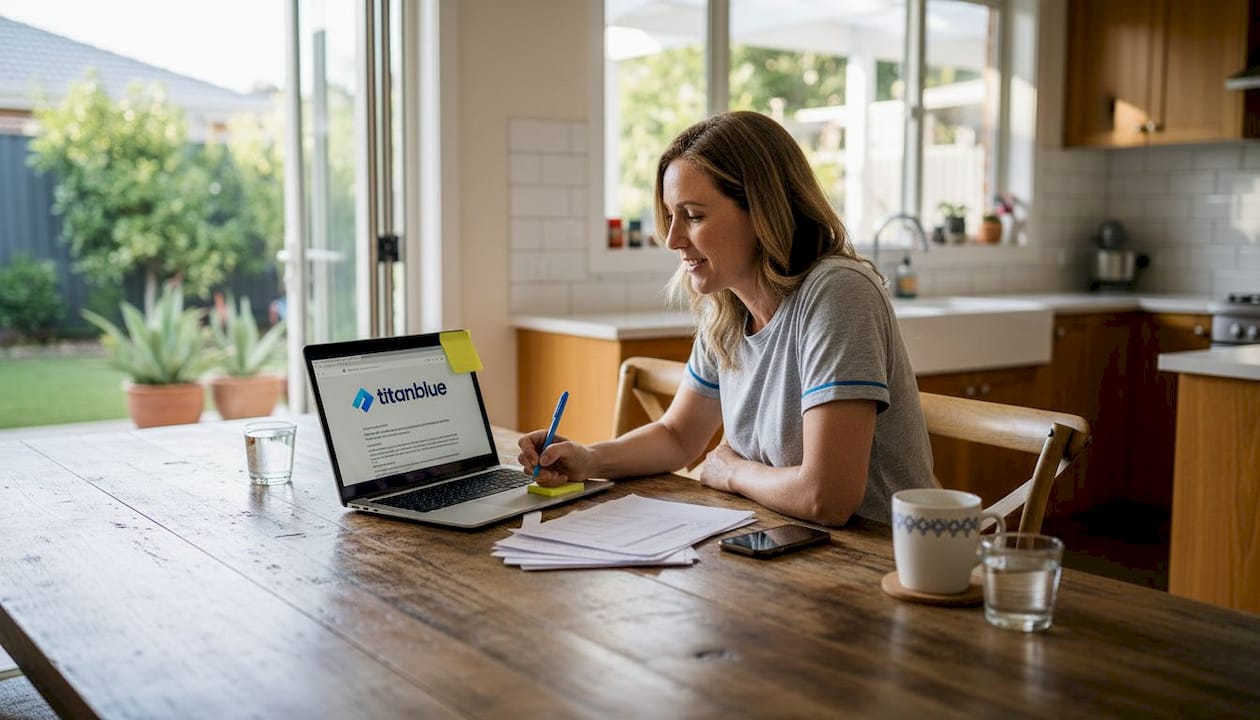
Tradies Website Design: Grow Local Leads with a High-Converting Site
A solid tradies website design is more than just getting your business online. It’s about building a tool that works around the clock to bring in leads, build trust, and make your job easier. Think of it as your hardest-working employee—the one that never calls in sick, answers questions 24/7, and pre-qualifies jobs while you’re out on the tools.
A professional website isn’t just a digital business card; it’s your virtual storefront and your number one sales channel.
Why Your Website Is Your Hardest Working Employee
Let's be real—as a tradie, your time is your money. Every minute spent on the phone with tyre-kickers or answering the same old questions is a minute you're not on the job earning. This is where a strategic website stops being a cost and starts being a core asset that actively makes you money.
For most potential customers, their first impression of your business happens online. Before they even think about picking up the phone, they’re sizing you up, judging your professionalism, reliability, and the quality of your work, all based on your website. An old, clunky, or non-existent site sends all the wrong signals, suggesting you might not be a serious operator.
Building Trust Before The First Call
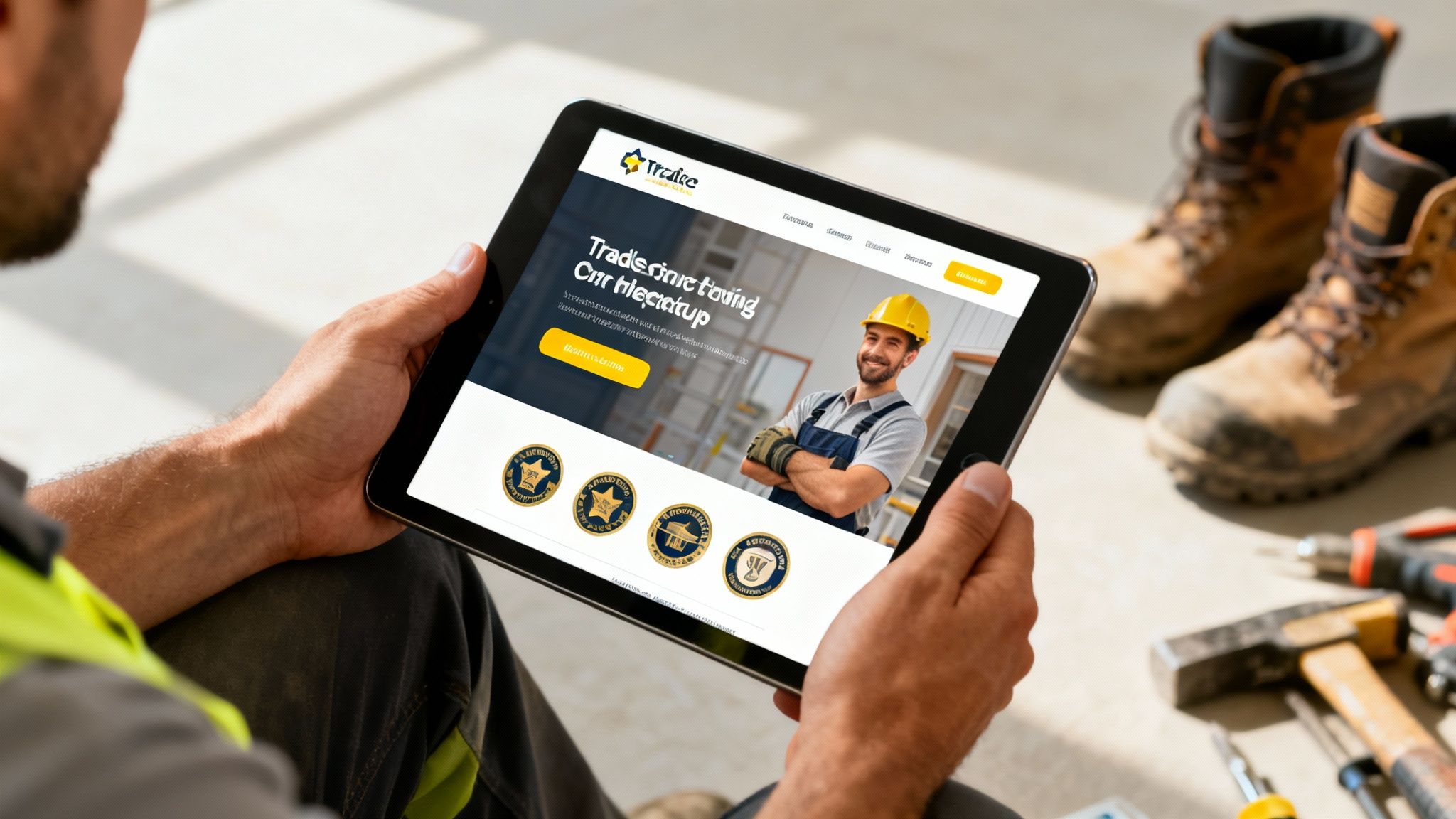
A well-put-together website is your ultimate trust-building machine. It's the perfect spot to show off your licenses, credentials, and insurance details, giving homeowners and commercial clients instant peace of mind. Even better, a gallery of high-quality photos from your completed projects offers real, tangible proof of your skills. You’re not just telling people you do great work; you’re showing them.
A few key things are non-negotiable for building that initial trust:
Clear Contact Information: Don't make people hunt for your phone number, email, or service area. Put it front and centre.
Customer Testimonials: Genuine reviews from happy clients are powerful. They provide the social proof needed to build confidence in your services.
A Professional 'About Us' Story: Share your experience and what makes your business different. It helps you connect with customers on a more human level.
A Lead Generation and Qualification Machine
Your website should do more than just sit there looking pretty; it needs to actively filter and qualify potential jobs for you. A detailed quote request form, for example, can ask all the right questions about a project from the get-go. This simple feature helps weed out the time-wasters and gathers the essential details you need to put together an accurate estimate, saving you countless hours on the phone.
The opportunity here for Aussie tradies is huge. It’s surprising, but in Australia, only 41% of small businesses have a website. That leaves a massive 59% without any online presence at all, even though 75% of consumers prefer to buy from businesses they can find online. This gap is especially wide for tradies, giving a massive head start to anyone who invests in a professional online presence. You can check out more on the current state of web design statistics in Australia.
Laying The Foundation For Your Digital Success
It’s tempting to jump straight into picking colours and fonts, but that’s a rookie mistake. I’ve seen it time and again: a website ends up looking decent but completely fails to bring in any work. A high-performing tradies website design is built on a solid strategy, not just pretty pictures.
Before you even think about the design, you need to nail down exactly what you need the website to do for your business.
Is your main goal to make the phone ring with emergency repair jobs? Or are you chasing more detailed quote requests for big projects? Maybe you’re focused on showcasing high-end, custom work to attract a more premium clientele. Each of these goals demands a completely different approach to the site's layout, content, and overall feel.
Defining Your Website's Core Purpose
Think of your website like another tool in your ute—it needs to be built for a specific job. A site for an emergency plumber, designed to catch frantic homeowners at 2 AM, will look and function very differently from one built for a custom home builder, who needs to nurture a lead over several weeks.
This is where you have to get inside the head of your ideal customer. Are they in a panic over a burst pipe and just need your phone number, right now? Or are they a commercial project manager, carefully vetting subcontractors and needing to see detailed case studies and proof of your capabilities? Understanding their mindset is the key to creating a site that solves their problem and, in turn, achieves your business goals.
Mapping The Ideal Customer Journey
Once you know who you're talking to and what you want them to do, you can map out their ideal path through your website. We call this the customer journey. It’s the logical flow from the moment they land on your site to the second they hit 'send' on a contact form or dial your number.
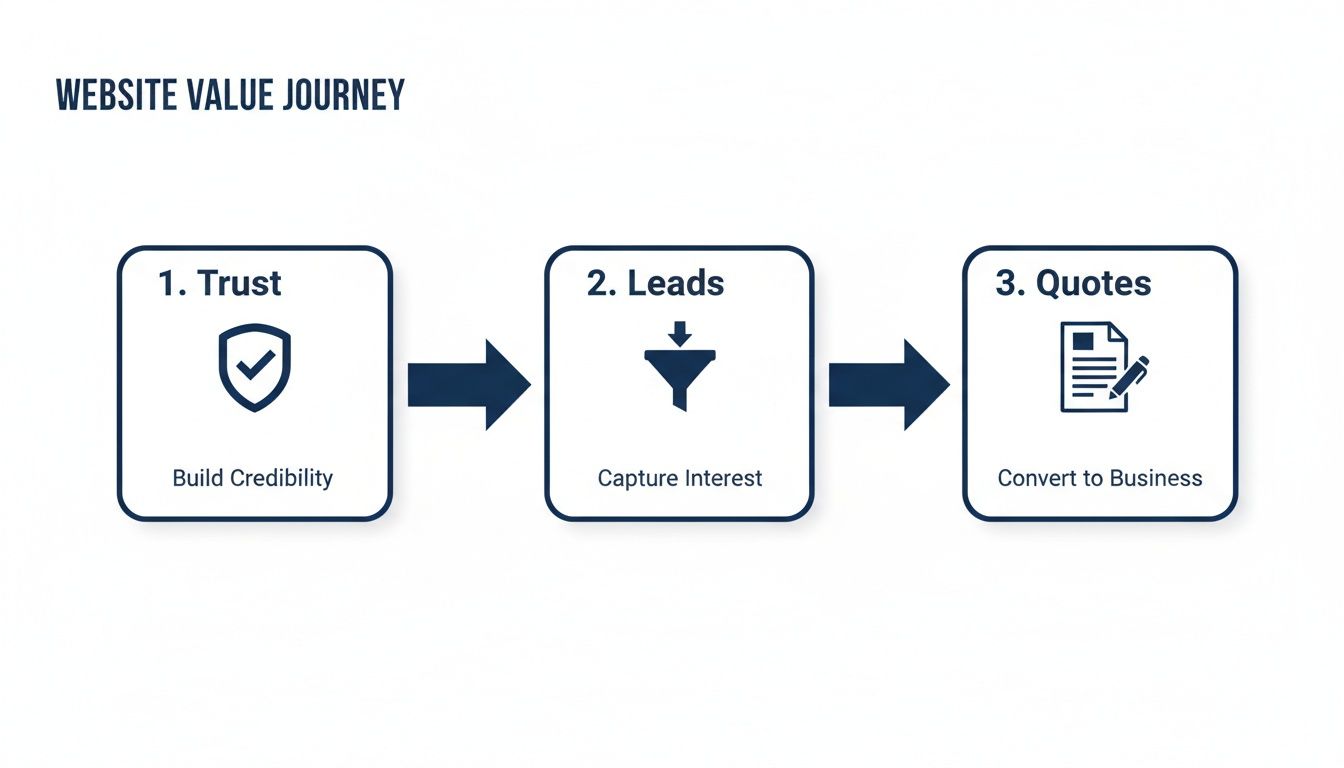
Your website’s job is to guide them seamlessly through this process. It's about turning a casual visitor into a paying customer by first establishing your credibility, then capturing their interest as a lead, and finally, making it dead simple for them to request a quote.
This journey shows that a successful site isn’t just a collection of pages; it’s a conversion machine designed to build trust and generate work. To get this right, you need a clear blueprint. Our comprehensive website planning checklist is a great place to start to make sure you've covered all the essential bases.
Structuring Your Site For Success
With your goal and customer journey locked in, you can start planning the essential pages. While every business is different, a solid tradie website needs a core set of pages to work effectively. It’s also worth getting your head around some general web design principles before you get too deep in the weeds, as they form the backbone of any successful online presence.
Here are the must-have pages that form the foundation of a tradie website that actually gets results.
A Homepage that builds instant trust and points visitors exactly where they need to go.
Detailed Service Pages that clearly explain what you do and, more importantly, the problems you solve.
An 'About Us' Page to share your story and connect with customers on a more personal level.
A Project Gallery or Portfolio to visually prove the quality of your work and expertise.
A Contact Page with multiple ways to get in touch, including a simple form and a phone number that’s impossible to miss.
This strategic groundwork is what separates a digital business card from a lead-generating asset. Getting it right from day one ensures your website is built for one purpose: to grow your business.
Designing A Website That Converts Visitors Into Customers
A sharp-looking website is a great start, but let's be honest—if it isn't making your phone ring or filling your inbox with quote requests, it’s just a digital ornament. When it comes to effective tradies website design, it’s all about one thing: turning a casual visitor into a paying customer.
This means every single page, from your homepage to your portfolio, needs to be built with a clear purpose and a laser focus on getting that next lead. This isn't just about picking colours; it's about getting inside a potential customer's head and guiding them to take action.
Nail The First Impression With Your Homepage
You get maybe three seconds to grab a visitor's attention when they land on your site. That first bit they see without scrolling—what we call 'above the fold'—is your most valuable real estate. It has to instantly answer three crucial questions: who you are, what you do, and why they should trust you.
Get this wrong, and they'll hit the 'back' button before you even get a chance to show them your work.
Here’s what that critical space absolutely must include:
A Clear Headline: Don't get clever; get clear. Something like "Your Reliable Plumber in Broadbeach" works ten times better than a vague marketing slogan.
An Obvious Call-to-Action (CTA): What’s the number one thing you want visitors to do? Make it impossible to miss. A big, bold button like "Request a Free Quote" or "Call Us Now" is perfect.
Trust Signals: Slap your license number, industry logos, or key certifications right up top. It builds instant credibility and tells visitors you’re a pro, not a cowboy.
Craft Service Pages That Solve Problems
So many tradies fall into this trap: they create service pages that are just boring lists of tasks. A page titled "Our Services" with a bullet list of "leaking taps, blocked drains, hot water systems" doesn't sell anything. It doesn't connect with the customer's actual problem.
Instead, you need dedicated pages for each of your core services. Not only is this a massive win for your SEO, but it also lets you speak directly to what the customer is going through.
Think about it. A "Blocked Drain Repairs" page shouldn't just list the service. It should talk about the frustration of a clogged sink, the worry about potential water damage, and how your fast, no-fuss service is the perfect solution. You're reframing what you do from a simple task to a valuable problem-solving exercise.
A well-designed service page doesn't just list what you do; it shows you understand the customer's problem inside and out, positioning your business as the only logical solution. This shift in perspective is what turns browsers into buyers.
Dominate Your Local Area With Location Pages
If you cover multiple suburbs or a whole city, dedicated location pages are an absolute game-changer for local SEO. A page specifically titled "Electrician Gold Coast" or "Carpenter Tweed Heads" screams to Google exactly where you work and helps you show up for those critical "near me" searches.
But don't just copy and paste, swapping out the suburb name. That’s lazy. Customise each page with local testimonials, photos of jobs you’ve done in that area, and maybe even a mention of a local landmark. It proves you're a genuine local operator, not some faceless national company.
Build A Portfolio That Sells
Your portfolio is where the talking stops and the proof begins. It's your chance to show, not just tell, people you do great work. Blurry, poorly-lit phone snaps just won't cut it anymore. Invest in getting some professional photos of your best projects—it will pay for itself.
Each project in your portfolio should be more than a picture; it needs to be a mini-case study.
Project Title: Keep it simple and descriptive (e.g., "Full Bathroom Renovation in Burleigh Heads").
High-Quality Images: Show off your work with plenty of before-and-after shots and detailed close-ups of your craftsmanship.
A Short Story: Write a couple of sentences about the job. What did the client want? What challenges did you solve? How did it turn out?
This storytelling approach helps potential customers see themselves in your work, making it way more likely they'll pick up the phone.
Investing in quality design pays dividends. While basic tradie websites in Western Australia can start at $3,000-$8,000 AUD, custom designs that prioritise mobile-first responsiveness deliver significantly higher returns. This focus is crucial, as 70% of Australian web traffic comes from mobile devices, and top-performing sites see 2-3x higher conversion rates as a result.
Ultimately, designing for conversion means every element on your site has a job to do. To see how these principles tie into a bigger strategy, you can learn more about conversion rate optimisation and how to properly turn more of your visitors into solid leads.
Getting Found With Local SEO And AI Search
Having the best-looking website in the neighbourhood doesn't mean a thing if local customers can't find you when a pipe bursts or the power goes out. A stunning tradies website design that’s invisible on Google is like having a top-of-the-line power tool with a dead battery—completely useless.
This is where local search engine optimisation (SEO) comes in. Think of it as the modern-day version of word-of-mouth, getting your business in front of potential clients at the exact moment they’re searching for your services in your suburb. For a tradie, this isn't just important; it's everything.
Your Google Business Profile Is Your Best Mate
Before you even think about the nitty-gritty of your website's SEO, you need to claim and flesh out your Google Business Profile (GBP). This is that info box that pops up in Google Maps and local search results, showing your business name, address, phone number, hours, and, crucially, your reviews.
It’s your digital shopfront on Google, and it’s completely free. A well-managed profile can drive phone calls and website clicks before a customer ever lands on your actual site.
To really make it work for you, you've got to:
Fill Out Everything: Don't be lazy here. Add your service areas, all your opening hours, a detailed list of every service you offer, and plenty of high-quality photos of your work, your team, and your van.
Get More Reviews: Make it a habit to ask every happy customer to leave you a review. Those positive reviews are one of the strongest signals to both Google and potential clients that you’re a pro they can trust.
Use Google Posts: Regularly share updates, special offers, or photos of your latest jobs using the "Posts" feature. This keeps your profile looking active and tells Google you’re well and truly open for business.
Pivot To The Future With AI And Answer Engine Optimisation
The way people search for tradies is changing, fast. Instead of just typing "plumber Broadbeach," customers are asking their phones and smart speakers specific questions like, "How much does it cost to fix a leaking tap in Broadbeach?" This is where Answer Engine Optimisation (AEO) becomes your secret weapon.
AEO is all about creating content on your website that directly answers these real-world questions. Your website needs to become the ultimate resource for your customers' problems. Creating a blog post or a detailed FAQ page that tackles common questions isn't a 'nice-to-have' anymore—it's essential for showing up in the new AI-powered search results.
This means you need to go beyond a simple list of services. You have to genuinely understand your customers' pain points and address them head-on. If you create audio or video content, like testimonials or how-to guides, get them transcribed. Tools for podcast transcription can turn that audio into keyword-rich text that search engines can easily crawl and rank.
Search engines are becoming answer engines. If your website provides the best, most direct answer to a local customer's question, you'll be the one who gets the call. It's that simple.
The rise of AI search means your content has to be more helpful and direct than ever. It's a massive shift, but getting ahead of it now will pay off big time. You can discover more about Generative Engine Optimisation to get a jump on your competition.
Ultimately, getting found online is a mix of mastering the local SEO basics that work today and preparing for the future of search that's arriving tomorrow.
Managing Your Website Without The Technical Headaches
Building a high-performing website is one thing; keeping it running smoothly is a whole different beast. For many tradies, the technical side of things can feel like a massive headache, but it honestly doesn't have to be. With the right setup, managing your online presence becomes just another part of running the business, not a second job you never signed up for.
I get it. A lot of tradies put off getting a proper website because the tech side feels completely overwhelming. Research backs this up, showing that the biggest roadblocks for small businesses are cost concerns for 34%, not seeing the need for 28%, and a lack of technical know-how for 22% of owners. You can dig into more of these stats about common barriers for small businesses on rockingweb.com.au.
The good news? Modern tools are built to put you in the driver's seat, no computer science degree required.
The Engine Room: Your Domain and Hosting
Let's quickly clear up the two core bits every website needs. Think of your domain name (like yourbusiness.com.au) as your business's street address. It’s the unique spot people type in to find you online. Simple.
Your web hosting is the actual block of land where your website lives. It’s the server space you rent to store all your files, images, and content so anyone on the internet can access them. Choosing good hosting is non-negotiable. Cheap, dodgy hosting means a slow, unreliable website—and that's a dead-certain way to send potential customers running to your competitors.
Take Control With A Content Management System
Gone are the days of calling a web developer and waiting three days just to change a phone number. A Content Management System (CMS) is the user-friendly software that lets you manage your website’s content without ever having to look at a line of code.
For most tradies, WordPress is the undisputed king. Its dashboard is straightforward, making everyday tasks dead simple. It empowers you to:
Upload new project photos straight from your phone right after finishing a job.
Add or tweak service descriptions as your business grows.
Post new customer reviews to build trust and social proof.
Update your contact details or service areas in a couple of minutes.
A good CMS gives you the power to keep your site fresh and relevant, which is exactly what both customers and Google want to see.
Being able to make quick updates yourself isn't just about convenience—it's about being agile. You can instantly show off your best work or adjust your marketing message without delays or extra invoices from a developer.
The Non-Negotiable: Ongoing Maintenance
Just like your tools or your ute, your website needs a regular tune-up to perform at its best and stay secure. Ignoring website maintenance is like never changing the oil in your van. It might run fine for a bit, but you know a costly breakdown is just around the corner.
This is all about protecting your investment. Key tasks include regular software updates, security scans to keep hackers out, and performance checks to make sure your site stays lightning-fast. For a deeper dive into what's involved, you can check out the specifics of a professional website maintenance package.
Your Simple Pre-Launch Checklist
Right before you flick the switch and show your new site to the world, running through a final checklist is an absolute must. This final once-over ensures you make a killer first impression and all your hard work pays off from day one.
Test All Forms and Buttons: Seriously, fill out your own quote form. Does the email actually show up in your inbox? Click every single button, especially the "Call Now" and "Get a Quote" ones.
Check It On Your Phone: Grab your mobile and browse the site. Then borrow someone else's. Does it look good and work perfectly on a smaller screen?
Proofread Everything: Read every word on the site out loud. It sounds silly, but it’s the best way to catch typos and clunky sentences that can make you look unprofessional.
Confirm Your Details: Double-check your phone number, email, and address on every page. It's a small thing, but getting it wrong can cost you jobs.
Your Tradie Website Questions Answered
Building a new website can feel like a massive undertaking, and it's bound to bring up a few questions. It’s a big move for your business, and you want to be damn sure you get it right the first time.
So, let's cut through the jargon and tackle the most common queries we hear from tradies just like you. My goal here is to give you straight, no-nonsense answers to help you make the right call. A proper tradies website design is an investment in your future, so let’s clear the air.
How Much Should I Expect To Pay For A Good Tradie Website?
This is always the first question, and the honest-to-God answer is: it depends. A professional website that actually generates leads isn't just an expense; it's an investment. The best way to think about it is to ask yourself, "How many jobs does this site need to land me to pay for itself?"
You might find a simple, template-based site for a few thousand dollars. But a fully custom design with specific features like quoting calculators or detailed service area maps will naturally cost more. The key isn't the price tag, but the return on investment. A cheap site that brings in zero calls is a lot more expensive than a quality one that keeps your phone ringing off the hook.
The real cost of a website isn't what you pay for it; it's the amount of business you lose by not having one that works. Focus on the value it will bring, not just the initial price.
How Long Does It Take To Build A New Website?
Patience is a virtue, but you’ve got a business to run. A typical website project for a tradie can take anywhere from four to twelve weeks, from our first chat to the day it goes live.
Keep in mind, this timeline is a two-way street. It really depends on a few things:
The complexity of the design: A straightforward five-page site will be much quicker than a beast of a site with dozens of service and location pages.
Your feedback and content: How quickly you can get us your project photos, service details, and feedback on designs plays a huge role.
Special features: If you want to integrate a complex quoting system or a customer login area, that's going to add time to the build.
Having a clear plan from the get-go is the single best way to keep the project on track and avoid dragging it out.
Can I Update The Website Myself After It's Built?
Absolutely—and you should insist on it. Any modern website worth its salt is built on a Content Management System (CMS). We prefer WordPress for good reason. A CMS is specifically designed to let you, the business owner, make simple updates without needing to know a lick of code.
You should be able to log in to a simple dashboard and handle common tasks yourself. This could be updating your business hours, uploading new photos to your gallery, or adding a new testimonial from a happy customer. We always give our clients a quick training session to make sure they feel confident making changes on their own.
What's More Important: SEO Or A Good Design?
That’s a classic question, but it’s a false choice. It's not an "either/or" situation. Think of them as two sides of the same coin—you absolutely need both, and they have to work together.
Here’s how I see it:
Great SEO is what gets potential customers to knock on your digital door. Without it, your brilliant website is just sitting in the dark where no one can find it.
A good design is what convinces them to come inside, trust you, and hire you for the job. It builds your credibility and turns a visitor into a genuine lead.
A successful tradies website design needs a strategic balance of both. One without the other is a recipe for a website that just doesn't deliver results.
Ready to build a website that works as hard as you do? Titan Blue Australia has over 25 years of experience creating high-performance websites for tradies across Australia. Let's talk about growing your business.
Titan Blue is your go-to digital partner for smart, results-driven solutions. We blend strategy, creativity and tech to grow your brand and get real results fast.