Winning Online: A Guide to Web Design for Law Firms
Your law firm’s website is your digital handshake. It’s often the very first impression a potential client gets, and it’s your chance to build credibility and trust before you’ve even had a conversation. A well-crafted site is far more than an online brochure; it’s your firm's most powerful client acquisition tool, directly influencing whether someone picks up the phone to call you or clicks over to a competitor.
Your Digital Handshake: Building Client Trust Online
Think about what happens when a potential client walks into your physical office. The reception area, the way your staff greets them, the overall professional atmosphere—it all sets the tone. It instantly communicates competence, organisation, and trustworthiness.
Your law firm's website does the exact same job, just in the digital world.
For most clients today, your website is the first point of contact. It shapes their perception of your practice in just a few seconds. A polished, professional, and easy-to-navigate site sends a powerful signal of credibility. It tells visitors you’re an established, serious, and detail-oriented firm. This initial interaction is absolutely critical; it lays the foundation of trust a client needs to feel comfortable sharing sensitive legal issues with you.
Why First Impressions Are Critical for Law Firms
The modern client journey almost always starts online. When people face a legal problem, they don't just find one name and make a call. They research, compare, and vet their options thoroughly. This reality puts immense pressure on your website to perform. A clunky, outdated, or confusing site can get your firm disqualified in the blink of an eye.
This is especially true here in Australia, where there’s a noticeable digital divide among legal practices. While most firms have a website, many fail to keep them current and effective. Research shows that while 87% of Australian firms have a website, only about one-third actively maintain it with fresh content.
Considering that 75% of potential clients visit 2-5 law firm websites before ever making contact, an outdated site isn't just a missed opportunity—it's a major liability that sends good leads straight to your competitors.
Your Website as a 27/7 Client Magnet
Beyond just making a great first impression, your website works around the clock as your most dedicated employee. It’s there to answer questions, explain your services, and showcase your expertise to potential clients at any time of day or night. This constant availability is essential for capturing leads whenever they decide to search for help.
To be truly effective, your site needs to perform several key functions without fail:
Educate Visitors: Clearly explain your practice areas in plain English. Focus on the problems you solve for clients, not just the legal terminology.
Build Authority: Show, don't just tell. Demonstrate your firm's expertise through insightful articles, case studies, and professional team profiles that highlight your experience.
Establish Connection: Use authentic photos of your team and genuine client testimonials to humanise your practice. People connect with people, not logos.
Encourage Action: Make it incredibly simple for visitors to take the next step. Prominent phone numbers, straightforward contact forms, and clear calls to action are non-negotiable.
A strategic approach to web design integrates all these elements seamlessly, turning your digital presence from a simple online listing into a robust client generation engine. To see how a powerful website fits into the bigger picture, check out our complete guide on marketing for law firms.
The Blueprint for a High-Converting Legal Website
Turning your firm's website from a simple online brochure into a client-generating powerhouse isn’t about flashy animations or complicated features. It’s about a deliberate, strategic blueprint. Your potential clients are often stressed, short on time, and looking for immediate reassurance. A great legal website prioritises absolute clarity and ease of use, making every visitor feel understood and confident from the moment they land on your page.
This all starts with clean, intuitive navigation. Put yourself in the shoes of a potential client. If they can’t find your practice areas, team profiles, or contact details in a matter of seconds, they’ll simply click away and find a competitor. A well-organised site structure guides them without friction, answering their most pressing questions almost instantly.
The Psychology of Trust in Web Design
Don't underestimate the power of visual cues. Elements like colour, typography, and imagery all send powerful subconscious messages about your firm's credibility. Subdued, professional colour palettes—think classic blues, greys, and crisp whites—evoke a sense of stability and competence. Likewise, clean and highly readable fonts ensure your message is easy to absorb without causing any visual strain.
High-quality, professional imagery is a must. Generic stock photos of gavels or courthouse steps feel impersonal and dated. What really works are authentic headshots of your legal team and photos of your actual office. This simple touch helps to humanise your firm and builds a far more genuine connection with potential clients.
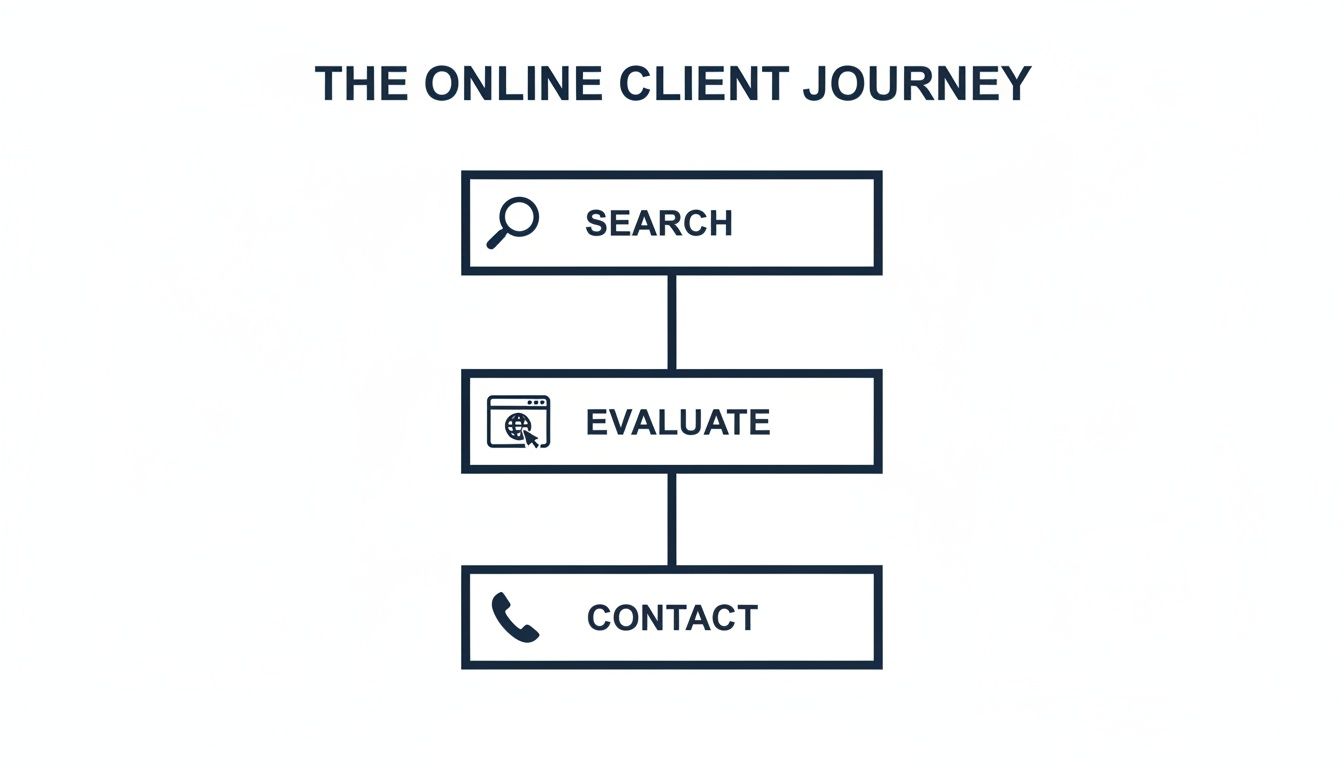
This diagram breaks down the typical online client journey, showing how a user moves from an initial search to evaluating your firm on your website, and finally, to making contact.
As you can see, your website is the critical middle step where a potential client decides whether to trust you. This just underscores how vital it is to have a design that builds that trust and encourages them to take the next step.
Designing for a Mobile-First World
Let's be blunt: the vast majority of your potential clients are now researching legal services on their smartphones. This makes a mobile-first design approach completely non-negotiable. A website that’s a pain to use on a phone—with tiny text, links you can't click, or painfully slow loading times—will send users running and torpedo your search engine rankings.
A mobile-first strategy means your website works flawlessly on every device. It should adapt gracefully to smaller screens, with big, easy-to-tap click-to-call buttons and simple contact forms that someone can fill out on the go. Google heavily favours mobile-friendly sites, so this isn't just a user experience issue—it’s a core part of your SEO success. The right strategy for website development for law firms always puts the mobile experience front and centre.
To build a site that consistently turns visitors into clients, make sure you nail these essential components:
Clear Practice Area Pages You need dedicated pages that explain your services in plain English. Focus on the client's problem and how your firm is the solution. This builds authority and is fantastic for targeted SEO.
Professional 'Our Team' Bios Humanise your firm by showcasing the expertise and personality of your lawyers. Professional photos and well-written profiles build personal connections and trust like nothing else.
Prominent Contact Information and Forms Make it ridiculously easy for potential clients to get in touch. A clear phone number, a simple contact form, and your physical address need to be impossible to miss.
Client Testimonials and Case Studies Nothing builds credibility faster than social proof. Authentic reviews and case studies demonstrating your firm's track record are one of the most powerful tools you have.
Insightful Blog or Resource Centre Establish your firm as an authority by publishing genuinely helpful content that answers common legal questions. This is also a goldmine for your SEO efforts.
Getting Found by the Right Clients with SEO
Having a professional, trustworthy website is a huge first step, but it’s only half the battle. A brilliant website is useless if potential clients—the ones actively searching for your specific legal expertise—can't find it. This is where Search Engine Optimisation (SEO) comes into play.
Think of SEO as the process of building the perfect signposts and clear pathways that lead directly to your digital front door. It’s how you signal to search engines like Google that your firm is the most relevant and authoritative answer for someone searching for legal help in your area.
Without a solid SEO foundation, even the most polished web design remains invisible, lost in the noise of the internet.
The Core of On-Page SEO
On-page SEO refers to all the optimisations you make directly on your website to help it rank higher. It always starts with getting inside the head of your potential clients and understanding what they're actually typing into Google.
Are they searching for a "family lawyer in Brisbane" or a "commercial litigation expert"?
Identifying these specific phrases, known as keywords, is fundamental. Once you know them, the next step is to place them strategically where search engines expect to find them. This includes your page titles, headings, and woven naturally throughout your content. The goal isn't to stuff keywords everywhere, but to make the page’s topic crystal clear to both humans and search algorithms.
For most law firms, clients are local. That makes local SEO an incredibly powerful tool. It’s the practice of optimising your online presence to attract more clients from searches happening right in your backyard. Given that over 46% of all Google searches are from people looking for local information, this is a figure you simply can't ignore.
The heart and soul of local SEO is your Google Business Profile. This free listing is what appears in Google Maps and the "local pack" results at the top of the search page. A fully optimised profile acts as a mini-website right where your clients are looking.
Here are the key elements for an effective Google Business Profile:
Complete and Accurate Information: Your firm’s name, address, phone number, and opening hours must be perfectly consistent everywhere online. Any variation can confuse Google and hurt your ranking.
Strategic Categories: Selecting the correct categories (e.g., "Family Law Attorney," "Criminal Justice Attorney") helps Google understand exactly what services you offer.
Positive Client Reviews: A steady stream of authentic, positive reviews is one of the strongest signals of trust and local authority you can build.
Technical SEO: The Unseen Foundation
Finally, technical SEO forms the bedrock of your entire online presence. These are the behind-the-scenes factors that users might not see, but which are critically important to search engines. Google wants to send its users to websites that are fast, secure, and reliable.
This means your website must load quickly on all devices, especially mobile phones. A slow site is a frustrating experience for users and a major red flag for search engines. It also means your site must be secure, using HTTPS encryption to protect visitor data—something that’s non-negotiable for law firms handling sensitive client information.
Think of it this way: good technical SEO is like having a building with solid foundations, reliable wiring, and secure locks. It signals to Google that your website is a high-quality, trustworthy resource that deserves a top spot in the search results.
Our comprehensive guide to SEO for legal firms offers more detailed strategies for getting these foundational elements right.
Creating Content That Engages and Converts
If your website's design is the structure, its content is the voice. This is the engine that drives your site, turning passive visitors into active, qualified leads. Getting your content strategy right goes way beyond just listing services; it's about proving your expertise, building trust, and showing potential clients you genuinely understand their problems.
Truly effective web design for law firms needs content that connects on a human level. This means crafting compelling practice area pages that speak directly to a client's specific pain points and clearly position your services as the obvious solution.
Crafting Compelling Practice Area Pages
Think of your practice area pages as digital consultations. A potential client landing on your family law page isn't just looking for a menu of services; they're searching for answers and reassurance during what is likely a very stressful time. Your content has to meet them where they are.
Instead of hitting them with dry legal definitions, start by acknowledging their problem. Use empathetic language that shows you get what they're going through. This simple shift immediately builds rapport and makes your firm feel far more approachable.
To make these pages work, focus on these core principles:
Problem-First Approach: Start by describing the client's challenge in their own words. For instance, a commercial litigation page might open with, "Facing a contract dispute that threatens your business?"
Solution-Oriented Language: Clearly explain how your firm's expertise directly solves their problem. Frame your services as benefits, not just features.
Clear Next Steps: End with a strong, unambiguous call to action. Tell them exactly what to do next, whether it’s "Call us for a confidential discussion" or "Complete our form to schedule a consultation."
Humanising Your Firm with Approachable Bios
Clients hire people, not abstract legal entities. Your lawyer bios are a massive opportunity to build a human connection and establish trust long before that first meeting. A bio that only lists academic credentials and professional memberships is a completely missed opportunity.
A great bio tells a story. It should highlight a lawyer's expertise while also revealing their personality and passion for their work. Why did they choose this area of law? What drives them to help their clients? Including a professional yet friendly headshot is non-negotiable.
Studies of legal consumer behaviour show that the "About Us" or lawyer bio page is the most visited section of a firm's website after the practice areas. This highlights just how critical it is for potential clients to feel a personal connection with the solicitor they might hire.
Becoming a Trusted Authority Through Blogging
Your blog or resource centre is where you prove your expertise and generosity. By developing insightful blog posts and legal guides, you answer the real-world questions your potential clients are typing into Google. This strategy positions your firm not just as a service provider, but as a genuinely helpful authority.
Focus on creating content that is actually useful. Think about the common questions you hear during initial consultations and turn them into clear, easy-to-understand articles. For example, a post titled "What Are the First Steps in the Conveyancing Process in Queensland?" can attract highly relevant traffic.
The key is to ditch the dense legal jargon. Write in plain English. Your goal is to make complex topics understandable and accessible, which empowers potential clients and builds immense trust. When you provide value upfront without asking for anything in return, you make it so much more likely they’ll reach out when they're ready to act. For a deeper look into building this kind of authority, explore our insights on content marketing for law firms.
Upholding Your Ethical and Technical Duties Online
For any law firm, a website is far more than just a digital brochure; it's a direct extension of your professional practice. When you operate online in Australia, you're bound by the same non-negotiable duties and high standards you uphold in the courtroom. Your digital presence must be a fortress of integrity, compliance, and security.
This means every claim you make, every service you describe, and every piece of advice you offer must strictly follow legal advertising guidelines and professional conduct rules. Any ambiguous statements or exaggerated claims can do more than just damage your reputation—they can put you in breach of your professional ethics. Those necessary disclaimers aren't just fine print; they're an essential part of responsible online communication.
Creating an Accessible Digital Front Door
Beyond the black-and-white rules of compliance, there's a profound ethical duty to make sure your website is accessible to everyone, including people with disabilities. Web accessibility isn't some optional extra you can bolt on later. It's a fundamental part of inclusive design that ensures every potential client can access your information and services. Frankly, it's both a moral imperative and a smart business decision that opens your firm to a much wider community.
So, what does an accessible website actually look like? It's about considering a whole range of user needs. For visually impaired users, the site needs to play nicely with screen readers, which vocalise the text on a page. This means using proper heading structures and providing text alternatives for all your images. For users with mobility impairments, the entire site must be navigable using only a keyboard, without ever needing to touch a mouse. Finally, for users with hearing impairments, any video content you post absolutely must include accurate captions or transcripts.
Making these adjustments doesn't just tick an ethical box; it also improves the overall user experience for everyone and can give your SEO a nice little boost.
Fortifying Your Digital Practice with Cybersecurity
In an age where digital threats are constantly evolving, robust cybersecurity is non-negotiable for a law firm. The entire solicitor-client relationship is built on a foundation of confidentiality, and your website has a critical role in protecting that sacred trust. Every single piece of data a potential client submits through a contact form is sensitive information that must be shielded.
This is where the technical safeguards come in. Implementing HTTPS encryption is the absolute baseline for security. It ensures all data transferred between a visitor's browser and your website is secure and private, stopping it from being intercepted by malicious actors. Secure online forms are just as vital for protecting those initial client enquiries.
Of course, your website is only one piece of the puzzle. The underlying IT infrastructure is paramount. For a deeper dive into the essential IT solutions for law firms that bolster both security and efficiency, there are some great expert resources out there. Remember, failing to secure your digital assets not only exposes your clients to risk but also jeopardises your firm's reputation and operational integrity. A single breach can undo years of trust-building in an instant.
Measuring Your Website's Performance and ROI
A great website is an investment, not an expense. But how do you actually know if that investment is paying off? The only way is to move beyond guesswork and start tracking tangible results that draw a straight line from your online presence to your firm's bottom line.
Measuring your website’s performance isn't about getting bogged down in complicated spreadsheets. It’s about zeroing in on a handful of key metrics that tell a clear story about what’s working and what isn’t. By tracking the right data, you can directly calculate your return on investment (ROI) and make smarter decisions about where to put your marketing dollars.
Key Performance Indicators for Law Firms
Instead of getting lost tracking every single click, smart firms focus on the actions that signal a genuine new client inquiry. These are the metrics that really matter, and you can track them easily with free tools like Google Analytics.
Here are the essential performance indicators to keep an eye on:
Form Submissions: This is your most direct metric. Tracking how many potential clients fill out your contact or consultation request forms tells you exactly how many leads your website is generating.
Click-to-Call Conversions: A huge chunk of your visitors will be on a mobile phone. Measuring how many of them tap your phone number to call the office is a crucial indicator of your mobile performance.
Search Engine Rankings: You need to monitor your position on Google for your most important keywords, like "family lawyer Sydney" or "commercial litigation Melbourne." A rising rank means more visibility and, ultimately, more traffic.
Focusing on these specific outcomes lets you see exactly how your web design for law firms translates into real business opportunities. For those ready to go a step further, understanding the principles of Conversion Rate Optimisation can help you turn more of those website visitors into qualified leads.
Budgeting for a Professional Website
Getting a handle on the costs of professional web design helps you make a strategic financial decision. It’s not just about getting a site online; it's about investing in a high-performance asset built specifically for client acquisition.
In Australia, the financial investment in a law firm website typically ranges from $8,000 to $25,000. The final figure depends on factors like the complexity of the design, the size of your practice, and whether you need advanced features like secure client portals or document-sharing functions. This is a strategic investment, especially when you consider that 75% of potential clients look at multiple firm websites before ever making contact. You can discover more insights about how Australian firms are budgeting for their websites on sparkinteract.com.au.
By tracking just a handful of key metrics, you can directly attribute new cases and revenue back to your website. This transforms your site from a perceived cost into a measurable, profit-generating part of your practice.
Ultimately, measuring performance empowers your firm. It gives you the clarity needed to justify the investment and proves that a well-designed website isn’t just a digital brochure—it’s one of the most powerful and reliable client generation tools you have.
Got Questions About Your Firm's Website?
Building a new website for your law firm can feel like a big undertaking, and it’s only natural to have a few questions before you dive in. We hear the same queries from firms all the time, so we've put together some straight answers to help you move forward with confidence.
Let's clear up the common sticking points around timelines, costs, and what happens after the website goes live.
How Long Does It Take to Build a New Law Firm Website?
From the first conversation to launch day, a professional law firm website typically takes between 8 to 16 weeks. The final timeline really comes down to the scale of the project.
A simple, clean website for a solo practitioner might land on the quicker end of that timeframe. On the other hand, a larger firm with multiple practice areas, custom features, and a dozen lawyers needing profiles will naturally require more time for strategy, design, and development. The biggest factor, though? How quickly your team can provide feedback and content along the way.
Can We Update the Website Ourselves Afterwards?
Yes, absolutely. We build modern websites on user-friendly platforms like WordPress, which are designed specifically for people who aren't developers.
You'll be able to add new blog posts, update your team's bios, or change the text on a practice area page without touching a single line of code. Any decent digital agency will walk you through the backend and provide training so your team feels completely comfortable making day-to-day updates.
Should We Focus on Website Design or SEO?
This is a classic question, but it sets up a false choice. The two are completely intertwined—you can't have one without the other if you want real results. Great SEO gets the right people to your website, but a terrible design will make them leave in seconds.
A beautifully designed website that nobody can find is a wasted investment. So is a site that ranks well but offers such a clunky, untrustworthy experience that it scares potential clients away.
The only effective approach is to weave SEO into the web design for law firms process from the very beginning. This ensures your site isn't just built to rank in Google, but is also designed to give visitors the seamless, professional experience they expect, turning that hard-won traffic into actual enquiries.
Ready to build a website that doesn't just look the part, but actively grows your practice? The team at Titan Blue Australia has spent over 25 years creating high-performing websites for Australian law firms. Let's talk about your firm's goals and build a site that becomes your most valuable client acquisition tool. Get in touch with us today.
Titan Blue is your go-to digital partner for smart, results-driven solutions. We blend strategy, creativity and tech to grow your brand and get real results fast.