


Last updated:
Website content writing is the whole process of planning, creating, and publishing the words on your website. We’re talking about everything from your homepage and service pages to blog posts and product descriptions—all of it crafted to hook visitors and get you found on search engines like Google.
Why Website Content Is Your Most Valuable Asset
In the past, a website was little more than a digital brochure. These days, it’s a dynamic sales tool, a brand storyteller, and your hardest-working employee. And website content writing is the fuel that makes it all run. Forget thinking of it as filler text; high-quality content is the foundation for everything you do online, from building genuine customer trust to driving real business growth.
Strategic content doesn’t just fill a page. It guides visitors from being casual browsers to becoming loyal customers. It gets ahead of their questions, solves their problems, and positions your brand as the only logical solution. This is especially true for Australian businesses trying to connect with a local audience—whether you’re a Gold Coast restaurant showing off your menu or a national mining corporation explaining complex services.
The Foundation of Digital Success
Effective content is the very core of your entire marketing strategy. Without compelling words, even the most beautiful website design will fall flat and fail to convert.
Think of it this way: design attracts the eye, but it’s the content that captures the mind and heart.
Here’s why it’s so critical:
- It Builds Authority and Trust: Well-researched, expertly written content shows you know your stuff, establishing credibility in your field.
- It Drives Search Engine Optimisation (SEO): Search engines are built to reward useful, relevant content. That means strong writing is non-negotiable for visibility.
- It Connects With Your Audience: Great content speaks directly to your ideal customer’s needs and pain points, building a genuine connection.
Connecting with a Digital-First Australia
The need for strong content is even more pronounced in Australia's highly connected market. With 97.1% of our 26.1 million population online, businesses have to work harder than ever to cut through the noise.
In fact, 74% of Australian businesses now have a documented content marketing strategy, which shows a clear shift towards prioritising quality writing to grab and hold attention. Professionally crafted website content is no longer a 'nice-to-have' for local businesses in retail, trades, and professional services—it's essential for boosting visibility and climbing the search rankings.
To see how your business can benefit, check out our expert website and content writing services for more details.
Building Your Content Strategy From The Ground Up
Great website content doesn't just happen. It's the end result of a deliberate, well-thought-out strategy. Before a single word gets written, you need a solid blueprint that guides every headline, every blog post, and every call to action. This plan is what turns content from just filling space into an engine that attracts your ideal audience and hits real business goals.
Diving straight into writing without a strategy is like starting a construction project without architectural plans. You might put something up, sure, but it won't be functional, sturdy, or built to last. A clear plan is what separates content that gets lost in the noise from content that actually delivers results.
Honestly, this initial planning is the most important part of the whole process. It dictates your messaging, pinpoints exactly who you're talking to, and clarifies what you want them to do next.
Defining Your Content Goals
First things first, you need to know what success actually looks like. Vague goals like "get more traffic" are useless. You need targets that are specific, measurable, and tied directly to your business's bottom line. What do you really want your website content to do for you?
Let’s look at some real-world examples for different Aussie businesses:
- For a Gold Coast Restaurant: The primary goal might be to boost online table bookings by 20% in the next three months. This would be driven by mouth-watering menu descriptions and a dead-simple reservation page.
- For a Law Firm in Queensland: Success could mean generating 15 qualified leads each month from people looking for specific legal help, funnelled through authoritative articles and detailed service pages.
- For a Tradesperson in Sydney: The objective could be to lock in 10 quote requests a week by showcasing finished projects with detailed case studies and easy-to-find contact forms.
When you have clear targets like these, you can properly measure your return on investment and prove the value of your website content. It stops being an expense and becomes one of your most powerful business assets.
Creating Detailed Customer Personas
You can't write content that truly connects if you have no idea who you're writing for. This is where customer personas are invaluable. A persona is essentially a character sketch of your ideal customer, pieced together from market research and real data about the people you already serve.
Go deeper than just basic demographics. A genuinely useful persona gets into the nitty-gritty—their goals, their daily challenges, and what truly motivates them. This is how you create content that doesn't just inform, but resonates.
Let's cook up a persona for a high-end fashion retailer in Melbourne:
Persona Name: "Fashion-Forward Fiona"
- Background: She's a 32-year-old marketing manager living in South Yarra. She’s all about quality, sustainability, and unique designs—fast fashion is not her thing.
- Goals: She wants to build a timeless wardrobe with pieces that work for her professional life but also reflect her personal style. Supporting local and ethical Australian designers is a huge plus.
- Challenges: Fiona is short on time, making it tough to discover new brands that fit her values. She’s tired of generic online stores and craves a more personalised shopping experience.
With Fiona in mind, the retailer’s content can now shift. Instead of boring product descriptions, they can create stories that highlight the craftsmanship, ethical sourcing, and unique style of each piece. This speaks directly to what Fiona cares about and builds a far stronger connection. Taking the time to develop detailed personas is one of the smartest content marketing best practices you can follow.
This visual shows how a solid strategy is the foundation for building trust and, eventually, winning loyal customers.
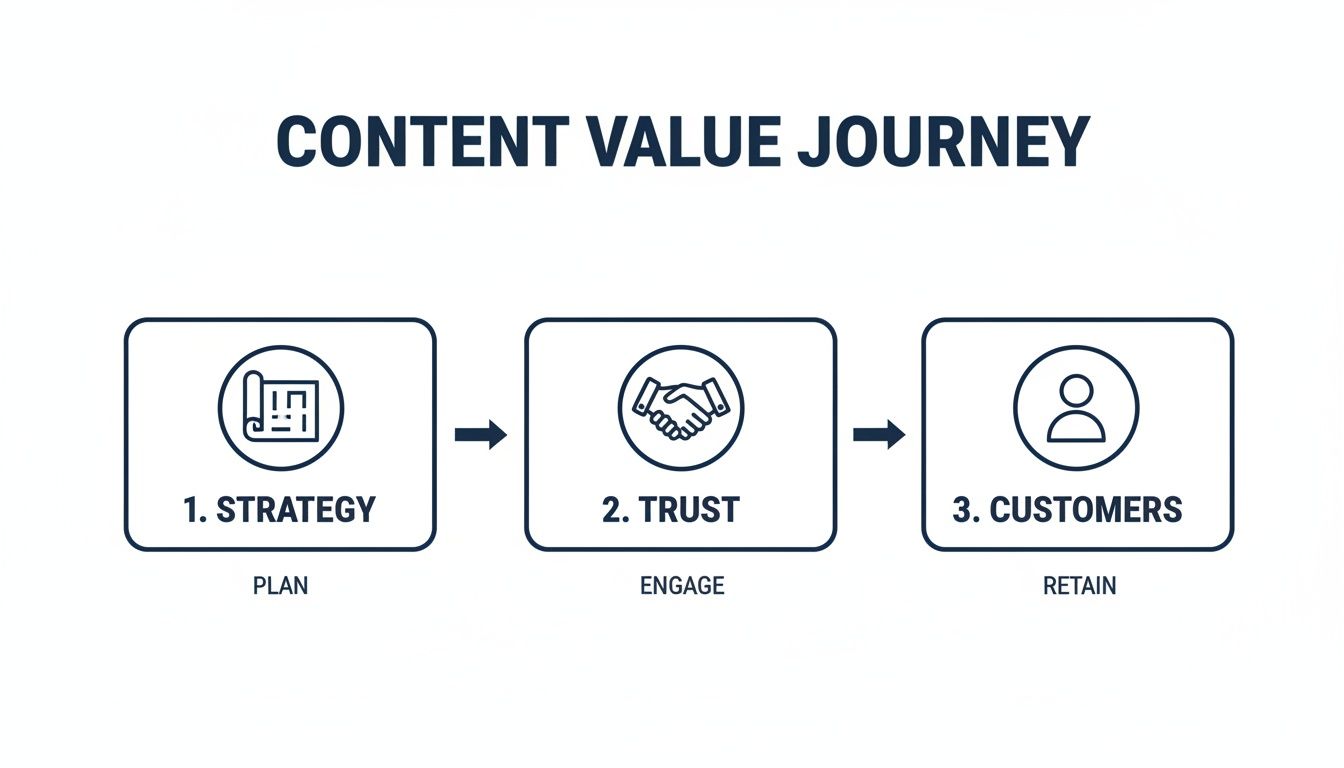
As you can see, that thoughtful planning phase is the non-negotiable first step. It’s what leads to meaningful, long-term customer relationships.
Mapping Content To The Customer Journey
Finally, your content needs to meet people where they are. A potential customer goes through several stages before they’re ready to buy, and your strategy needs to account for that. This is the customer journey, typically broken down into three phases: awareness, consideration, and decision. Each stage needs a different type of content to be effective.
If you want a deeper dive into these fundamentals, understanding what a content marketing strategy truly is can give you a comprehensive framework for your website.
Let's map this out for a manufacturing company to see how it works in practice:
- Awareness Stage: At this point, the customer has a problem but might not have a name for it yet. Your job is to educate. Think helpful blog posts like "5 Signs Your Production Line Is Inefficient" or "How to Cut Down on Material Waste in Manufacturing."
- Consideration Stage: Now, the customer is actively researching solutions. Your content should position you as an expert and help them compare their options. This is the perfect place for detailed case studies, downloadable guides comparing different types of machinery, or service pages that break down your unique process.
- Decision Stage: The customer is ready to pull the trigger. Your content here needs to build trust and make it incredibly easy for them to choose you. Customer testimonials, transparent pricing pages, and a simple "Request a Consultation" form work wonders at this stage.
By aligning your content with the customer journey, you make sure every single page on your site has a clear purpose. It guides visitors smoothly from one step to the next, making the entire process feel natural and helpful.
Structuring Content for People and Search Engines

You can write the most brilliant content in the world, but if it’s impossible to read or find, it’s useless. A solid structure is the bridge between your great ideas and your audience, making sure your message lands with both human readers and search engine crawlers.
Forget intimidating walls of text. The real goal here is to create an experience that feels effortless and inviting from the moment someone lands on your page.
Good website content is as much about architecture as it is about words. How you organise information directly impacts whether a visitor stays to learn more or clicks away in frustration. It all comes down to using simple but powerful tools like smart headings, short paragraphs, and strategic formatting to guide them through the page.
The Power of Scannable Content
Let’s be honest: people don’t read websites word-for-word, at least not at first. They scan. They’re looking for keywords, headings, and key phrases that scream, "You're in the right place!" In fact, studies show that most users will leave a web page in just 10–20 seconds. The only thing that keeps them around longer is a clear value proposition.
Your job is to make that value immediately obvious, and scannability is your greatest ally in doing this.
By breaking your content into digestible chunks, you’re catering to this natural behaviour. It’s a way of respecting your reader's time, making your information far more accessible and, ultimately, more persuasive. The easier it is for them to find what they need, the longer they'll stick around.
Building Blocks of a Great Page Structure
Creating a well-structured page isn't rocket science. It’s about using standard web conventions to create a clear visual hierarchy. This hierarchy guides the reader's eye down the page, highlighting the most important information along the way.
Here are the core components you need to master:
- Clear Headings and Subheadings (H2s, H3s): Think of these as signposts. An H2 introduces the main topic, while H3s break that topic into smaller, related points. They make your content a breeze to navigate for both readers and search engines.
- Extremely Short Paragraphs: This is non-negotiable. Keep paragraphs to a maximum of one to three sentences. This creates essential white space, making the text feel less dense and much easier to read on any screen, especially mobile.
- Bullet Points and Numbered Lists: When you have a series of related items, like benefits, features, or steps in a process, lists are perfect. They slice through blocks of text and present information in a highly scannable format that people can absorb at a glance.
This combination of elements creates a rhythm that keeps readers engaged and moving through your content. Learning more about what is user experience design is a great next step, as it shows how these structural pieces fit into the bigger picture of a positive digital journey.
Real-World Examples for Aussie Businesses
Theory is one thing, but seeing structure in action is far more useful. Let’s apply these principles to a couple of common industries to see how a thoughtful layout can build authority and drive action.
Example One: A Law Firm's Service Page
Imagine a Brisbane law firm wants to create a service page for "Family Law." A dense wall of text detailing legal statutes will send potential clients running for the hills. A structured approach, on the other hand, builds trust and clarity right away.
- H2 Title: Expert Family Law Services in Brisbane
- Opening Paragraph: A short, empathetic paragraph that acknowledges the reader's difficult situation.
- H3 Subheading: How We Can Help You
- Bullet Points:
- Divorce and Separation Agreements
- Child Custody and Parenting Plans
- Property and Financial Settlements
- Binding Financial Agreements (Prenups)
- H3 Subheading: Our Approach to Family Law
- Numbered List:
- Initial Consultation: We listen to understand your unique circumstances.
- Strategic Advice: We provide clear, practical guidance on your legal options.
- Negotiation and Mediation: We prioritise amicable resolutions to minimise stress and cost.
- Court Representation: We offer strong representation if litigation becomes necessary.
- Call to Action: A clear, final section with contact details and a form.
This structure instantly communicates expertise and process. A potential client can quickly see if the firm handles their specific issue and understands exactly what to expect, turning a complex service into an accessible solution.
Example Two: A Tradesperson's Project Page
Now, picture a Gold Coast builder showcasing a recent renovation. They need to demonstrate their skill and professionalism to win over new clients.
- H2 Title: Modern Kitchen Renovation in Broadbeach
- Opening Paragraph: Briefly describe the client's goal (e.g., "to create an open-plan entertainer's kitchen").
- H3 Subheading: Project Scope and Key Features
- Bullet Points:
- Custom cabinetry with stone benchtops
- Installation of a large island bench
- New timber flooring throughout
- Energy-efficient LED lighting
- H3 Subheading: The Transformation Process
- Short Paragraphs: Use "before" and "after" photos, with brief captions explaining the work done at each stage.
- Client Testimonial: A powerful quote from the happy homeowner.
This layout does more than just show a finished product; it tells a compelling story of transformation and competence. By structuring the content logically, the builder showcases their expertise and the value they deliver, making it far easier for a prospective client to trust them with their own home.
Writing Compelling Copy That Actually Converts
With a solid structure mapped out, it's time to get down to the words themselves. This is where sharp website content writing works its magic, turning a passive visitor into an active customer. It’s the difference between just telling people what you do and actually persuading them to take the next step.
Good copy doesn't read like a hard sell. It feels more like a helpful conversation, guiding your reader towards a solution that solves a real problem for them. Every sentence is a chance to build trust and show your value.
Grabbing Attention With Irresistible Headlines
Your headline is your first—and sometimes only—shot at making an impression. It has to do all the heavy lifting, stopping someone mid-scroll and convincing them to stick around.
A great headline speaks directly to a reader's pain point or desire. It promises a clear benefit or sparks just enough curiosity to make it impossible not to read on. So often, I see businesses use vague or overly clever headlines that fall flat because they don't instantly communicate what's in it for the reader.
For example, a law firm might be tempted to go with something like "Legal Excellence You Can Trust." It sounds professional, sure, but it's also completely generic. A far more compelling alternative? "Get a Fair Property Settlement Without the Courtroom Drama." Now that hits on a specific pain point and offers a genuinely desirable outcome.
Hooking Readers in the First Paragraph
Once the headline has done its job, your opening paragraph needs to deliver on that promise. This is where you have to reel the reader in and convince them they've landed in the right place.
The best opening lines usually do one of three things:
- Empathise with a problem: Show them you understand their frustration. A plumber’s website could kick off with, "Tired of unreliable quotes and messy job sites? We get it."
- Ask a direct question: Engage them straight away with a question they're probably already asking themselves. A clothing store could open with, "Struggling to find jeans that actually fit and feel amazing?"
- State a surprising fact: Catch their attention with an unexpected statistic or insight relevant to their needs.
The goal is to create an immediate connection. That initial rapport is what keeps them on the page, eager to find out how you can help.
Mastering the AIDA Model for Conversions
One of the most durable frameworks for persuasive writing is the AIDA model. It’s a simple, four-step structure that guides a reader from their first glance all the way to taking action.
AIDA is an acronym for:
- Attention: Snag their attention with that powerful headline and compelling hook we just covered.
- Interest: Now that you have their attention, build on it with interesting, relevant details. This is where you can highlight key features or dig deeper into the problem you solve.
- Desire: Here’s the crucial shift from building interest to creating a real want for your product or service. You do this by zeroing in on the benefits and painting a picture of how their life or business will be better.
- Action: Finally, tell them exactly what to do next. Your call to action (CTA) needs to be crystal clear and compelling. Don't be subtle; make it obvious and easy.
Applying the AIDA model ensures your content has a logical, persuasive flow. It methodically builds the case for your solution, so when you get to the call to action, it feels like the most natural next step, not an abrupt sales pitch.
A Practical AIDA Example for a Restaurant
Let’s put this into practice for a Gold Coast restaurant promoting a new seasonal tasting menu.
- Attention (Headline): Experience the Taste of Summer on the Gold Coast
- Interest (Body Copy): "Forget the ordinary. Our new summer tasting menu is a celebration of the region's freshest local produce, from Mooloolaba prawns to Bangalow pork, all sourced this week."
- Desire (Benefits): "Imagine a five-course journey where each dish is expertly paired with a boutique Australian wine, all while you enjoy stunning waterfront views. It’s more than a meal; it’s an unforgettable evening."
- Action (CTA): "Our summer menu is only available for a limited time. Book Your Table Now to secure your spot."
This simple formula works for any industry, whether you’re a fashion retailer describing a new collection or an IT company detailing its managed services. It’s a fundamental part of what’s known as conversion rate optimisation, a process where every element on a page is fine-tuned to encourage visitors to take that all-important next step.
Optimising Content for SEO and AI Discovery

Writing brilliant content is only half the battle. If no one can find it, does it even exist? This is where the technical side of website content writing comes into play, ensuring your hard work actually gets in front of the right people on search engines like Google.
This whole process is called on-page SEO. It’s not about trying to trick algorithms; it’s about making your content incredibly clear, accessible, and authoritative for both real people and the search engine crawlers indexing the web. But the game has changed. We’re not just optimising for traditional search anymore—we’re also setting you up for the new frontier: AI and Large Language Models (LLMs).
Mastering the Fundamentals of On-Page SEO
On-page SEO covers all the optimisations you make directly on your website to help it rank higher. Think of these elements as signposts that tell Google exactly what your page is about and why it’s the best answer for someone's search query.
If you skip these foundational pieces, even the most amazing content can get completely lost in the digital noise.
Here are the absolute non-negotiables you need to nail:
- Title Tags: This is your clickable headline in the search results. It has to grab attention, include your main keyword, and stay under 60 characters so it doesn’t get awkwardly cut off.
- Meta Descriptions: That little blurb under the title tag is your sales pitch. While it doesn't directly influence rankings, a compelling meta description can make a massive difference to your click-through rates.
- Image Alt Text: This text describes an image for search engines and for users with visual impairments. Always write descriptive alt text, and if it feels natural, include relevant keywords.
- Internal Linking: Linking to other relevant pages on your site helps search engines map out your website's structure and spreads authority from one page to another. For more on this, check out these actionable SEO content writing tips.
These technical details are the bedrock of visibility. Neglecting them is like writing a brilliant book but forgetting to put a title on the cover—no one will know to open it.
Preparing Your Content for AI and LLM Discovery
The way people find information is shifting right under our feet. They're no longer just typing keywords into a search bar; they’re asking conversational questions to AI assistants and getting direct answers. Your content needs to be ready for this change.
Optimising for AI discovery means structuring your content so it provides direct, natural answers. Think about the questions your customers ask every day. A Queensland tradesperson might get asked, "What are the benefits of a metal roof in Queensland?" Your content should answer that question clearly and straight to the point.
This approach is the core of what’s now called Generative Engine Optimisation. You can learn more about getting ready for the future of search with our guide on Generative Engine Optimisation. By using conversational language and providing direct answers, you position your content to be picked up by LLMs and featured in a whole new kind of search result.
The Role of AI in Content Creation
The rise of AI tools has also completely reshaped how we create content. Australia’s content marketing scene is a perfect example of this. A staggering 85.1% of marketers are now using AI for tasks like creating blog and website copy, with many saying it automates up to 68% of their repetitive work.
This is a huge deal for businesses like retailers or manufacturers who need to pump out product descriptions at scale. For Gold Coast restaurants or even national mining companies, adopting this tech can lead to 28% higher search rankings when the content is consistently published and properly reviewed. You can dig into these trends and what they mean for Aussie businesses by reading the full research about blogging statistics.
But let's be clear: AI should be your assistant, not your replacement.
Use AI to:
- Brainstorm Ideas: Get a hand with generating outlines, different headline options, or new angles for a topic.
- Conduct Research: Quickly summarise dense reports or pull out relevant statistics.
- Refine Drafts: Clean up grammar, adjust the tone, and improve clarity.
The critical human touch is still irreplaceable. You need a strategist to set the goals, understand your audience’s subtle needs, and make sure every piece of content perfectly reflects your brand’s voice. AI boosts efficiency, but it’s the human oversight and strategy that turn good content into game-changing results.
Common Questions About Website Content Writing
Even with the best strategy in place, you’re bound to hit a few roadblocks or have questions pop up. It happens to everyone. This last section is all about tackling the most common queries we get from business owners and marketers, with clear, no-nonsense answers to keep you moving forward.
Think of it as your go-to guide for those "am I doing this right?" moments.
How Long Should My Website Content Be?
This is the big one, the question we hear almost daily. And the most honest answer is this: it really depends on what the page is trying to achieve. There's no one-size-fits-all word count, but there are some solid guidelines we've seen work time and time again.
- Homepage: Your homepage is your digital handshake. It needs to be concise and impactful. Aim for around 400-600 words to get your value across, point people in the right direction, and avoid overwhelming them right out of the gate.
- Service/Product Pages: Now we need to get into the details. For these pages, you're looking at 600-1000+ words. You have to thoroughly explain the features, the benefits, how it all works, and answer every question a potential customer might have before they even think to ask.
- Blog Posts: When you're writing a blog post to rank in search engines, longer is almost always better. In-depth, authoritative posts of 2,000 words or more consistently perform best for SEO because they completely solve a searcher's problem.
The golden rule? Write enough to be genuinely helpful and cover the topic from every angle, but not a single word more. Always, always prioritise value over hitting an arbitrary word count.
How Often Should I Update My Website Content?
Forget about frequency for a second and focus on consistency. A frantic burst of ten new articles followed by six months of radio silence sends confusing signals to both your audience and the search engines. What really matters is setting a realistic rhythm you can actually maintain.
For most small and medium businesses, publishing one high-quality blog post every week or fortnight is a fantastic, sustainable target. This tells Google that your site is alive, active, and consistently adding fresh value for users.
Beyond creating new content, you also need to look after your core pages. Plan to review your "evergreen" content—like your homepage and main service pages—at least once every 6-12 months. It’s a simple check-in to make sure all your information is still accurate, relevant, and pulling its weight for your business goals.
Can AI Really Handle My Website Content Writing?
There's no denying it—AI has become a massive help in the world of content. The numbers don't lie. Australian businesses using AI writing tools have seen a 77% jump in content output within just six months, turning what used to be sporadic updates into a consistent online presence. This is a game-changer, especially when you consider that long-form articles (perfect for detailing services for trades or retailers) generate 77.2% more shares than shorter pieces.
For businesses right here in Queensland and across the country, this has a direct impact on the bottom line. Properly managed, AI-optimised website content writing can fuel a 47% higher conversion rate, turning browsers into bookings and casual visitors into qualified leads. You can dig into more of the data on how AI is transforming content creation on firewiredigital.com.au.
But here’s the catch: AI should never be left to fly solo. It's a phenomenal assistant for brainstorming ideas, churning out first drafts, and speeding up research. However, it completely lacks the strategic thinking, brand personality, and genuine human empathy that connects with a reader. The best approach is a hybrid one: let AI do the heavy lifting to accelerate the process, then have a skilled human writer refine, polish, and ensure the final piece is strategic, on-brand, and actually speaks to your audience.
Ready to transform your website into a powerful asset that drives growth? At Titan Blue Australia, we combine over 25 years of digital expertise with advanced AI strategies to create content that captivates your audience and delivers proven results. https://titanblue.com.au
Make Titan Blue a preferred source in Google
One click tells Google to surface our articles more often in Top Stories, AI Overviews and AI Mode.

This Week in Australian AI Search: Google’s UGC Data Program
Google's UGC Fresh Data Program and Indexing API quota update, plus our Google AI Mode…

Google AI Mode Adds Official Links: What It Means for Australia
Google is adding more links to AI Mode and testing an official websites section. Here…

Best AEO and GEO Agencies in Australia (2026): 7 Compared
Best AEO agency and GEO agency in Australia, compared: seven agencies, what their own pages…