Website design for legal firms: Elevate Trust and Drive Client Growth
Effective website design for a legal firm isn't just about looking professional. It’s about creating a digital presence that builds immediate trust and turns curious visitors into clients. Think of it as your firm's most crucial marketing asset, working 24/7 to build your authority and bring in new cases.
Your Digital Handshake: Why Law Firm Websites Matter
Your website is your firm's digital front door. Long before a potential client even thinks about calling your office, they’ll visit your site to form their first—and often final—impression. This first interaction is your digital handshake. It needs to instantly communicate your firm's competence, professionalism, and trustworthiness.
In the past, a referral was sealed with a conversation. Today, even the strongest personal recommendation is immediately followed by a Google search. A potential client’s journey to your firm almost always begins online.
The Modern Client Journey
An outdated, slow, or confusing website actively drives potential business away. It creates doubt and suggests a lack of attention to detail—the last thing anyone wants from their legal counsel.
On the flip side, a modern, polished, and user-friendly site reassures visitors that they’ve found a capable and professional advocate.
Your website has to juggle several critical goals at once:
Establish Credibility: It needs to showcase your expertise and successes to build immediate confidence.
Generate Leads: The site must make it incredibly simple for visitors to contact you, whether it's through a form, a phone call, or booking a consultation.
Educate and Inform: Providing valuable, easy-to-understand content helps potential clients make sense of their situation and positions your firm as an authority.
Reflect Your Brand: The design should align with your firm's values and the type of clients you want to attract.
A well-planned website acts as the central hub for all your digital marketing. It's the destination where your search engine optimisation, social media, and advertising campaigns all lead. A strong law firm website doesn't just list your services; it also connects you with relevant legal technology and platforms designed specifically for law firms.
Ultimately, investing in high-quality website design isn't an expense—it's a foundational part of running a successful practice. An effective site becomes your most diligent employee, tirelessly working to attract, engage, and convert the right clients. Building this powerful digital presence is a key part of any effective strategy for marketing for law firm growth.
Designing for Trust and Credibility
In law, trust isn't a feature—it’s the entire foundation of the client relationship. Your website has to start building that trust from the very first click, acting as the digital handshake for your firm's integrity. Every single choice, from the font you use to the photos on your homepage, sends a subconscious signal to a potential client about your professionalism and attention to detail.
Think of it like this: a cluttered, disorganised office would instantly make a client feel uneasy. A cluttered website does the exact same thing. A clean, professional, and easy-to-navigate layout quietly communicates that your legal practice is just as meticulous and well-managed.
The Power of Authentic Visuals
One of the fastest ways to build a real connection is through your imagery. Polished stock photos might seem like the safe bet, but they often come across as impersonal and generic. Potential clients want to see the real people they might be trusting with their most sensitive legal issues.
Professional Team Photos: Invest in high-quality, professional headshots and group photos of your legal team. Genuine smiles and a consistent visual style make your firm feel approachable and human.
Office Environment: Don't be shy about showing off your actual office space. This helps prospective clients picture themselves meeting with you, which makes the idea of booking a consultation feel far less intimidating.
By choosing authenticity over generic perfection, you start building rapport before a single word is even exchanged. It shows you’re a real, accessible team ready to help.
Essential Credibility Signals
Beyond visuals, some elements are non-negotiable for building instant credibility. Visitors are actively looking for proof of your expertise and a track record of success. Placing these trust signals strategically throughout your site can be the deciding factor for a potential client choosing to contact you.
These key elements include:
Detailed Attorney Bios: Go deeper than just a list of qualifications. Share each lawyer's story, their passion for their practice area, and what drives them to help people. A well-written bio creates a personal connection.
Client Testimonials: Social proof is incredibly powerful. Displaying genuine testimonials from happy clients provides that crucial third-party validation of your skills and service.
Case Results and Success Stories: Where ethically permissible, showcasing successful case outcomes is a clear demonstration of your firm’s capabilities. Present this information professionally, focusing on the positive results you achieved for your clients.
Over 94% of law firms globally now have websites, but the real competitive edge in Australia comes from sites that are managed with professional care. This reflects a wider trend where dedicated marketing oversight is becoming the standard. For Australian law firms, this means professional website design is no longer a luxury—it’s a critical strategy for long-term success, especially in an industry where tech-savviness can be a key differentiator.
The backbone of all these credibility signals is compelling, well-structured content. To make sure your attorney bios and success stories are crafted to convert, it's smart to explore the principles of strategic website content writing that speaks directly to your ideal client. By thoughtfully integrating these elements, your website transforms from a simple online brochure into a powerful tool for building confidence and securing new clients.
Building an Intuitive Client Journey
A flashy website is useless if potential clients get lost or can't find what they need. The best legal firm websites are built around a clear blueprint—one that guides visitors seamlessly from the problem they have to the solution you offer.
Think of your site's structure like a well-organised courthouse. Every sign and hallway should lead logically to the right room. This structure, often called the user journey, anticipates what a potential client needs at each step of their decision-making process. By mapping this out, you create a digital experience that feels genuinely helpful, not confusing, encouraging them to take the next step.
If you want to dig deeper into the strategy behind this, learning about what is customer journey mapping is a great place to start. It’s a process that applies far beyond just web design.
Core Pages Every Law Firm Website Needs
While every firm is unique, a strong legal website stands on a foundation of essential pages. These pages work together to answer a visitor's most pressing questions: Who are you? What do you do? Have you solved problems like mine? And how can I get in touch? If any of these are missing, you create a dead end for a potential client.
At a minimum, your website must include these foundational elements:
A Professional Homepage: This is your digital front door. It needs to state clearly who you are, what you specialise in, and who you help, all while directing visitors towards the next logical action.
Detailed Attorney Profiles: People hire people, not faceless firms. Your attorney bios should go beyond a list of qualifications to build a personal connection and showcase individual expertise.
Clear Contact Information: It sounds obvious, but you’d be surprised how many sites get this wrong. Provide multiple, easy-to-find ways for someone to reach out, including a phone number, email address, and a simple contact form.
These pages form the basic framework, but the real power comes from building out content that speaks directly to a client’s specific legal challenge.
Developing High-Value Practice Area Pages
Your practice area pages are arguably the most important lead-generation tools on your entire website. A generic "Family Law" page just doesn’t cut it anymore. To truly connect with someone in need, you have to address their specific pain points with dedicated content.
For instance, instead of one broad page, create separate, in-depth pages for specific services like “Divorce Proceedings,” “Child Custody Agreements,” and “Property Settlement.”
This targeted approach does two things brilliantly. First, it shows a potential client you have deep expertise in their exact situation, which builds immediate confidence. Second, it gives your SEO a massive boost by allowing you to target the specific keywords people are actually searching for when they need help.
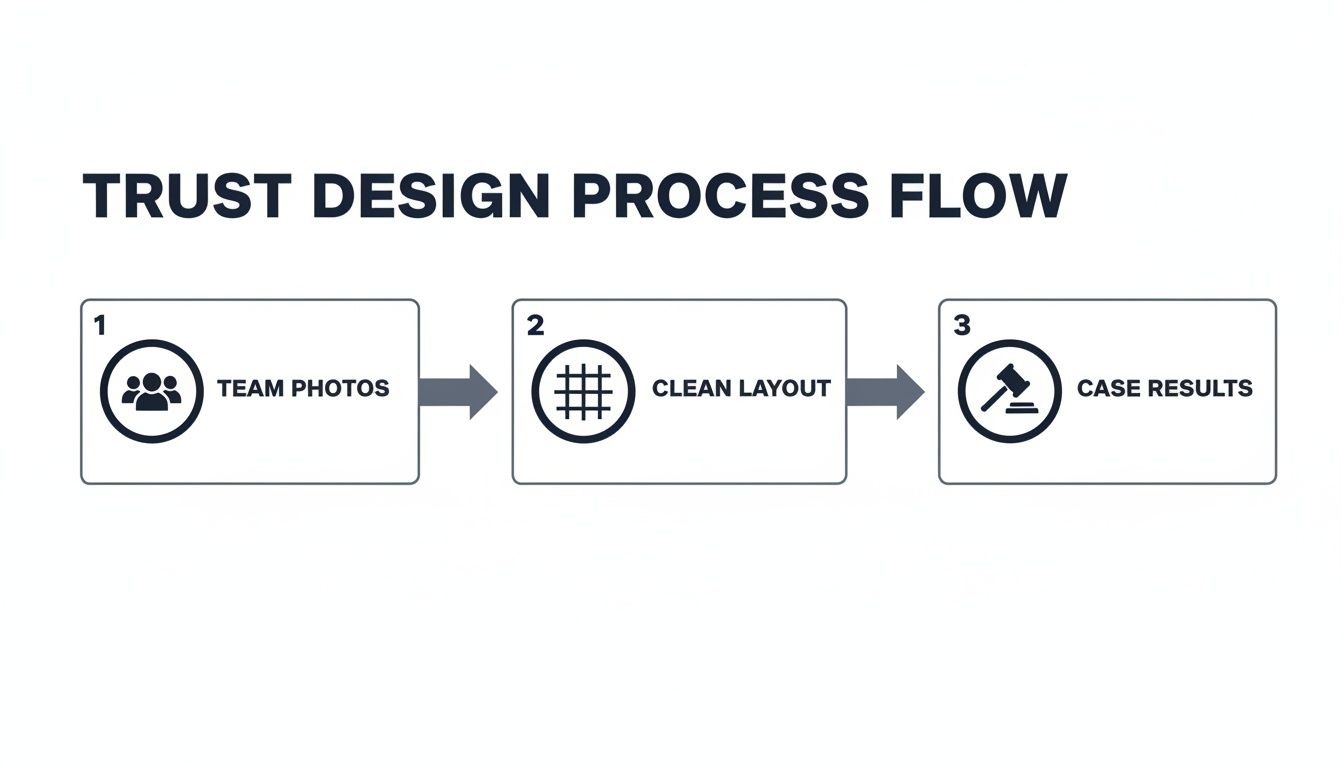
This infographic breaks down the foundational steps of designing for trust—the essential ingredient for any successful client journey.
As you can see, a journey built on trust starts with authentic team photos, is supported by a clean layout, and is proven by tangible case results.
Establishing Authority with a Resource Centre
Beyond just explaining your services, one of the best ways to build trust is to demonstrate your expertise freely. A resource centre or blog is the perfect place for this. It’s where you shift from selling your services to establishing your firm as an authority in its field.
By consistently publishing genuinely helpful content, you achieve several key goals:
You answer client questions: Writing articles that address common legal queries shows empathy and understanding. You're helping people before they've even paid you a cent.
You boost your SEO: A regularly updated blog provides a steady stream of fresh content for search engines to index, improving your visibility in search results over time.
You create shareable assets: An insightful article can be shared on social media or in newsletters, extending your firm's reach and attracting new visitors to your site.
Ultimately, a well-structured website guides, informs, and reassures. By focusing on an intuitive client journey and building out these essential pages, you transform your site from a simple online brochure into a powerful, automated tool for attracting and securing new cases.
Mastering SEO to Attract the Right Clients
Having a professional, trustworthy website is a huge step, but it's only half the battle. If potential clients can't find you when they're searching for legal help, your website might as well be invisible. This is where Search Engine Optimisation (SEO) becomes your most powerful tool for bringing in new clients.
Think of SEO as teaching your website to speak Google's language. When someone types "family lawyer in Brisbane" into the search bar, SEO is what helps Google understand that your Brisbane-based family law firm is the best, most relevant result to show them. It’s not about tricking the system; it’s about clearly signalling your expertise so the right people can find you.
Good SEO puts your firm in front of potential clients at the exact moment they’re actively looking for your services. That’s what makes it one of the most effective strategies you can have in your digital marketing plan.
Dominating Local Search Results
For most law firms, your clients are right in your backyard. This makes local SEO an absolute non-negotiable. It’s the art of fine-tuning your online presence to attract clients in your specific geographic area, whether that's your city or right down to your suburb.
The cornerstone of all local SEO is your Google Business Profile (GBP). This is the free listing that pops up in Google Maps and the "map pack" section you see in search results. A well-managed GBP is often the very first interaction a potential client has with your firm.
To turn your profile into a client magnet, you need to focus on these key areas:
Complete and Accurate Information: Make sure your firm's name, address, and phone number (NAP) are identical everywhere—on your website, in your GBP, and across any other online directories. Consistency is everything.
Select the Right Categories: Be specific. Instead of just "Lawyer," choose precise categories like "Family Law Attorney" or "Criminal Justice Attorney" that truly reflect what you do.
Gather Client Reviews: Don't be shy about asking satisfied clients to leave a review. Positive reviews are a massive trust signal, not just for potential clients but for Google’s algorithm too.
A sharp, optimised GBP acts like a digital billboard for your local area, driving calls and website clicks from people who are ready to take the next step.
Targeting the Right Keywords for Your Practice
To attract the right kind of client, you have to get inside their head and figure out the exact words and phrases they're typing into Google. These are your keywords, and the goal is to align your website's content with what people are searching for.
Forget targeting a broad, generic term like "lawyer." You'll get much better results by focusing on specific, high-intent keywords that match the services you offer.
For instance, a personal injury firm would be smart to target phrases like:
"car accident lawyer Gold Coast"
"workplace injury claim process QLD"
"medical negligence solicitors near me"
By creating dedicated pages on your site for each of these specific services, you're telling search engines you're an authority on those topics. This dramatically increases your chances of showing up for those valuable searches and attracting clients who have a specific, urgent need. For a deeper dive, our comprehensive guide offers more advanced strategies on SEO for legal firms that can help you get ahead.
Creating Content That Answers Client Questions
Modern search engines, especially with the rise of AI, are getting scarily good at understanding the intent behind a search. People aren't just typing in keywords anymore; they're asking full-blown questions. Your website needs to have the answers.
Think about what keeps your potential clients up at night. What are their most pressing questions about their legal situation? By creating content—like blog posts, detailed FAQs, and resource articles—that directly addresses these pain points, you position your firm as a helpful, trustworthy authority.
For example, data from the Australian legal market in 2026 shows just how crucial this online presence is. A significant 73% of legal consumers begin their lawyer search online, highlighting the need for a high-quality website to remain competitive. Furthermore, Australian firms with active blogs attract 97% more inbound links, which boosts their search authority and organic traffic. These firms also have 434% more indexed pages, expanding their digital footprint. You can read more about these valuable law firm marketing statistics and how they impact growth.
This approach doesn't just build trust with potential clients. It also makes your website visible for new types of search, like voice queries on a smart speaker or the answers that pop up in AI-powered search results.
The Critical Role of Technical SEO
Finally, don't forget what's going on "under the hood." The technical health of your website plays a huge part in how well you rank. Google wants to send its users to sites that offer a great experience, and two of the most critical factors are mobile-friendliness and loading speed.
Most people searching for legal help are doing it on their smartphone. If your site is a clunky, hard-to-navigate mess on a small screen, they'll be gone in seconds. Likewise, a website that takes forever to load will just frustrate people and send them straight back to the search results.
Both of these are big red flags for search engines and can seriously hurt your rankings. Making sure your website is fast, secure, and works beautifully on mobile is a foundational step that makes all your other SEO efforts much more effective.
7. Locking It Down: Ethics and Website Security
The legal world is built on a foundation of trust and strict ethical codes. Your website isn’t just a marketing tool; it’s a digital extension of your firm’s professional integrity. Every single element, from the claims you make to how you handle data, has to meet an incredibly high standard. Think of these requirements less as hurdles and more as opportunities to prove your firm's credibility.
Get this wrong, and you’re not just looking at a damaged reputation. A slip-up in ethics or security can have serious, real-world consequences for your practice. Your digital front door needs to be just as secure and professionally managed as your physical office.
Keeping Your Advertising Honest
When you advertise legal services online, you’re playing by a specific set of rules that can change depending on where you practice. The core principle is simple: inform, don’t overpromise. You have to steer clear of misleading claims or guaranteeing specific case outcomes.
To make sure your firm’s website is playing by the book, it's a good idea to stay across general website compliance guidelines. Keeping informed is the best way to navigate the complexities of digital marketing without crossing any lines.
Here are the non-negotiables:
Be Truthful, Always. Every statement about your firm, your services, or your past wins must be accurate and verifiable. Ditch words like "expert" or "specialist" unless you have the formal accreditation to back them up.
Handle Testimonials with Care. Client stories are compelling, but they need to be handled ethically. Always, always include a disclaimer like, "Past results are not indicative of future outcomes." This manages expectations and keeps you compliant.
Display Clear Disclaimers. Your website needs the right legal fine print. This means a clear privacy policy, terms of use, and a statement that makes it obvious that using the site doesn't automatically create an attorney-client relationship.
Building a Digital Fortress
Beyond the advertising rules, your technical responsibilities are just as serious. Clients are trusting you with incredibly sensitive information, and your website has to be a vault. One security breach can shatter that trust for good.
The absolute baseline for security is an SSL (Secure Sockets Layer) certificate. This is what puts the 's' in "https" and shows the little padlock icon in the browser bar. It encrypts the connection between your website and your visitors, protecting any sensitive details they enter into a contact form. Without it, you’re not only risking client data but also your search rankings, as browsers now actively flag non-secure sites.
A secure website isn't a "nice-to-have"—it's a fundamental signal of professionalism. It tells potential clients you take their privacy as seriously as you take their legal case.
But security isn't a set-and-forget task; it demands constant attention. Regular updates to your website's software, plugins, and server environment are critical for patching up vulnerabilities that hackers are always looking to exploit. Proactive monitoring and support, often handled through a dedicated website maintenance package, ensures your digital front door stays locked tight against any threats.
Finally, another powerful way to demonstrate diligence is by making your site accessible to users with disabilities by following the Web Content Accessibility Guidelines (WCAG). An accessible website is a clear sign that you're committed to serving every potential client, reinforcing the trust and professionalism your firm is built on.
Turning Website Visitors Into New Cases
A professional-looking website is a great start, but let's be honest—its real value is measured in the business it brings in. This is where we get to the sharp end of effective website design for legal firms: turning your online traffic into actual, paying clients. It’s all about conversion. We need to stop worrying about vanity metrics like page views and focus on the numbers that actually grow your practice.
Success isn't about how many people land on your site; it's about how many of them pick up the phone or fill out a form. The goal is to measure and optimise for real-world results: contact form submissions, direct calls, and consultation requests. Every single design choice should be pulling a potential client towards that final, crucial step of asking for your help.
The Power of a Clear Call-to-Action
A call-to-action (CTA) is the signpost on your website that tells a visitor exactly what to do next. Vague suggestions like "learn more" just don't cut it. You need clear, direct, and compelling instructions on every page. Without them, even the most interested person might just click away.
Think of your CTAs as the guiding hand leading a potential client through your site. They need to be strategically placed and impossible to miss.
Be Specific: Ditch the generic "Contact Us." Use action-focused language like "Request a Free Case Evaluation" or "Book Your Consultation Now." It’s direct and tells them what to expect.
Create Urgency: When someone is in a tough spot, phrases like "Speak With an Attorney Today" can prompt them to act immediately.
Offer Value: A CTA is far more powerful when it offers something in return, which brings us to the next point.
Increase Engagement by Offering Value
One of the best ways to get a visitor to take that next step is by offering them something of genuine value right off the bat. This isn’t just a sales tactic; it’s about building trust and lowering the barrier to entry. Giving away helpful information or a no-risk first step can seriously boost your conversion rates.
Consider rolling out some of these powerful value-based offers:
Free Case Evaluations: This is a classic for a reason. It gives potential clients a stress-free way to understand their situation and see if your firm is the right one to help them.
Downloadable Guides: Offering a free PDF, like "What to Do After a Car Accident," not only positions you as an expert but also captures their contact details for follow-up.
Online Assessment Tools: Simple quizzes or tools that help visitors figure out if they have a case can be incredibly engaging and great for generating qualified leads.
Your website isn't just a digital brochure; it's an engine for client acquisition. By continuously analysing its performance and making data-backed adjustments, you ensure it consistently delivers new cases for your firm.
On top of this, you can't ignore local search. For instance, Australian law firms that neglect their Google Business Profile are leaving a massive amount of local traffic on the table—we're talking up to 7 times more visits compared to firms with poorly managed profiles. This is critical, especially when you realise that 50-60% of inbound calls now come straight from the Google Maps Pack, not just the standard search results. With local searches in Australia climbing 20% year-over-year, mostly from mobile users ready to act, a well-optimised local presence is one of your most powerful conversion tools. You can dive deeper into Australian web design industry trends on ibisworld.com to see just how important this is.
Common Questions About Law Firm Websites
Starting a new website project always kicks up a bunch of questions. Getting your head around the key variables from the start helps you make smart decisions, set realistic expectations, and make sure your investment actually pays off for your firm.
Here are the straight-up answers to the questions we hear most from legal professionals.
How Much Should a Law Firm Website Cost?
The cost of a new website can swing pretty wildly. You could get a simple, template-based site for a few thousand dollars, but a fully custom website with in-depth SEO, unique features, and professionally written content can easily range from $10,000 to over $50,000.
Think of it as a direct investment in your firm’s most powerful marketing asset. The final number comes down to things like the number of pages, how complex the design is, and how deep the initial marketing strategy goes. Always ask for a detailed proposal that breaks down every single cost and deliverable—no surprises.
How Long Does It Take to Build a New Law Firm Website?
A typical project timeline can be anywhere from 6 weeks to 6 months. A more straightforward site using an existing structure can often be up and running in 6-10 weeks.
On the other hand, a complex, custom-built website with heaps of content is a bigger job, often taking 4-6 months from the first chat to the final launch.
The single biggest thing that speeds up or slows down the timeline? The firm's ability to give timely feedback, content, and approvals at each stage. Having a clear, agreed-upon project plan is the only way to keep everything moving.
What Are the Must-Have Features?
For a modern law firm website to do its job, a few features are completely non-negotiable. Get these right, and you're on your way.
Mobile-Responsive Design: It has to look and work perfectly on every device, especially smartphones. That’s where most of your clients are starting their search.
Clear Calls-to-Action (CTAs): Obvious buttons and links like "Request a Consultation" are essential. They tell visitors exactly what to do next.
Essential Content: You need detailed practice area pages and professional attorney bios to show you're an authority and build trust with potential clients from the get-go.
Strong Technical Foundations: Fast page-load speeds and an SSL certificate (https) are critical for both security and ranking well on Google.
Can Our Firm Update the Website Ourselves?
Absolutely. A modern website is built on a user-friendly Content Management System (CMS) like WordPress, which is designed for people who aren't developers. You should have no trouble adding a new blog post, updating a lawyer's profile, or tweaking the text on a page.
Any good agency will give you training on how to handle the day-to-day content updates. For big structural changes, though, it’s always best to loop in your design partner to avoid accidentally breaking the site’s functionality or design.
Titan Blue is your go-to digital partner for smart, results-driven solutions. We blend strategy, creativity and tech to grow your brand and get real results fast.