

Last updated:
Thinking that website design is just about looking good is an old-school idea. These days, smart website design with seo means treating looks and search visibility as two sides of the same coin. For any Australian business trying to get ahead, this isn’t just a nice-to-have; it’s a must. It’s a strategic move that saves you from expensive redesigns down the track and directly boosts your bottom line.
Why Great Design Is Your Strongest SEO Asset
For a long time, business owners treated design and SEO as totally separate jobs. First, you’d get a beautiful website built. Then, you’d bring in an SEO expert to try and “optimise” it. That whole process is clunky and often creates massive flaws that are a real headache—and expensive—to fix later on. The right way to do it is to build SEO into the process from the very first wireframe.
A website that looks fantastic but is invisible to search engines has failed its most basic job. On the flip side, a site that ranks well but is confusing or a pain to use will just send potential customers running. When you fuse these two disciplines, you get a digital presence that’s both easy to find and genuinely enjoyable to use.
The Real Cost of Ignoring SEO in Design
When SEO is just an afterthought, common design choices can accidentally kill your rankings before you even launch. For instance, a designer might go for a trendy, complex navigation style that looks cool to a user but is completely baffling to a search engine crawler. This makes it incredibly difficult for Google to find and index your most important pages.
Performance is another classic problem area. A visually stunning site loaded with high-res images and slick animations might win design awards, but if it takes more than three seconds to load, a huge chunk of your visitors will hit the back button before they see anything. That high bounce rate screams “bad user experience” to Google, which can seriously hurt your rankings.
Connecting Design to Revenue in Australia
The commercial impact of getting this right is massive. Australia’s digital economy is tipped to hit AUD $120 billion by the end of 2025, with businesses forecast to pour around $1.5 billion into SEO services that same year. For the small and medium businesses that are the backbone of the Aussie economy, organic search is responsible for about 53% of all website traffic.
A beautiful website that isn’t structurally sound for search is statistically missing out on more than half its potential audience. You can see more on these key Australian digital marketing trends here.
At the end of the day, your website is a business tool, and its success is measured by the leads and sales it generates. By prioritising website design with seo from day one, you’re building an asset that works for your business 24/7, turning casual visitors into loyal customers. It’s all about making smart, informed choices from the get-go, which our guide on custom website design and development explores in more detail.
Building Your Strategic SEO Blueprint
Before a single pixel is placed or a line of code is written, the real work begins. The foundation of a high-ranking website is laid with a solid plan, and this is where website design with SEO truly starts. It’s about making sure every design choice has a purpose that goes way beyond just looking good. Think of it as reverse-engineering success by getting inside the heads of your audience and understanding how search engines think.
Skipping this initial phase is a recipe for costly mistakes down the track. Imagine building a beautiful retail store but placing it on a street no one ever drives down. That’s exactly what launching a website without an SEO blueprint is like. You might have the most visually stunning site in your industry, but if no one can find it, it’s not going to generate a single lead or sale.
Understanding Your Australian Audience
First things first: you need to deeply understand your ideal customers. What problems are they actually trying to solve? And, more importantly, what specific words and phrases are they typing into Google to find those solutions? This is the heart and soul of keyword research.
For any Aussie business, local nuance is everything. A plumber in Perth isn’t competing with one in Parramatta, so your keyword strategy has to reflect that. Go beyond the obvious terms like “plumber Perth.” Dig deeper for specific, long-tail keywords that signal real intent, like “emergency hot water system repair Fremantle” or “best commercial plumbing services Joondalup.” These longer phrases usually have less competition and attract customers who are ready to make a call.
A well-researched keyword list is far more than just a bunch of terms; it’s a direct reflection of your customers’ needs. It tells you exactly what content to create and how to structure your site to meet those needs head-on.
This visual shows how SEO should be woven into your design process from the start, moving from design to optimisation and, finally, to real, measurable growth.
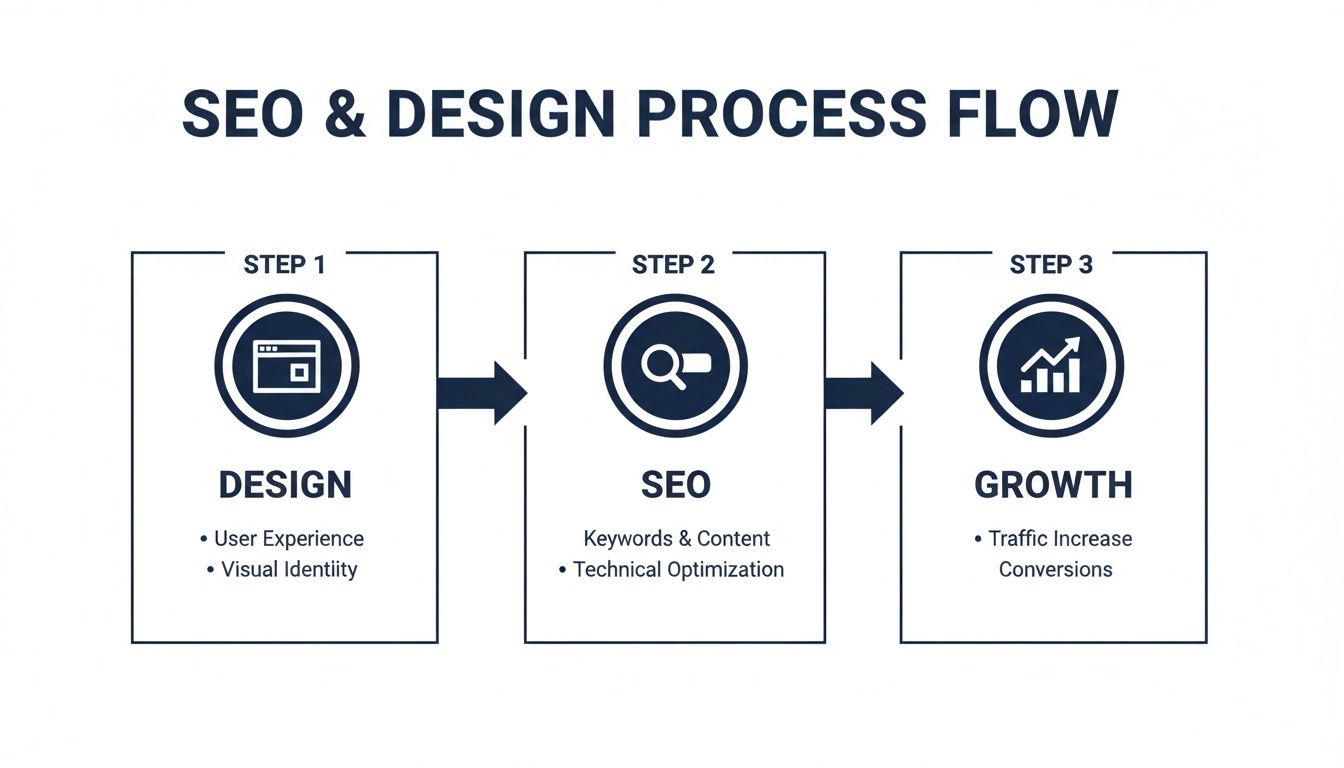
The key takeaway here is that SEO isn’t an afterthought. It’s a parallel track that informs and sharpens the design process, paving the way for sustainable business growth.
Analysing the Competitive Landscape
Once you know what your audience is searching for, it’s time to see who’s already showing up for those terms. A competitor analysis isn’t about copying what others are doing; it’s about sniffing out opportunities and finding gaps you can exploit.
Take a hard look at the top-ranking sites for your target keywords and start asking some critical questions:
- Content Gaps: What topics are they covering well, and where are the holes? Maybe they have a great blog but zero video tutorials. That’s a gap you can fill.
- User Experience (UX): Is their site a pain to navigate? Is it slow or clunky on mobile? A frustrating UX on a competitor’s site is a weakness you can capitalise on with a superior design.
- Backlink Profile: Where are they getting their authority from? Knowing their backlink sources can give you a roadmap for your own outreach strategy later.
This analysis gives you a clear benchmark. It shows you where the bar is set and exactly how you can raise it. For a more detailed breakdown, our guide on how to improve Google rankings provides some practical steps you can take.
Architecting a Site for Success
Armed with your keywords and competitive insights, you can now start mapping out your site architecture. This is the logical structure of your website—basically, a blueprint of how all your pages are organised and linked together. A well-planned architecture makes your site intuitive for users and dead simple for search engine crawlers to understand.
Your goal is to create a clean, logical hierarchy. Start with your main service or product categories, then branch out into more specific sub-pages. For instance, a law firm might structure its site like this:
- Homepage: A broad overview of the firm and its main practice areas.
- Main Service Pages: Family Law, Business Law, Property Law.
- Specific Sub-Pages: Under the “Family Law” section, you’d have dedicated pages for Divorce, Child Custody, and Property Settlements.
This structure makes sure your most important pages are only a couple of clicks from the homepage, which helps spread “link equity” (or authority) throughout your site. It also creates a natural user journey, guiding visitors straight to the information they need without any confusion. This planning phase is the most critical part of website design with SEO because it builds a powerful, scalable, and search-friendly framework from day one.
Designing for Speed and User Engagement
A stunning website that takes forever to load is one of the biggest liabilities in modern business. It’s a surefire way to frustrate users and it sends a clear signal to search engines that your site offers a poor experience. In the world of website design with seo, speed isn’t just a bonus feature; it’s a foundational pillar. A fast, intuitive, and mobile-friendly site is no longer just a nice-to-have.

The simple truth is that design choices have a direct, measurable impact on performance. Things like slow-loading elements, heavy code, and unoptimised images can absolutely sink your rankings before you even get off the ground. That’s why adopting a performance-first mindset during the design phase is so critical for long-term visibility.
Decoding Core Web Vitals for Designers
Google’s Core Web Vitals are a set of metrics that measure a user’s real-world experience on a webpage. They might sound technical, but the concepts are actually pretty straightforward and are heavily influenced by your design decisions. To deliver a great user experience and climb the SEO ranks, it’s vital to focus on responsive design and the performance of your mobile web application.
Thinking about these from the very beginning of a project is a game-changer. For a deeper dive, it’s worth learning more about catering for Google Core Web Vitals and how to properly align your design with them.
Here’s a practical look at how design impacts these key metrics:
- Largest Contentful Paint (LCP): This is all about how long it takes for the biggest element on the screen—usually a hero image or video—to load. To keep LCP low, designers should avoid using massive, uncompressed images “above the fold” and instead use modern, lightweight formats like WebP.
- First Input Delay (FID): This metric tracks how quickly your page responds when a user tries to do something, like click a button. Heavy JavaScript from complex animations or third-party plugins can block the browser, so it’s on the designer to be mindful of how many scripts a page relies on.
- Cumulative Layout Shift (CLS): This measures visual stability. We’ve all experienced it—you go to click something, and the page suddenly moves because an ad loaded late. To stop this from happening, always specify dimensions for images and videos in the design so the browser can save a dedicated space for them.
A seamless user experience is a direct signal to Google that your site is valuable. When users stay longer, interact more, and don’t bounce away in frustration, search engines take notice and reward you with better visibility.
Practical Steps for a Faster Website
Speed isn’t just about passing tests; it’s about respecting your user’s time. A fast website feels more professional and trustworthy, which naturally leads to higher engagement and better conversion rates. Luckily, many of the biggest performance wins come from simple, intentional design choices made early on.
It’s no secret that page speed is a massive ranking factor. In Australia, the unofficial rule is that your pages must load in under 2.5 seconds to stay competitive. Anything over five seconds is often considered dead in the water in SEO terms.
Here are some actionable tips to build speed directly into your design process:
- Optimise Every Single Image. Before any image gets uploaded, it needs to be compressed. Tools can slash file sizes without any noticeable drop in quality. You should also be serving images in next-gen formats like WebP, which offers far better compression than old-school JPEGs and PNGs.
- Rethink Your Font Choices. Custom web fonts look fantastic, but every single one adds to your page load time. Try to limit your design to one or two font families and always use modern font formats like WOFF2 for the best possible performance.
- Keep Your Code Squeaky Clean. It’s crucial to work with developers who write clean, efficient HTML, CSS, and JavaScript. Bloated code from page builders or piling on too many plugins can slow your site to a crawl. The simpler and more streamlined the code, the faster the page will be.
Ultimately, designing for speed and engagement just means putting the user first. When you focus on creating a fast, stable, and intuitive experience, you naturally align your website with the very things search engines are trying to promote. This approach ensures your website design with seo is built on a foundation that will stand the test of time.
Crafting Content and On-Page SEO
Once you’ve got a rock-solid technical foundation and a logical site structure, it’s time to focus on the heart of your website: the content itself. This is where your brand’s voice comes alive, but it’s also a critical battleground for search visibility. Real **website design with seo** isn’t about slapping keywords on a page later; it’s about weaving optimisation directly into every word, image, and link from the very beginning.
This process is so much more than just keyword stuffing. It’s about creating a clear hierarchy of information that’s genuinely compelling for your audience while also being perfectly legible for search engines. Every single element, from the main headline down to the smallest image caption, plays a role in signalling your page’s relevance and authority.
Building a Strong Topical Hierarchy
Think of each page on your website as telling a story about one specific topic. On-page SEO is how you make the plot of that story crystal clear to search engines. Your most powerful tools here are your headings and titles, which act as signposts for both users and the bots crawling your site.
The page title (or title tag) is the first thing people see in the search results and remains one of the most potent on-page ranking factors. It needs to be concise, compelling, and include your primary keyword near the start. The H1 heading—your main on-page headline—should then reinforce that topic, often using a slight variation of the keyword to capture different search intents.
From there, you’ll use H2s and H3s to break the topic down into logical sub-sections. This doesn’t just make your content a breeze to read; it also helps Google understand the nuance and depth of what you’re providing. For example, a page about “custom home builders” might have H2s like “Our Design and Build Process” and “Sustainable Building Materials,” creating a rich, structured content experience that search engines love.
Writing for Humans First and Search Engines Second
Keywords are crucial, but your number one goal is to connect with a human reader. Shoving keywords into every sentence creates a robotic, unreadable mess that will send visitors bouncing right off your site. Modern SEO actually rewards content that feels natural, engaging, and genuinely helpful.
To get this right, focus on a few core principles of readable web content.
- Use Extremely Short Paragraphs: Keep your paragraphs to a maximum of one to three sentences. This creates valuable white space, making the content less intimidating and way easier to scan on mobile.
- Leverage Bullet Points: When you’re listing features or steps, bullet points are far more effective than a dense block of text. They break things up and let readers absorb information in seconds.
- Employ Bold Text Strategically: Use bold text to make key phrases, statistics, or important takeaways pop. This guides the reader’s eye through the page and highlights the must-know info.
Structuring your content for scannability improves the user experience, and that sends all the right signals to search engines. For a deeper dive, our guide on effective content writing on your website unpacks even more strategies.
The Strategic Power of Internal Linking
Internal linking is one of the most overlooked parts of on-page SEO, but it’s something you should be thinking about during the design and content creation phases, not as an afterthought. An internal link is simply a link from one page on your website to another. This simple action delivers two massive benefits.
First, it creates logical pathways for your users, guiding them from one relevant piece of content to the next. This keeps them on your site longer and helps them discover more of what you have to offer. For instance, a blog post about “kitchen renovation ideas” should absolutely link to your “kitchen cabinetry services” page. It just makes sense.
Second, internal links are vital for spreading authority, or “link equity,” throughout your site. High-authority pages, like your homepage, can pass some of that strength to other important pages through these links. A well-planned internal linking structure helps search engines find your deeper pages and understand which ones you consider most important. This deliberate approach transforms your website from a collection of standalone pages into a cohesive, interconnected resource that’s far more powerful in the eyes of Google.
Future-Proofing Your Site With Local and AI SEO
When you’re building a new website, thinking about website design with SEO isn’t just about what works today. You’ve got to be looking at what’s coming next. Right now, the search world is being pulled in two directions that are critical for Australian businesses: an intense focus on local results and the explosion of AI-powered search.
Baking these trends into your design from day one isn’t just a good idea—it’s how you get a serious leg up on the competition.
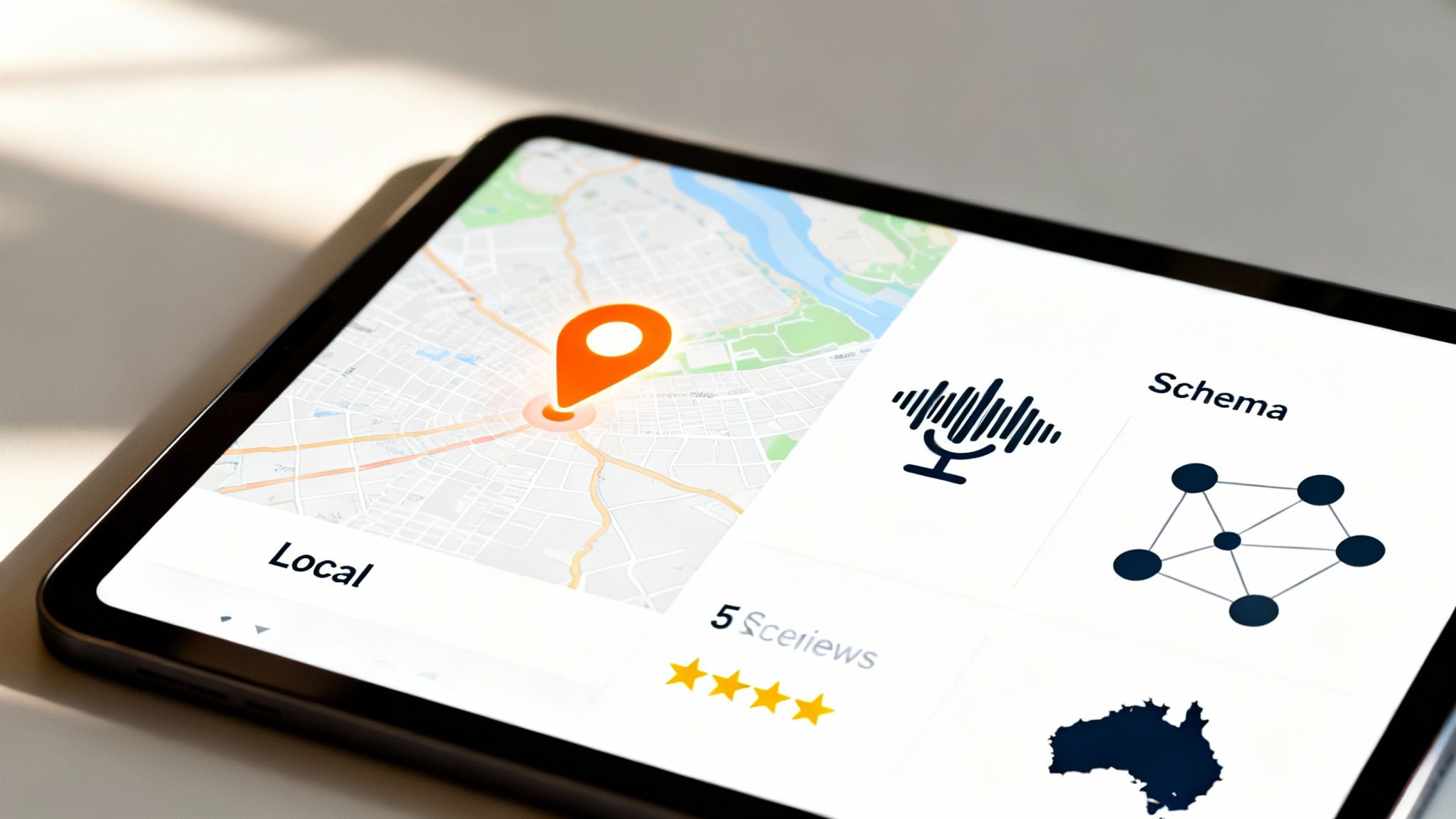
Think about it. A site could be perfectly optimised on a national scale, but if it’s invisible to customers just down the road, it’s missing its most valuable traffic. For service businesses, retailers, and restaurants, getting found by people nearby is everything. This is where your website design becomes your best tool for local visibility.
Designing for Local Search Success
Dominating local search isn’t an accident. It comes from a deliberate design strategy that screams your geographic relevance to both users and search engines. You need to embed location-based trust signals right into the fabric of your site.
First things first: make your contact details impossible to miss. Your business name, address, and phone number (NAP) need to be in your website’s footer and on a dedicated contact page. This consistency is non-negotiable; it builds trust with users and helps search engines confirm you’re a legitimate local business.
A useful tip is to embed a Google Map directly on your contact page. It’s not just for helping customers find you. It sends a powerful, direct signal to Google about your physical location, cementing your place in the local community.
Beyond the basics, your design should naturally weave in other local trust signals.
- Showcase Customer Reviews: Don’t hide your glowing reviews. Create a dedicated section on your homepage or service pages to feature testimonials. Bonus points if they mention the customer’s suburb or city, as this adds another layer of social proof.
- Create Location-Specific Pages: If you serve multiple areas, say the Gold Coast and Brisbane, build out dedicated pages for each. These pages need unique content tailored to that location, which is how you start ranking for searches like “law firm Gold Coast.”
- Prioritise Mobile Friendliness: The huge majority of “near me” searches happen on a phone. Your design must be responsive and work flawlessly on mobile, otherwise you’re throwing away all that on-the-go traffic.
Preparing Your Site for AI and Voice Search
The other massive shift is the move to conversational, AI-driven search. Tools like ChatGPT and voice assistants like Siri are fundamentally changing how people look for information. People aren’t just typing in keywords anymore; they’re asking detailed questions. To stay visible, your site needs to be designed to provide clear, direct answers.
This is where structured data, also known as Schema markup, becomes your secret weapon. It’s a layer of code you add to your site to help search engines understand the context of your content. Think of it as creating a detailed cheat sheet for Google.
For example, you can use Schema to explicitly tell search engines things like:
- Your business’s opening hours.
- The price and availability of a specific product.
- The date, time, and location of an upcoming event.
- The steps involved in a recipe.
When someone asks a voice assistant, “What time does that Italian restaurant in Broadbeach close?”, Google can pull that answer straight from your structured data. Suddenly, your site is positioned as the definitive source. Planning for Schema integration during the design phase ensures your site is built to be a primary source for this next generation of search. To get a better handle on how AI is reshaping the industry, check out this guide on the future of SEO in the age of generative AI.
As AI keeps evolving, designing a site that these new systems can easily understand is paramount. If you’re looking to see how this fits into your wider marketing efforts, you can explore specialised Generative Engine Optimisation services that are built for this new frontier.
By combining a strong local presence with a structure that’s ready for AI, your website design with SEO strategy becomes a smart, forward-thinking investment in your business’s future visibility.
Have a Few Questions?
When you’re looking at a new website design that properly integrates SEO, a few questions always pop up. Here are some of the most common ones we hear from Australian business owners, with straight-up answers to give you some clarity.
How Long Until a New Website Design Shows SEO Results?
It’s the big question, and the answer really has two parts.
You can actually see the initial payoff from a new, well-optimised site pretty quickly. Technical fixes—like much faster load speeds and a slick mobile experience—can get noticed and indexed by Google within just a few weeks of going live.
But let’s be realistic. If you’re chasing significant, long-term rankings for competitive keywords, that’s a marathon, not a sprint. You should expect to see real, meaningful movement up the search results within 3 to 6 months.
Of course, that timeline depends on a few things:
- How tough your industry is: Ranking for “cafe in Byron Bay” is a totally different ball game than “business law firm Sydney.”
- Your content game: The quality and consistency of the content you publish after the launch are absolutely massive.
- Off-page authority: Any work you do to build authority through backlinks will definitely speed things up.
Think of your new website as the perfect launchpad. It doesn’t guarantee you’ll hit page one overnight, but it creates the ideal foundation to make all your future SEO efforts faster, more effective, and built to last.
Can I Just Apply SEO to My Current Website?
Yes, you can. Plenty of businesses see great results by running a thorough SEO audit on their existing site and doing a targeted overhaul—fixing on-page elements, beefing up content, and building some backlinks.
However, you can reach a point where you’re just throwing good money after bad. If your site is built on an old, clunky framework, has deep-seated architectural issues, or gives mobile users a headache, you’re just putting band-aids on fundamental flaws. These problems will always be an anchor, holding you back.
In the long run, a complete redesign is often the smarter, more cost-effective move. It lets you build the SEO framework correctly from the ground up, making sure every single element—from the site structure to the code itself—is engineered for peak performance and visibility. It’s about choosing a permanent solution over a temporary fix.
What’s More Important: A Beautiful Design or Perfect SEO?
This is a classic question, but honestly, it’s a false choice. In today’s market, a beautiful design and rock-solid SEO are completely codependent. One just can’t succeed without the other. They’re two halves of the same whole.
Imagine a technically perfect site that’s ugly, confusing, or a pain to navigate. Users will get frustrated and leave in seconds, sending your bounce rates through the roof. That behaviour screams to Google that your site isn’t a quality result, which will tank your rankings.
On the flip side, a stunning website that’s slow, poorly coded, and invisible to search engines will never get the traffic it needs to generate leads or sales. It becomes a gorgeous digital brochure that nobody ever gets to see.
The real goal of effective website design with seo is to fuse these two disciplines. You want to create an experience that delights human users and ticks all the right boxes for search engines.
How Does AI Search Change Website Design?
AI-powered search, like Google’s Search Generative Experience (SGE) and ChatGPT, is all about getting direct, authoritative, and easy-to-scan answers. This shift has some pretty big implications for how we design websites.
Your design now has to be laser-focused on creating a crystal-clear information hierarchy. That means using your headings (H1, H2, H3) logically to give your content structure and breaking down complex topics into formats that are easy to skim.
Here are a few key design points to keep in mind for AI search:
- Answer-First Content: Design layouts that put clear answers to common questions right near the top of the page.
- Scannable Formats: Make liberal use of bullet points, numbered lists, and Q&A sections. AI models absolutely love this kind of structured info.
- Structured Data (Schema): Implementing Schema markup is no longer optional; it’s critical. It gives search engines vital context, making it much easier for them to pull your information for AI-generated results.
At the end of the day, a fantastic user experience and well-organised content are what will make you visible in this new era of AI search.
At Titan Blue Australia, we’ve spent over two decades mastering the art of building websites that don’t just look beautiful but are engineered to rank. We fuse proven SEO strategies with expert design to create digital assets that drive real, measurable growth for Australian businesses. Ready to build a website that works as hard as you do? Discover our custom web design and SEO solutions today.
Make Titan Blue a preferred source in Google
One click tells Google to surface our articles more often in Top Stories, AI Overviews and AI Mode.

Best Dental Website Design Agencies in Australia: 7 Compared
Best dental website design agencies in Australia 2026: seven compared on dental proof, booking, AHPRA…

Childcare Centre Website Design Australia: The 2026 Guide
Childcare centre website design Australia: show hours, ages and enrolment as text so parents and…

Electrician Website Design Australia: The 2026 Guide
Electrician website design Australia: what to build, what we found on eight Gold Coast electrician…