Website Development for Law Firms A Guide to High-Impact Results
Your law firm’s website is no longer just an online brochure. It's your digital front door, your hardest-working business development officer, and your primary brand-building tool—all rolled into one, working 24/7. It's the first place most potential clients will ever interact with your firm.
That first impression can be the difference between a new client calling you or clicking away to one of your competitors.
Your Website Is Your Firm’s Most Valuable Asset
This is especially true in the fiercely competitive Australian legal market. A professional, intuitive website doesn't just look good; it instantly communicates expertise and builds trust. Long before a potential client reads a lawyer's bio or skims through a case study, they're forming an opinion based on your site's design, speed, and overall feel.
This is where getting your website development for law firms right becomes absolutely critical.
More Than Just a Digital Brochure
Thinking of your website as a static pamphlet is a throwback to the early days of the internet. Today, a high-performance legal website is a dynamic, lead-generating machine. It’s engineered from the ground up to do one thing: drive growth by attracting, engaging, and converting visitors into qualified clients.
This guide is your roadmap to building exactly that. We’ll walk through the essential pillars that transform a standard website into a powerful asset for your firm:
Strategic Planning: We’ll look at how to align your website's goals directly with your firm's business objectives, so you can see a real, measurable return on your investment.
Client-Centric Design: It's all about creating a user experience that feels trustworthy and naturally guides visitors toward getting in touch.
Technical Excellence: We'll cover what it takes to build a secure, fast, and search-engine-friendly foundation that works flawlessly on any device.
Ongoing Growth: A website is never "finished." We’ll discuss the post-launch strategies for maintenance, content, and optimisation that ensure long-term success.
Your website is the very cornerstone of your firm's professional identity and the key to building an effective online presence. To get a better handle on how all these pieces fit together, it helps to understand the core principles of professional website design and website development and how they combine to create a powerful final product.
Laying the Foundation for a Strategic Website
Diving straight into design mock-ups and coding is like a barrister walking into a trial without reading the brief. A successful law firm website always starts with a rock-solid strategic blueprint, making sure every single element is built with purpose and directly supports your firm's most critical goals.
This foundational phase is what turns your website from a passive digital brochure into an active, hardworking tool for business growth. It’s all about asking the right questions before a single line of code is written. What, exactly, do you need this website to achieve for your practice? The answer shapes the entire project.
For many firms, the main goal is crystal clear: generate a consistent stream of qualified leads. For others, it might be about attracting top legal talent, showcasing a partner's deep expertise in a niche area, or simply building undeniable credibility in a competitive market. Each goal demands a completely different strategic approach.
Defining Your Ideal Client
To build a website that actually connects with people, you first need to know precisely who you're talking to. Creating detailed client personas isn’t a nice-to-have; it's a non-negotiable step. This goes way beyond simple demographics. It's about getting inside the heads of your ideal clients and understanding their specific legal challenges, their burning questions, and their pain points.
Imagine you're a family law firm in Melbourne. Your ideal client could be a 45-year-old professional navigating a complex property settlement. Their biggest worries are protecting their assets and getting a fair outcome for their children. They are almost certainly time-poor, stressed, and searching for an advisor who projects confidence, empathy, and expertise.
This deep understanding directly shapes your website’s messaging, its tone of voice, and the entire user experience. Every piece of content, from a punchy headline to a final call-to-action, should speak directly to that person's situation, assuring them they’ve found the right firm to guide them through a tough time.
Architecting a User-Focused Site Structure
Once you have clear goals and client personas, you can start mapping out a logical and intuitive site structure. A well-organised website guides visitors effortlessly to the information they’re looking for, building trust and encouraging them to take that next step.
Your sitemap needs to include several essential pages, each serving a distinct strategic purpose:
In-Depth Practice Area Pages: These are absolute gold for both SEO and client education. A page on "Commercial Litigation" shouldn't just be a laundry list of services. It needs to explain the process, answer common client questions, and show off your firm’s specific experience in that field.
Professional Lawyer Profiles: Potential clients hire people, not just faceless firms. Your lawyer bios must go beyond a dry list of qualifications. They need to showcase personality, deep expertise, and a track record of successful outcomes, making your team feel both approachable and highly credible.
Compelling Case Studies and Testimonials: Nothing builds trust faster than social proof. Detailing past successes and featuring genuine client testimonials provides the concrete evidence people need to see that your firm can deliver results.
A Thought Leadership Blog: A regularly updated blog is a powerhouse for attracting organic traffic. By providing valuable, insightful answers to your clients' legal questions, you establish your firm as an authority and a go-to resource they can trust.
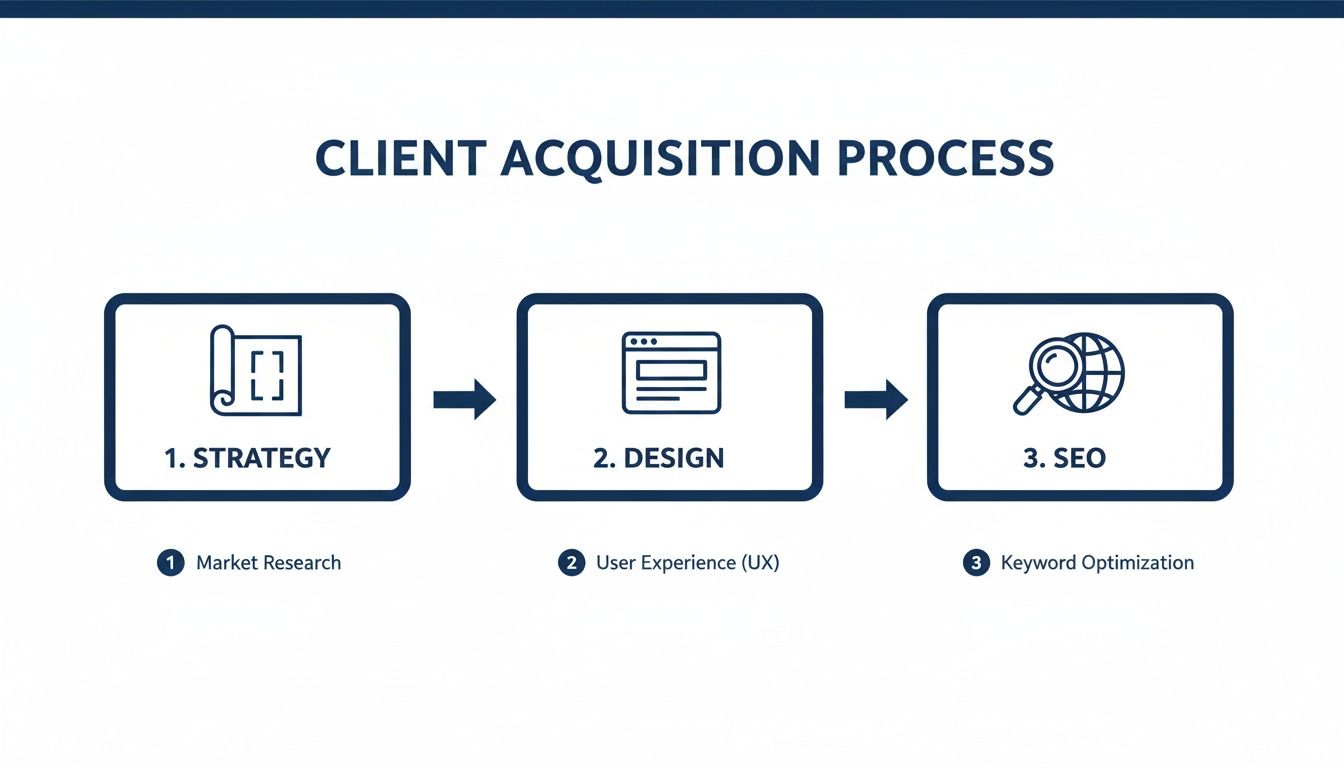
This diagram shows how a solid strategic foundation fuels a powerful client acquisition process.
The flow here makes one thing clear: a successful outcome is never an accident. It's the direct result of a deliberate process where strategy informs design, and both are then amplified by great SEO. This structured approach, a specialty of experienced law firm website developers, ensures your investment is strategically sound right from day one. By getting this groundwork right, you guarantee your website will function as a high-performance asset, consistently working to achieve measurable growth for your firm.
Designing a Website That Builds Trust and Drives Action
Your strategic blueprint sets the stage, but it's the design that truly brings your law firm’s digital presence to life. For a potential client in a tough spot, your website's look and feel is more than just window dressing—it’s a direct reflection of your firm's professionalism, credibility, and ability to get results.
Think of it as the visual handshake. It can either build immediate trust or create instant doubt.
This is precisely why a powerful approach to website development for law firms zeroes in on client-centric design. We go far beyond generic templates to create a professional, modern experience that powerfully communicates your firm’s unique identity and values, tailored specifically for the Australian legal market.
Creating an Intuitive and Professional Aesthetic
Those first few seconds a visitor spends on your site are everything. Your design needs to be clean, uncluttered, and professional, projecting an image of calm competence. This isn’t the place for flashy animations or confusing layouts. The goal is to create an intuitive user journey from the moment they land.
Your website’s navigation should be as clear and confident as the guidance you provide a new client. Menus must be logically organised, practice areas easy to find, and your contact details accessible from every single page. A potential client should never have to hunt for information; the path to their answers has to be obvious and effortless.
The Power of Authentic Imagery
Stock photos of smiling, generic business people in boardrooms do more harm than good. They feel impersonal and chip away at the very trust you’re trying to build. One of the most powerful design assets you have is high-quality, authentic imagery of your actual team and office.
When prospective clients can see the real people they’ll be working with, it humanises your firm and makes that first step of reaching out far less intimidating. It transforms a faceless legal entity into a team of approachable, trusted advisors.
This authenticity is a cornerstone of effective website design for law firms and plays a massive role in making visitors feel understood and confident in what you can do for them.
Designing for a Mobile-First World
It's almost a guarantee that your next client will find you on their smartphone. Modern web design stats show just how critical mobile optimisation is, with around 50% of mobile users in Australia preferring to use business websites over apps. This trend means a mobile-first approach is completely non-negotiable.
What's more, with 53% of mobile users abandoning sites that take longer than three seconds to load, performance is paramount. A mobile-first design ensures your website looks and functions perfectly on a smaller screen, with tappable buttons, readable text, and simple navigation. It’s not about shrinking your desktop site; it’s about rethinking the experience from the ground up for the on-the-go user.
Driving Action with Social Proof and Clear CTAs
A beautifully designed website is only effective if it guides visitors to take the next step. This comes down to a smart combination of social proof and strategic calls-to-action (CTAs).
Client Testimonials: Feature genuine quotes from satisfied clients right on your homepage and relevant practice area pages.
Case Results: Showcase your track record with concise, compelling summaries of successful cases. This demonstrates your firm's ability to deliver positive outcomes.
Clear Calls-to-Action: Every page should have a clear, action-oriented CTA, like "Request a Free Consultation" or "Contact Our Team Today." These buttons need to be visually distinct and placed where a user would naturally look next.
By weaving these elements into your design, you build undeniable credibility and make it simple for potential clients to go from passive browsers to active leads. To ensure your website also adheres to international data protection standards, it's a good idea to consult a comprehensive GDPR compliance checklist as part of your process.
Building Authority with Content and SEO
A brilliant website is completely useless if your ideal clients can't find it. Think of it like a perfectly argued legal brief that no one ever gets to read. This is where strategic content and search engine optimisation (SEO) come into play, turning your new website from a digital brochure into a client-attraction machine.
Great website development for law firms isn't just about looking good; it's about being visible. SEO is simply the process of making your website more appealing to search engines like Google. When a potential client in your area searches for legal help, you want your firm showing up high in the results.
This isn’t about trickery or trying to fool Google. It's about genuinely proving your expertise and answering the questions your clients are already asking online.
SEO for Law Firms is Simpler Than You Think
At its core, SEO for a law firm is about connecting people who have problems with the experts who can solve them. It all starts with understanding the exact phrases and questions your potential clients are typing into Google. This is what we call keyword research.
Instead of guessing, we identify the high-intent terms that signal someone is actively looking for legal services. For law firms, these are almost always specific to a location and practice area.
A few examples of powerful keywords for Australian firms might include:
'Family lawyers Sydney': This targets people looking for family law expertise right in the Sydney area.
'Commercial litigation Melbourne': This is aimed squarely at businesses that need help with commercial disputes in Melbourne.
'Brisbane wills and estates lawyer': This gets you in front of people looking for help with estate planning in a specific city.
Once you know what these key phrases are, you can start weaving them into the most important pages of your website—like your service pages and lawyer bios. This makes it crystal clear to both clients and search engines what you do and where you do it.
Creating Content That Screams "Expert"
Your content is the fuel for your SEO strategy. It’s how you prove your firm’s authority and start building trust long before a potential client ever picks up the phone. A solid content strategy goes way beyond basic service descriptions and focuses on delivering real, tangible value.
The goal is to create what Google calls "people-first" content. This just means writing clear, helpful, and comprehensive articles that directly address the pain points and questions of your target audience. Search engines are getting smarter every day, and their main job is to reward content that is genuinely useful to people.
By consistently publishing high-value content, you position your firm not just as a service provider, but as a trusted authority in your field. This is the foundation of building a dominant local search presence.
Leading Australian law firms are increasingly treating their websites as their most important client acquisition tool. They don’t just have modern designs; they regularly update their sites with legal insights and news, making sure they’re optimised to rank for potential local clients.
A Practical Content Framework That Works
To build this kind of authority, your firm needs a structured approach. This isn't about writing random blog posts when you have a spare moment; it’s about building a library of resources that showcases your expertise and attracts qualified leads.
Your content plan should include a mix of the following:
In-Depth Legal Guides: Create comprehensive articles that break down complex legal topics into plain English. For example, a guide on "The Process of Buying a Business in Queensland" can attract highly qualified commercial law leads.
Detailed Case Studies: Anonymised case studies are incredibly powerful. They demonstrate your firm's ability to get positive outcomes and provide the social proof potential clients need to feel confident in choosing you.
Helpful Articles: Regularly publish articles that answer the most common questions your clients ask. Think about the top five questions you get in initial consultations for each practice area and turn them into detailed, helpful posts.
This strategic approach is exactly what makes content marketing for law firms so effective. It transforms your website from a static online brochure into a dynamic, educational hub that consistently draws in your ideal clients and proves you have the expertise they need.
Mastering the Technical Side of Your Website
Beyond the slick design and persuasive content, the technical nuts and bolts of your website are what make it secure, fast, and dependable. Getting the technical side right isn’t just a nice-to-have for law firms; it’s a non-negotiable that protects sensitive client data and builds trust from the very first click.
Think of your website’s technical build as the structural engineering of an office building. It doesn’t matter how impressive the interior design is if the foundation is weak—the whole structure is at risk. A technically sound website works flawlessly under pressure and is built to last.
Uncompromising Security and Privacy
For a law firm, security isn't just another feature. It's a fundamental ethical and professional duty. Every single interaction on your site, whether it's a simple contact form submission or a detailed case inquiry, deals with sensitive information that absolutely must be protected.
This isn’t just an internal standard; it’s a client expectation. A recent study revealed that a staggering 82% of users will abandon a website if they feel it lacks proper security. That number is a stark reminder of how critical robust security is, especially when dealing with the confidential nature of legal matters.
To meet this standard, your website needs several key security elements firmly in place:
SSL Certificates: This is what adds the 's' to 'https' and puts that little padlock icon in the browser bar. It encrypts all data passing between a visitor's browser and your site, shielding client information from prying eyes.
Secure Contact Forms: Your forms can't just look good; they must be configured to protect every submission, ensuring client inquiries are sent securely and remain confidential.
Adherence to Australian Privacy Principles: Your website must comply with local privacy laws. That means having a comprehensive privacy policy that clearly explains how you collect, use, and protect user data.
Performance and Accessibility for All Users
A website’s speed is directly linked to user satisfaction and search engine rankings. Slow-loading pages are a massive turn-off and can send potential clients clicking away before they even see what you offer. Fast load times create a professional impression and are a critical factor in how Google ranks your site.
We dive much deeper into this in our guide on catering for Google Core Web Vitals, which breaks down the key performance metrics that Google cares about.
Just as important is accessibility. Your website must be usable by everyone, including people with disabilities who might use screen readers or other assistive tech. Following the Web Content Accessibility Guidelines (WCAG) isn't just the right thing to do; it’s a smart business move that opens your doors to more potential clients. This means clean, well-structured code and ensuring images have descriptive alt text.
The Right Technology Stack
Choosing the right Content Management System (CMS) is another pivotal technical decision. You need something that empowers your team, not holds them back. A flexible and user-friendly CMS like WordPress lets your staff easily update content—like adding new lawyer profiles or publishing blog posts—without needing to call a developer for every little change.
This kind of autonomy is crucial for a website that needs to grow and adapt with your firm.
Ultimately, a technically superior website is fast, secure, and open to everyone. It's vital to discuss these technical must-haves with your development team to ensure your digital presence is built on a solid, reliable foundation designed for the long haul.
Growing Your Practice After Your Website Launch
Launching your new website is a fantastic milestone, but it's really just the starting line, not the finish. The most common mistake we see law firms make is falling into the 'set and forget' trap. A website isn't a static brochure; it's a dynamic, living asset that needs ongoing attention to deliver a real return on your investment.
Think of your site as a critical part of your practice. It needs a proactive strategy covering maintenance, optimisation, and continuous improvement. Without one, even the most impressive website will quickly become outdated, insecure, and far less effective at bringing in new clients.
Your Proactive Website Maintenance Plan
A solid maintenance plan is your insurance policy. It protects you from technical headaches and security threats, ensuring your site remains a reliable, high-performing tool for your firm.
In Australia, law firms are investing more in their digital presence than ever before, with marketing spending growing at an impressive rate. Smart firms know that investing in maintenance packages is essential to keep up with changing web standards, stay competitive, and keep clients engaged. Find out more about how Australian law firms are using digital strategy for growth.
So, what should your maintenance checklist cover? A few key areas:
Regular Software Updates: Your website's content management system (CMS) and any plugins need constant updates. This isn't just for new features; it's crucial for patching security holes and keeping things running smoothly.
Consistent Security Scans: Actively scanning for malware or suspicious activity helps you catch and block threats before they can damage your site or, worse, compromise sensitive client data.
Performance Monitoring: You have to keep a close eye on page load times and overall site speed. It’s a massive factor for both user experience and how well you rank in search engines.
Secure Backups: This one is non-negotiable. Regular, secure backups of your entire website are your safety net. If anything goes wrong, they allow for a quick and painless restoration.
Improving Lead Generation Over Time
Keeping the lights on is one thing, but making your website better at its main job—turning visitors into qualified leads—is where the real growth happens. This is where Conversion Rate Optimisation (CRO) comes into play.
CRO is simply the practice of using data and user feedback to improve how well your website performs. It’s all about understanding how people actually use your site and then making small, data-driven tweaks to encourage more of them to get in touch.
You can get started with simple tools. Website analytics, for example, can show you which pages are the most popular and, more importantly, where you're losing people. This kind of insight is gold. It allows you to make informed decisions to improve the user journey and steadily boost your lead generation, ensuring your website evolves right alongside your practice.
Got Questions? We've Got Answers
When you're looking at building a new website for your firm, a lot of questions come up. It's a big investment of time and money, so you want to get it right. Here are some of the most common queries we hear from Australian law firms, with straightforward answers to help you plan your next move.
How Much Does a Law Firm Website Cost in Australia?
This is the big one, and the honest answer is: it depends. The cost can swing pretty dramatically based on your firm's size and what you need the site to do.
For a smaller practice needing a professional, clean, and effective online presence, you might be looking at a starting point of a few thousand dollars. But for a large, multi-practice firm that needs custom features like a secure client portal, advanced integrations, or a huge content library, the investment will be significantly higher.
The best way to think about it is as a core business asset, not just a line-item expense. Key factors that shape the final figure include whether you opt for a custom design or a template, the sheer number of pages, who is creating the content, and any special functions. Always ask for a detailed proposal that breaks everything down so there are no surprises later, especially when it comes to ongoing costs.
How Long Does It Take to Build a New Law Firm Website?
The timeline really hinges on the complexity of the project.
If you’re running with a well-defined structure and using an existing design framework, a new site can be up and running in as little as 4 to 6 weeks. This works well when speed is a priority and the scope is clear from day one.
On the other hand, a fully custom build with unique features and a mountain of content will naturally take longer. You're typically looking at 10 to 16 weeks from the first strategy session to launch day. The single biggest bottleneck we see? Waiting for the firm to supply the final text and images. If you can get your content ready ahead of time, you'll shave a huge amount of time off the process.
What Ongoing Maintenance Is Required After Launch?
Your website isn't a "set and forget" project. Keeping it secure, fast, and relevant requires consistent attention after it goes live. Good maintenance isn't just about fixing things when they break; it’s about proactive care to protect your investment and make sure it keeps working hard for your firm.
A solid maintenance plan should cover the essentials:
Software and Plugin Updates: This is non-negotiable for patching security holes and keeping everything playing nicely together.
Daily or Weekly Backups: Your safety net. If anything goes wrong, you have a recent, secure version to restore from.
Security Monitoring: Actively scanning for and blocking threats before they can cause damage.
Performance Checks: Making sure the site stays zippy and provides a smooth experience for every visitor.
Beyond the technical side, you need to keep your content fresh. Regularly updating lawyer profiles, publishing new blog posts, and showcasing recent case results is vital. It tells both potential clients and Google that your firm is active, current, and authoritative.
At Titan Blue Australia, we build high-performance websites that serve as the foundation for your firm's growth. With over 25 years of experience, we deliver digital strategies that drive results. https://titanblue.com.au
Titan Blue is your go-to digital partner for smart, results-driven solutions. We blend strategy, creativity and tech to grow your brand and get real results fast.