

Last updated:
TL;DR:
- Slow websites cause visitor frustration and reduce business revenue over time.
- Regular assessment using Core Web Vitals guides effective performance improvements.
- Ongoing monitoring and small, consistent optimizations are key to sustained website success.
A slow, clunky website doesn’t just frustrate visitors. It costs you real business. When pages take too long to load or navigation feels confusing, people leave and rarely come back. For small to medium-sized businesses across Australia, this is a problem that compounds over time. Poor performance quietly drains your visibility, your leads, and your revenue. The good news is that website optimisation is learnable and actionable. This guide walks you through a proven, step-by-step process to assess, improve, and sustain better website performance, covering everything from technical speed fixes to on-page SEO and ongoing monitoring.
Table of Contents
- Assessing your website’s current performance
- Foundational improvements: Speed, structure, and user experience
- Optimising for search engines: On-page SEO essentials
- Monitoring progress and ongoing optimisation
- Why the best optimisation is a mindset, not a one-off project
- Take your optimisation further with expert help
- Frequently asked questions
Key Takeaways
| Point | Details |
|---|---|
| Measure before changing | Use Core Web Vitals and leading tools to benchmark your website’s strengths and weaknesses before optimising. |
| Prioritise user experience | Start with speed and structure improvements that make your site faster and easier for visitors. |
| Focus on quality SEO | Develop high-quality content and secure trusted backlinks for lasting search results. |
| Monitor progress monthly | Regularly check your site’s health using free tools and act on trends for continuous improvement. |
Assessing your website’s current performance
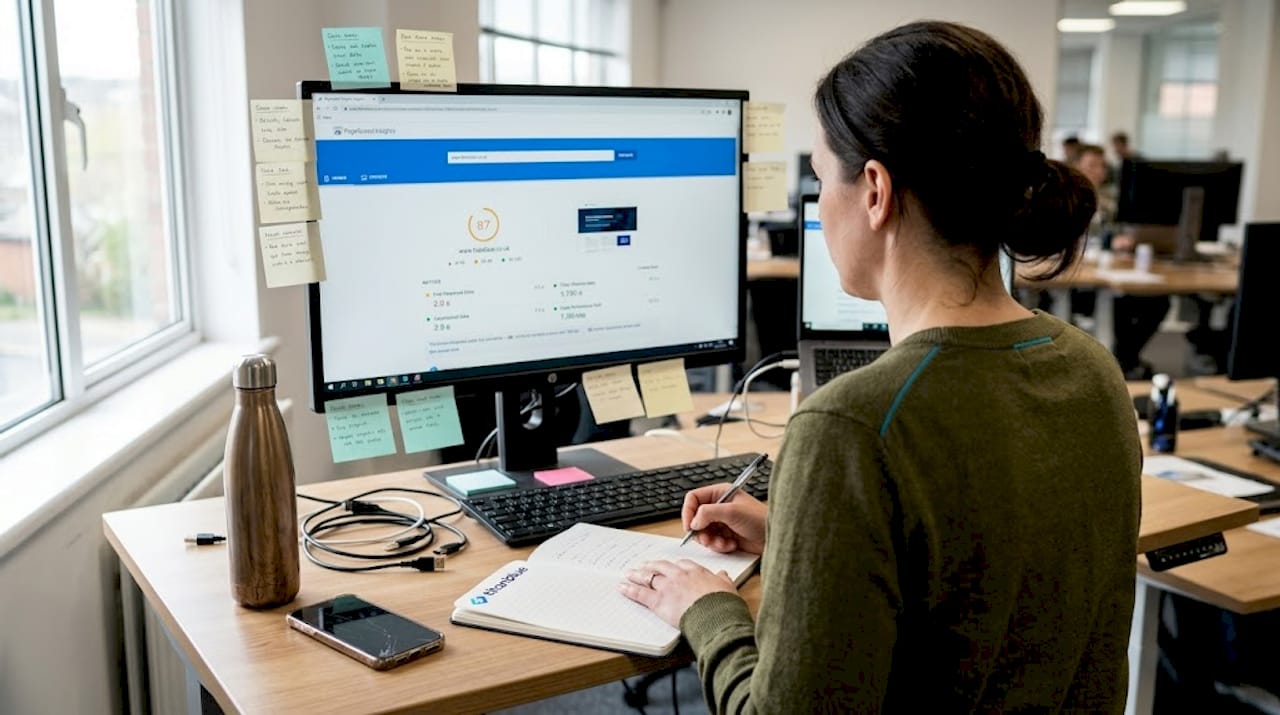
Before you change a single thing on your website, you need to know where you actually stand. Making changes without data is guesswork. With data, every decision has purpose and direction.
The gold standard for performance measurement is Core Web Vitals, a set of key performance metrics defined by Google. There are three metrics you need to understand:
- LCP (Largest Contentful Paint): How long it takes for the main content to load. A good score is 2.5 seconds or less.
- INP (Interaction to Next Paint): How quickly your site responds to user input. Aim for 200 milliseconds or less.
- CLS (Cumulative Layout Shift): How much the page layout shifts unexpectedly. A score of 0.1 or below is considered good.
These three numbers tell you a lot about how real users experience your site. Poor scores here mean frustrated visitors and lower rankings on Google.
To measure them, use these tools:
| Tool | What it measures | Cost |
|---|---|---|
| PageSpeed Insights | LCP, INP, CLS, field data | Free |
| Lighthouse | Lab-based performance audit | Free |
| Google Search Console | Real user data (CrUX) | Free |
| GTmetrix | Detailed waterfall and performance grades | Free/Paid |
Run a site audit by entering your URL into each tool. Focus first on your homepage and your most-visited pages. Read the reports carefully. Look for red and orange flags first, as these represent the biggest opportunities for improvement.
To get the most out of your assessment, start with an optimisation checklist so nothing gets missed during this process.
Pro Tip: Always save a screenshot or export your initial audit results before making any changes. These baseline numbers become your benchmark for measuring real progress later.
Foundational improvements: Speed, structure, and user experience
Once you have reliable benchmarks, you can start implementing core improvements designed to deliver instant, measurable value. The good news is that many of the highest-impact fixes are not complicated. They just require methodical attention.
Speed is your first priority. Slow pages lose visitors in seconds. Here are the quick wins that move the needle most:
- Compress and resize images before uploading (use WebP format where possible)
- Enable browser caching so returning visitors load pages faster
- Minify CSS, JavaScript, and HTML files to reduce file sizes
- Use a content delivery network (CDN) to serve files from servers closer to your visitors
- Eliminate unnecessary third-party scripts and plugins
If you want a deeper look at how to boost site speed, there are practical methods worth exploring once you have the basics in place. For more advanced tactics, the speed improvement tricks available go further into the technical side.
Structure matters just as much as speed. A well-structured site helps both users and search engines navigate your content logically. Prioritise mobile-first design, since the majority of Australians browse on their phones. Use clear, logical navigation menus. Apply proper heading hierarchy (H1, H2, H3) to organise your content.
User experience ties it all together. Make sure your calls to action are visible and clear. Check colour contrast for readability. Ensure your forms work smoothly on all devices.

Here is a comparison of common problems and the best-practice solutions:
| Common problem | Best-practice solution |
|---|---|
| Uncompressed large images | Convert to WebP, compress before upload |
| No mobile optimisation | Implement responsive, mobile-first design |
| Cluttered navigation | Simplify to 5-7 top-level menu items |
| Missing calls to action | Add clear, prominent buttons on key pages |
| Slow server response | Upgrade hosting or implement caching |
As noted in effective SEO approach, one well-optimised page consistently outperforms many thin or neglected ones. Focus your energy where it counts.
Optimising for search engines: On-page SEO essentials
With technical and usability basics in place, your next focus should be search engine optimisation to make your site as discoverable as possible. SEO is not about cramming in keywords or building hundreds of links. Research confirms that quality content and backlinks drive the biggest measurable impact, with an effect size of d=1.049 in meta-analysis. That is a strong signal to focus on substance over volume.
Here is a step-by-step on-page SEO process to follow for each important page:
- Conduct keyword research. Identify the phrases your target customers are actually searching. Use Google Search Console, Google’s autocomplete, or tools like Ubersuggest.
- Write a compelling title tag. Keep it under 60 characters and include your primary keyword naturally.
- Craft a clear meta description. Summarise the page in 150-160 characters. Make it worth clicking.
- Use headings correctly. One H1 per page, then H2s and H3s to organise subtopics logically.
- Add alt text to all images. Describe each image accurately using relevant keywords where natural.
- Build internal links. Connect related pages across your site to distribute authority and help users navigate.
- Implement structured data. Use schema markup to help Google understand your content type, whether it is a service, product, or article.
To understand how to improve website performance with SEO, it helps to see how these on-page factors connect to technical performance. If you are newer to this topic, SEO for Australian businesses is a good starting point. Once your site is live or recently updated, following the right SEO steps after launch ensures nothing is overlooked.
Pro Tip: Use your primary keyword once in the first paragraph, once in a subheading, and a few times naturally throughout the body. Forcing it in every second sentence will actually hurt your rankings.
Monitoring progress and ongoing optimisation
Implementing improvements is not a one-and-done event. Longevity in optimisation comes from continual monitoring and refinement. Sites that improve and then go unmaintained quickly fall behind competitors who are actively iterating.
Set a monthly review schedule. The monitoring tools for optimisation you need are all free: PageSpeed Insights, Lighthouse, Google Search Console, and GTmetrix cover both lab data and real-user field data. Check your Core Web Vitals scores, track organic traffic trends, and look at which pages are gaining or losing visibility.
When you review data over time, look for patterns rather than reacting to single data points. A one-week dip in traffic might be normal fluctuation. A three-month downward trend in LCP scores signals something that needs attention.
Here are the most common pitfalls to avoid as you maintain your optimisation efforts:
- Neglecting mobile performance after focusing only on desktop results
- Skipping updates to plugins, themes, or your CMS, which can introduce performance and security issues
- Publishing new content without SEO review, leaving pages unoptimised from day one
- Ignoring Core Web Vitals field data in favour of only lab-based scores, which may not reflect real user experience
- Setting and forgetting your site after an initial round of improvements
“One well-optimised page consistently outperforms dozens of weak, thin pages. Put your effort where your audience actually lands.”
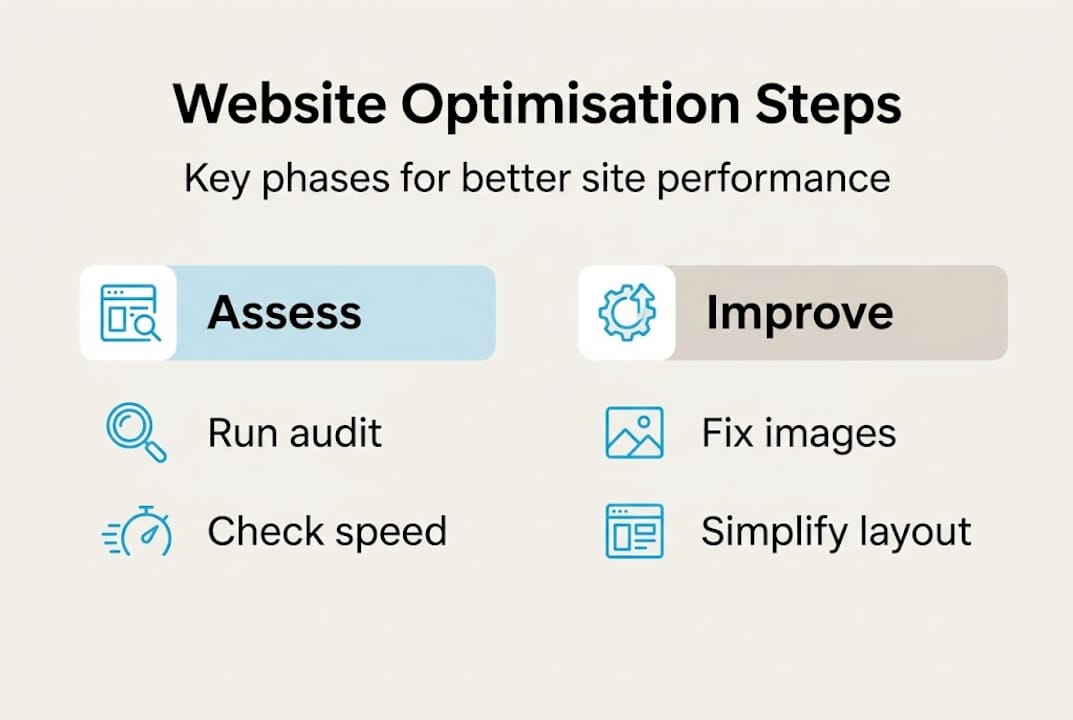
The simplest workflow to keep results sustainable is this: check your metrics, identify the weakest area, fix it, retest, and repeat. For practical guidance on speed and conversion tips, the link between faster pages and higher conversion rates is well documented. When you are ready to go deeper, advanced speed techniques can push your performance even further.
Why the best optimisation is a mindset, not a one-off project
Here is something most guides will not tell you. Chasing a perfect performance score is not the goal. A score of 100 on PageSpeed Insights does not automatically mean your customers are having a great experience or that your leads are increasing. What matters is real-world impact on real users.
Australian small and medium businesses have a genuine competitive advantage here. You do not need a massive budget or a large technical team. You need consistency. Businesses that commit to small, regular improvements consistently outpace those that do one big overhaul and walk away.
Understanding web agencies and Core Web Vitals can shift how you think about performance from a technical checkbox into a genuine business strategy. The businesses winning online right now are not the ones with the flashiest websites. They are the ones who evaluate, fix, monitor, and repeat, week after week. That discipline, applied strategically, is where the real leverage lies.
Take your optimisation further with expert help
You now have a clear process: assess, improve, optimise for search, and monitor continuously. Putting all of this into practice takes time and know-how, and that is exactly where professional support makes a real difference.

At Titan Blue, we work with small and medium-sized businesses across Australia to build faster, more visible, and higher-converting websites. Whether you need tailored SEO services, support with your design and development, or a locally experienced team for web design on the Gold Coast, we are here to help you move forward with confidence. Get in touch now and let’s build something that performs.
Frequently asked questions
What are Core Web Vitals and why do they matter?
Core Web Vitals are three performance metrics (LCP, INP, CLS) that measure how fast, stable, and responsive your website is, directly influencing both your Google rankings and the experience visitors have on your site.
How often should website performance be reviewed?
Review your website’s performance at least monthly using free monitoring tools such as PageSpeed Insights, Lighthouse, or Google Search Console to catch issues before they affect your rankings or conversions.
What is the most effective first step for better website optimisation?
Evaluating your current site using Core Web Vitals and trusted testing tools gives you the factual baseline you need before making any meaningful improvements.
Is it better to focus on one page or the whole website?
Optimising your most important pages well is far more effective than spreading efforts thinly. As the research confirms, one well-optimised page outperforms many thin ones.
Which on-page SEO factors deliver the biggest results?
High-quality content, well-researched keywords, and authoritative backlinks have the largest measured impact on search performance, making these the areas worth prioritising first.
Recommended
- Website Optimisation Checklist for Small Business Owners
- Improve Website Performance with SEO in 2024
- Boost Website Speed with Simple Optimisations
- Boost Website Speed with Simple Optimisations
Make Titan Blue a preferred source in Google
One click tells Google to surface our articles more often in Top Stories, AI Overviews and AI Mode.

Cleaning Company Website Design Australia: The 2026 Guide
Cleaning company website design Australia: the pages, quote forms and schema that win jobs, plus…

Is AI Search Just Google? What the Numbers Say for Australian Businesses (2026)
Is AI search just Google? Google reports 2.5B+ monthly AI Overviews users. Sourced figures, our…

Choosing a Meta Ads Agency in Queensland: A Small Business Guide (2026)
How to choose a Meta Ads agency in Queensland: what a good agency does, tracking,…