What Is Digital Marketing Strategy And How To Build It
Quick Answer: What Is Digital Marketing Strategy
Imagine setting off on a road trip without a map or a destination in mind. Running online activities without a digital marketing strategy feels much the same. This plan ties together audience insights, channel choices, content planning, SEO groundwork, paid media tactics and performance monitoring into one seamless journey.
Every solid strategy rests on six core elements. They work in unison to guide your campaigns from kick-off to touchdown.
Core Elements Of A Digital Marketing Strategy
Here's a quick reference to each element, its role and the key benefit:
Audience Profiling Role: Identifies who you serve and what they need Key Benefit: Ensures campaigns speak directly to the right people
Channel Mix Role: Chooses where you engage your customers Key Benefit: Maximises impact by focusing on top-performing platforms
Content Planning Role: Defines the messages you share Key Benefit: Keeps prospects engaged and moving through the funnel
SEO Setup Role: Optimises for search visibility Key Benefit: Drives free, organic traffic over time
Paid Media Tactics Role: Allocates ad spend for rapid reach Key Benefit: Delivers quicker results and precise targeting
Performance Tracking Role: Measures results and informs tweaks Key Benefit: Prevents wasted budget and drives continual improvement
Each block clicks into place like puzzle pieces, giving your strategy a clear path to success.
How The Pieces Fit Together
Think of each element as a signpost. You begin with audience research to pick the right channels. Content then becomes the roadside attraction that draws people in. SEO lays the rails, paid ads fuel the engine and analytics keep everything on course.
For example, a local boutique might segment shoppers by buying habits, spark interest with Instagram stories, publish blog posts on product craftsmanship, fine-tune local SEO and run targeted ads to bring foot traffic through the door.
Without regular tracking, you’d end up pouring budgets into tactics blindfolded, never knowing which stops truly added value.
Real World Analogy
A digital marketing strategy is like planning a gourmet feast. You invite the right guests (audience), gather fresh ingredients (channels), follow your recipe (content plan), season thoughtfully (SEO) and plate with style (paid media).
Gather audience data like selecting produce at a farmers’ market
Map channels like choosing cooking methods (grill, bake, sauté)
Draft content like mixing flavours in a dish
Optimise SEO like adjusting seasoning to taste
Test ads like sampling before serving the final plate
Review analytics like asking diners for honest feedback
Immediate Benefits
A concise strategy aligns your team around shared goals and keeps scattergun tactics at bay. It directs resources toward high-impact moves and boosts overall efficiency.
53% of senior marketers say a structured plan helps them allocate resources more confidently.
Now you have the framework to craft campaigns that deliver measurable business growth.
Understanding Key Components Of Digital Marketing Strategy
Imagine setting off on a journey without a map. Your digital marketing strategy is that roadmap you didn’t realise you needed.
It begins by defining who you’re talking to and charting the shortest path between your goals and your audience. When every action is tied back to a clear objective, you avoid guesswork and stay focused on growth.
Audience Insights And Channel Selection
Getting to know your audience is like learning a friend’s coffee order—it’s all about the small details. Research might show that 65% of local shoppers reach for their phones before they step outside. Knowing this, you can steer your efforts towards social feeds and search ads tailored for mobile scroll sessions.
Pinpoint demographics and challenges for targeted messaging
Match content types to favourite platforms
Adapt tone to fit each channel’s vibe
Knowing where your customers hang out online is half the battle won.
Take the case of a corner café. By shifting ads to evening Instagram Stories, they saw a 40% uplift in page visits and a 15% rise in foot traffic.
Content Signposts And SEO Rails
With channels picked, your content becomes the signposts guiding visitors along the route. Think blog articles, videos or infographics lighting the way.
Search engine optimisation lays down the rails that keep everything on track. When you tweak headlines, meta descriptions and keywords, you make sure your signposts show up in the right place at the right time.
Develop topic clusters that match each stage of the journey
Optimise on-page elements for better discoverability
Link related content to build authority and trust
This approach helped a tech startup boost organic impressions by 82% in just three months. Pairing high-performing blog posts with paid ads accelerated their lead generation.
Analytics Dashboard And Course Corrections
Think of analytics as your in-dashboard gauges: speed, fuel and upcoming turns.
Key performance indicators include:
Conversion Rate on landing pages
Click-Through Rate for ads
Audience engagement on social channels
Review these figures weekly to spot any slowdowns before they become bigger issues. It’s the difference between reactive tweaks and strategic, data-driven pivots.
Integrating AI search tools refines your metrics and speeds up decision-making. Over time, small adjustments stack up into significant gains, ensuring your strategy stays on course.
When you treat your marketing plan like a GPS, every element—from audience research to analytics—works together to guide prospects towards your ultimate destination.
Define Your Audience And Set SMART Goals
To launch a digital marketing strategy, you first need to pinpoint exactly who you’re talking to. Clarity on your audience powers every message and makes it simpler to track real outcomes.
Build Detailed Buyer Personas
Think of buyer personas as characters in your brand’s story. They bring cold data to life, so everyone understands the faces and frustrations you’re solving.
Each profile should cover:
Name and Demographics (age, location, occupation)
Goals and Motivations (what they hope to achieve)
Challenges and Pain Points (what’s holding them back)
Channel Preferences (do they scroll social media or dive into emails?)
Spotting problems is only the start. Turning each pain point into a SMART goal makes your plan concrete and measurable.
Your goals should be:
Specific, like lifting site visits by 25% per month
Measurable, such as generating 50 new leads every 30 days
Attainable within your budget and resource limits
Relevant to your broader business ambitions
Timebound, for instance wrapped up in 90 days
Keep vanity metrics off the table—they only distract from genuine progress.
Turning pain into measurable goals is the heart of an actionable strategy.
With this approach, campaigns stay firmly tethered to what really matters.
Align Metrics With Business Outcomes
Every SMART goal needs a matching key performance indicator. Compare shallow stats with the ones that drive growth:
Vanity Metrics (Example: Social impressions) – Surface-level reach
Actionable Metrics (Example: Lead volume) – Direct business impact
Revisit these numbers often. Adjust tactics based on hard data, not hunches. Zoom in on customer retention, lifetime value and engagement rate to keep growth on track.
Practical Tips To Stay Focused
Tiny segments often reveal far richer insights—and a better ROI. Avoid falling for raw pageviews without context.
Track Lead Quality over simple quantity—score leads by engagement
Review Customer Lifetime Value every quarter to refine your approach
Run audience microtests to vet assumptions before scaling up
Hold weekly check-ins to spot and fix drift quickly
These habits lock your team onto objectives. SMART goals convert abstract ideas into campaign benchmarks. Mapping every customer journey casts light on hidden touchpoints to optimise.
Update personas as you learn more—guard against strategy fatigue. Clear goals fuel stronger storytelling and sharper execution. Always link spend back to at least one SMART target so your budget drives real business growth.
When you centre your strategy around audience and SMART goals, everything else falls into place. No more scatter-brain tactics—just measurable progress. Now, you’re poised to choose the channels that deliver on those goals.
Choose Channels And Allocate Your Budget
Matching your audience’s habits with the right digital channels is the first step to squeezing every dollar for growth. Your budget should reflect where you’ll see the biggest impact, not just chase big numbers for the sake of it.
In 2025, Australia’s online advertising market reached $17.2 billion, with search commanding 44% of spend and video climbing to 29%. Learn more about digital ad spend in Australia on DataReportal.com
Comparison of Australia’s key digital channels:
Search: Spend Share 44% | Growth Rate: Stable | Best Use Case: Capturing active buyers
Video: Spend Share 29% | Growth Rate: High | Best Use Case: Storytelling and product demonstrations
Display: Spend Share 12% | Growth Rate: Consistent | Best Use Case: Remarketing and cart abandonment recovery
Social: Spend Share 10% | Growth Rate: Dependable | Best Use Case: Building community engagement
Use these figures as a starting point. No single channel guarantees success—cost efficiency, audience fit and creative assets all shape real returns.
Evaluate Channel Performance
Once you’ve set baseline budgets, launch small-scale pilots to see what really moves the needle. Track metrics like CPC (cost per click), CTR (click-through rate) and CPA (cost per acquisition) to make apples-to-apples comparisons.
Allocate small test budgets to each channel
Run campaigns for a fixed period (e.g. two weeks)
Analyse results and reassign funds to top performers
A law firm we worked with discovered paid search delivered a 45% lower cost per lead than their display ads.
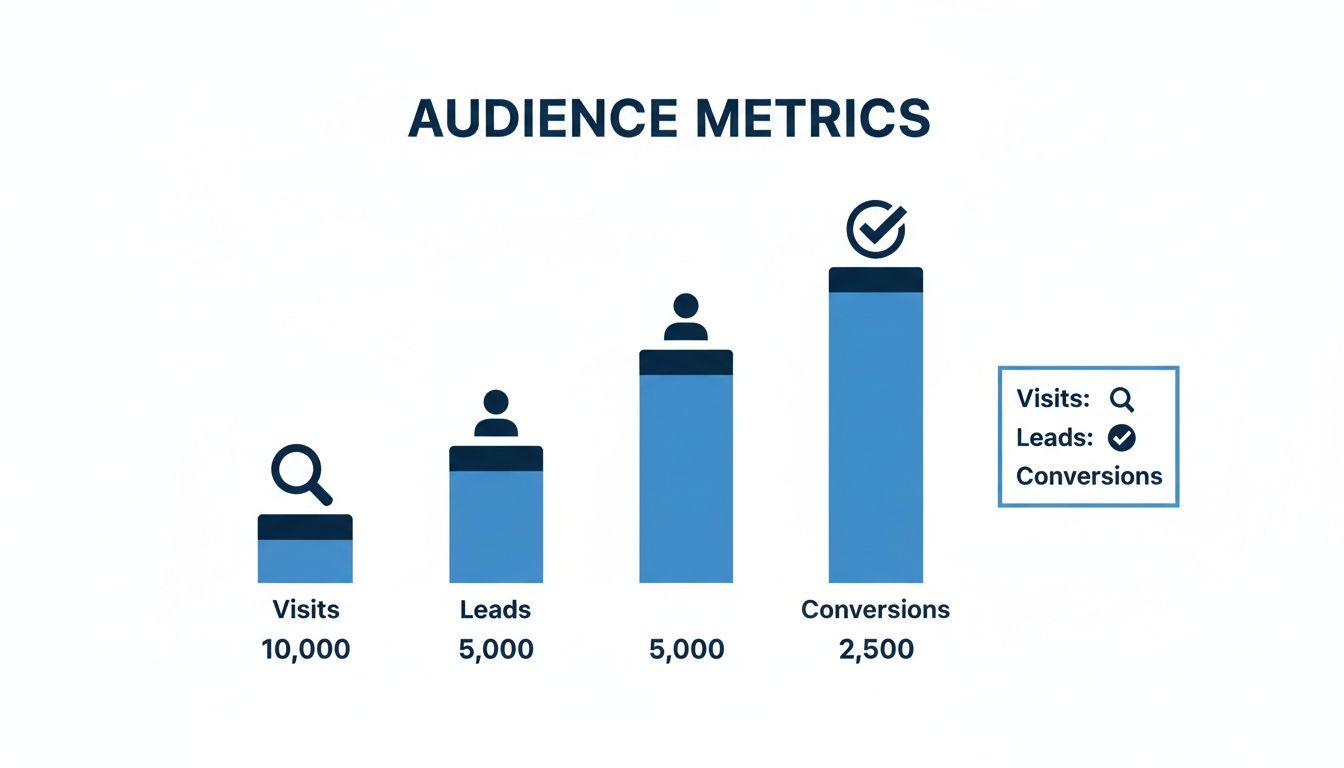
Infographic On Audience Metrics
This visual breaks down visits, leads and conversions, revealing drop-off points where you can unlock the biggest gains. Analytics tools will drill into which campaigns push prospects through each stage most efficiently.
Spot high-traffic channels with low conversion rates
Boost creative or landing-page tests where drop-off is steep
Redirect budget to funnels with consistent lead-to-sale ratios
Balance Risk And Scale Up
Mix proven channels with daring experiments to minimise risk and uncover fresh opportunities. Here’s a simple allocation framework:
Core Budget: 70% on established channels like search and display
Test Budget: 20% on emerging platforms and ad formats
Flex Fund: 10% for rapid pivots or seasonal bursts
One retail SME tripled its return after moving test funds from display ads to short-form video.
Best Practices For Allocation
Rotate channel budgets monthly to capture seasonal shifts
Apply day-parting to spend more during peak user hours
Use audience segment insights to sharpen targeting
Pair paid tests with organic efforts for a holistic view
Key Budget Insights
Every budget decision should tie back to your SMART goals and KPIs. When a channel underperforms, reallocate swiftly—and always rely on data over gut feel.
Monitor spend share versus channel growth rates
Rotate budgets weekly for agile shifts
Document learnings to guide future cycles
Celebrate small wins promptly to maintain momentum
Craft Content And Build SEO Foundations
Think of your content plan as a rail network. Each keyword is a track, guiding readers straight to the right page.
Without a clear map of user intent, you risk building dead ends when search trends shift. A solid plan stops wasted effort and confusion before it starts.
Chart high-traffic keywords as mainlines
Add long-tail sidings for niche subject areas
Confirm every route with real search data
Match content to what each visitor is looking for
With this blueprint, you’ll steer clear of off-track content and usher customers smoothly along your site.
Keyword Research And Topic Clusters
Good research is the cornerstone of any SEO effort. Follow these steps to uncover topics that matter:
Identify seed keywords that resonate with your audience’s language
Analyse search volume and difficulty to spot the biggest opportunities
Group related terms into topic clusters around a central “pillar” page
Align clusters with stages of the customer journey for extra relevance
This process yields content that not only ranks but also converts. For instance, a local café could group “best flat white” with “coffee beans supplier” to create a comprehensive coffee hub. Interlink blog posts and product pages to signal depth and expertise to search engines.
Design Mobile-First Content
In Australia, over 70% of web traffic comes from mobile devices. If your content isn’t optimised for small screens, you’re leaving visitors frustrated.
Use responsive images and flexible layouts so your pages adapt to every device. Check font sizes, tap targets and heading structures to keep everything legible.
Over 70% of web traffic comes from mobile devices in Australia, highlighting the need for mobile-first design.
Implement fluid grids for dynamic layouts
Serve scaled images with srcset
Test interactions on real mobiles and tablets
Next up: setting templates for consistent blog posts, landing pages and on-page tweaks.
Content Templates For Consistent Execution
Here are key templates to standardise your output:
Blog Post: Purpose is to educate and attract; Key Element includes an engaging headline and clear subheadings
Landing Page: Purpose is to convert visitors into leads or sales; Key Element includes a strong Call-to-Action and trust signals
On-Page Tweak: Purpose is to improve existing pages; Key Element includes an optimised title and meta description
Compile a list of target keywords and intent statements
Arrange keywords into clusters around your pillar pages
Confirm mobile-friendly layouts and fast load times
Optimise meta titles and descriptions with focus terms
Add local signals, like accurate Google Business details
Now, let’s look at how to prepare for the next wave of search.
Prepare For Voice And AI Search
Voice assistants and AI-driven tools are reshaping how people search online. Writing for natural language queries boosts your chances of appearing in voice results.
AI content assistants can help brainstorm topics and draft conversational outlines. Start with their suggestions, then add local context and your own expert voice.
“Optimising for voice search can increase local visibility by 30%,” according to industry reports.
Local signals remain just as important for voice queries:
NAP Consistency: Builds trust with search engines
Google Business: Drives map pack rankings
Reviews: Influences click-through rates
By combining thorough keyword work, mobile-first design, consistent templates and AI readiness, you’ll build SEO foundations that last. This approach not only keeps you on track today but adapts seamlessly as search behaviour evolves.
Implement Paid Media And Optimise Performance
Paid media gives you a direct line to fresh prospects and sharper campaign insights. By running ads on search engines, social channels and programmatic networks, you’re in control of who sees your message, how much you spend and how you pivot in real time.
When you set a budget, choose a daily or lifetime cap that matches your SMART goals. This way, you avoid overspend and can quickly reinvest in ads that deliver.
Keep your creative tightly focused on what matters to your audience. Swap headlines, images or short clips to uncover what truly resonates.
Craft messages that tackle a specific pain point
Use a clear call to action like Download Guide or Book Now
Mirror your ad copy and visuals on the landing page for a seamless journey
Selecting Paid Platforms
Your choice of platform hinges on where your customers spend their time.
Search ads on Google or Bing catch people ready to act. Social ads on Facebook and LinkedIn spark interest and build trust. Programmatic buys let you reach visitors across hundreds of sites—perfect for retargeting those who left without converting.
Key Insight Programmatic display can boost remarketing conversion rates by 30% when paired with targeted audiences.
Google Ads for high-intent search traffic
Facebook Ads for granular demographic and interest-based targeting
LinkedIn Ads to engage professionals and decision-makers
Programmatic for broad, context-based reach
Analyse Campaign Metrics
Monitor these core metrics and their formulas to keep performance on track:
CPC (Cost Per Click): Total Spend ÷ Clicks | Ideal Range: $0.50–$2.00
If CPC climbs above target, refine your match types or narrow your audience. A sluggish CTR often means you need fresher headlines or a bolder call to action. And by setting the right conversion window in your analytics, you’ll credit each channel fairly.
Iterative Testing And Reporting
Ongoing tests are the engine room of paid media success. Start with a dashboard that shines a spotlight on your top three KPIs—no clutter, just clarity.
Build custom dashboards in Google Data Studio
Hold weekly performance huddles with your team
Shift budget toward your highest-performing ads
Small tweaks add up. One retail client, for example, lifted conversions by 20% in just two weeks after A/B testing two Facebook creatives.
Log every test result in a shared spreadsheet to avoid repeating experiments. Adopt clear naming conventions for campaigns and ad sets so winners are obvious at a glance. Then use automated rules to pause underperformers or boost spend on ads that hit key thresholds.
For SMBs, blending paid media with SEO and content marketing delivers both quick wins and long-term growth. Keep your brand voice consistent across every channel, review progress with stakeholders each month, and start small when exploring new platforms. That way, you can test before you fully commit your budget.
FAQ
Paid campaigns often show early signs of success within 3 months, while organic SEO usually needs around 6–12 months to gain real traction.
Think of paid ads as quick-sprouting seedlings. Organic SEO, by contrast, is more like a climbing vine—slow to start but building strength over time.
CPC and CTR improvements shine a light on ad efficiency
Uplifts in conversion rate indicate your message is resonating
Strong lead quality numbers tie directly back to business impact
Track these metrics weekly to decide which tactics deserve more budget. For example, a local retailer invested AU$2,000 in search ads and enjoyed a 35% jump in qualified leads in just eight weeks.
Which Channels Suit B2B And B2C
B2B Primary Channels: LinkedIn, Email Marketing Best Tactic: Thought Leadership
B2C Primary Channels: Instagram, Facebook Best Tactic: Product Demos
How Small Budgets Focus On High Impact Tactics
Tight budget? No worries. Aim for strategies that deliver big returns without a big outlay. Outsmart rather than outspend the giants.
Refine audience segments to reduce CPC
Tap into user-generated content for authentic reach
Run time-limited offers to spark quick conversions
Reinvest savings into your top-performing ads
“Microtests on new ad formats can boost ROI by up to 50% with minimal spend.”
What Role Does AI Play In A Modern Plan
AI tools accelerate audience research by analysing trends and sentiment in seconds. It’s like having a team of analysts ready to guide your next move.
For content, AI can draft outlines and suggest headlines—letting you focus on adding real expertise. Chatbots on your site speed up response times and capture more leads.
By combining AI insights with your own judgement, you keep your strategy fresh and stay a step ahead of competitors.
Which KPI Matters Most Today
If you had to pick one metric, conversion rate usually takes the prize. It links clicks to actual outcomes, making ROI easy to measure.
Conversion Rate – Percentage of visitors who take a desired action
Cost per Acquisition – Total spend divided by new customers gained
Ready to transform your digital marketing strategy? Partner with Titan Blue Australia and tap into over 25 years of proven performance.
Titan Blue is your go-to digital partner for smart, results-driven solutions. We blend strategy, creativity and tech to grow your brand and get real results fast.