What is edm marketing: A Practical Guide to EDM Marketing Success
When you hear the term EDM marketing, or Electronic Direct Mail, don't get hung up on the acronym. At its core, it’s simply the art of sending commercial messages straight to someone's digital inbox. Think of it as a direct line of communication, allowing you to have a one-on-one conversation with your audience, warm up leads, and build relationships that last.
Decoding EDM Marketing
So, how does EDM marketing work in the real world?
Imagine you own a boutique fashion store. A potential customer pops onto your website, browses a few items, and signs up for your newsletter to get a 10% discount. That sign-up is the handshake—the permission slip you need to start a direct conversation.
EDM is the series of thoughtful messages you send after that initial handshake. It’s not about blasting a generic weekly newsletter to every single person on your list. Real EDM marketing is much smarter than that. It’s about sending targeted, relevant, and timely content that gently guides a person from a casual browser to a loyal, paying customer. This direct connection is a cornerstone of any solid approach to digital marketing in Australia, forming a crucial bridge between your brand and your audience.
The Core Components of EDM
At its heart, any successful EDM strategy is built on a few key pillars. Nail these, and you'll have a solid foundation for campaigns that actually get results.
Here’s what you need:
A Quality List: This is your foundation. It’s a collection of email addresses from people who have explicitly given you permission—or opted-in—to hear from you.
Segmentation: This is where you slice and dice your email list into smaller, more focused groups based on specific criteria. You might segment by purchase history, location, or even how they’ve interacted with your past emails.
Personalised Content: Once you have your segments, you can create content that speaks directly to each group's interests. A first-time buyer might get a welcome series, while a long-term customer could get exclusive early access to a new collection.
Moving Beyond the "Batch and Blast"
In the early days, EDM was often just about "batch and blast" emails—firing off one identical message to an entire database. Let's be clear: that outdated approach is highly ineffective because it ignores what individual customers actually care about.
Modern EDM is the complete opposite. It's a data-driven discipline focused entirely on delivering value.
This evolution is critical because today's consumers expect relevance. A generic promotion is easy to ignore, but an email recommending a product based on a previous purchase? That feels helpful and personal. The ideas behind this are universal; for a broader look at how these principles work across different sectors, it's worth reviewing general email marketing strategies for businesses in industries like hospitality.
By focusing on what your audience actually wants, you transform your presence in their inbox from just more noise into a welcome and valuable interaction.
Why Australian Businesses Rely on EDM
In a world of fleeting social media trends and algorithm shifts you can't predict, Electronic Direct Mail (EDM) offers something incredibly rare: stability and direct control. For Australian businesses, building a solid email list isn't just another marketing task; it's about creating a tangible asset. This asset means you own your customer relationships, freeing you from the whims of third-party platforms.
When you post on social media, you're essentially renting space on someone else's property. One algorithm change can tank your reach overnight, cutting you off from the very audience you worked so hard to build.
EDM flips that dynamic completely. Your email list is yours. It's a direct line of communication that you control, ensuring your messages land right in your audience’s digital doorstep.
This direct access translates into one of marketing's biggest wins: a seriously impressive return on investment. With email consistently delivering a high ROI, it remains one of the most cost-effective channels out there. Every dollar you put into a well-planned EDM campaign has the potential to generate significant revenue, making it a smart move for businesses of any size.
Turning Clicks into Customers
The real magic of EDM marketing is its power to drive specific, measurable actions. It’s brilliant at turning casual interest into profitable outcomes by speaking directly to a customer's needs at just the right moment. By using automation and data, you can create highly relevant experiences that feel personal and timely.
Here are a few real-world examples of how this plays out:
Recovering Lost Sales: An online retailer in Melbourne sees a customer has left items in their shopping cart. A few hours later, an automated "abandoned cart" email is triggered. It’s a gentle nudge, reminding them of the products they liked and maybe offering a small discount to seal the deal. This simple, automated action can recover a huge percentage of otherwise lost sales.
Building Brand Loyalty: A local café on the Gold Coast uses segmented newsletters to connect with its regulars. They might send an exclusive offer for a free coffee to customers who haven't visited in a month or announce a new seasonal menu to their most loyal patrons. This kind of targeted communication makes customers feel seen and keeps the brand top-of-mind.
Nurturing High-Value Leads: A Sydney-based law firm can use EDM to nurture potential clients who downloaded an info guide from their website. Over the next few weeks, they can send a series of helpful emails that build trust and establish their expertise. By the time that person is ready to seek legal advice, the firm is the obvious choice.
These scenarios show how EDM is so much more than just sending newsletters; it's a strategic tool for guiding customers along their journey with your brand.
Owning Your Audience Connection
At the end of the day, the reason so many Aussie businesses swear by EDM is that it builds a deeper connection with customers. A well-crafted email strategy lets you deliver genuine value, whether that’s through exclusive content, personalised recommendations, or special offers. This consistent delivery of value is the bedrock of building lasting relationships and increasing customer lifetime value.
Stronger relationships naturally lead to stronger revenue. By cultivating an engaged email list, businesses create a reliable channel for driving sales and promoting new products. These efforts are the core of powerful customer engagement strategies that turn one-time buyers into loyal brand advocates.
In essence, EDM marketing gives you the framework to not only reach your audience but to truly connect with them in a way that directly fuels your business goals.
How to Build Your First EDM Campaign
Jumping into electronic direct mail (EDM) marketing might feel like a huge task, but it really just breaks down into a few clear, manageable steps. Your first campaign isn't about having a massive email list from day one; it's about building a solid foundation. Get the goal right, find the right audience, and deliver a message that actually connects. Start smart, and the momentum will follow.
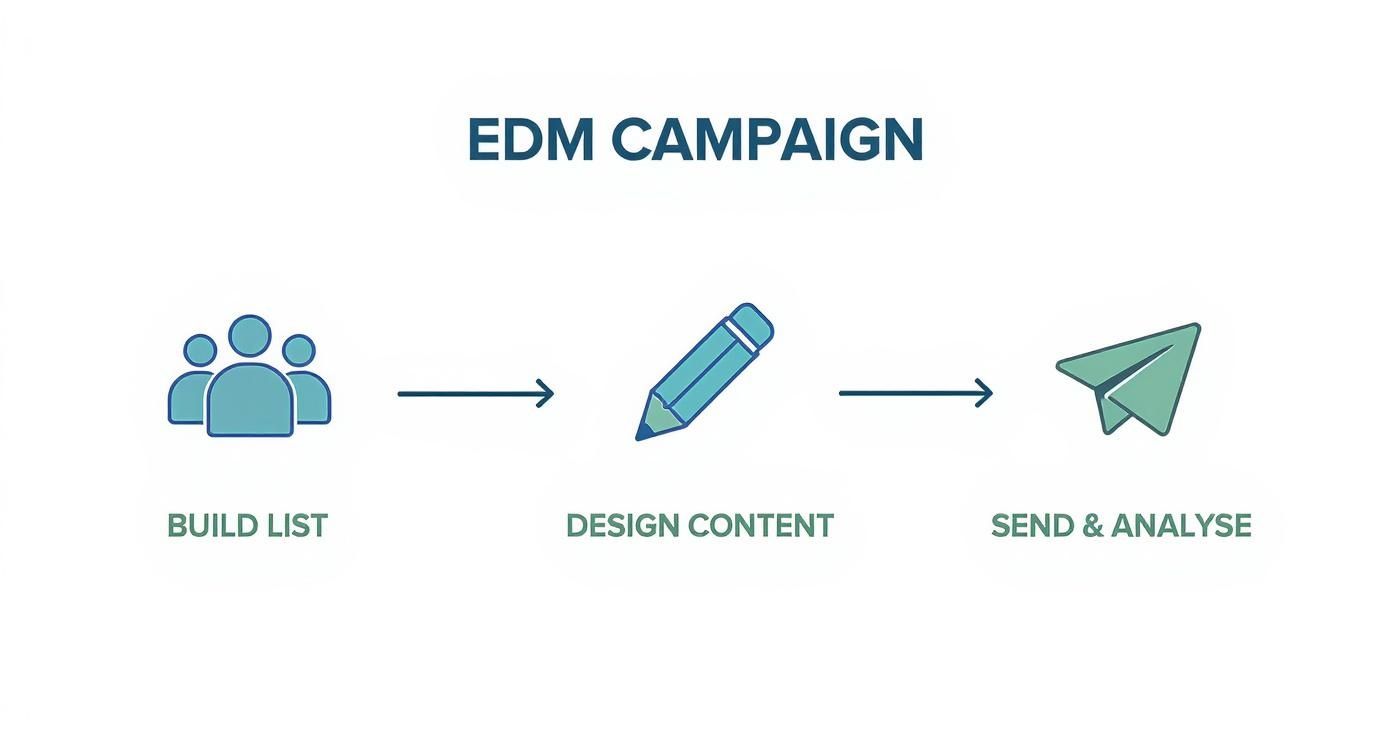
Think of it as a simple, three-stage cycle: build your list, design your content, then send it out and analyse what happened.
This process isn't a one-and-done deal. It's a loop. What you learn from your analysis feeds right back into how you grow your list and what you create next time.
Setting Your Campaign Goals
Before you write a single word, you need to know why you're sending the email. A clear objective is your North Star, guiding every decision you make, from the subject line to the call-to-action. Without a goal, you’re just sending emails into the void and hoping for the best.
What do you want to achieve? Maybe you want to build brand awareness, drive traffic to a new blog post, or generate direct sales for a product launch. Defining this upfront is non-negotiable.
For instance, a campaign designed to generate sales will look totally different from one meant to nurture new leads. The sales email might be packed with product shots and big "Shop Now" buttons. The nurture email, on the other hand, would focus on helpful, educational content to build trust over time.
Building and Segmenting Your Audience
Your email list is the heart and soul of your EDM efforts. It's absolutely vital to build this list with people who have explicitly given you permission to contact them. Whatever you do, never buy email lists. It’s a fast track to a damaged sender reputation and a breach of spam laws.
Focus on quality over quantity, always. An engaged list of 1,000 subscribers who genuinely want to hear from you is infinitely more valuable than a list of 10,000 who don't care.
Once you have a list, the real magic happens with segmentation. This simply means dividing your audience into smaller, more targeted groups based on shared characteristics. It’s the difference between shouting a generic message to a crowd and having a meaningful, relevant conversation.
You can segment your audience based on all sorts of data:
Demographics: Group subscribers by age, gender, or location.
Purchase History: Target customers who’ve bought specific products or spent over a certain amount.
Website Behaviour: Create segments for people who have visited certain pages or abandoned their shopping cart.
Engagement Level: Separate your super-fans from those who haven't opened an email in months.
Crafting Compelling Content
With your goals set and your audience segmented, it’s time to actually create the email. In a crowded inbox, your content needs to grab attention and persuade the reader to take that next step.
It all starts with a powerful subject line. It's the first thing anyone sees, and it alone often decides if your email gets opened or ignored. Keep it short, spark some curiosity, and personalise it whenever you can.
The body of your email has to deliver on the promise of your subject line. Use a clean, mobile-friendly design with a clear visual hierarchy. Good headings, short paragraphs, and great images work together to guide the reader’s eye and make your message easy to scan and digest. And your call-to-action (CTA)? It needs to be unmissable, telling the reader exactly what to do next.
Setting Up and Automating Your Campaign
Automation is where EDM marketing gets really powerful, allowing you to send timely, relevant messages without lifting a finger for each one. A welcome series is the perfect place to start. This is simply a sequence of emails automatically sent to new subscribers to introduce your brand and start building that relationship.
For those wanting to go a step further, understanding the principles of marketing automation opens up a whole new world of sophisticated, personalised customer journeys. These automated workflows handle the repetitive tasks, freeing you up to focus on the big-picture strategy.
Testing and Optimising for Success
Don't make the mistake of thinking your job is done once you hit "send." The final step is to test different elements to see what truly resonates with your audience. This is usually done through A/B testing, where you send two versions of an email to a small slice of your list to see which one performs better before sending the winner to everyone else.
You could test different subject lines, CTA button colours, or even the tone of your email copy. For a deep dive into the practical steps, check out this excellent guide to A/B testing email campaigns. The insights you gain from testing are pure gold for improving every campaign you send in the future.
Understanding Your Campaign Performance Metrics
So you've launched your EDM campaign. Great first step, but how do you know if it’s actually working? Firing off emails into the void isn't a strategy. You need to listen to the story your data is telling you, and that's where performance metrics—or Key Performance Indicators (KPIs)—come in.
Think of these numbers as the dashboard in your car. Each one gives you a vital piece of information, helping you steer your strategy, accelerate what’s working, and pull over to fix what isn’t.
Instead of drowning in a sea of data, focusing on a few core metrics will give you a crystal-clear picture of your campaign’s health and its real impact on your business.
Key Metrics That Truly Matter
When you open up your campaign report, it’s easy to get distracted by vanity metrics. But the smartest marketers track the numbers that connect directly to engagement and revenue.
Here are the essential KPIs you need to keep a close eye on:
Open Rate: This is simply the percentage of people who opened your email. A high open rate is a good sign—it means your subject line was compelling and your brand is recognised and trusted in the inbox.
Click-Through Rate (CTR): Now we're getting warmer. This measures the percentage of recipients who clicked on at least one link inside your email. CTR is a powerful indicator of genuine engagement, showing your content hit the mark and your call-to-action was persuasive.
Conversion Rate: This is the big one. It tracks the percentage of people who clicked a link and then completed the action you wanted them to, like making a purchase or filling out a form. This metric is the ultimate proof that your campaign is driving actual business outcomes.
Unsubscribe Rate: This shows you the percentage of people who opted out after receiving your email. A few unsubscribes are perfectly normal with any send, but a spike could be a red flag that your content isn't meeting your audience's expectations.
By focusing on metrics like CTR and conversion rate over open rate alone, you shift from measuring attention to measuring action. Action is what grows your business.
How Australian Campaigns Stack Up
It’s one thing to know your own numbers, but understanding the local benchmarks helps put your results into context. The Australian market has its own unique rhythm of engagement.
Here in Australia, EDM is still an incredibly effective tool. We see a remarkable average email open rate of around 43.5%, which comfortably beats the global averages. This shows just how receptive Aussie consumers are to a well-crafted email.
Even better, Australians also have the world's highest click-to-open rates at about 8.3%. That means nearly one in twelve people who open an email are engaged enough to click a link. On the flip side, the local market sees a slightly higher unsubscribe rate of around 0.37%, which tells us that while audiences are engaged, they won't hesitate to opt out if the content isn't hitting the mark.
Connecting Metrics to Your Strategy
Each metric is a clue that helps you refine your approach. A low open rate might mean your subject lines need work, or maybe your sender name isn't recognisable enough.
On the other hand, a high open rate but a low CTR suggests your subject line wrote a cheque that the email content couldn't cash. To get a better handle on this crucial metric, you can use a click-through rate calculator to analyse your performance in more detail.
By regularly reviewing these KPIs, you can stop guessing and start building a data-driven strategy. This continuous cycle of measuring, learning, and optimising is the secret to building an EDM program that delivers consistent, predictable results for your business.
Staying Compliant with Australian Spam Laws
Operating in the world of email marketing isn’t just a box-ticking exercise; it's the foundation of a trustworthy relationship with your audience. For any Australian business, getting your head around the Spam Act 2003 is non-negotiable. This law is designed to protect people from unwanted marketing messages, and it sets crystal-clear rules for what you can and can’t do.
Sticking to these laws isn’t just about dodging hefty fines (which can be massive, by the way). It’s about showing respect for your subscribers' inboxes, which builds the kind of brand integrity that creates loyal customers. When people trust you to respect their choices, they’re far more likely to actually open and engage with your emails.
The Three Pillars of Spam Act Compliance
Navigating the Spam Act is pretty straightforward once you understand its three core principles. Every single commercial message you send, whether it’s an email or an SMS, has to meet these three conditions. Think of them as the essential ingredients for any compliant and ethical campaign.
Building your strategy around these pillars ensures you’re not only meeting your legal duties but also following best practices for a great customer experience.
You Must Have Consent: You absolutely need permission to send marketing messages. This consent can be express (someone actively ticks a box to subscribe) or inferred (based on an existing business relationship, like a recent purchase).
You Must Identify Yourself: Every message has to clearly and accurately identify you or your business as the sender. This means including your correct contact information.
You Must Provide a Functional Unsubscribe: Every email has to include a simple, clear, and working way for the recipient to opt out of future messages. This unsubscribe link must be easy to find and use.
Putting Compliance into Practice
Knowing the rules is one thing, but applying them consistently is what really counts. Let’s break down how these principles translate into your day-to-day marketing.
When it comes to consent, a pre-ticked subscription box on your checkout page doesn't cut it. That’s not valid express consent. The user has to actively choose to opt-in. Inferred consent is a bit more nuanced—if someone buys a product from you, you can probably infer consent to email them about similar products, but not about completely unrelated services.
The golden rule of consent is simple: if you have to wonder whether you have permission to email someone, you probably don’t. Always aim for clear, unambiguous consent to build a high-quality, engaged email list.
Your sender identification should be displayed clearly, usually in the email footer. This means including your business name, Australian Business Number (ABN), and a physical or postal address. Hiding this info or making it hard to find is a direct breach of the Act.
Finally, that unsubscribe link must work, and you need to act on it fast. When someone opts out, you’re legally required to process that request within five working days. Making the link tiny, hiding it in confusing text, or forcing people to log in to unsubscribe are all terrible practices that violate the spirit and letter of the law. A simple, one-click unsubscribe is always the best way to go.
The Future of EDM with AI and Personalisation
The world of EDM marketing is always evolving, and right now, two massive forces are shaping its future: Artificial Intelligence (AI) and hyper-personalisation. These aren't just buzzwords; they represent a fundamental shift in how businesses connect with their audience.
We're moving beyond generic email blasts and into the realm of intelligent, one-to-one conversations.
AI is completely changing the game for marketers. It can automate and fine-tune tasks that once soaked up hours of manual work, like figuring out the perfect time to send an email for maximum opens or even drafting subject lines that people actually want to click. This frees up marketing teams to focus on the big picture—strategy—instead of getting bogged down in repetitive tasks.
The Rise of Hyper-Personalisation
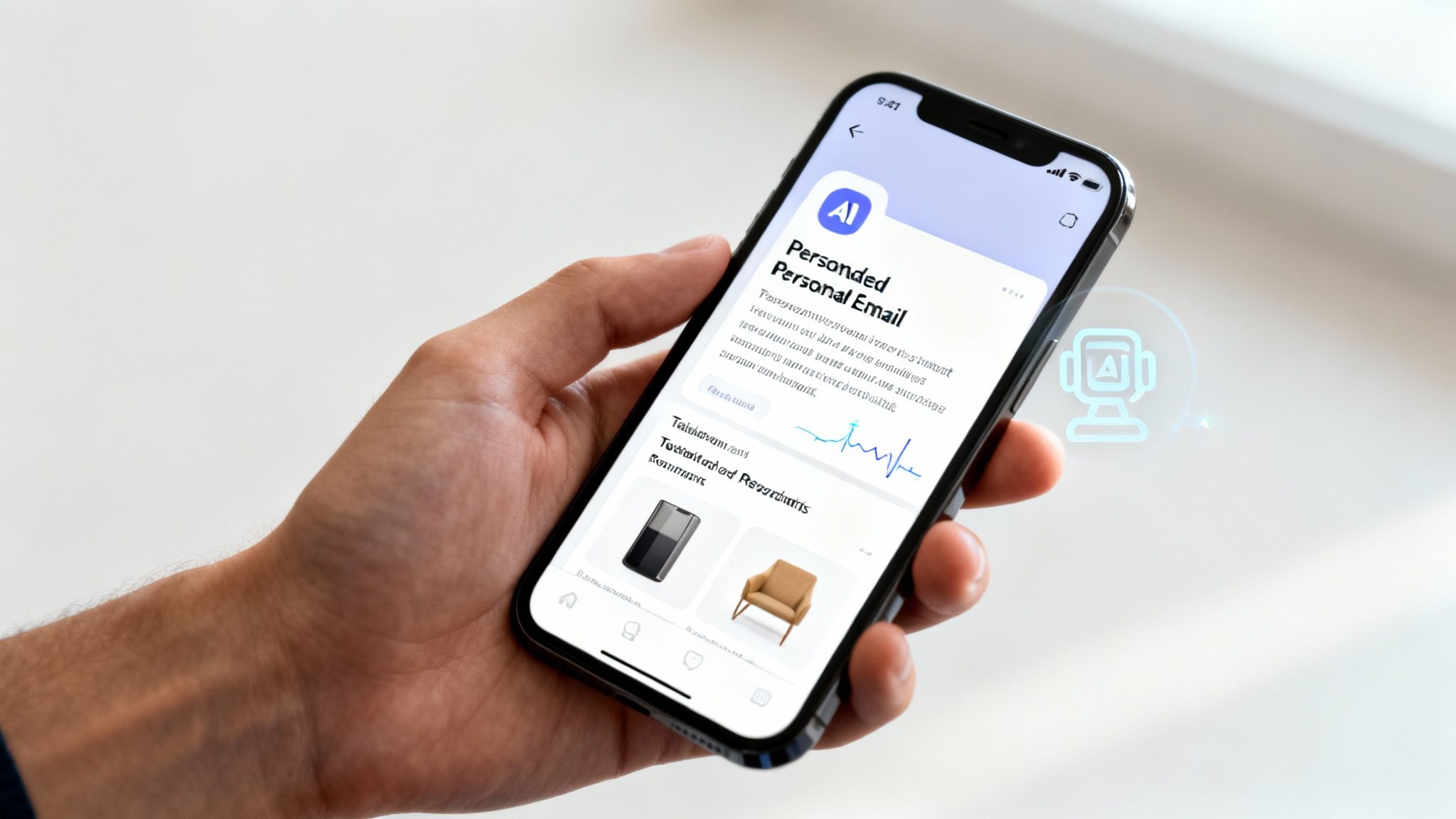
Hyper-personalisation takes the core idea of EDM—speaking directly to your customer—and cranks it up to eleven. It’s a world away from just dropping a subscriber's first name into a greeting. True hyper-personalisation uses real-time data to serve up dynamic content that feels uniquely relevant to each person.
Imagine an online store sending an email that doesn’t just show random sale items. Instead, it features products based on a customer’s recent browsing history, past purchases, and maybe even their local weather. That’s the power of a hyper-personalised approach. It makes the customer feel seen and understood, turning a simple promotion into a genuinely helpful, curated experience.
Dynamic Content: The content inside an email changes based on the recipient’s data, ensuring it’s always relevant.
Predictive Recommendations: AI algorithms anticipate what a user might be interested in next and suggest products or content accordingly.
Behavioural Triggers: Emails are sent automatically based on what a user does, like visiting a specific webpage or abandoning their shopping cart.
Embracing AI and Overcoming the Hurdles
The engine driving much of this innovation involves technologies like Large Language Models (LLMs), which are becoming essential for creating personalised content at scale. If you're curious about the tech behind it all, our guide explaining what Large Language Models are is a great place to start. These AI tools help craft nuanced and effective messages tailored for different audience segments.
But let's be realistic—getting to this advanced stage of EDM isn’t without its challenges. For many Australian businesses, just getting the basics of data management right is still a major roadblock. In fact, a significant 18-20% of professionals point to data gathering and audience segmentation as their biggest obstacles.
And even with all these powerful new tools, creating personalised content is still a time-consuming process for many. You can explore more industry data from MailerLite to see how Australian businesses are navigating these issues. The future of EDM clearly lies in closing the gap between what the technology can do and what businesses can practically implement.
Common Questions About EDM Marketing
As you get ready to launch or refine your EDM marketing, a few questions always seem to pop up. Getting your head around these practical points can make all the difference, giving you the confidence that you’re on the right track from day one.
Let’s tackle some of the most common ones.
How Often Should I Send Marketing Emails?
There’s no magic number here; it all comes down to your audience and how much value you’re providing. The key is consistency over intensity. For some brands, a weekly newsletter hits the perfect note. For others, a monthly round-up or the occasional promo email is all they need to stay connected.
The best approach? Let your subscribers tell you. Offer preferences when they sign up, allowing them to choose how often they want to hear from you. Keep a close eye on your engagement metrics—if your unsubscribe rates spike after you ramp up the frequency, that’s a clear signal to pull back.
Your sending schedule should be dictated by one thing: how often you have something genuinely valuable to say. Firing off emails just to stick to a schedule is a fast track to annoying your audience.
What Makes a Good EDM Campaign?
A great EDM campaign isn’t just about a flashy design. It’s built on three core elements that have to work together to give your subscriber a seamless experience.
Relevance: The message has to click with the person receiving it. This is where audience segmentation becomes your best friend, allowing you to send targeted content that actually resonates.
Value: Every single email should offer something worthwhile. It could be a discount, genuinely helpful information, or exclusive content they can’t get anywhere else.
A Clear Action: Don’t leave them guessing. Your email needs to guide the subscriber toward a specific next step with a compelling call-to-action (CTA).
Thinking about the user is essential, especially when you consider just how many people use email. Back in 2021, there were over 4.1 billion global email users, and that number is expected to shoot past 4.5 billion by 2025. This just reinforces email's role as a primary communication channel, a trend we see reflected in Australia's high digital adoption rates. You can dive deeper into these trends by exploring more digital marketing statistics.
At Titan Blue Australia, we build digital strategies that deliver real results. With over two decades of experience helping Australian businesses grow, we combine proven performance with forward-thinking solutions. https://titanblue.com.au
Titan Blue is your go-to digital partner for smart, results-driven solutions. We blend strategy, creativity and tech to grow your brand and get real results fast.