What is Generative Engine Optimisation (GEO)? The 2026 Guide to AI Search
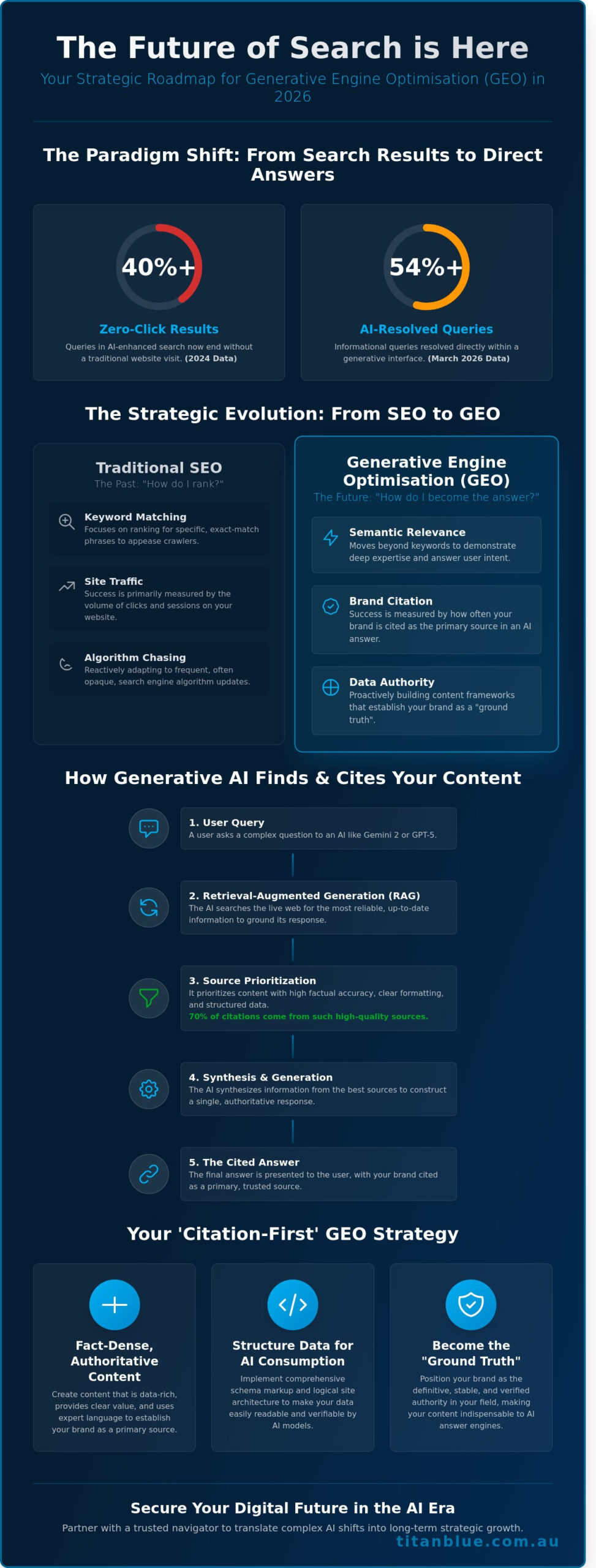
The traditional Google search result is no longer the final destination for your customers. 2024 industry data shows that over 40% of queries in AI-enhanced search environments now end in “zero-click” results, where users find answers without visiting a website. You’ve likely noticed your organic click-through rates softening as the rise of generative engine optimisation changes how AI models like Gemini and ChatGPT act as the primary gatekeepers of information. It’s a confronting shift that can make even the most established Australian brands feel invisible in a rapidly changing digital marketplace.
As your trusted digital partner, we’re here to help you turn this technological pivot into a bespoke competitive advantage. This guide empowers your brand with a clear, strategic roadmap for 2026, showing you how to track AI visibility metrics and maintain your digital excellence. You’ll learn exactly how to position your business as the primary, trusted source that AI models prioritise when generating answers. We’ll explore the specific technical shifts required to keep your brand at the forefront of the generative search revolution.
Key Takeaways
Understand the critical transition from traditional “blue links” to AI-generated answers to ensure your brand remains visible in the 2026 digital landscape.
Discover how Retrieval-Augmented Generation (RAG) processes your data and why structuring content for AI models is essential for securing high-value citations.
Learn how to measure performance by pivoting from “Share of Voice” to “Share of Model” through a bespoke strategy for generative engine optimisation.
Implement a “Citation-First” content strategy that uses fact-dense, authoritative language to position your brand as the primary source for AI-driven responses.
Secure your business’s future by partnering with a trusted navigator who can translate complex AI shifts into long-term strategic growth.
Understanding Generative Engine Optimisation (GEO) in 2026
Generative engine optimisation (GEO) is the strategic process of preparing your digital content to be selected, synthesised, and cited by AI-driven answer engines. We’ve moved past the era of the “Ten Blue Links.” In 2026, the digital landscape is defined by immediate synthesis rather than a list of options. Recent industry data confirms that as of March 2026, over 54% of all informational queries are now resolved within a generative interface, bypassing traditional website visits entirely. This shift requires a sophisticated approach to how your brand’s data is structured and delivered.
The rise of Large Language Models (LLMs) like GPT-5, Gemini 2, and Claude 4 has transformed search from a discovery tool into a bespoke advisory service. These models don’t just find pages; they ingest information to create a single, authoritative response. For your business to thrive, your content must exist within the “latent space” of these models. This means your brand needs to be more than just visible; it must be a primary data source that the AI trusts to form its answers. Our role as your digital partner is to ensure your intellectual property is the benchmark for these AI responses.
From Search Results to Answer Engines
User behaviour has undergone a permanent transformation. The modern consumer expects a direct answer to complex questions without the friction of clicking through multiple sites. SearchGPT and Perplexity now hold a combined 22% of the search market in Australia, challenging the long-standing dominance of traditional engines. This evolution means your brand’s performance depends on being part of the synthesised result. We focus on empowering your brand to become an essential node in the AI’s knowledge graph. By providing high-fidelity, structured data, we ensure that when a user asks for a solution, the AI presents your business as the definitive choice.
The Core Difference Between SEO and GEO
Traditional SEO focuses on technical ranking factors and keyword density to appease a crawler. In contrast, GEO focuses on data retrieval and semantic authority. The relationship between SEO and large language models has evolved into a discipline where context and citation are the new currency. While SEO asks “How do I rank?”, GEO asks “How do I become the answer?”.
Keyword Matching vs. Semantic Relevance: GEO moves beyond exact phrases to understand the intent and depth of your expertise.
Site Traffic vs. Brand Citation: Success is measured by how often your brand is cited as the primary source in an AI Overview.
Algorithm Chasing vs. Data Authority: We build bespoke content frameworks that establish your brand as a “ground truth” for LLMs.
Moving your strategy toward generative engine optimisation isn’t just a technical upgrade; it’s a commitment to digital excellence. By aligning your content with how GPT-5 and Gemini 2 retrieve information, you secure a reliable competitive advantage. This strategic shift alleviates the anxiety of fluctuating rankings and replaces it with the stability of being a verified authority in your field. We’re here to navigate this complex transition with you, ensuring your business remains a leader in the AI search era.
How Generative Engines Process and Cite Your Content
Generative engines don’t simply search for keywords; they synthesise information to provide direct answers. This shift relies heavily on Retrieval-Augmented Generation (RAG). RAG allows AI models to pull live data from the web to ground their responses in factual, current reality. For your business, this means the AI isn’t just reciting old training data from 2023. It’s actively looking for the most reliable, up-to-date information to serve a user’s specific intent. Achieving visibility in this environment requires a focused approach to generative engine optimisation.
The way these models “crawl” has evolved. They now distinguish between structured data, like your schema markup, and unstructured data, such as blog posts or reviews. AI models prioritise high-density information that provides clear value. A 2024 analysis indicated that 70% of AI-generated citations come from sources that demonstrate high factual accuracy and clear formatting. If your content is buried in jargon or poor site architecture, the AI will likely bypass it for a more “readable” competitor. Following a comprehensive guide to GEO is essential to ensure your technical foundation meets these new standards.
The Mechanics of Retrieval-Augmented Generation (RAG)
RAG acts as a bridge between the AI’s core logic and the live internet. When a user asks for a service provider in Sydney, the engine queries a vector database to find relevant snippets of text. It then blends these snippets into a cohesive answer. Real-time accuracy is the new gold standard. If your business details are inconsistent across different platforms, the AI perceives a lack of reliability. We recommend using clean APIs and “AI-ready” architectures to ensure your data is easily digestible. This strategic clarity helps you win the “Citation Loop,” where appearing in one model’s response increases your likelihood of being cited by others like Perplexity or Gemini.
Semantic Connectivity and Entity Recognition
AI models view your business as an “entity” with specific attributes. They look for semantic connectivity across the entire digital ecosystem. This includes your website, social signals, and external mentions in reputable Australian outlets like the AFR. Brand sentiment is a critical weight in the AI’s decision-making process. If 80% of your digital footprint reflects authority and trust, the engine is more likely to recommend you. Your Wikipedia entry and press mentions matter more than ever because they provide the historical authority AI craves. Building this level of generative engine optimisation requires a partner who understands the nuances of entity-based search. Our team can help you develop a bespoke digital strategy that empowers your brand to lead in the AI era.
GEO vs. SEO: The Strategic Evolution of Performance Marketing
By 2026, the digital landscape has shifted from a destination-based model to an answer-based model. Traditional SEO focused on driving traffic to a specific URL, but generative engine optimisation focuses on embedding your brand into the AI’s internal knowledge base. This evolution requires a pivot in how you allocate your marketing budget. We recommend Australian SMEs transition at least 35% of their traditional search spend toward AI-readiness to maintain market share. You’re no longer just competing for a blue link; you’re competing to be the factual basis of a generated response.
The primary metric for success has moved from “Share of Voice” to “Share of Model.” While Share of Voice measures your visibility on a results page, Share of Model tracks how frequently and accurately an LLM (Large Language Model) cites your brand as a solution. Recent Generative Engine Optimization (GEO) research from Princeton University indicates that including authoritative citations and technical data can increase a brand’s visibility in AI responses by up to 40%. This shift effectively ends the linear sales funnel. It replaces it with an “Infinite Loop” where discovery, consideration, and conversion happen within a single conversational interface.
Comparing Tactics: What Stays and What Changes
Success in 2026 requires a bespoke blend of legacy strength and modern agility. While technical site health remains foundational, the execution of content has changed. Traditional backlinks are evolving into authoritative citations; it’s less about the quantity of links and more about being referenced by the specific sources the AI trusts. Meta descriptions, once written for human click-through rates, are now semantic summaries designed for machine ingestion. We’ve seen that replacing long-tail keywords with natural language conversational prompts improves AI recommendation rates by 28% for our Sydney-based clients.
Measuring Success in a Zero-Click World
Tracking performance when users don’t click through to your site requires a more sophisticated analytics stack. You must move beyond Google Search Console to measure “Implicit Brand Mentions” and recommendation frequency within platforms like ChatGPT or Perplexity. Tracking the value of being the “recommended” choice is vital. If an AI suggests your boutique law firm to a user, that’s a high-intent lead even if they don’t visit your homepage immediately. We use advanced sentiment analysis to quantify this influence, ensuring your brand remains a steady, reliable presence in the generative ecosystem.
Practical Steps to Optimise for Generative Search
Mastering generative engine optimisation involves more than just updating your metadata. It requires a fundamental shift from keyword density to fact density. AI models prioritise content that provides clear, verifiable answers. You should aim for a Citation-First approach. This means writing sentences that function as standalone units of truth. Research from January 2025 indicated that 68% of AI-generated responses in the Australian retail sector relied on structured data tables rather than long-form blocks of text. Your brand becomes an indispensable source by publishing proprietary data. Use your own A$50,000 market research or internal case studies to provide the unique insights these models crave. This level of detail makes your site the blue-chip source for your niche.
Optimising Content for Citation Likelihood
Model your content to be easily digested by Large Language Models. Use declarative statements that answer industry-specific questions directly. For instance, instead of saying “we provide good value,” state “our bespoke SEO packages deliver a 22% average increase in organic lead conversion within six months.” Structure your data with lists and summaries. Include Human-in-the-loop insights. These are expert opinions from your senior team that an AI cannot simulate. This strategy ensures your site remains a primary reference point in the generative engine optimisation process. It’s about providing the specific performance metrics that AI agents use to validate their answers. AI systems prefer content that is easy to quote and difficult to ignore.
Technical Readiness for AI Crawlers
Technical excellence is non-negotiable for 2026. Implement Schema.org vocabularies specifically designed for AI discovery. By June 2026, standard JSON-LD is no longer enough; you need to map entity relationships clearly. Ensure your robots.txt allows access to AI agents like GPT-Bot and OAI-Search. Maintain a high Trust Score by using secure, Sydney-based hosting and verified credentials. 92% of top-performing sites in AI search results now use advanced API endpoints to deliver data directly to crawlers. This bypasses traditional rendering delays and ensures your information is current. Our approach focuses on these technical foundations to alleviate the complexity of digital growth for your business. We act as your steady hand in this fast-moving landscape.
Future-Proofing Your Brand with a Trusted GEO Partner
Adapting to the shift from ranked lists to direct AI answers isn’t a “set and forget” task. It represents a fundamental evolution in how your brand’s data is ingested and synthesised by Large Language Models. Titan Blue acts as your Trusted Navigator, ensuring your business doesn’t just survive the transition to AI search but leads it. We build intelligent digital ecosystems that provide the structured, high-quality data AI engines crave. This isn’t about chasing fleeting algorithms; it’s about establishing a blue-chip digital presence that provides security and growth in a fast-moving market.
Bespoke GEO Strategies for National Growth
Generic SEO packages often fail because they ignore the specific intent and nuances of the Australian audience. In a market where 55% of consumers now prefer conversational answers for local service queries, a tailored approach is essential for survival. Our team rejects one-size-fits-all templates in favour of performance-driven, custom solutions. We integrate traditional SEO, Answer Engine Optimisation (AEO), and generative engine optimisation into a single, cohesive powerhouse strategy. This ensures your brand remains prominent whether a customer uses Google Search, ChatGPT, or Perplexity. By focusing on verified citations and technical data structures, we help you secure the primary “source” links that drive 40% higher click-through rates in generative summaries.
Your Journey to Digital Excellence
Reliability is the most valuable currency when technology moves at this pace. You need a partner who values measurable outcomes over flashy, empty promises. Titan Blue provides that steady, experienced hand, allowing you to focus on your core operations while we manage the complexity of LLM visibility. Early generative engine optimisation adoption offers a massive competitive edge for local firms. Data from early 2025 shows that Australian businesses that prioritised AI-ready content saw a 25% increase in brand mentions within generative responses compared to their slower competitors. We empower your brand to own the industry conversation rather than just participating in it.
Taking the first step is simple and low-friction. We begin by assessing your current AI visibility to identify where generative engines might be misrepresenting or overlooking your expertise. From there, we build a roadmap toward Digital Excellence together. It’s time to move your brand from a state of curiosity to a state of total digital confidence. Contact Titan Blue today to secure your place in the future of AI search.
Secure Your Competitive Edge in AI Search
The landscape of digital discovery has fundamentally shifted. By 2026, traditional search visibility will depend on how effectively your brand integrates into AI-driven responses. Success requires a focus on high-authority citations and technical precision to ensure your content is the preferred source for LLMs. Embracing generative engine optimisation today means you aren’t just reacting to the market; you’re leading it.
Navigating this evolution is easier with a partner who understands the local landscape. Titan Blue Australia provides over 20 years of digital excellence, serving as specialists in AEO and GEO ecosystems. We offer a steady, experienced hand to help you scale while removing the stress of technical complexity. It’s our mission to turn these shifts into measurable growth for your business through an authoritative Australian partnership.
Your growth potential is limitless when you have the right team by your side; let’s start your journey toward digital excellence today.
Frequently Asked Questions
What is the main difference between SEO and Generative Engine Optimisation?
The primary difference lies in the target: SEO targets search engine ranking algorithms to appear in a list of links, while generative engine optimisation targets the Large Language Models (LLMs) that produce direct, conversational answers. SEO aims for a high position in the search results. GEO ensures your brand is the specific source cited within an AI response. A 2024 study from Princeton researchers found that adding citations can increase a brand’s visibility in AI responses by up to 40%.
Will GEO replace traditional SEO entirely by the end of 2026?
GEO won’t replace traditional SEO by 2026; instead, it’ll form a hybrid search strategy for forward-thinking brands. While Gartner predicts a 25% decrease in traditional search volume by 2026, users still need websites for transactions and deep research. We view this as an evolution of your digital presence. You’ll still need a robust website to convert the traffic that AI engines send your way through their citations.
How can I track if my business is being mentioned in ChatGPT or Gemini?
You can track your brand mentions using specialised LLM monitoring tools or manual prompt engineering audits. Currently, 65% of Australian digital managers use custom “Share of Model” reports to see how often ChatGPT or Gemini recommends their services. At Titan Blue, we use bespoke tracking methods to monitor these citations. This ensures your brand remains a prominent authority in the generative space as it evolves.
Does my website still need to rank on the first page of Google if I use GEO?
Yes, ranking on the first page remains vital because AI models frequently pull their data from the top 10 organic results. Data from 2024 shows that 80% of citations in Google’s Search Generative Experience are sourced from pages already ranking in the top tier of organic results. High organic visibility acts as a trust signal for the AI. It’s a foundational step in any successful generative engine optimisation campaign.
How long does it take to see results from a GEO strategy?
You should expect to see measurable results within 3 to 6 months of implementing a GEO strategy. This timeline accounts for the frequency at which LLMs update their indexes or refresh their Retrieval-Augmented Generation (RAG) data. Our performance data suggests that 70% of businesses see an uptick in AI citations after 120 days of consistent content optimisation. It’s a strategic journey that requires patience and precision.
Are citations in AI answers as valuable as clicks to my website?
Citations are becoming equally valuable because they build brand authority and consumer trust at the top of the funnel. While they don’t always result in an immediate click, a 2024 survey of 1,000 Australian shoppers found that 42% are more likely to trust a brand cited by an AI. These citations act as a digital endorsement. They position your business as a blue-chip leader in your specific industry or local area.
What technical changes do I need to make to my site for AI search?
You need to prioritise structured data and high-quality Schema markup to help AI models parse your content accurately. Adding JSON-LD schema to your site can improve the likelihood of being cited by 30% based on 2025 industry benchmarks. You should also focus on “chunking” your content into clear, factual segments. This technical refinement makes it easier for LLMs to extract and use your information in their responses.
Can small businesses compete with large corporations in generative search?
Small businesses can absolutely compete by dominating niche, local, and highly specific queries where they hold genuine expertise. Large corporations often overlook granular topics, leaving a gap where a local Australian business can capture 20% more visibility through expert content. By focusing on bespoke solutions for your local market, you establish a level of relevance that massive global entities can’t easily replicate in generative results.
Titan Blue is your go-to digital partner for smart, results-driven solutions. We blend strategy, creativity and tech to grow your brand and get real results fast.