


Last updated:
TL;DR:
- Effective online lead generation is a structured process involving stages that attract, qualify, and convert prospects into customers. SMB owners must focus on demand and lead gen together while measuring each funnel stage with specific KPIs to optimize results. Building a clear workflow and leveraging automation and AI enhances speed, qualification, and overall system performance.
If you run a small or medium-sized business and feel like your website is getting traffic but not producing customers, you are not alone. Understanding what is lead generation online is the starting point for fixing that problem. Most SMB owners treat lead generation as a single action, like running a Google Ad or posting on social media. It is not. It is a structured process with distinct stages, and when you understand how those stages connect, you stop chasing one-off wins and start building something that works consistently.
Table of Contents
- Key takeaways
- What online lead generation actually means
- Lead generation workflows and automation
- How to generate online leads: practical steps
- Measuring and optimising lead gen performance
- Myths about online lead generation
- My honest take on SMB lead generation
- How Titan Blue helps SMBs generate more leads
- FAQ
Key takeaways
| Point | Details |
|---|---|
| Lead gen is a process, not a tactic | Online lead generation works across funnel stages, each with a specific goal and metric. |
| Demand gen comes first | Building awareness before capturing leads produces higher quality contacts and better conversion rates. |
| Automation reduces lead loss | A proper lead generation workflow with routing and nurture sequences keeps leads engaged until they are ready to buy. |
| Speed to lead matters enormously | Responding within five minutes increases your chance of converting a lead by a significant margin. |
| Measure by stage, not overall | Each funnel stage needs its own KPI. One broad metric across the whole funnel produces poor decisions. |
What online lead generation actually means
At its core, lead generation online is the process of attracting people who have shown interest in what you sell and converting that interest into a contact you can follow up with. That contact becomes a lead. The goal is to capture their details, typically a name and email address or phone number, so you can continue the conversation outside of that first interaction.
What makes this different from general marketing is buyer intent. Lead generation targets the roughly 5% of your market actively evaluating a solution right now, while demand generation works on educating the other 95% who are not yet ready. Both matter. But confusing one for the other is one of the most common and costly mistakes SMB owners make.
The funnel has three stages you need to understand:
- TOFU (top of funnel): This is where you attract attention. Blog posts, social ads, SEO content, and video all sit here. The goal is reach and awareness.
- MOFU (middle of funnel): This is where you build trust and qualify interest. Lead magnets, webinars, email sequences, and case studies belong here. A visitor becomes a lead at this stage.
- BOFU (bottom of funnel): This is where decisions are made. Free trials, demos, consultations, and direct sales conversations happen here. The goal is conversion.
Demand gen and lead gen are complementary, not competing. Skipping demand generation and jumping straight to lead capture produces low-quality, unresponsive contacts. You need both working together for your pipeline to function properly.
A quality lead is not just anyone who fills out a form. It is someone whose behaviour signals genuine intent: they visited multiple pages, downloaded a resource, or clicked on a specific offer. Buyer intent separates leads worth pursuing from contacts who will never convert.
Lead generation workflows and automation
A lead generation workflow is the sequence of steps that moves a prospect from first contact through to a sales conversation. Most SMBs have pieces of this in place without realising it. The problem is the pieces are not connected.
There are five common workflow types worth knowing:
- Cold outbound: You contact prospects who have not interacted with your brand yet. Reply rates sit at 3 to 8% for email alone, which is why multi-channel outreach matters.
- Intent-based targeting: You reach out to prospects whose online behaviour signals buying intent. This is more efficient because you are contacting people already looking.
- Multi-channel outreach: Combining email with LinkedIn or other platforms achieves a 12 to 18% combined response rate versus 3 to 8% for email alone. The lift is significant.
- Re-engagement sequences: These target leads who went quiet. Automated follow-up sequences can revive contacts who expressed interest but did not convert at the time.
- Inbound qualification: Someone fills out your form or contacts you. The workflow then scores, routes, and follows up with that lead automatically.
Automation is what makes these workflows scale. Automated lead gen workflows with routing, scoring, and nurture sequences prevent lead loss and create a repeatable system. Without automation, leads fall through the cracks when your team is busy or away.
The concept of speed-to-lead is where most SMBs lose money. Responding within five minutes increases your likelihood of contact and conversion by 100 times compared to waiting even an hour. Automated responses handle this instantly, even at 11pm on a Sunday.

AI-powered workflows take this further. 83% of sales teams using AI agents report measurable lead generation results, and AI-driven workflows can double the number of meetings booked per month. The key is correct setup, which we will address shortly.
Pro Tip: Set up an automated acknowledgment email that fires within 60 seconds of a form submission. It does not need to be long. A simple confirmation with a clear next step reassures the lead and keeps the conversation alive while your team prepares a proper response.
How to generate online leads: practical steps
Getting your own lead generation system up and running does not require a massive budget. It requires a clear structure. Here is how to approach it:
- Define your ideal customer profile first. Who specifically are you trying to reach? Industry, role, location, company size, and problem they are trying to solve. Without this, every other step produces noise.
- Choose your TOFU channels. For most SMBs, this means SEO content, Google Ads, or Meta Ads. These drive traffic to your website. If you are new to this, digital marketing basics are worth getting across before spending money on ads.
- Create a lead magnet. This is what sits at the MOFU stage. A useful checklist, a free audit, a case study, or a short guide. Something genuinely worth giving an email address for.
- Build your nurture sequence. Once someone opts in, what happens next? Three to five emails over two weeks, each one adding value and moving the prospect closer to a decision, is a solid starting point.
- Set your BOFU qualification criteria. What actions tell you a lead is ready to speak with sales? Opened three emails, visited your pricing page, downloaded two resources. Define this before you start.
- Assemble a basic technology stack. You need a form tool, a CRM to store contacts, an email platform, and ideally a lead scoring mechanism. Many affordable tools do all four.
Common pitfalls to avoid include sending traffic to your homepage instead of a dedicated landing page, using a contact form as your only lead capture mechanism, and failing to follow up more than once. Targeted content that matches buyer stage converts 73% better than generic messaging, which is why mapping your content to funnel stage is worth the extra effort.
Pro Tip: Review your Gold Coast competitors’ lead magnets before building your own. Search for the problem your customers face, see what free resources already exist, then create something more specific or more useful. Specificity wins.
For local SMBs wanting practical lead generation tips specific to this market, the local context matters. Buyer behaviour in Australia, and in Queensland particularly, has its own patterns worth accounting for.
Measuring and optimising lead gen performance
The biggest measurement mistake SMBs make is tracking one number across the whole funnel. Tracking total leads tells you almost nothing useful. Applying a single metric across funnel stages leads to poor decisions because each stage has a different purpose and a different success signal.
Here is how to structure your measurement:
| Funnel stage | Primary metric | What it tells you |
|---|---|---|
| TOFU | Reach and traffic volume | Are enough people finding you? |
| MOFU | Marketing Qualified Leads (MQLs) | Are visitors converting to leads? |
| BOFU | Sales Qualified Leads (SQLs) and close rate | Are leads turning into customers? |
A typical B2B funnel converts 10 to 20% of TOFU contacts into MOFU leads, and 15 to 30% of those MOFU leads into BOFU opportunities. The average lead-to-MQL rate sits at around 13%. If your numbers fall well below these, you have a specific stage to investigate rather than a vague problem to solve.
Once you have stage-specific metrics, you can run focused tests. If TOFU traffic is strong but MOFU conversions are weak, your lead magnet is the problem. If MOFU numbers are healthy but BOFU conversion is low, look at your sales follow-up process and speed-to-lead. The data points you to the fix.
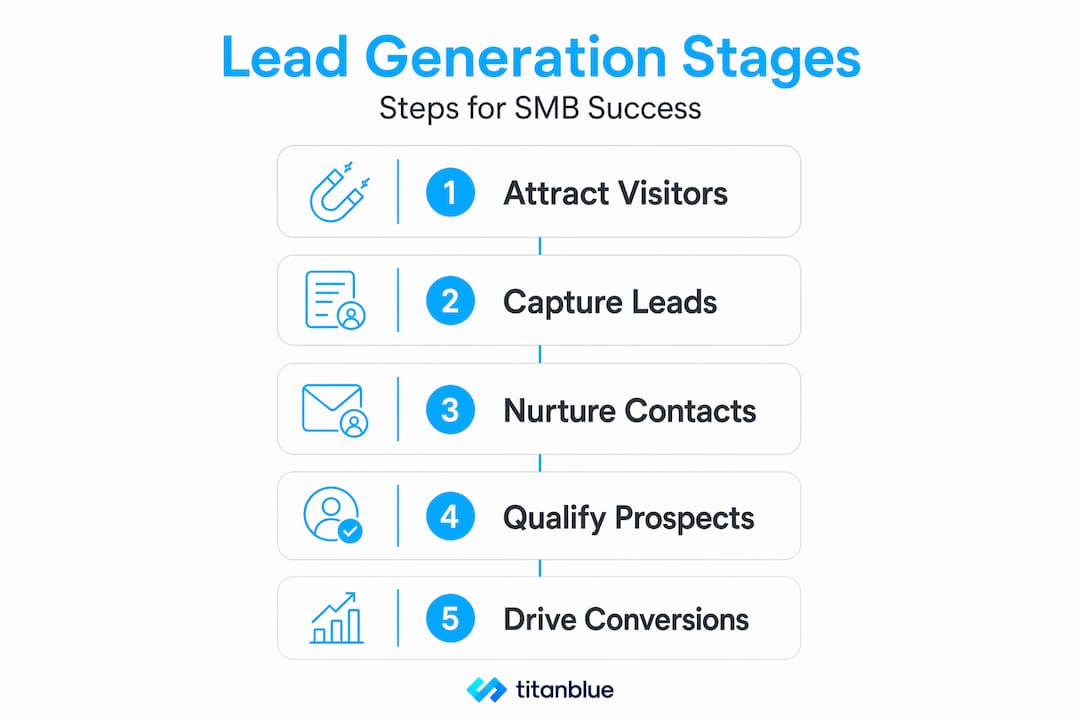
Using a CRM that logs every touchpoint makes this analysis straightforward. You can see where leads drop off and adjust your workflow accordingly.
Myths about online lead generation
There are a few persistent myths that cost SMB owners time and money. Let us deal with them directly.
Myth one: More leads is always better. Wrong. A hundred low-quality leads waste more time than twenty well-qualified ones. Volume without qualification is a drain on your team and your budget.
Myth two: AI does the work for you. AI is a tool that requires correct setup, not a solution that runs on autopilot. SMB owners who over-rely on AI without a defined ideal customer profile and proper workflow design do not scale their results. They scale their mistakes. Getting AI working effectively in your marketing requires deliberate configuration, not just switching on a tool.
Myth three: Digital lead generation replaces human connection. It does not. Digital lead gen transitions prospects toward real conversations for sales closure. Automation handles the volume and the timing. A real person still closes the deal.
The businesses that get online lead generation right are not the ones with the biggest ad budgets. They are the ones who understand which stage of their funnel is leaking and fix it methodically.
The practical takeaway here is simple. Build your workflow, set your metrics by stage, use AI to handle volume and speed, and make sure a human picks up the conversation at the right moment.
My honest take on SMB lead generation
I have worked with a lot of small and medium-sized businesses over the years, and the pattern I see most often is the same one. A business owner invests in ads, gets some traffic, collects a few leads, and then wonders why the phone is not ringing. The gap is almost never the top of the funnel. It is the middle and the handoff at the bottom.
The moment I shifted the conversation from “how do we get more leads” to “what happens after someone fills out a form,” results changed. In my experience, the follow-up sequence and the speed of response matter far more than the ad creative or the targeting.
What I have also learned is that AI amplifies whatever system you already have. If your qualification process is vague, AI will send you more vague leads faster. If your workflow is precise, AI makes it run at a scale you could not achieve manually. The structured workflow comes first. The tool serves the structure.
For any SMB I work with now, the first thing I want to see is a documented workflow from first touch to sales handoff. Not a complicated one. Even a simple five-step process written down beats a sophisticated setup that lives only in someone’s head.
— Richie
How Titan Blue helps SMBs generate more leads
If you have read this far, you understand that effective online lead generation is a system, not a one-off campaign. Building that system requires a website that converts, content that attracts the right traffic, and digital marketing that reaches buyers at the right stage.
Titan Blue specialises in exactly this. Our web design services are built around conversion, not just aesthetics. A site that looks good but fails to capture leads is just an expensive brochure. We build sites that pull visitors through the funnel. Our digital marketing for small business services cover SEO, Google Ads, Meta Ads, and AI-powered marketing, all tailored to SMB budgets and goals. If you want a lead generation system that actually connects your traffic to your sales team, get in touch with Titan Blue today.
FAQ
What is lead generation online in simple terms?
Online lead generation is the process of attracting potential customers through digital channels and capturing their contact details so you can follow up and convert them into paying customers. It works across funnel stages from awareness through to purchase.
How is lead generation different from demand generation?
Demand generation builds awareness and educates a broad market. Lead generation captures contact details from people already interested in buying. Both work together; skipping demand gen before running lead gen produces low-quality, unresponsive contacts.
What is a lead generation workflow?
A lead generation workflow is the automated sequence of steps that moves a prospect from first contact to sales conversation. It includes data capture, lead scoring, routing, nurture sequences, and handoff to your sales team.
How quickly should I respond to a new lead?
Responding within five minutes increases your chance of successful contact and conversion by 100 times compared to waiting an hour. Automated acknowledgment emails handle this instantly while your team prepares a personal follow-up.
What metrics should I track for online lead generation?
Track reach and traffic at the top of the funnel, marketing qualified leads at the middle, and sales qualified leads plus close rate at the bottom. Each stage needs its own metric. One overall number across the funnel does not tell you where to improve.
Recommended
- Modern Construction Lead Generation Guide
- 6 Top Lead Generation Tips Gold Coast Businesses Need
- SEO Marketing for Small Businesses Guide – Titan Blue Australia
- SEO Marketing for Small Businesses Guide – Titan Blue Australia
Make Titan Blue a preferred source in Google
One click tells Google to surface our articles more often in Top Stories, AI Overviews and AI Mode.

This Week in Australian AI Search: Google’s UGC Data Program
Google's UGC Fresh Data Program and Indexing API quota update, plus our Google AI Mode…

Google AI Mode Adds Official Links: What It Means for Australia
Google is adding more links to AI Mode and testing an official websites section. Here…

Best AEO and GEO Agencies in Australia (2026): 7 Compared
Best AEO agency and GEO agency in Australia, compared: seven agencies, what their own pages…