WordPress Website Maintenance Service for Australian Businesses
Think of a WordPress website maintenance service as the regular servicing for your business’s most important digital asset. It’s not just a technical task; it's the proactive care that keeps your site secure, up-to-date, and running like a well-oiled machine, so you don’t have to deal with surprise breakdowns. This covers everything from crucial security scans and software updates to performance optimisation.
Why Your WordPress Site Is a Core Business Asset
It’s tempting to treat your website like a digital brochure you build once and then forget about. But that view misses the point entirely. Your WordPress site is your hardest-working employee, operating 24/7 as your top lead generator, customer service rep, and brand ambassador.
For any Australian business, this asset is doing heavy lifting around the clock.
For a construction firm on the Gold Coast, it’s the engine capturing qualified project enquiries while you're busy on-site.
For a local cafe in Melbourne, it's where customers check daily specials and book a table for Saturday brunch.
For a plumber in Sydney, it's the first point of contact for an emergency call-out, building trust before your van even arrives.
Ignoring its upkeep is like never servicing the engine in your delivery van. Sooner or later, it will break down—and the cost in lost revenue and customer trust will be far greater than proactive care ever would have been.
The Problem with a "Set and Forget" Mindset
The digital world never stands still. New security threats pop up daily, software needs constant updates to work properly, and your customers' expectations for a fast, reliable experience are only getting higher. A "set and forget" approach leaves your most valuable business tool completely exposed.
This is especially true here in Australia, where WordPress is the go-to platform for countless small and medium businesses. As of 2026, WordPress powers an incredible 42.6% of all websites globally. In Australia, it’s estimated that over 50% of business sites in Queensland and New South Wales are built on WordPress.
But that popularity makes it a prime target. Local stats show a shocking 90% of WordPress vulnerabilities in our region come from outdated plugins—a critical issue, especially as Australian cyber threats jumped by 15% in 2025 alone.
A professional WordPress website maintenance service is an investment in business continuity, not just a technical expense. It connects routine digital upkeep with tangible outcomes like lead generation, customer loyalty, and a strong brand reputation.
Investing in a maintenance plan is all about protecting the engine of your digital operation. When your site is properly cared for, it doesn’t just work—it instils confidence in your customers and directly supports your bottom line. If your site feels outdated, you might also be interested in how a website redesign can boost leads and revenue.
The Five Pillars of Comprehensive Website Care
A lot of business owners think website maintenance is just a simple checklist of techie chores. But proper website care is much more than that. It’s a complete system built on five essential pillars, each one supporting a critical part of your site's health.
Think of it this way: these pillars work together to protect, speed up, and support your online presence. They ensure your digital shopfront is always a strong, reliable asset for your business, not a liability. Let's break down what each one actually means for you.
1. Unbreachable Security
This first pillar is your website’s 24/7 digital security system. Just like you’d install alarms and deadbolts at your physical business premises, this part of a maintenance service builds a tough defence to keep intruders out. And it's not a one-time setup; it's a constant, active patrol.
This involves a few key actions:
Firewall Configuration: A strong firewall acts as your digital bouncer, inspecting all traffic trying to visit your site and blocking known threats before they even get to the front door.
Malware and Virus Scanning: Regular, automated scans sweep every corner of your website’s files and database, hunting for malicious code. If anything suspicious is found, it's flagged and dealt with immediately.
Vulnerability Patching: When a weakness is found in WordPress or one of its plugins, a maintenance service ensures that gap is closed fast, stopping hackers from getting a foothold.
Without this pillar, your website is an open target. For an Aussie trades business collecting customer details online, a security breach could mean a devastating loss of trust and serious legal headaches. Security is the foundation everything else is built on.
2. Flawless Backups and Recovery
The second pillar is your website’s insurance policy. No matter how strong your security is, things can still go wrong. A server might crash, a software update could cause a conflict, or a simple human error could wipe out years of work. Flawless backups mean that if the worst happens, you’re not starting from scratch.
This is much more than just clicking a "backup" button in your dashboard. A professional service ensures:
Regular, Automated Backups: Your entire website—all your files, images, pages, and database—is backed up on a consistent schedule, usually daily.
Off-site Storage: Backups are stored in a separate, secure location, completely isolated from your main web server. This is non-negotiable. If your server gets hacked, your clean backups remain safe and sound.
Tested Recovery Process: A backup is useless if you can't restore it. A proper service includes a proven, tested process for quickly restoring your site to a recent, clean version, keeping downtime to an absolute minimum.
For a restaurant that relies on its website for online bookings, even a few hours of downtime means dozens of lost reservations and a big hit to revenue. This pillar ensures you can get your whole online operation back up and running in minutes, not days.
3. Seamless Software Updates
Imagine driving your car but never changing the oil or rotating the tyres. Sooner or later, it’s going to break down. The third pillar, seamless software updates, is the regular tune-up for your website’s engine (the WordPress core), its features (plugins), and its design (theme).
Every update released by developers contains vital security patches, bug fixes, and performance improvements. A comprehensive maintenance plan handles this entire process for you, making sure your website keeps running smoothly and securely. This includes managing updates for WordPress itself, along with every theme and plugin that adds functionality to your site.
You can see how this fits into a structured plan by exploring the different tiers of website maintenance packages.
4. Peak Performance Optimisation
The fourth pillar is all about one thing: speed. In 2026, a slow website is a failing website. Study after study shows that visitors will give up and leave a page that takes more than just a couple of seconds to load. Peak performance optimisation is the work that ensures your site is as fast and responsive as it can possibly be.
It’s like making sure your cafe has fast, efficient service during the chaotic lunch rush. This pillar involves tasks like compressing images, cleaning up the database, and refining code to make sure your pages load almost instantly. A fast site doesn't just keep your customers happy—it's also a major ranking factor for search engines like Google.
5. Proactive Health and Uptime Monitoring
Finally, the fifth pillar acts as your 24/7 digital watchman. You can’t stare at your website every minute of the day, but a good maintenance service can. Uptime monitoring tools constantly ping your site to make sure it’s online and accessible to your customers.
If your site ever goes down—even for a moment—the service provider is instantly alerted and can start investigating the problem straight away. This proactive approach means issues are often fixed before you or your customers even realise something is wrong. It’s all about making sure your digital doors are always open for business.
Understanding Maintenance Plans and Pricing in Australia
Trying to figure out the cost of a WordPress maintenance service in Australia can feel like reading a menu in the dark. There are so many options out there, and it’s tough to know what you’re actually paying for—or what your business genuinely needs.
The key thing to realise is that these plans aren't one-size-fits-all. They’re usually tiered to match different business goals, budgets, and how much you rely on your website. Whether you’re a plumber in Perth or running a cafe in Cairns, the right plan is all about matching the service level to your digital needs.
Let’s break down the typical structures you’ll come across.
The Three Common Tiers of Service
Most providers organise their services into different levels. Think of it as a good, better, and best system, where each tier builds on the last, adding more comprehensive support as you go up the ladder.
A Basic Essentials plan is the entry point. It's the perfect fit for a new local trade business or a small startup that just needs the fundamentals covered without a huge cost. This tier almost always includes the absolute non-negotiables:
Core Updates: Keeping your WordPress software, theme, and plugins up-to-date to patch security holes as they appear.
Essential Backups: Regular, secure backups of your entire site, giving you a safety net if something goes wrong.
Basic Security Monitoring: Simple scans to check for obvious threats or malware.
This foundational plan stops your site from falling into disrepair and protects the money you first spent building it. It’s the bare minimum required to keep your digital shopfront safe and running. If you're curious about what that initial investment looks like, have a look at our guide on the cost for website creation.
Moving up a notch, a Business Growth plan is geared towards established businesses with steady online traffic—think a bustling restaurant or a growing construction company. This includes everything from the basic tier but layers on services focused on improving user experience and getting results, like performance optimisation and more hands-on support.
Finally, a Premium Partner plan is for companies aiming for aggressive growth or those with complex, mission-critical websites. This top-tier service acts as a true partnership, where the provider is more like an extension of your own team. You might get dedicated developer hours for custom changes, proactive strategic advice, and advanced SEO monitoring.
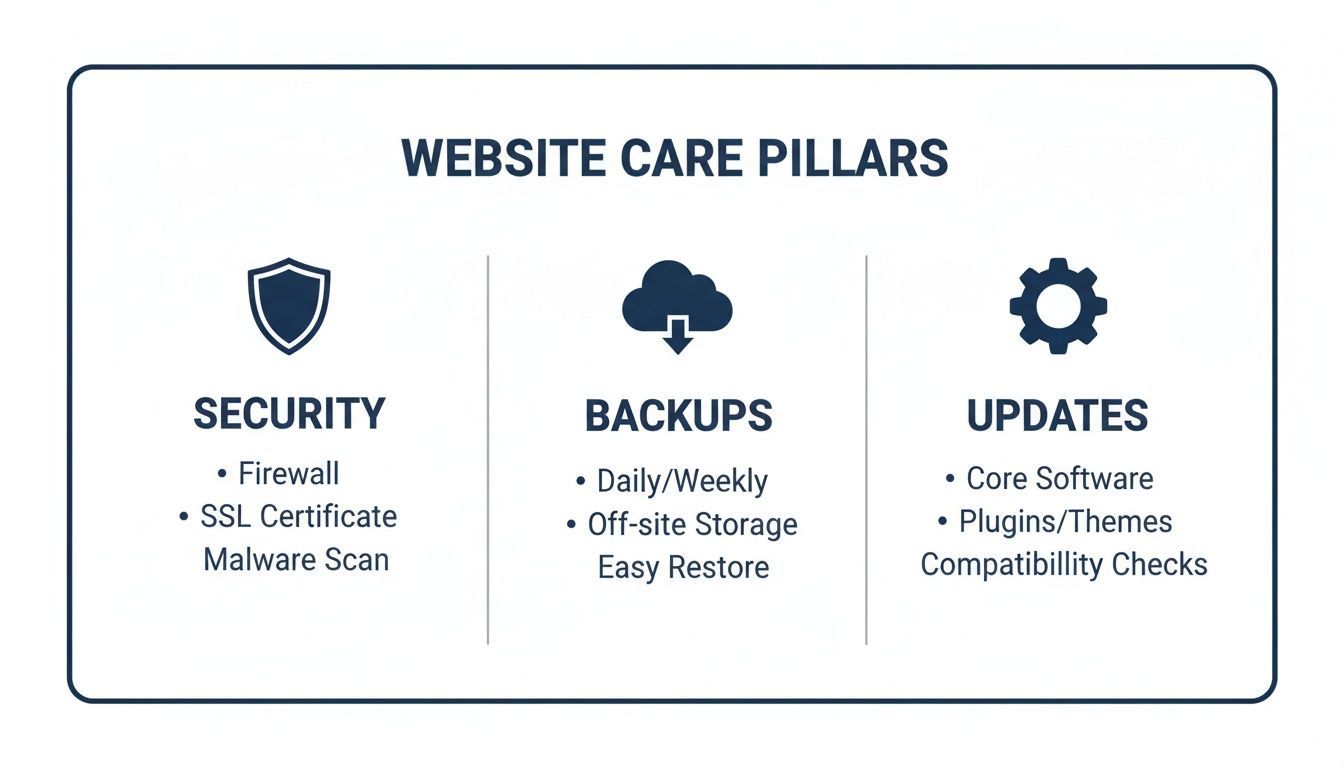
The infographic below shows the three pillars that form the foundation of any solid maintenance plan.
These three elements—Security, Backups, and Updates—are the absolute bedrock. They’re what keep your WordPress website protected, functional, and ready for business.
What Drives the Cost Differences
Understanding why one plan costs more than another helps you see the value, not just the price. The cost of WordPress maintenance in Australia varies quite a bit, reflecting the diverse needs of small to medium businesses.
In 2026, you'll find plans ranging from essential "keep the lights on" updates to full-service support that includes SEO and custom development. For a medium-sized hospitality business, for instance, proper maintenance can ensure 99.9% uptime and boost Google rankings by up to 30% just through speed improvements. That's critical when WordPress powers over 61% of the CMS market.
So, what are you paying for? Several key factors influence the price tag.
The primary cost drivers are the amount of hands-on support, the frequency and complexity of the work, and the inclusion of strategic services that actively help your business grow.
This means a plan that includes two hours of a developer’s time each month will naturally cost more than one that only handles automated updates. Likewise, a service that delivers detailed monthly reports and strategy calls is providing far more value than a simple "set-and-forget" schedule.
When you understand this, you can make an informed decision about your website's health, choosing a plan that delivers real, tangible value to your business.
The Real Cost of Neglecting Your Website
It’s tempting to push website maintenance to the bottom of the to-do list, treating it as a "maybe next month" expense. But this isn't saving money—it's taking a huge risk that can unravel your revenue, reputation, and customer trust faster than you'd think.
Viewing maintenance as just a technical chore misses the point entirely. A professional WordPress website maintenance service is actually one of the smartest forms of risk management any modern Australian business can invest in. It’s the difference between preventing a disaster and paying a fortune to clean one up.
Financial Losses from Security Breaches
Let's walk through a real-world scenario. A thriving solar panel installer on the Sunshine Coast generates all its leads through its WordPress site. A contact form plugin is out of date, leaving a known security hole wide open. Hackers find it, slip through, and grab a database full of customer names, addresses, and phone numbers.
The fallout is a financial nightmare. On top of the immediate cost of hiring experts to patch the breach, the company now faces hefty data breach fines and a total collapse of public trust. New leads vanish overnight, and existing clients start questioning their professionalism.
This isn't just a scary story. Security is a massive headache for WordPress site owners in Australia, with cyber threats getting more common. Globally, a staggering 30,000 new websites are hacked daily. The Australian Bureau of Statistics reported a worrying 22% jump in cyber incidents hitting SMEs in 2025, and outdated plugins were the cause of an incredible 90% of those breaches. The average cost for a small Aussie business to recover from a hack like this is around $25,000—while proactive maintenance prevents it for a tiny fraction of that price.
Lost Revenue from Poor Performance
Now, let's picture a popular restaurant in Brisbane's busy hospitality scene. It's Friday afternoon, and they’re prepping for the weekend rush. But their website, bloated with massive images and clunky old code, is painfully slow.
Potential diners trying to book a table or even just check the menu get fed up and click away. Every extra second it takes to load costs them customers. We know that even a one-second delay can cause a huge drop in conversions. For this restaurant, a slow site during peak booking hours could easily mean a 50% drop in online reservations, taking a direct bite out of their weekend profits.
And the damage isn't just for one night. A slow site kills your search engine rankings, making it harder for new customers to find you in the first place. If you're wondering why you're not getting found, our guide on why your business might not be appearing on Google can shed some light on the issue.
Long-Term Brand and Reputation Damage
The most dangerous cost of neglect is the slow, quiet death of your brand’s credibility. A website that’s often down, sluggish, or full of errors sends one clear message to your customers: this business doesn't care about its digital presence.
Think about how these small things add up:
A broken contact form means you're missing sales enquiries, and potential clients feel completely ignored.
An expired security certificate hits visitors with a scary browser warning, destroying trust before they even see your homepage.
Outdated content and old promotions make your business look stale, unprofessional, and out of touch.
Each one of these issues chips away at your reputation. In a competitive market where customers have endless options, a bad online experience is all it takes to send them running straight to your competitor. Rebuilding that lost trust costs far more time and money than simply keeping your site in top shape from the beginning.
How to Choose the Right Maintenance Partner
Choosing a provider for your WordPress website maintenance isn't just another item on your to-do list. It's one of the most critical decisions you'll make for your business's online presence.
This isn't about finding a helpdesk; it's about finding a genuine partner. Making this choice based on price alone is a huge mistake. You need to look closer at their expertise, how they communicate, and their entire approach to looking after your site.
Think of it like hiring a key employee. You need someone reliable, genuinely skilled, and who actually gets what your business is trying to achieve. For an Aussie business, this means finding someone who understands the local market—not just a team that fixes things when they break.
Look for Local Expertise and Industry Knowledge
A great maintenance partner gets the unique challenges and opportunities of the Australian market. An agency based overseas simply won’t grasp the nuances of connecting with customers in Sydney versus a small town in rural WA.
A local team means better support during your business hours and a much deeper understanding of who your customers are.
Beyond geography, their industry experience is a deal-breaker. Do they have a track record with businesses like yours?
For a restaurant in Melbourne, a partner experienced in hospitality knows how vital your online booking system is and that every second of load time can cost you dinner reservations.
For a tradie on the Gold Coast, a provider who knows the construction sector will understand that a mobile-friendly site for on-the-go quotes and strong local SEO are non-negotiable.
Ask potential partners for case studies or examples from your industry. This is your proof that they’ve solved your specific problems before, rather than just applying a generic, one-size-fits-all fix.
Evaluate Their Communication and Reporting
Clear, consistent communication is the foundation of any good partnership. You should never be left in the dark, wondering what’s happening with your website. A professional provider will have a proper process for keeping you in the loop.
Before you even think about signing, ask them how they communicate. What do their reports look like? A quality report should do more than just list off updated plugins. It needs to give you real insights into your site's health, security, and performance, explaining what was done and why it actually matters to your business.
A true maintenance partner acts as an extension of your team. They offer proactive advice and strategic insights to help you get more value from your digital asset, not just react when something breaks.
This proactive approach is what separates a basic service from a genuine partnership. They should be looking for opportunities to improve your site, not just waiting for you to send them a trouble ticket.
Scrutinise the Service Level Agreement
The Service Level Agreement (SLA) is your contract. It's the document that spells out exactly what services you're getting and sets the expectations for both sides. Don't just skim it—read it properly.
A solid SLA must clearly detail these critical points:
Guaranteed Response Times: How quickly will they get back to you on a support request? What about a real emergency, like your site going completely offline?
Emergency Procedures: What is the exact process if your site goes down? Who do you contact, and what steps will they take to get you back online?
Scope of Services: The SLA has to state what’s included in your plan. This means things like the number of updates, the types of security scans, and whether any developer time is included for small fixes.
A vague or non-existent SLA is a massive red flag. This document is what protects your business by ensuring there's accountability. It turns their promises into solid commitments.
How Maintenance Boosts SEO and AI Search Readiness
So far, we've talked about how a WordPress website maintenance service acts as a shield for your business—guarding you against hackers, data loss, and embarrassing site errors. But that's only half the picture. Quality maintenance is also one of the most powerful offensive weapons in your marketing arsenal, directly impacting how customers actually find you online.
Proper maintenance isn't just about keeping the lights on. It’s about turning your site into a favourite of search engines like Google. Many of the core maintenance jobs, like performance optimisation, are also massive factors in how well you rank. A snappy, fast-loading site keeps visitors happy, sending strong positive signals to Google that your page delivers a great experience.
On the flip side, a slow, buggy website does the complete opposite. If a plumber’s site in Sydney takes five seconds to load, you can bet a potential customer with a burst pipe is going to hit the back button instantly. This high "bounce rate" is a red flag for Google, telling it the site isn't helpful and pushing it further down the search results.
Gaining a Competitive Edge with Technical SEO
Technical SEO sounds complicated, but a good maintenance plan handles all the essentials for you. It's about making sure your website's foundation is solid, clean, and dead simple for search engines to crawl and understand. This is where ongoing maintenance becomes a real strategic advantage.
A professional service takes care of the crucial behind-the-scenes work that lifts your visibility:
Site Speed: Regular database cleanups, image compression, and code refinements result in lightning-fast load times—a top Google ranking factor.
Mobile-Friendliness: With most searches now happening on phones, a well-maintained site guarantees a flawless experience on any device, which Google loves.
Security Signals: An active SSL certificate and a malware-free site signal trustworthiness to both users and search engines. It’s non-negotiable for ranking well.
These aren't one-off fixes. They demand consistent, proactive attention to keep your site performing at its peak, giving you a lasting edge over competitors who let their digital assets gather dust.
Preparing Your Site for the Future of AI Search
The way people find information online is already changing. Instead of just seeing a list of blue links, users are getting direct answers from AI tools like Google’s AI Overviews. This shift makes having a well-structured, healthy website more critical than ever.
A well-maintained website is easier for AI systems to crawl, understand, and trust. This positions your business to be the source for AI-generated answers, making you visible in the search landscape of tomorrow.
Think about it: AI prefers websites that are fast, secure, and logically organised. A messy, slow, or insecure site is confusing for AI crawlers, making it highly unlikely that your content will ever be featured.
By investing in a WordPress website maintenance service, you aren't just protecting what you have today. You're building a future-proof asset that’s ready for the next wave of search technology. To get a better handle on this, you can learn more about how AI search is reshaping online visibility.
Your WordPress Maintenance Questions, Answered
When it comes to looking after a WordPress website, a lot of questions pop up, especially for busy Aussie business owners. We get it. You want to make sure your website is in safe hands without getting bogged down in technical jargon. Here are some straightforward answers to the questions we hear most often.
How Often Does My Site Need Maintenance?
Think of it like getting your car serviced. A brand-new site might just need a monthly check-up to keep things ticking over. But an older, more complex website—like a busy online store or a booking site with lots of plugins—really benefits from weekly attention to stay in top shape.
For most businesses, a professional monthly plan is the sweet spot. It’s frequent enough to catch small issues before they snowball into major headaches like a security breach or a site that grinds to a halt. Consistency is everything; it’s the scheduled, proactive care that keeps your site healthy and secure.
Can I Do WordPress Maintenance Myself?
Technically, yes. But the real question is, should you?
Sure, you can click the ‘update’ button on plugins and run a backup yourself. The problem is, professional maintenance is so much more than that. It’s knowing which updates are safe to run together and which ones will conflict and crash your site. It’s knowing how to properly clean up a database without accidentally deleting critical information.
The real value isn't just in doing the tasks. It's in the expertise to do them right—safely and efficiently—so you can get back to what you do best: running your business.
As a business owner, your time is money. Every hour you spend wrestling with a broken plugin is an an hour you’re not making sales, talking to customers, or planning your next move.
What’s the Difference Between Hosting and Maintenance?
This is a really common point of confusion, but the difference is simple when you think about it like this:
Hosting is the plot of land your business is built on. It’s the server space where all your website’s files live, making your site visible to the world.
Maintenance is the team that keeps the actual building secure, clean, and running perfectly. This covers everything inside your website—the WordPress software, your theme, and all those plugins.
While some web hosts throw in basic backups or security scans, it's no substitute for a dedicated maintenance plan. A proper maintenance service is laser-focused on the health, speed, and security of your actual website, not just the server it sits on.
At Titan Blue Australia, we take the worry out of website management with a proactive, expert-led approach. If you’re ready to protect your digital asset and ensure it’s always working for you, let’s talk about how our maintenance services can help your business thrive. Learn more about our proven approach at https://titanblue.com.au.
Titan Blue is your go-to digital partner for smart, results-driven solutions. We blend strategy, creativity and tech to grow your brand and get real results fast.