


Every Gold Coast retailer knows that simply having an online shop is no longer enough when competition grows daily. Clear goals and a sharp focus on your ideal customers lay the groundwork for digital strategies that actually deliver results. This guide breaks down every vital step, from defining your target audience and crafting standout content to mastering local SEO and performance tracking, helping you increase your shop’s visibility and e-commerce sales.
Table of Contents
- Step 1: Define Business Goals And Key Target Audiences
- Step 2: Develop Optimised Website And Content Assets
- Step 3: Implement Effective Seo And Local Search Tactics
- Step 4: Launch Targeted Social And Paid Ad Campaigns
- Step 5: Measure Performance And Refine Strategy
Quick Summary
| Key Insight | Explanation |
|---|---|
| 1. Define clear business goals | Establish specific, measurable objectives to guide your digital marketing strategy effectively. |
| 2. Understand target audiences | Collect demographic and psychographic data to create detailed customer personas for tailored marketing. |
| 3. Optimise content for SEO | Implement effective SEO practices to enhance visibility and drive relevant traffic to your website. |
| 4. Leverage social media ads | Use targeted social media campaigns to engage potential customers and boost brand awareness. |
| 5. Measure and refine strategies | Continuously track performance metrics and adjust your marketing tactics to improve ROI over time. |
Step 1: Define business goals and key target audiences
Successfully launching a digital marketing strategy requires precise targeting and crystal-clear business objectives. In this section, you’ll learn how to systematically identify your ideal customers and establish meaningful marketing goals.
Begin by understanding your business’s core purpose and revenue targets. This means breaking down your overarching business vision into specific, measurable objectives. For retail businesses, these goals might include increasing online sales, expanding market share, or improving customer retention rates. Target market segmentation allows you to create more personalised and effective marketing approaches.
To define your key target audiences, you’ll need to collect and analyse comprehensive customer data. This involves examining several critical dimensions:
- Demographic information: Age, gender, income level, location
- Behavioural characteristics: Purchasing habits, online browsing patterns
- Psychographic details: Interests, values, lifestyle preferences
- Motivational factors: What drives their purchasing decisions
Utilising frameworks like the STP (Segmentation, Targeting, Positioning) method can help you precisely map out your potential customer groups. Identifying high-quality customer data enables you to craft marketing campaigns that genuinely resonate with your intended audience.
The more precisely you define your target audience, the more effectively you can tailor your marketing strategies.
Once you’ve identified your target segments, create detailed customer personas that represent your ideal buyers. These personas should include specific details about their backgrounds, challenges, and motivations – transforming abstract demographic data into relatable, actionable profiles.
Pro tip: Review and refine your target audience definitions quarterly to ensure your marketing strategies remain aligned with evolving customer preferences and market dynamics.
Step 2: Develop optimised website and content assets
In this crucial stage of your digital marketing strategy, you’ll transform your target audience insights into compelling website content and digital assets that drive engagement and conversions. The goal is to create a powerful online presence that speaks directly to your ideal customers.

Digital content marketing requires a strategic approach to developing website content that attracts and retains your audience. Start by mapping your content strategy to the specific needs and preferences of the customer personas you developed earlier. This means crafting content that addresses their pain points, answers their questions, and provides genuine value.
Your content development process should focus on several key elements:
- Compelling website copy that communicates your brand’s unique value proposition
- Engaging product descriptions that highlight benefits, not just features
- High-quality visual assets including professional images and graphics
- Informative blog posts that demonstrate industry expertise
- Customer-centric landing pages designed to convert visitors
Successful digital content transforms information into an experience that resonates with your target audience.
Ensure your content is not only informative but also optimised for search engines. This means incorporating relevant keywords naturally, creating clear headings, and structuring your content to improve readability. Pay attention to technical elements like page load speed, mobile responsiveness, and intuitive navigation.
Consider creating a diverse content mix that includes written articles, video tutorials, infographics, and interactive elements. This variety helps you connect with different learning styles and keeps your audience engaged across multiple touchpoints.
Pro tip: Regularly audit and update your website content to ensure it remains fresh, relevant, and aligned with your evolving business objectives and customer needs.
Step 3: Implement effective SEO and local search tactics
Now that you’ve developed your content assets, it’s time to ensure they reach your target audience through strategic search engine optimisation (SEO) techniques. This critical step will help your business become more visible to potential customers searching for your products and services.
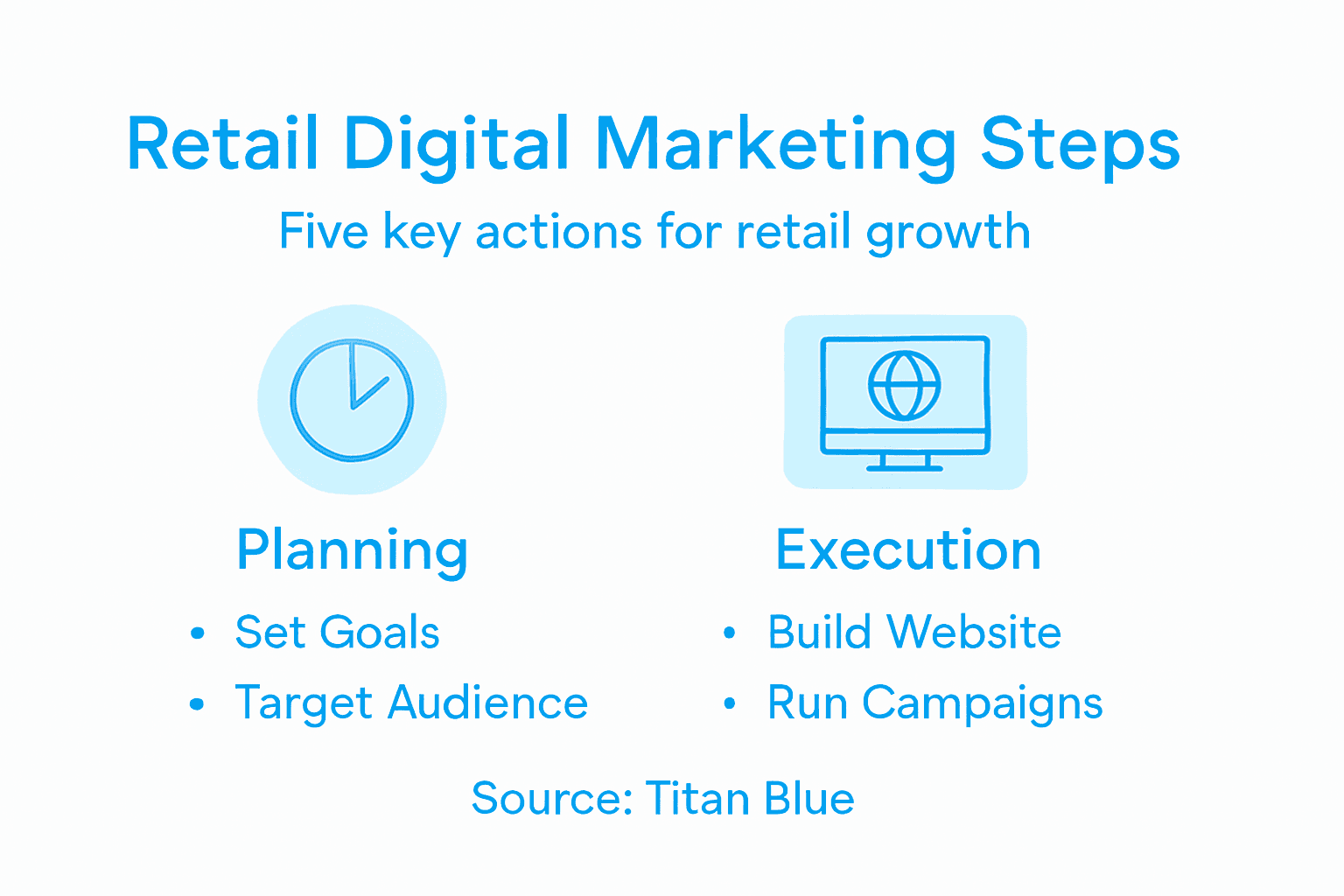
Local SEO strategies are essential for small retail businesses looking to attract nearby customers. Begin by optimising your Google Business Profile with accurate business information, high-quality images, and regular updates. This helps improve your visibility in local search results and Google Maps listings.
Your local SEO approach should encompass several key tactics:
- Keyword research focused on location-specific search terms
- Google Business Profile verification and complete profile optimisation
- Local citation building across online directories
- Customer review management on multiple platforms
- Mobile-friendly website design with fast loading speeds
Successful local SEO transforms your online presence into a powerful customer acquisition tool.
Pay special attention to on-page SEO elements like title tags, meta descriptions, and header tags. Incorporate local keywords naturally, ensuring your content speaks directly to your community. This means using phrases like “Gold Coast retail” or “local [your industry] specialists” that resonate with nearby customers.
Consistent name, address, and phone number (NAP) information across all online platforms is crucial for local search ranking. Even minor discrepancies can negatively impact your search visibility, so audit your online listings regularly.
Pro tip: Invest in local link-building by partnering with other Gold Coast businesses and participating in community events to improve your local search authority.
Step 4: Launch targeted social and paid ad campaigns
With your digital foundations in place, it’s time to amplify your reach through strategic social media and paid advertising. This step will transform your marketing efforts by connecting directly with potential customers across multiple digital platforms.
Targeted buyer personas are the cornerstone of successful advertising campaigns. Begin by developing detailed profiles that capture your ideal customer’s demographics, interests, and online behaviours. These personas will guide your ad targeting, messaging, and creative strategies.
Your paid advertising approach should include several critical elements:
- Platform selection matching your target audience’s preferences
- Compelling ad creative with clear value propositions
- Precise audience targeting using demographic and interest filters
- Budget allocation across different marketing channels
- Conversion-focused landing pages for each campaign
Effective social media marketing transforms casual browsers into engaged customers.
Focus on creating multi-platform advertising strategies that leverage the unique strengths of platforms like Facebook, Instagram, and LinkedIn. This means tailoring your messaging and visual content to suit each platform’s specific audience and engagement style.
Constantly monitor your campaign performance by tracking key metrics such as click-through rates, engagement levels, and conversion rates. Be prepared to quickly adjust your targeting, creative, or budget based on real-time data insights.
Pro tip: Allocate 10-20% of your initial ad budget for testing and experimenting with different targeting options and creative approaches to discover your most effective campaign strategies.
Step 5: Measure performance and refine strategy
The final stage of your digital marketing journey involves systematically tracking your campaign performance and making data-driven refinements to maximise your marketing effectiveness. This crucial step transforms raw data into actionable insights that continuously improve your business’s online strategy.
Analytical performance measurement requires establishing clear objectives and selecting relevant metrics aligned with your specific marketing goals. This means moving beyond surface-level statistics to understand the deeper impact of your digital efforts.
Key performance metrics you should track include:
- Website traffic volume and sources
- Conversion rates across different channels
- Customer acquisition cost
- Return on advertising spend
- Social media engagement levels
- Email marketing performance
Data-driven refinement separates successful marketing strategies from mediocre attempts.
Utilise analytics tools to conduct comprehensive performance audits that reveal nuanced insights about your marketing campaigns. Pay close attention to how different customer segments respond to your messaging, which platforms drive the most valuable traffic, and where potential improvement opportunities exist.
Be prepared to make iterative adjustments based on your findings. This might involve reallocating budget, modifying ad creative, refining audience targeting, or pivoting your overall marketing approach to align more closely with observed customer behaviours.
Pro tip: Schedule monthly performance review sessions where you systematically analyse your key metrics, ensuring your digital marketing strategy remains dynamic and responsive to changing market conditions.
The table below outlines key metrics, what they reveal, and suggested action steps:
| Metric | Reveals | Action Raised |
|---|---|---|
| Website traffic sources | Where visitors originate | Invest in top traffic channels |
| Conversion rate | Effectiveness of site/pages | Optimise underperforming areas |
| Customer acquisition cost | Cost to gain a customer | Streamline costly processes |
| Return on ad spend | Ad investment effectiveness | Adjust ad strategy for gains |
Here’s a summary of how each step in the digital marketing strategy contributes to business growth:
| Strategy Step | Main Focus | Business Impact |
|---|---|---|
| Define goals & audiences | Customer identification | Enhances campaign relevance |
| Develop website & content assets | Content optimisation | Increases engagement |
| Implement SEO & local search | Search visibility | Drives qualified traffic |
| Launch social & paid ad campaigns | Multi-platform outreach | Boosts brand awareness |
| Measure & refine performance | Data-driven adjustments | Improves ROI over time |
Elevate Your Retail Success with Titan Blue’s Expert Digital Solutions
Struggling to define precise business goals and effectively reach your target audiences It is challenging to develop optimised content and implement SEO tactics that truly connect with local customers The complex process of launching targeted social and paid ad campaigns while measuring performance can feel overwhelming Titan Blue understands these pain points and specialises in transforming your digital marketing strategy into measurable retail success on The Gold Coast
We help you:
- Clearly identify and engage your ideal customer segments through tailored strategies
- Develop compelling websites and content that boost engagement and conversions
- Implement cutting-edge SEO and local search optimisation like AI Search and Generative Engine Optimisation that drive qualified traffic
- Launch targeted Google Ads and Meta Ads campaigns designed for maximum ROI
Ready to move beyond uncertainty and create a focused results-driven marketing approach Partner with Titan Blue and gain a trusted local ally dedicated to growing your brand with innovative digital marketing and web design solutions Start today by visiting our website and discover how our custom website design and targeted digital advertising campaigns can unlock your retail business potential
Frequently Asked Questions
What are the first steps to define my retail business goals?
Start by breaking down your overarching business vision into specific, measurable objectives. Identify key areas like increasing online sales or improving customer retention rates, and set clear targets to achieve these goals within the next 6 to 12 months.
How can I identify my ideal customer for effective marketing?
Use customer data to gather insights on demographics, behaviours, and motivations. Create detailed customer personas to represent your ideal buyers and tailor your marketing strategies based on their preferences within 30 days.
What content should I develop for my retail website?
Focus on creating compelling website copy, engaging product descriptions, and informative blog posts that address your customers’ pain points. Ensure that all content is optimised for search engines to improve visibility and build relevance over time.
How do I improve my local search visibility for my retail business?
Begin by optimising your Google Business Profile with accurate information and high-quality images. Implement local SEO tactics such as adding location-specific keywords and maintaining consistent contact information across all online platforms to enhance search rankings.
What should I monitor to measure the performance of my digital marketing efforts?
Track key metrics like website traffic, conversion rates, and customer acquisition costs. Regularly analyse this data to identify trends and adjust your strategy accordingly, aiming for actionable improvements every month.
How can targeted social media campaigns benefit my retail strategy?
Targeted social media campaigns can connect you directly with potential customers by using well-defined buyer personas. Tailor your ad content to resonate with these audiences and track performance metrics to refine your approach for better engagement and conversions.
Recommended
- 10 Powerful Retail Marketing Strategies for AU SMEs in 2025
- 10 Powerful Retail Marketing Strategies for AU SMEs in 2025 – Titan Blue Australia
- Australian E Commerce SEO Services a Guide to Driving Growth
- Mastering Ecommerce SEO Marketing – Titan Blue Australia
Make Titan Blue a preferred source in Google
One click tells Google to surface our articles more often in Top Stories, AI Overviews and AI Mode.

Solar Installer Website Design Australia: The 2026 Guide
How solar installer websites in Australia should show CEC accreditation, real install proof and AI-ready…

Hotel & Hospitality Website Design Australia: 2026 Guide
Hotel and hospitality website design in Australia explained: booking flow, schema, AEO and what actually…

Restaurant Website Design Australia: The 2026 Guide
What a restaurant website in Australia needs: HTML menus, bookings, GBP sync, schema, and AI-ready…