

Last updated:
When you’re looking to go solar, it can feel like you’re drowning in options. But really, it all comes down to four things: the panel’s efficiency, its durability, the overall cost, and the quality of your installer. Getting this balance right is the key to maximising your savings and seeing a solid return on your investment for decades to come.
Your Guide to Choosing the Right Solar Panels
Investing in solar is one of the smartest financial moves an Australian homeowner or business can make. But with all the technical jargon out there, it’s easy to feel overwhelmed. This guide is designed to cut through that noise and give you the confidence to make a great decision.
With over 25 years in the industry, we’ve seen firsthand that a successful solar project is about much more than just the panels. It’s about designing a complete, high-performance system that’s perfectly matched to your property and your needs.
Why Your Panel Choice Is So Critical
The panels you choose today will directly dictate your system’s performance for the next 25+ years. This single decision impacts how much electricity you’ll generate, how quickly the system pays for itself, and how well it stands up to Australia's harsh climate. As you start exploring your options, it's a good idea to understand the full scope of comprehensive solar power services available.
Here’s what’s really at stake when you make your choice:
- Maximising long-term savings: Higher-quality panels typically generate more power over their lifespan, which means bigger reductions on your electricity bills.
- Achieving a faster ROI: A well-designed system pays for itself sooner, turning what was once a liability into a genuine asset.
- Ensuring reliability and peace of mind: Durable panels backed by solid warranties protect you from defects and performance decline, securing your investment.
- Boosting your property’s value: A professionally installed, high-quality solar system is a huge drawcard for any potential buyers down the track.
We'll walk you through each of these factors, giving you the practical knowledge you need to move forward. You can also check out our portfolio to see how we’ve helped other Australians make the switch to renewables at our https://titanblue.com.au/portfolio/australian-renewable-energy-website/. By the time you’re done reading, you’ll be ready to choose a solar solution that delivers real, lasting value.
Making Sense of Solar Panel Tech and Efficiency
Jumping into the world of solar means getting your head around the tech that makes it all work. The first real step in picking the right panels is understanding the main types you’ll come across. It’s a decision that will pay you back for years, so it pays to know what you’re looking at.
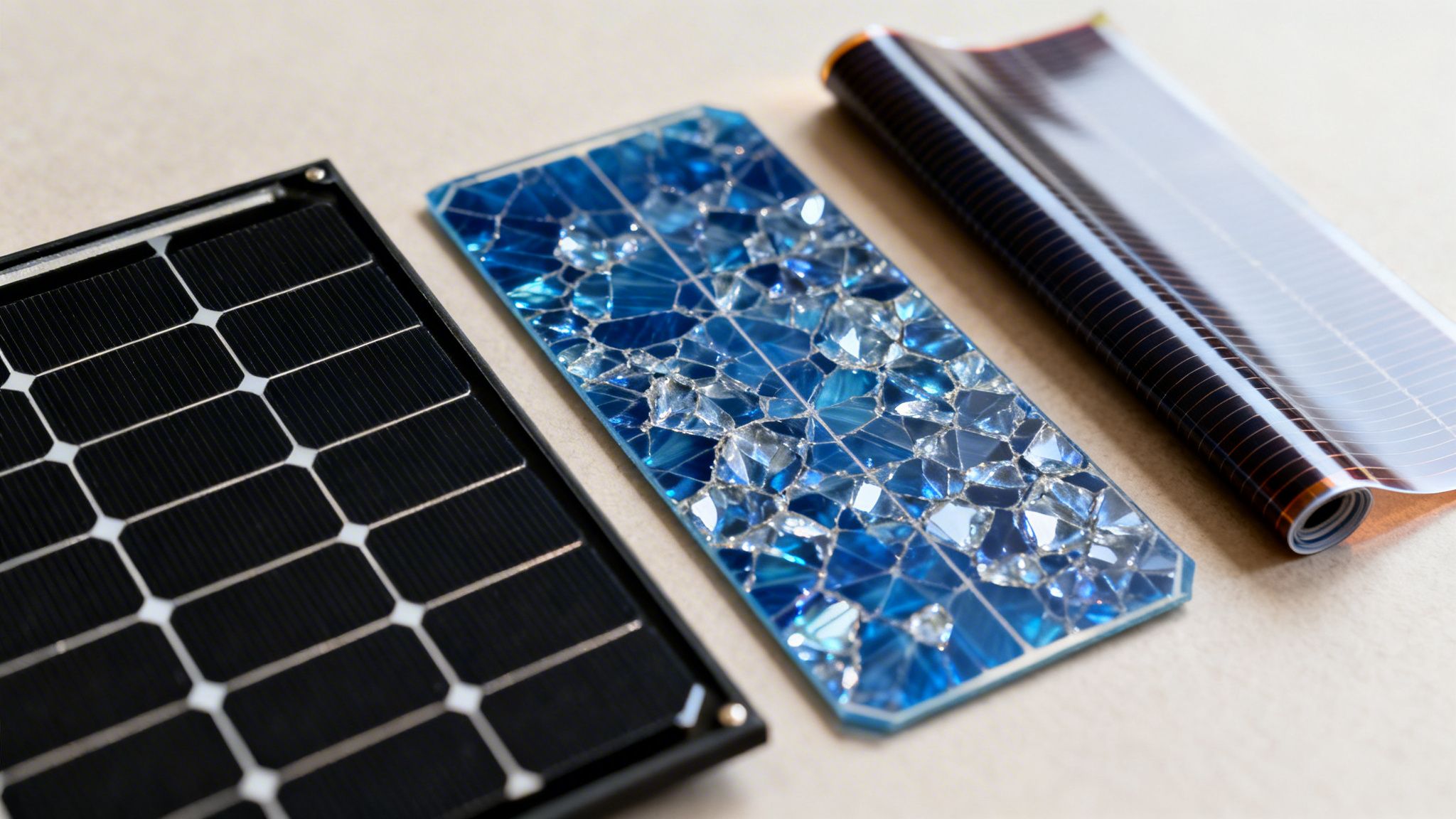
You’ll generally find three key technologies on the market: monocrystalline, polycrystalline, and thin-film. Each has its own pros and cons, making them a better or worse fit depending on your roof, budget, and especially our sunny Australian climate.
Monocrystalline Solar Panels: The High-Efficiency Choice
Most people see monocrystalline panels as the top-shelf option. They're made from a single, pure silicon crystal, which gives them that sleek, uniform black look and, more importantly, a higher efficiency rating.
Because the silicon is so pure, electrons can move around more freely. This translates to more electricity from a smaller amount of space. If you’ve got a small roof but big energy needs, these are your go-to.
Imagine a busy cafe on the Gold Coast trying to run its coffee machines and air-con all day. Monocrystalline panels can crank out the power needed from a limited roof area, giving them maximum output right when the sun is at its peak. They also handle the heat of an Aussie summer better than other types, which is a massive plus.
Polycrystalline Solar Panels: The Budget-Friendly Workhorse
Next up are polycrystalline panels, the ones with that classic blue, marbled look. They’re made by melting down multiple silicon fragments, a process that’s a fair bit cheaper to run.
This simpler manufacturing means polycrystalline panels are easier on the wallet upfront. The trade-off is that they aren’t quite as efficient, usually sitting in the 15% to 17% range. You’ll need a bit more roof space to generate the same amount of power as you would with monocrystalline.
For homeowners with plenty of unshaded roof and a firm budget, these panels are a fantastic, reliable choice. They hit that sweet spot between cost and performance, putting solar within reach for a lot more people.
Thin-Film Solar Panels: Flexible for Niche Jobs
Thin-film is a completely different beast. These panels are created by layering thin photovoltaic material onto a backing, which makes them incredibly lightweight and flexible.
While they have the lowest efficiency of the three, their flexibility means they can be used in ways rigid panels just can’t. You might see them integrated into building materials or used on caravans and boats. Their performance isn’t as affected by high heat, but you need a lot of space, which makes them impractical for most residential rooftops.
The type of panel you choose has a direct impact on your system’s output, a fact that’s becoming more crucial as Aussies install bigger and bigger systems. In fact, with over 4.31 million solar systems expected to be installed nationwide by early 2026, the trend is clearly shifting towards higher-efficiency models to make the most of our abundant sunshine. The average system size has already grown to 11.57 kW by the end of 2025, pushed by a demand for panels that can handle our growing energy appetite.
It is important to remember that a panel’s efficiency rating isn't just a number on a spec sheet; it tells you exactly how much sunlight it can turn into power. A panel with 22% efficiency will produce significantly more electricity from the same patch of roof than one rated at 17%. This difference is everything if you have a small or awkwardly shaped roof. Going for higher efficiency lets you squeeze every last drop of power out of the space you have, which means bigger savings and a faster return on your investment.
When you’re weighing up different panel technologies, it can also be useful to look at guides for other sunny regions, like this one on Finding the Best Solar Panels for Florida. While the climate is different, the core idea of matching panel performance to your local environment is the same. For us here in Australia, just make sure any panel you’re considering is approved by the Clean Energy Council (CEC) to ensure it meets our local standards.
Unpacking Panel Durability and Warranties for Aussie Conditions
When you invest in solar, you're not just buying panels; you're buying a power station for your roof that needs to perform reliably for the next 25 years. Getting your head around panel durability and the warranties that back them up is absolutely critical, especially with our harsh Australian climate. This is what separates a great investment from a long-term headache.
A solar panel warranty isn't just one single document—it's actually split into two very different parts. Knowing the difference is a must when you're figuring out which panels to choose.
- Product Warranty: This covers the panel's physical integrity. Think of it as a guarantee against manufacturing defects, frame corrosion, and any premature wear and tear from the elements. This is your first line of defence.
- Performance Warranty: This is a guarantee of a certain level of power output over time. All panels degrade a little each year, and this warranty ensures yours won't lose efficiency faster than a specified rate.
These warranties are far more than just fine print. They're your assurance that the system will actually deliver the energy savings you've been promised, year in and year out.
Why Durability is Non-Negotiable in Australia
Let's be honest, the Australian climate can be brutal. Your panels will face some of the most extreme weather on the planet, which makes tough construction a necessity, not just a nice-to-have.
From blistering UV radiation that can break down cheaper materials to wild hailstorms that can shatter glass, your panels have to be built to last. If you're near the coast, you've also got corrosive salt mist to worry about, which can eat away at frames and electrical connections. It's why panels with proven, real-world durability are so important.
A business on the Gold Coast, for example, has to contend with both high UV and salt spray, making a robust, well-warranted panel essential. With the Aussie solar market's explosive growth—set to hit 4.31 million systems by early 2026—and the increasing frequency of extreme weather events, choosing panels built for our conditions has never been more vital. You can find more on the facts and statistics shaping Australia's solar industry on solarcalculator.com.au.
To protect your investment, always look for panels from highly reputable manufacturers. This isn't just a sales buzzword; it's a classification that means the manufacturer is financially stable, heavily invested in R&D, and has a proven track record of producing quality, reliable products.
A key feature to look for is Potential Induced Degradation (PID) resistance. PID is a known issue where panels can lose significant power output when exposed to high voltages and humidity—a common scenario in many parts of Australia. PID-resistant panels are specifically engineered to stop this from happening.
Reading Between the Lines of a Warranty
When it comes to warranties, longer is almost always better. For product warranties, the industry standard has been around 12 years, but you'll see premium brands now offering 25 years. A 25-year product warranty shows huge confidence from the manufacturer that their product can handle the elements.
Performance warranties typically run for 25 or 30 years. The key metric to check here is the guaranteed output at the end of the warranty period. Top-tier panels usually guarantee 85% to 90% of their original output after 25 years. A lower-quality panel might only promise 80%, and that difference really adds up to a lot of lost energy and savings over the system's life.
Finally, think about the company backing the warranty. A 25-year warranty is worthless if the company goes bust in five years. This is why it’s a smart move to choose a brand with a strong, established Australian presence.
Having a local office and support team means that if you ever need to make a claim, you're dealing with someone in your own time zone who understands Australian consumer law—not a faceless overseas call centre. That local support can make the entire claims process much smoother and far less stressful.
Calculating Solar Costs and Your Return on Investment
While it’s easy to get caught up in the technical specs, the real test of a solar investment comes down to the numbers. A system can have all the best features, but if it doesn’t make financial sense for your home or business, it’s not the right fit. Let’s get into how you can properly evaluate the costs and forecast your returns.
When you start getting quotes, you’ll see one metric pop up again and again: the cost per watt ($/W). This little number is your best friend for comparing different offers, especially if installers propose slightly different system sizes. It’s a straightforward way to get an apples-to-apples comparison.
To figure it out, just divide the total system cost (before any rebates) by the system's size in watts. For example, if a 10,000-watt (10kW) system is quoted at $12,000, your cost per watt is $1.20/W.
Breaking Down Your Total System Price
The final price on your quote should be an all-inclusive figure covering every single part of the project. There should be no hidden surprises down the track. Make sure any quote you get clearly itemises the following:
- Solar Panels: The cost of the panels themselves, which will differ based on brand, efficiency, and warranty.
- Inverter: The brains of the operation, converting DC power from the panels into the AC power your property uses.
- Mounting Equipment: All the racking and hardware needed to securely fix the panels to your roof.
- Labour and Installation: The fees for the accredited team who will be doing the work.
- Permits and Grid Connection: These are the administrative costs for council approvals and getting you connected to the electricity network.
If any of these components are missing from a quote, don't hesitate to ask your installer about them directly. A comprehensive quote leaves no room for doubt.
Calculating Your Return on Investment
The two financial outcomes that matter most are your return on investment (ROI) and the payback period. The payback period is simply the time it takes for your savings on electricity bills to completely cover your initial outlay. Once you hit that milestone, all the energy your system produces is pure profit.
Your calculation starts with the net upfront cost. This is the total price tag minus any government incentives you’re eligible for. Here in Australia, the main incentive is the federal Small-scale Technology Certificate (STC) program, which provides a significant upfront discount that can knock thousands off your initial cost.
The Australian solar market is booming, with over 4.31 million systems installed by February 2026. This growth is fuelled by strong incentives, but market forces are also a major factor. With panel prices tipped to rise by 15-20% in the first half of 2026 due to shifts in global supply chains, your timing matters. Currently, the cost per watt is sitting between AUD 1.00-1.50/W, and getting your system installed before these price hikes can seriously speed up your payback period. For businesses, the ROI often hits an impressive 15-20% annually. You can get more details on these market shifts by reading about the upcoming Australian solar panel price increases.
The diagram below shows the two main types of warranties that safeguard your investment for decades to come.
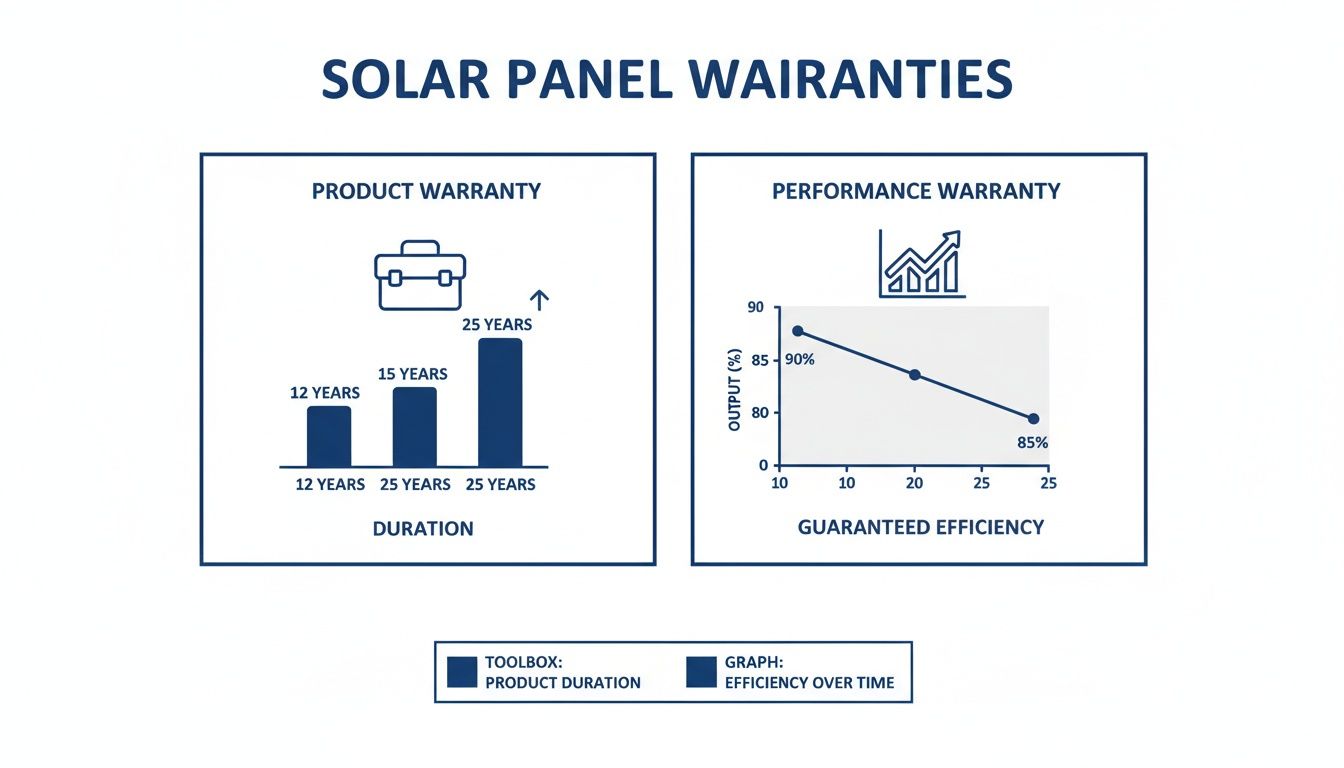
As you can see, a product warranty covers physical defects for 12-25 years. Alongside that, a performance warranty guarantees your panels will still produce a high level of output—typically 85-90% of their original capacity—even after 25 years of service.
A Practical Payback Period Example
Let’s crunch the numbers with a simple example. Imagine a small business on the Gold Coast installing a 10kW system. Here's a simplified look at how the payback period might be calculated.
We can illustrate this with a sample payback calculation for a 10kW system. Let's assume a Total System Cost of $12,000. After applying a typical STC Rebate of around $3,500, the Net Upfront Cost for the business is $8,500. If this system generates Estimated Annual Bill Savings of $2,500, the payback period can be found by dividing the net cost by the annual savings.
$8,500 / $2,500 = 3.4 years.
In just over three years, this system has completely paid for itself. From that point on, it will continue generating free electricity for another 20+ years. That's a powerful return.
How to Find and Vet a Quality Solar Installer
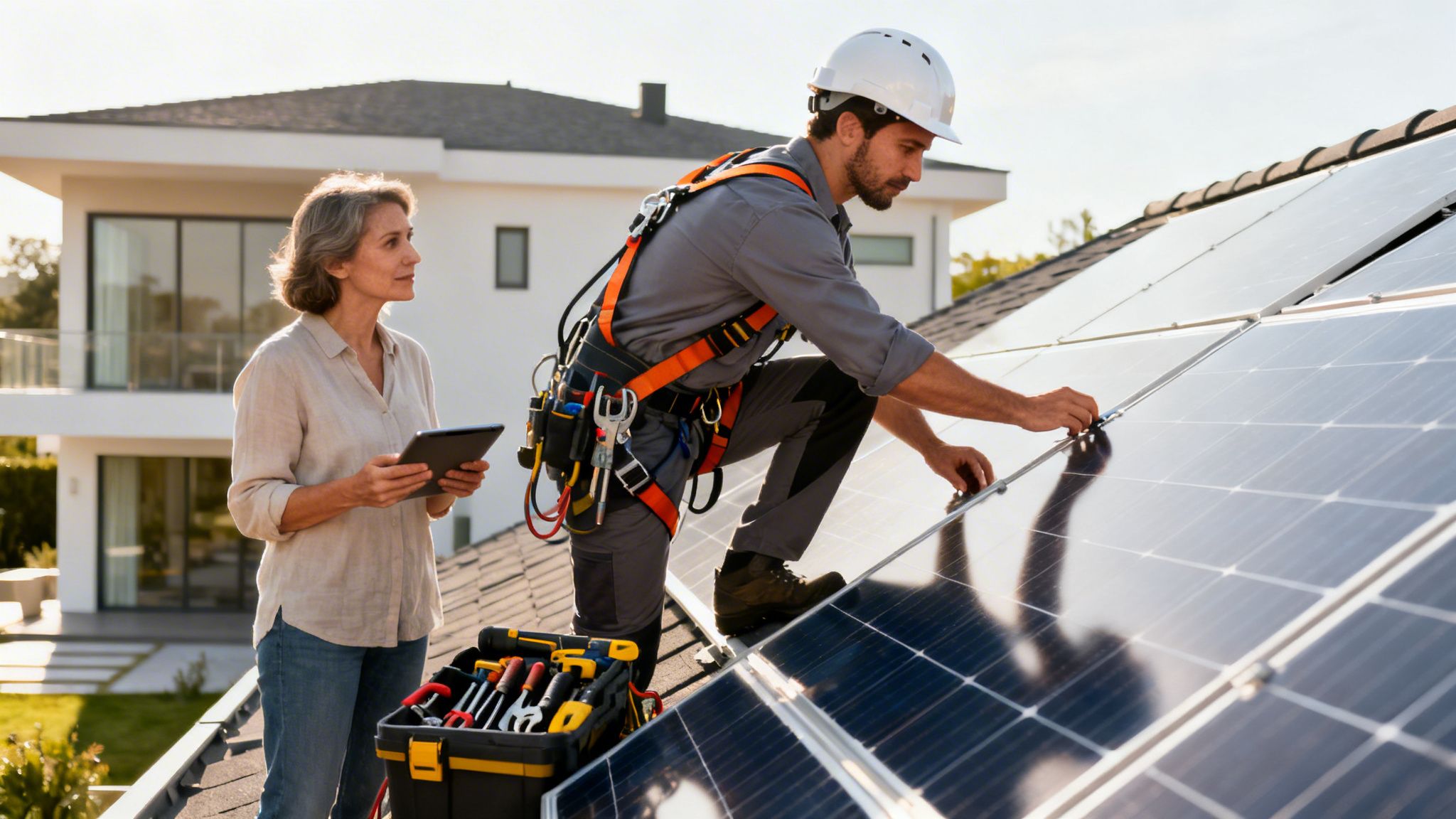
You can spend weeks choosing the most advanced, efficient, and durable solar panels on the market, but their performance means very little if the installation is a botched job. A top-tier solar system is only as good as the team that puts it on your roof.
Honestly, your choice of installer is probably the single most critical decision in your entire solar journey.
A great installer ensures your system is safe, performs at its peak, and stays compliant with all local standards for decades. A bad one? They can leave you with roof leaks, underperforming panels, and even voided warranties. This is why learning how to vet a quality solar installer is a non-negotiable step.
The Installer Checklist: The Bare Minimum
Before you even start comparing quotes, there are a few absolute essentials any legitimate installer in Australia must have. Think of these as the minimum entry requirements. If a company can't tick these boxes, you should walk away immediately.
- Clean Energy Council (CEC) Accreditation: This is the gold standard. A CEC-accredited installer has undergone rigorous training and is held to the highest industry standards for safety and quality. Your system must be installed by one to be eligible for STC rebates.
- Full Licensing and Insurance: Your installer must hold all necessary state electrical licences. Critically, they also need comprehensive public liability insurance to protect your property from any accidental damage during the installation.
- A Proven Local Track Record: Look for a company with a physical office and a history of successful installations in your area. They'll understand local council regulations, grid connection processes, and the specific weather challenges your system will face.
These credentials aren't just for show; they are your primary safeguard against shoddy workmanship and fly-by-night companies that might disappear after taking your deposit.
Key Questions to Ask Every Potential Installer
Once you have a shortlist of accredited and insured installers, it’s time to dig deeper. Their answers to these questions will reveal a lot about their experience, professionalism, and commitment to customer support. A quality installer will welcome these questions and give you clear, confident answers.
1. How long have you been in business, and how many systems have you installed in my area?
Experience matters. A company with hundreds of local installs has a deep understanding of what works and what doesn't in your region.
2. Which panel and inverter brands do you recommend, and why?
A good installer won't just push one brand. They should be able to explain why they trust certain manufacturers, referencing things like warranty support, performance in Australian conditions, and their long-term reliability.
3. Can you provide references or show me examples of your recent work?
Reputable companies are proud of their work and should be happy to share case studies or photos. Checking their online reviews is also a smart move. Just as tradespeople build their reputation through great work, a professional online presence is often a sign of a well-run business. You can learn more about how we help with website design for tradies to see what a strong online footprint looks like.
4. What does your post-installation support look like?
What happens if your system has an issue in five years? Who do you call? A quality installer will offer monitoring support and have a clear process for handling warranty claims.
5. Who will be performing the installation? Are they direct employees or subcontractors?
Ideally, the company uses its own trained, in-house installation team. This generally ensures better quality control and accountability compared to using constantly changing subcontracted crews.
Red Flags to Watch Out For
Just as important as knowing what to look for is knowing what to avoid. Some installers use tactics that should set off immediate alarm bells.
It's wise to be extremely wary of any company that uses high-pressure sales tactics. This includes "today only" deals, offers that seem too good to be true, or any attempt to rush you into signing a contract before you’ve had time to do your research.
Other warning signs include:
- Unusually Vague Quotes: A professional quote will be fully itemised, showing the cost of panels, the inverter, mounting hardware, and labour. If it’s just a single number with no breakdown, ask for more detail.
- Cash-Only Deals: Insisting on cash payments is often a way to avoid creating a paper trail and can be a sign of a dodgy operator.
- Lack of a Physical Address: If a company only has a mobile number and no verifiable business address, it’s a major red flag. They could be impossible to track down if something goes wrong.
Choosing the right installer is about finding a long-term partner for your solar investment. Taking the time to properly vet them will give you the confidence that your system will be a valuable asset for many years to come.
You’ve done the heavy lifting—researching panels, vetting installers, and are now on the home stretch. Before the installation crew pulls up, a few final checks can make all the difference between a smooth project and one with last-minute headaches.
Think of this as your final pre-flight check. It’s your chance to dot the i's and cross the t's, making sure what you signed off on is exactly what gets installed.
Start by grabbing your system design and walking through it one last time with your installer. Pinpoint the exact placement of the panels on the roof, where the inverter will be mounted, and the route for any external conduit. This is your last real opportunity to flag any concerns before the drilling starts.
Finalising Key Components and Permits
Now is also the moment for a final decision on any add-ons. If you've been on the fence about a solar battery, decide if you're installing it now or just want a "battery-ready" system for a later upgrade. Making this call now ensures the inverter and wiring are correctly specced for the future.
While your installer should be handling the admin, it's smart to double-check the status of two critical pieces of paperwork:
- Local Council Permits: Confirm that any required building or planning approvals are officially secured. A holdup here can stop the entire project in its tracks.
- Grid Connection Approval: Your installer needs the green light from your electricity distributor to connect your system. Make sure this approval is in hand.
Getting a handle on the project's administrative side is just as crucial as the hardware itself. For businesses, particularly in construction, having a clear view of all project stages is vital. We’ve shared some thoughts on how to present project information effectively in our guide on website design for construction companies.
Questions for Your Final Walkthrough
After the tools are packed away, your installer will do a final walkthrough and handover. This is your time to ask the important questions and really get to know your new system. Don't be afraid to ask—a good installer will happily walk you through everything.
Have a list of questions ready to go. Here are a few to get you started:
- How do I use the monitoring app to see my energy production and what my home is using?
- What’s the proper shutdown and restart procedure for an emergency or if I need to do maintenance?
- Who is my direct contact for warranty claims or if I have questions about performance down the track?
- Is there any routine maintenance I need to do myself, like cleaning the panels?
Getting clear answers here puts you in control from day one. It means you’ll know how to track your system’s performance and exactly who to call if you ever need support, giving you total peace of mind in your investment.
As you get closer to making a final decision on solar, it's completely normal for a few last-minute questions to pop up. You’ve done the hard yards on the big stuff, but now the finer details about the tech, the installation, and the system's real-world value start to come into focus.
This is where our 25+ years in the business comes in handy. We’ve heard just about every question there is, so we've put together some straight answers to the most common queries we get from Aussie homeowners. Let's clear up those final uncertainties so you can move forward with confidence.
Will My Roof Need Reinforcement to Support Solar Panels?
For the vast majority of modern homes, the answer is a simple no. A typical solar panel setup, including the mounting hardware, only adds about 12 to 20 kilograms per square metre to your roof. Most Australian roofs are engineered to handle far greater loads than this, so extra reinforcement is rarely on the cards.
That said, any installer worth their salt will carry out a thorough roof inspection during their site assessment. If they spot any pre-existing structural issues, or if your roof is on the older side, they’ll flag it immediately. Any strengthening work required will be discussed with you long before the installation begins, guaranteeing your home’s safety and the system's stability for years to come.
How Much Maintenance Do Solar Panels Actually Require?
You’ll be glad to hear that solar panel systems are incredibly low-maintenance. For most of Australia, regular rainfall does a great job of washing away the dust and grime that naturally builds up, keeping your panels running efficiently.
However, if you're in a particularly dusty region or going through a long dry patch, a professional clean every few years is a smart move. It's also a good idea to chat with your installer about routine system health checks to make sure the inverter, wiring, and all connections are still in top shape.
Can I Still Go Solar If I Have a Metal Roof?
Absolutely. In fact, metal roofs are one of the best surfaces for a solar installation. They're exceptionally durable and their lifespan often outlasts the 25-year warranty on the panels themselves. This is a huge long-term benefit, as it means you probably won't have to remove your solar system just to replace the roof underneath.
The installation method depends on the type of metal roof you have:
- Standing Seam Roofs: These are perfect for solar. Installers can use specialised clamps that attach directly to the seams without a single drill hole, which keeps your roof's warranty and waterproofing completely intact.
- Corrugated or Trapezoidal Roofs: These styles do need drilling, but a professional installer will use purpose-built brackets with heavy-duty, weatherproof sealants to create a secure and totally leak-proof fit.
At Titan Blue Australia, we believe in empowering businesses with the right information to make smart digital decisions. Whether it's optimising for search or building a powerful online presence, our 25+ years of experience can help you grow. Discover how our digital strategies deliver real results at https://titanblue.com.au.
Make Titan Blue a preferred source in Google
One click tells Google to surface our articles more often in Top Stories, AI Overviews and AI Mode.

Best Medical Practice Website Design Agencies in Australia: 7 Compared
Best medical practice website design agencies in Australia, compared: seven picks, what each page shows,…

Shopify Website Design Australia: The 2026 Guide
Shopify website design Australia: product pages, collections, delivery info and product data that win sales,…

Cleaning Company Website Design Australia: The 2026 Guide
Cleaning company website design Australia: the pages, quote forms and schema that win jobs, plus…