


Last updated:
If you're a Brisbane plumber, café owner, builder or solar installer, the search game has changed. You're not only trying to rank. You're trying to be the business an AI engine names when someone asks for the best option nearby.
That shift is why AI brand visibility Brisbane matters now. A customer might still search in Google, but they might also ask ChatGPT for a shortlist, read a Google AI Overview, or use Gemini to compare providers before they ever click a website. If your business isn't part of that answer set, you can be excellent at what you do and still miss the lead.
The New Visibility Frontier for Brisbane Businesses
Only 13% of businesses in Brisbane appear in AI recommendations, which means most local operators aren't showing up when AI tools generate answers for customers looking for services, venues, and suppliers (audit.new Brisbane AI visibility report).

For a local business, that creates two realities at once. The first is risk. If AI tools can't confidently identify who you are, what you do, and where you serve, they skip you. The second is opportunity. Most of the market still hasn't adapted, so a business that gets organised now can move ahead without waiting for everyone else to catch up.
What AI visibility means in the real world
Traditional SEO tried to win a click. AI search often tries to answer the question before the click happens. That's a major change for trades and hospitality.
A customer might ask for:
- A nearby solution such as an emergency plumber in Brisbane
- A recommendation list such as places for dinner before a show
- A comparison such as solar providers for a specific suburb
- A trust check such as which local business is established and reliable
If your digital footprint is patchy, AI has nothing solid to work with. If your footprint is clear, consistent, and specific, AI is more likely to include you in the answer.
Practical rule: AI doesn't reward the business with the fanciest wording. It rewards the business with the clearest signals.
This is why generic marketing advice falls short. A Brisbane restaurant doesn't need abstract talk about machine learning. It needs to know whether its menu pages, location details, reviews, service descriptions, and third-party mentions are helping or hurting.
Why local operators can leapfrog bigger brands
AI systems don't think like a traditional ranking report. They piece together a brand profile from your site, your Google Business Profile, your citations, your content, and what other websites say about you. That means smaller businesses can compete if they remove ambiguity and build authority around a tight service area.
If you want a plain-English primer on how this works, this guide on AI search visibility for brands is useful because it frames visibility as inclusion in answers, not just rankings. For businesses already thinking about how AI search fits into local lead generation, a practical starting point is this overview of AI search strategy.
The key point is simple. If you're invisible to AI, you don't just lose traffic. You can lose the recommendation before the customer even sees the usual search results.
Building Your AI-Ready Digital Foundation
Before content, before PR, before clever prompts, your business needs a clean digital foundation. AI tools need structured, machine-readable signals. If your website is vague, inconsistent, or hard to parse, you make their job harder and your own visibility weaker.
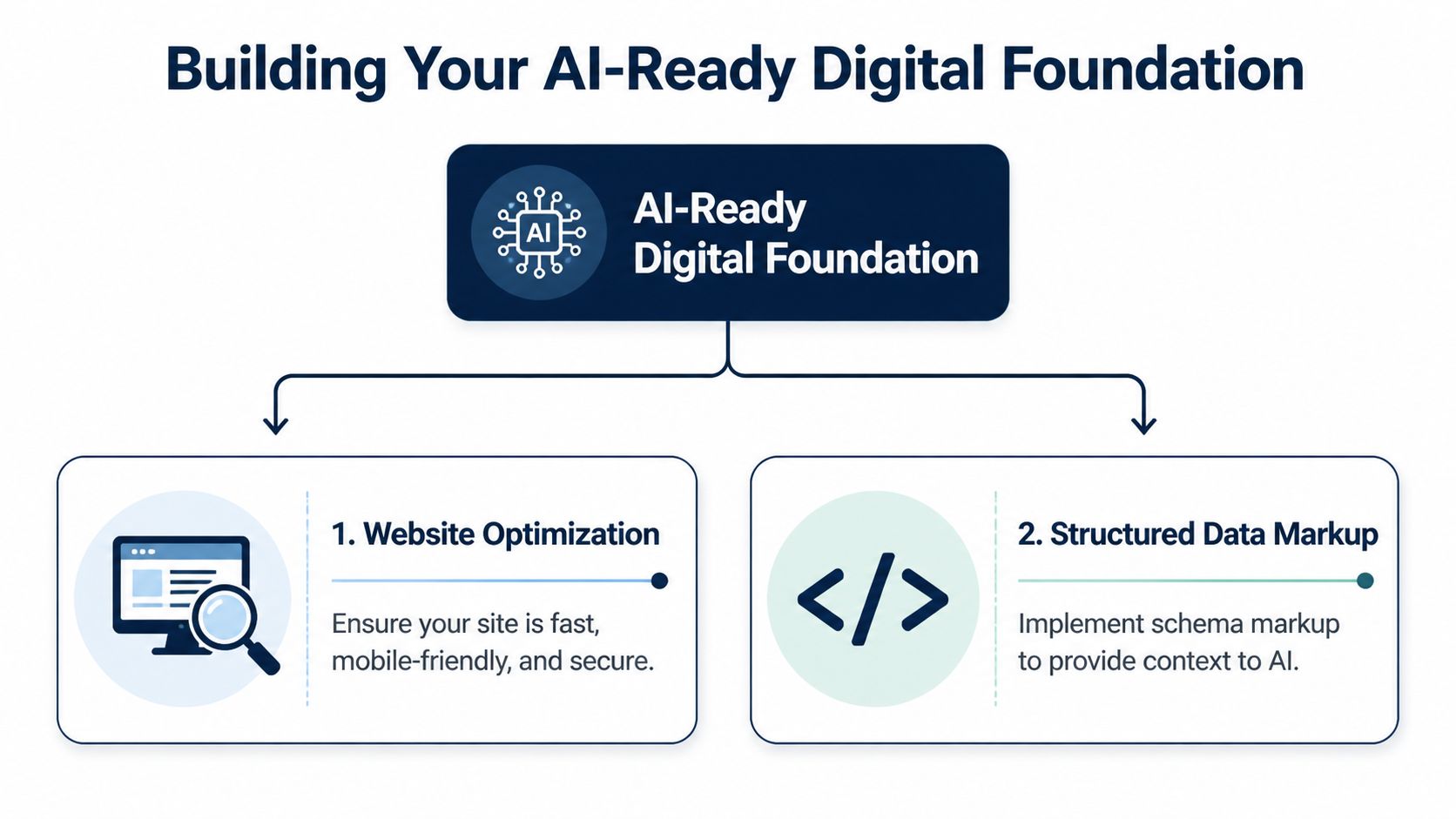
One of the clearest examples is schema. Correctly deploying JSON-LD for local business services can boost indexing and visibility in AI results by up to 3 times, yet over 55% of Australian SMB websites fail to implement it properly due to technical parse failures (Trysight on declining brand visibility in AI).
Start with your Google Business Profile
For local trades and hospitality, your Google Business Profile is often the cleanest public source of truth. AI systems pull from the broader web, but your GBP still helps confirm identity, category, service area, and relevance.
For a Brisbane plumber, that means:
- Use the right primary category that matches the core service you want to be known for
- Fill in service details properly instead of leaving broad one-line descriptions
- Define service areas clearly so Brisbane suburbs and nearby regions are reflected
- Add real business attributes that help confirm what customers can expect
- Keep posts and updates current so the profile doesn't look abandoned
For a restaurant, the same principle applies, but with different detail. Cuisine type, booking options, opening hours, dietary information, and suburb relevance all matter because AI tools look for confidence signals. Gaps create doubt.
Then fix what your website is telling machines
Most business owners think schema is a developer-only problem. It isn't. It's a business clarity problem first.
Your website should make these points obvious:
- Who you are. Business name, brand identity, and contact details must match everywhere.
- What you do. Services need plain labels, not clever headings that only make sense to your team.
- Where you do it. Brisbane, Gold Coast, or specific service areas should be explicit.
- Why you're trusted. Reviews, credentials, experience, and proof should be visible.
JSON-LD schema helps package that information so machines can interpret it properly. For local businesses, the basic aim is to mark up your organisation as a local business, connect it to its services, and make location relevance unmistakable.
If a machine has to guess what your page means, you've already made visibility harder.
A lot of operators also miss a simpler issue. They hide important service details inside tabs, sliders, or messy page builders. Humans can sometimes work through that. AI parsers often won't do it well.
What works and what doesn't
What works:
- Straight service page names such as emergency plumbing Brisbane
- Visible suburb and service area references in normal page copy
- Consistent business details across contact page, footer, and profiles
- Fast, mobile-friendly pages with clean HTML and clear headings
What doesn't:
- Homepage-only messaging that never explains individual services
- Thin location pages written only for search engines
- Overbuilt pages where key content is buried in accordions and scripts
- Mismatched details across website, directories, and profiles
If your team wants a practical checklist before touching code, this guide on whether your website is AI-ready is a sensible place to start. If you're also weighing software choices, this broader piece on the benefits of AI marketing platforms is useful for understanding where tools help and where they don't.
The trade-off is straightforward. Fancy design can help brand perception, but clarity wins discovery. For AI search, the business that says exactly what it does usually beats the business that says it beautifully but vaguely.
AI Content Playbooks for Local Authority
Once the foundation is solid, content becomes your proof. AI engines don't just want to know that you exist. They want evidence that you know your patch, understand your service category, and can answer the questions a local customer is specifically asking.

The strongest approach isn't publishing random blogs every few weeks. It's building topical authority around the services you want to be recommended for. Successful strategies involve 20-30 content clusters, and a common failure point is that 60% of brands omit direct competitor comparisons in their content, which leaves them invisible in AI-generated lists.
Build clusters, not isolated posts
A Brisbane electrician, for example, shouldn't stop at one service page. The content set needs to support the topic from multiple angles.
A useful cluster could include:
- Core service pages for installation, repairs, upgrades, and emergency work
- Local pages tied to Brisbane service areas you cover
- FAQ articles answering urgent pre-purchase questions
- Comparison pages that explain service options, standards, or fit-for-purpose choices
- Process pages that show what happens from quote to completion
A restaurant can take the same logic and adapt it:
- pages for functions, dining style, menus, and bookings
- articles answering practical questions such as parking, dietary needs, or best times to visit
- locally relevant pages tied to events, nearby venues, or neighbourhood intent
Use AI as a working partner, not the writer of record
Large language models are useful for speed, but they need tight direction. The best use isn't asking for "a blog about plumbing". It's asking for structured help inside a real content workflow.
Try prompts like:
- Map the category. "List the subtopics a Brisbane emergency plumber should cover to become a trusted local authority online."
- Surface buyer questions. "What would a homeowner in Brisbane ask before booking an emergency plumber at night?"
- Draft a comparison outline. "Create an outline comparing burst pipe repairs, blocked drain callouts, and hot water failures for local service pages."
- Find content gaps. "What important service questions are usually missing from local restaurant booking pages?"
Then have a human operator rewrite, validate, localise, and sharpen the copy. That's where authority comes from.
Working standard: If your content could be swapped with a business in any other city, it isn't local authority content yet.
Put comparison content back into the mix
Many businesses avoid comparison pages because they're worried it feels too salesy. In AI search, that's often a mistake. Customers compare options before they enquire, and AI tools look for pages that help resolve those comparisons.
A strong comparison page doesn't need to name rival businesses. It can compare:
- service methods
- inclusions
- response times
- quality levels
- suitability for different situations
That helps AI understand where your business fits and what problems you solve best.
A helpful explainer on production workflows is this ShortGenius AI ad creative tool, particularly if your team is turning service ideas into short-form assets as part of a wider content operation. For written service pages and educational pieces, this guide on writing website content keeps the focus where it belongs: useful, specific copy that answers buying questions.
A quick visual breakdown helps here:
The content standard that gets remembered
The pages that tend to earn attention from AI have a few things in common:
- They answer real questions plainly
- They show local relevance without keyword stuffing
- They explain service differences clearly
- They include proof, not just claims
Thin, generic content doesn't build authority. A useful page does. That's the practical difference.
Dominating Local Citations and Signals
Most business owners spend too much time looking inward. They tweak titles, rewrite service pages, and adjust headings, but ignore the wider web. That's a mistake because AI systems don't build trust from your website alone. They cross-check.

That matters because authority-driven brands secure 10 times more citations and mentions in AI-generated answers, which creates a real advantage for businesses that have a strong off-site footprint, transforming local citations, reviews, industry mentions, and community references from background SEO work into recommendation signals.
Why off-site signals matter so much
A website can say anything about itself. AI tools know that. They place more confidence in patterns that appear across multiple sources.
For a Brisbane service business, those sources often include:
- Local directories with consistent name, address, phone, and service details
- Industry associations that confirm category relevance
- Review platforms that reinforce reputation and service type
- Local media or community mentions that show your business exists tangibly
- Partner and supplier references that connect your business to a genuine operating network
If your website says you're a trusted local provider but the broader web barely mentions you, the trust picture is weak. If the same business details keep appearing in credible places, your profile becomes easier for AI to validate.
What to prioritise first
Don't chase every listing you can find. That's busywork. Prioritise the mentions that improve identity, location confidence, and category clarity.
Start with:
- Your core business details. Make sure your business name, address, phone, and website are written the same way everywhere.
- Your primary category mentions. A plumber should be described as plumbing-related consistently. A venue should be described as the kind of venue it is.
- Your local area references. Brisbane, the Gold Coast, and relevant suburbs should appear naturally where appropriate.
- Your trust assets. Reviews, awards, membership pages, and profile pages should support the same business story.
A messy citation profile doesn't usually kill trust on its own. It creates doubt, and doubt is enough to keep you out of an AI recommendation.
The trade-off most businesses miss
There's a difference between volume and usefulness. One solid local mention on a credible website can be more valuable than a pile of low-quality listings with thin or outdated information.
That means a practical local strategy often looks like this:
- clean up inconsistent old citations
- strengthen the best existing profiles
- earn mentions from relevant community and industry sources
- support those mentions with a site that clearly matches the same story
For businesses already focused on search performance at the suburb level, this guide on SEO for local businesses is a useful companion because it aligns local discoverability with broader trust-building work.
The point isn't to be everywhere. It's to be clearly and consistently represented where AI systems look for corroboration.
Measuring Your AI Visibility Accurately
Plenty of businesses test AI visibility the wrong way. They type one prompt into ChatGPT, don't see their name, and assume the strategy failed. Or they do see their name once and assume the job's done. Neither conclusion is reliable.
Australian data shows that single-query AI visibility can fluctuate by 40-60% due to model randomisation, which is why one-off checks are misleading and multi-run testing is essential (ROI.com.au on AI measurement challenges).
Why one prompt tells you almost nothing
AI models vary. The wording of the prompt changes the answer. The platform changes the answer. Even the same prompt can produce different outputs across multiple runs.
A Brisbane café might appear when someone asks for "best brunch in Brisbane CBD" and disappear when the phrasing shifts to "good breakfast spot near Central station". A plumber might appear for a service-specific query but not for a broader recommendation query.
That's normal. The job isn't to obsess over one result. The job is to measure patterns.
A practical testing method
Use a repeatable process. Keep it simple enough that you can run it regularly.
Build a prompt set
Create a list of prompts that reflect how customers ask. Include:
- Service-first prompts such as emergency plumber Brisbane
- Problem-first prompts such as who fixes burst pipes in Brisbane
- Comparison prompts such as best local options for a blocked drain
- Location-intent prompts tied to suburbs or landmarks
- Recommendation prompts where a customer is clearly choosing
For hospitality, use prompts around dining occasions, neighbourhood intent, booking needs, and cuisine relevance.
Test across multiple runs
Run each prompt multiple times in the AI tools that matter to your audience. Record whether your business is:
- fully mentioned
- partially mentioned
- not mentioned
Also note whether the mention is accurate. An inaccurate mention isn't a win. If the model names your business but gets your service wrong, that still needs work.
Score what you see
A simple scoring model keeps teams honest:
- Full mention when the business name and service fit are correct
- Partial mention when the name appears but detail is thin or incomplete
- No mention when you're absent
Then compare your appearance rate across your own prompt set over time. That's far more useful than checking a single flashy query.
Measurement rule: Track accuracy, not just presence. Being named for the wrong thing can send the wrong leads.
What to look for in the results
Patterns matter more than isolated wins.
If you're strong on informational prompts but absent from recommendation prompts, your content may educate without proving commercial fit. If you're present for broad Brisbane queries but absent for suburb-level intent, your location signals may be weak. If one AI tool mentions you and another doesn't, your broader footprint may need work.
A useful review rhythm is:
- Weekly checks for a small sample of priority prompts
- Monthly comparison against your own baseline
- Quarterly review of prompt set, visibility quality, and content gaps
Don't overcomplicate the tooling early on. A spreadsheet, a clear prompt library, and disciplined note-taking are enough to start.
What matters is consistency. If you measure loosely, you'll make loose decisions. If you measure properly, you'll know whether your website fixes, content improvements, and citation work are changing how AI systems describe your business.
Quick Wins and Your Next Steps
A Brisbane café owner doesn't need a six-month transformation before taking action. Three practical moves can put the business on firmer ground this week.
First, the café cleans up its Google Business Profile. Services, categories, booking details, and opening information all match the website exactly. Second, it publishes one useful local FAQ page that answers real questions customers ask before visiting. Third, it tightens business details across its main directory listings so the same identity appears everywhere.
What this looks like in practice
By the end of the week, the business hasn't become an AI authority overnight. But it has done something more important. It has reduced ambiguity.
The same pattern works for a trade business:
- Tidy the profile so your service areas and core offerings are explicit
- Publish one strong page answering a high-intent local question
- Fix your citations so your contact and business details don't conflict
For a restaurant or venue:
- Clarify your offer on-page and in your profile
- Add one useful page around bookings, functions, or local visitor questions
- Strengthen review and listing consistency across the web
The fastest wins usually come from clarity
Most businesses don't need more noise. They need better signals.
Start here:
- Rewrite one weak service page so it says exactly what you do and where.
- Add one local FAQ page based on questions customers already ask by phone.
- Check your main business listings and make sure details match.
- Review your Google Business Profile for missing categories, services, and updates.
- Create one comparison-style page that helps a buyer choose the right service option.
A broader digital marketing checklist for small business can help you prioritise what to fix first if your online presence has grown unevenly over time.
The businesses that win in AI search won't always be the biggest. They'll often be the clearest, the most consistent, and the easiest to verify. That's good news for local operators in Brisbane and on the Gold Coast. You don't need to outspend everyone. You need to remove confusion and build trust in the places AI systems are already looking.
If you want help improving your visibility in AI search, Titan Blue Australia works with businesses across the Gold Coast, Brisbane, and beyond on websites, SEO, AEO, content, and digital strategy built for how customers search now.
Make Titan Blue a preferred source in Google
One click tells Google to surface our articles more often in Top Stories, AI Overviews and AI Mode.

ChatGPT GPT-6 Search Upgrade: What It Means for Australia
OpenAI rolled out GPT-6 to ChatGPT on 7 October 2026 with faster search. Here is…

Best Dental Website Design Agencies in Australia: 7 Compared
Best dental website design agencies in Australia 2026: seven compared on dental proof, booking, AHPRA…

Childcare Centre Website Design Australia: The 2026 Guide
Childcare centre website design Australia: show hours, ages and enrolment as text so parents and…