

Last updated:
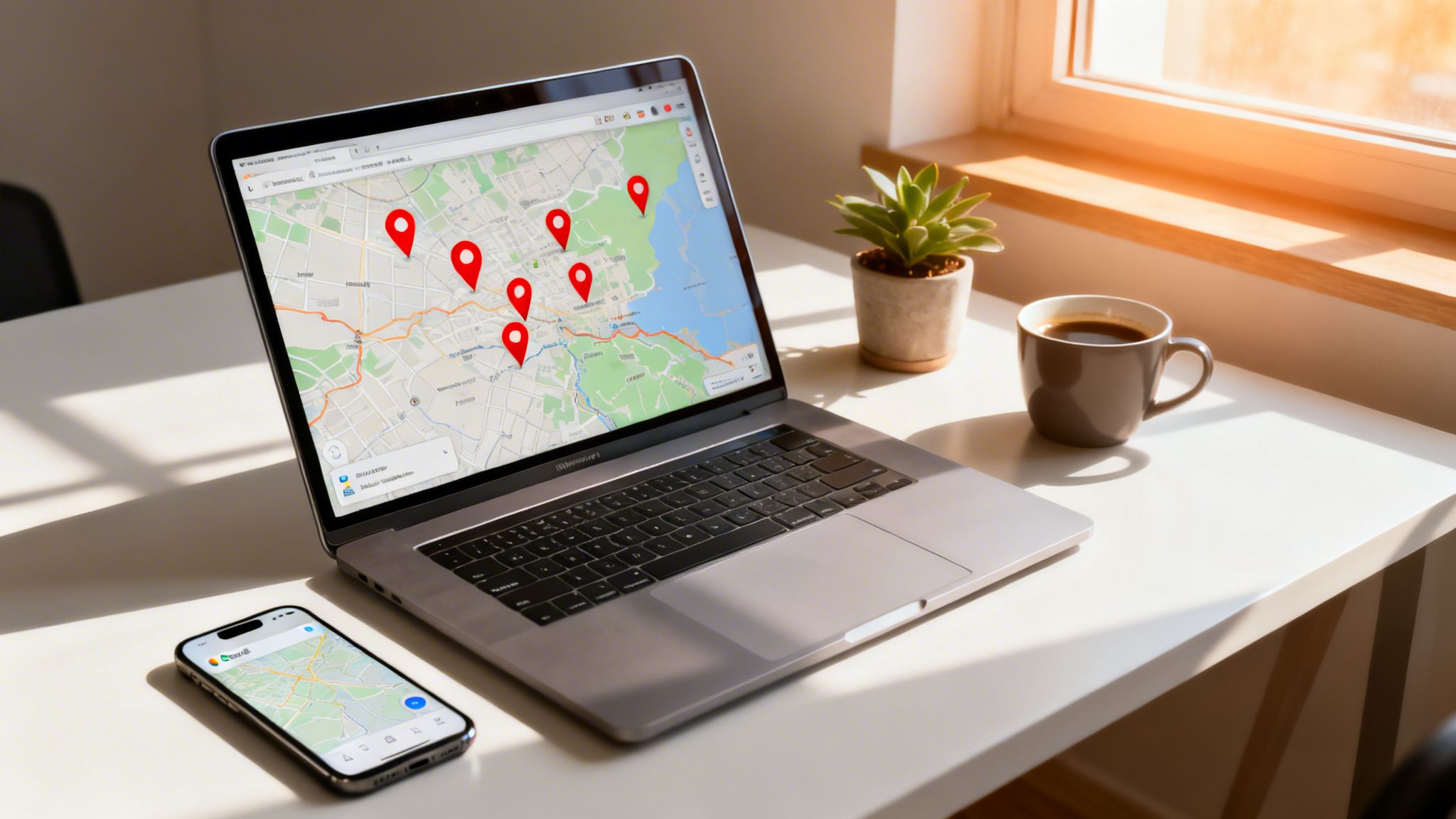
Local SEO for small businesses is all about optimising your online presence to show up in front of local customers who are actively searching for what you offer. It’s the strategy that turns those online searches into real-world customers walking through your door.
Why Local SEO Is Your Biggest Opportunity
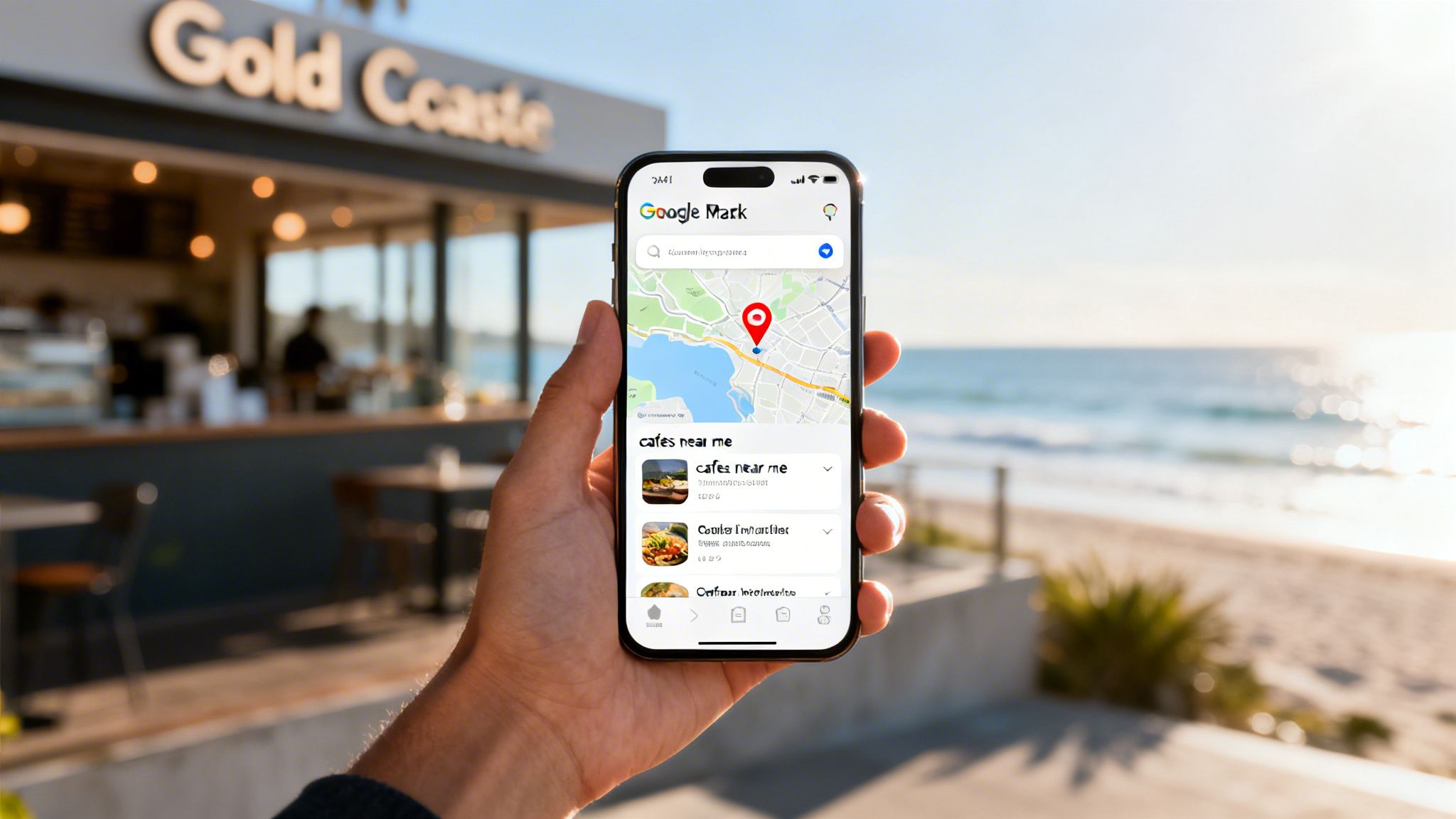
Let's get straight to it. Your next customer isn't digging through a phone book; they're online right now, searching for a business just like yours. For any Aussie small business, whether you're a cafe on the Gold Coast or a plumber in Broadbeach, getting local search right isn't just a nice-to-have—it's essential for survival and growth.
Think of it as your digital storefront. It's the modern equivalent of having the best spot on the main street. You're connecting with high-intent customers typing in "near me" searches, putting your business on their map at the exact moment they need you.
A staggering 46% of all Google searches carry local intent. That means nearly half of the 3.5 billion searches happening every day are for local information. The opportunity here is massive.
Turning Searches Into Customers
The heart of local SEO lies in tools like your Google Business Profile and getting featured in that all-important Google Map Pack. These aren't just technical jargon; they're powerful assets that build instant credibility and drive foot traffic.
When a potential customer sees your business pop up with a great rating, correct opening hours, and a clear address, you immediately build trust. It’s a simple, proven process.
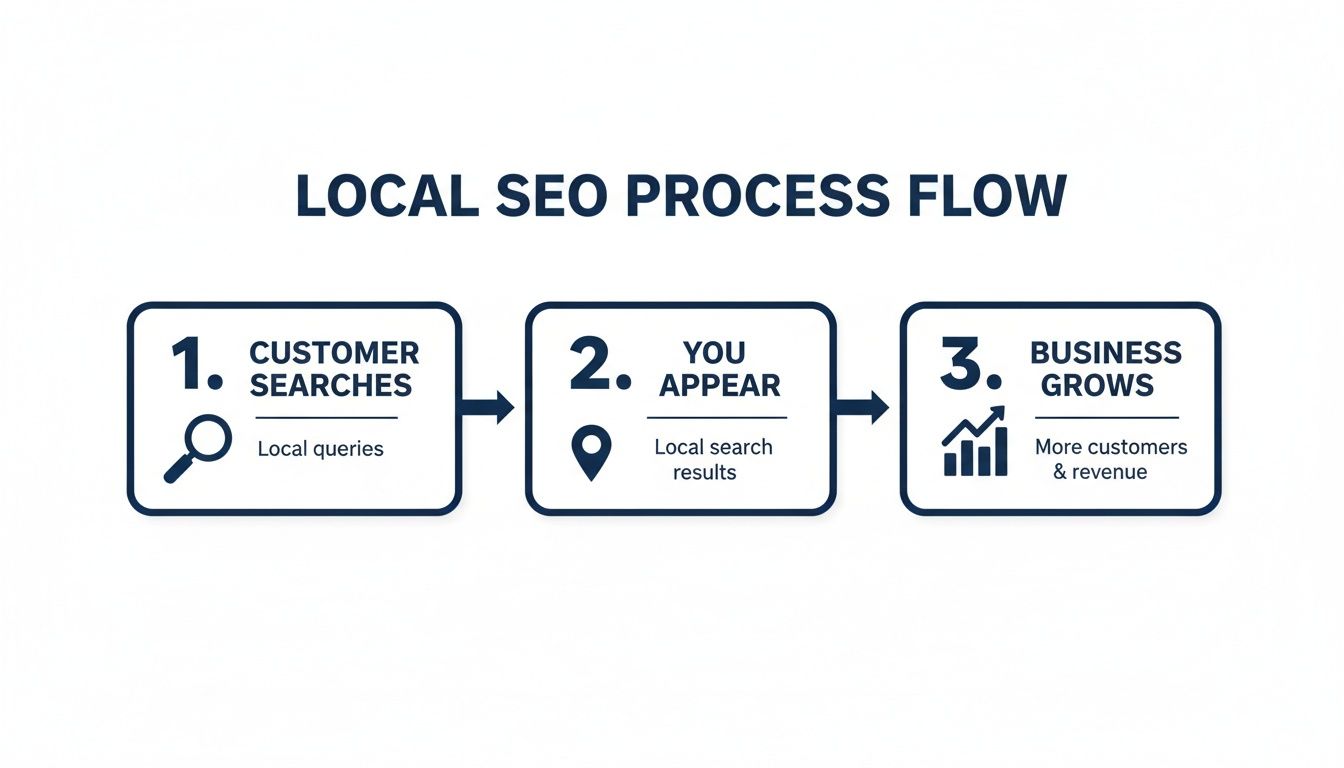
This flow from discovery to growth is a clear, repeatable path once you have a solid local SEO foundation in place.
Your Practical Playbook for Growth
This guide is designed to be your hands-on playbook. We’re cutting through the noise to give you actionable steps that will genuinely improve your local visibility. You won’t just learn the "what," but the "how" behind building a strong local search presence that delivers real results.
To get started with some practical steps, check out this guide on how to improve local SEO rankings for your small business. The core principles of search engine optimisation are also crucial, and you can learn how to boost your business with SEO for small businesses in our related article.
Your Google Business Profile Foundation
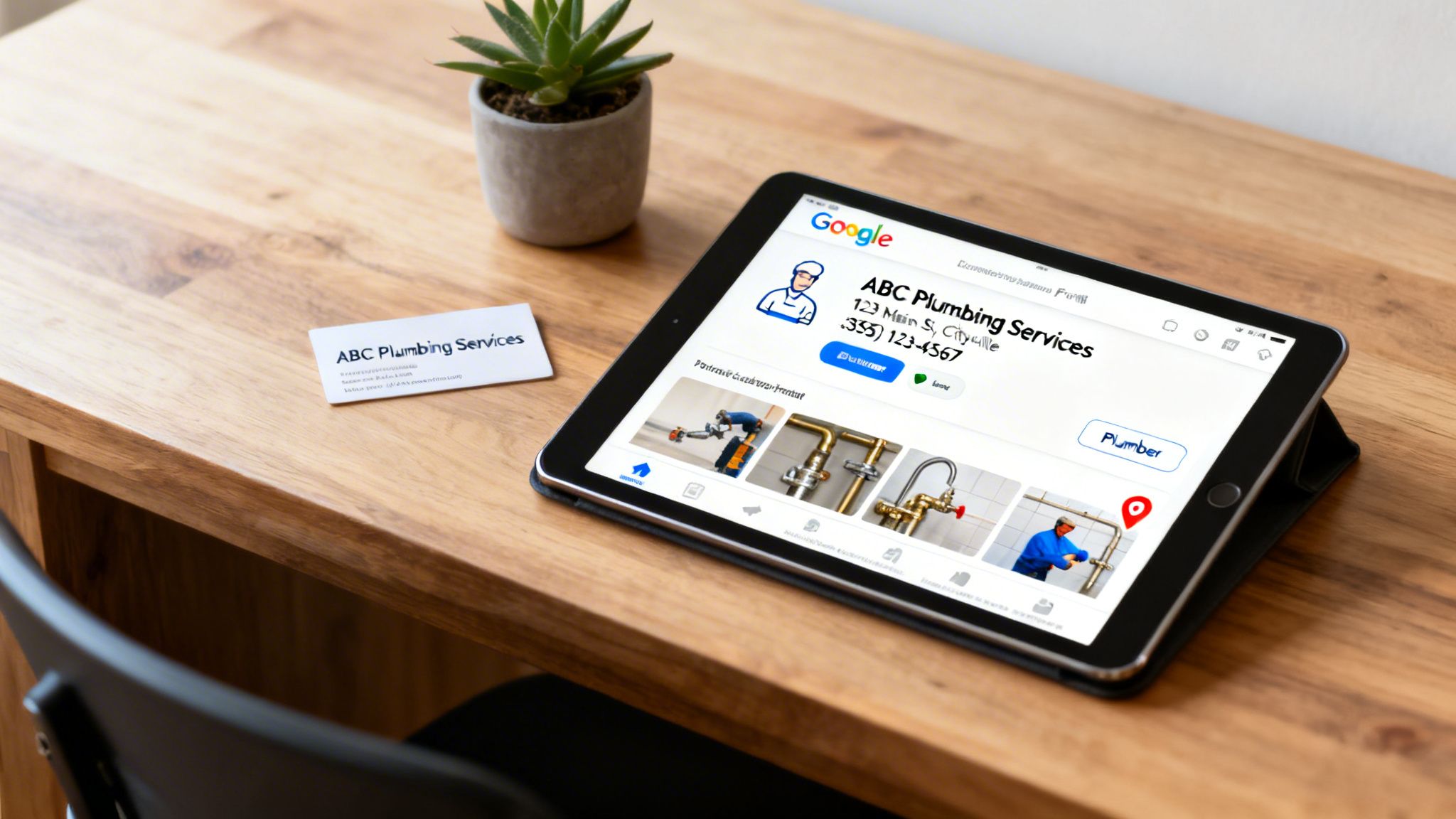
Think of your Google Business Profile (GBP) as the digital front door to your business. This isn't just another online listing; it’s the powerful foundation upon which your entire local search presence is built. Getting this right is the most impactful step you can take, moving your business from being invisible to being the first choice for customers nearby.
A well-optimised GBP is like a mini-website that lives directly within Google's search results and on Google Maps. It’s where customers find your phone number, get directions, read reviews, and see photos of your work—often without ever needing to click through to your actual website. It’s your number one tool for building trust and giving people the info they need, instantly.
Nailing Your Categories and Description
Your first critical task is to pick the right categories. This is how you tell Google exactly what you do, so it can show your business in the most relevant searches. Always choose the most specific primary category you can find.
For instance, a plumber shouldn’t just select ‘Tradesperson’. ‘Plumber’ is a far better choice. If you install solar panels, you should choose ‘Solar Energy Contractor’, not just ‘Contractor’. That level of precision is vital.
Once your primary category is set, add any relevant secondary categories. Think about everything you offer. That same plumber might also add:
- Hot Water System Installation
- Gas Fitter
- Drain Cleaning Service
This helps you show up for more searches without watering down your main specialisation.
Next, it’s time to write a business description that speaks directly to your ideal customer. Ditch the generic fluff and focus on what makes you different.
A restaurant on the Gold Coast could write something like, "Escape to a taste of the Mediterranean at our Broadbeach eatery, featuring fresh, locally sourced seafood and sunset ocean views from our beachfront deck. Perfect for a relaxed family dinner or a romantic evening out." This sells an experience, not just a meal.
The Power of Visuals and Engagement
High-quality photos are non-negotiable. People want to see your work, your team, your location, and your products. In fact, businesses with photos receive 42% more requests for driving directions on Google Maps and 35% more clicks through to their websites.
Make sure you upload a good variety of images:
- Exterior Shots: Show customers what your business looks like from the street.
- Interior Shots: Give them a feel for the atmosphere inside.
- Team Photos: Put a human face to your business. It builds trust.
- Photos of Your Work: For tradies, this is your portfolio. Before-and-after shots are absolute gold.
Here's a pro tip: before uploading your images, make sure they are geotagged with your location’s coordinates. It gives them an extra local SEO boost.
Beyond photos, you need to actively use the features Google gives you. Google Posts are perfect for sharing timely updates like special offers, new services, or upcoming events. It keeps your profile looking fresh and active, which sends positive signals to both customers and Google.
The Q&A feature is another goldmine. Don’t wait for customers to ask questions—add your own FAQs and answer them proactively. Think about what people always ask you: "Do you offer free quotes?", "Is there parking available?", "Are you open on public holidays?". Answering them here saves everyone time and positions you as a helpful expert.
The Unbreakable Rule of NAP Consistency
Finally, we get to the most fundamental rule of local SEO: NAP consistency. This stands for Name, Address, and Phone number.
These three details must be identical everywhere your business is listed online. That means your GBP, your website, your social media profiles, and every single online directory needs to match perfectly.
Inconsistencies kill trust with Google. If one directory lists your business as "ABC Plumbing Pty Ltd" and another just has "ABC Plumbing," Google’s algorithm can get confused and might even see them as two different businesses. This confusion can seriously drag down your local search rankings.
Your business name, address, and phone number should be written the exact same way across every corner of the internet. This consistency is a massive trust signal for search engines, proving you are a legitimate, established local business.
Establishing this bedrock of consistent information is paramount. You can go deeper and learn more about how Google My Business and local SEO work together to drive real results. By getting these foundational elements right, you create a powerful, trustworthy profile that acts as the launchpad for all your local marketing efforts.
Winning with On-Page Local SEO Signals
A perfectly polished Google Business Profile is a massive win, but it’s only half the battle. Think of it as the sign above your shopfront—it gets people to the door. Your website is what convinces them to come inside.
For local SEO for small businesses to really work, your website needs to send just as many strong local signals as your GBP. This is where we connect the dots, optimising your website’s pages to show both Google and your customers that you're a local authority.
It’s about moving beyond a generic "Services" page and creating specific, high-value pages that speak directly to what people in your area are searching for.
Craft Location-Specific Service Pages
If there's one on-page tactic that moves the needle more than any other, it's creating dedicated pages for each service in each main location you cover. A generic page just can’t compete.
I see this all the time. A construction company on the Gold Coast has one page titled "Our Building Services" listing everything they do. That's a huge missed opportunity.
Instead, they should be creating individual, laser-focused pages.
- The common mistake: A single page for "Home Renovations".
- The better approach: Separate pages like "Home Extensions Broadbeach," "Kitchen Renovations Mermaid Beach," and "Deck Builders Burleigh Heads."
This lets you tailor everything—headings, text, images, and testimonials—to that specific suburb and service. You're telling Google exactly what you offer and where, which dramatically boosts your chances of ranking for those valuable, high-intent local searches.
Weave Local Keywords in Naturally
Once you have your location pages, you need to infuse them with local keywords. This doesn't mean stuffing "Plumber Gold Coast" into every other sentence. That stopped working years ago.
It's all about integrating your location naturally into the most important parts of the page.
Focus your efforts on key areas like your Page Title (Title Tag), which is your prime real estate. Make it concise and include both the service and location (e.g., "Emergency Solar Panel Repair | Gold Coast & Tweed Heads"). Your Meta Description should also include your location and give people a compelling reason to click. Lastly, integrate your main keyword into the H1 heading and use variations in subheadings and the body content. This reinforces your local relevance in a way that feels authentic.
The key is to write for humans first, search engines second. Natural language that clearly communicates your service area will always outperform robotic, keyword-stuffed text.
If you're looking for more actionable advice, you can deepen your knowledge by exploring these helpful on-page SEO tips for Sydney businesses, which apply just as well to any Australian local business.
Implement Technical Local Signals
Beyond the content you write, there are a few technical elements you can add to your website to practically scream "local business" at search engines. They’re simple to implement but are often overlooked.
An easy win is to embed a Google Map on your contact page or in the footer. It’s a direct visual confirmation of your address and gives customers a one-click way to get directions.
The next step is to add Local Business schema markup. This is just a snippet of code on your website’s back-end that hands Google a perfectly organised digital business card.
This code clearly defines your:
- Business Name
- Address
- Phone Number
- Opening Hours
- Service Area
By structuring this data, you remove all the guesswork for search engines. It helps them understand exactly who you are, what you do, and where you operate. This technical signal strengthens the link between your website and your GBP, creating a powerful synergy that drives better rankings.
Building Authority Through Reviews And Citations
Beyond what you say on your own website and Google Business Profile, Google is constantly looking for external proof that your business is legitimate and trusted. Two of the most powerful signals in local SEO are customer reviews and online business citations.
Think of them as third-party endorsements. They show Google that you’re a real, active business valued by the local community, and that you’re actually located where you claim to be.
Mastering Your Customer Review Strategy
Customer reviews have become the modern-day word-of-mouth, and they're a huge factor in the decision-making process. The numbers don't lie: an overwhelming 97% of consumers read online reviews for local businesses, and 41% always check them before making a choice.
A high star rating can be the one thing that convinces a customer to choose you over the competitor just down the road. It’s that simple.
So, how do you get more reviews without being pushy? The trick is to make it incredibly easy for customers to leave feedback right when they’re happiest with your service.
Here are a few simple ways to do it:
- Simple Email Follow-Ups: A day or two after a job is done, send a quick, polite email with a direct link to your Google review page.
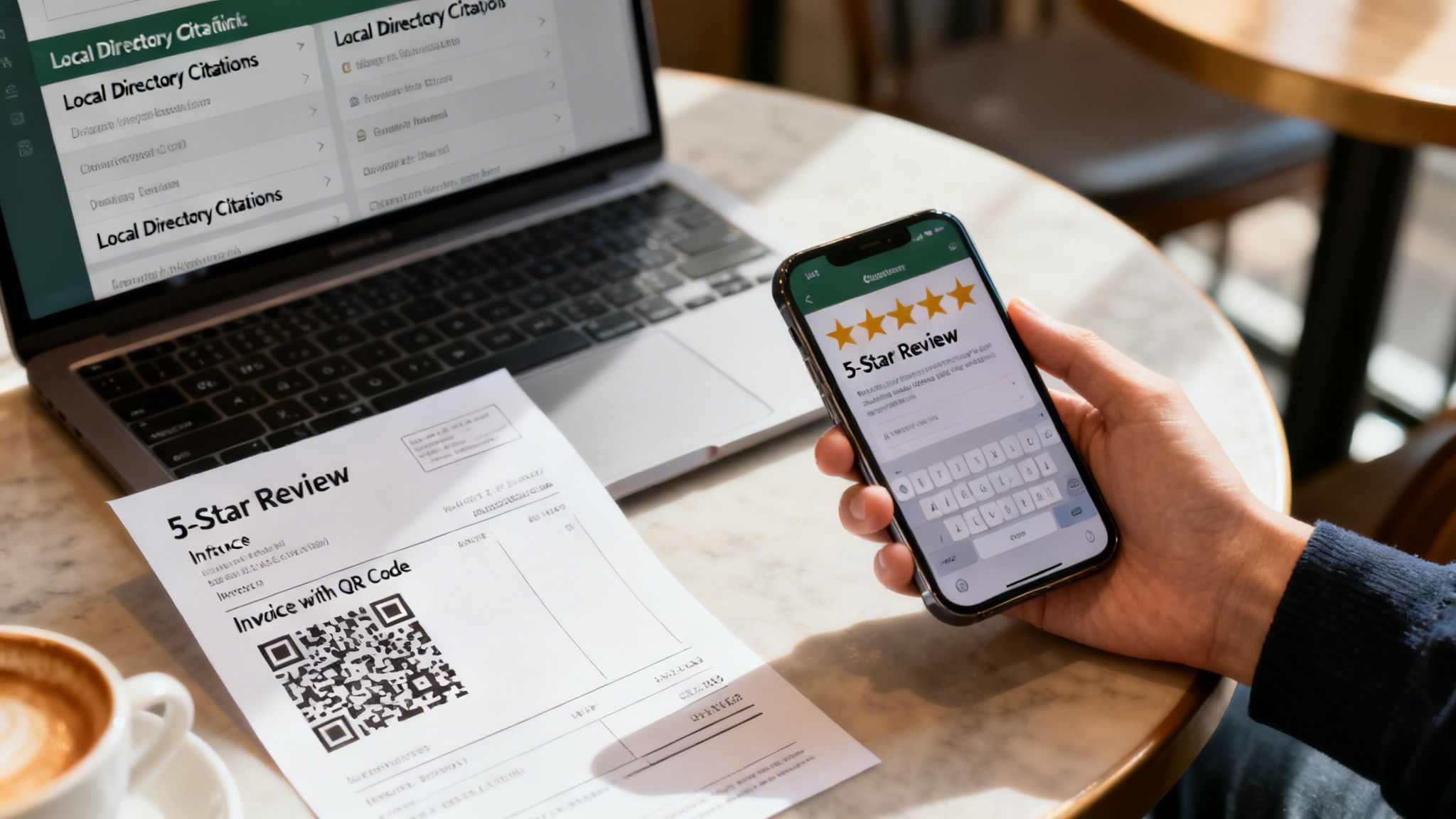
- QR Codes on Invoices: If you’re a tradie or run a café, a QR code on the final bill can take a customer straight to the review form on their phone. It’s fast and friction-free.
- Text Message Requests: A friendly SMS with a review link has a fantastic open rate and is one of the most effective methods out there.
Responding to every single review—good or bad—is non-negotiable. Thanking someone for positive feedback shows you appreciate their business. More importantly, a thoughtful response to a negative review shows everyone you’re committed to great customer service. To dig deeper on this, check out our article on why customer reviews matter so much.
Never ignore a negative review. A public, professional response that offers a solution or clarifies a misunderstanding can turn a bad experience into a display of your business's integrity and commitment to customer satisfaction.
Building A Consistent Citation Profile
Now, let's talk about citations. They’re simply online mentions of your business's core information: your Name, Address, and Phone number (NAP). You'll find them in online business directories, on industry-specific websites, and on local community portals.
The goal here is to build a profile of accurate and, most importantly, consistent citations all over the web.
Consistency is everything. Just like with your Google Business Profile, your Name, Address, and Phone number must be identical everywhere it appears online. A tiny difference, like "St" instead of "Street" or including "Pty Ltd" on one site but not another, can confuse search engines and weaken your local authority.
Finding And Managing Your Citations
First things first, you need to lock down your core citations on the major, high-authority platforms. These are the foundational directories where every business should have a listing.
Start with these key places:
- Your Website: This is the primary source of truth. Your NAP should be clearly listed, ideally in the footer of every single page.
- Google Business Profile: As the centrepiece of your local SEO, it has to be perfect.
- Key Australian Directories: Focus on prominent local directories that carry weight here in Australia.
- Social Media Profiles: Make sure your business details on Facebook, Instagram, and LinkedIn are accurate and match everything else.
Once your foundation is solid, you can start looking for more niche and industry-specific directories. A restaurant, for instance, might want a listing on a popular food blog, while a builder could get listed on a construction industry association website.
Building citations isn’t a one-and-done job. It’s an ongoing process of checking for accuracy, cleaning up duplicates, and adding new, relevant listings over time. This steady effort strengthens your digital footprint and proves to Google that you’re a trusted local business, giving you a serious edge in a competitive market.
Creating Content That Connects With Your Community
Solid on-page SEO and a great review profile will get potential customers to your digital doorstep. Now, it’s time to invite them in and show them you’re part of the neighbourhood. This is where you shift from being a business in a community to becoming a valued part of it, using content that proves you’re a local expert and builds real connections.
The whole strategy boils down to two things: creating genuinely useful content that solves local problems and building partnerships that anchor your business in the community. It’s a powerful mix that drives relevant traffic and earns you authoritative local backlinks.
Developing Hyper-Local Content Ideas
The best local content is the kind that answers questions and solves problems unique to your area. Forget generic blog posts. A post on "five plumbing tips" is fine, but it’s not going to make you stand out from the crowd.
You need to get specific. Prove you understand the local landscape. That’s how you become the go-to resource people actually search for.
Think about these real-world examples:
- A Gold Coast plumber: Instead of generic tips, write a blog post on 'Common Plumbing Issues in Broadbeach Homes', talking about problems caused by coastal corrosion or the unique quirks of older buildings in the area.
- A local restaurant: Create a guide to 'The Best Local Produce on the Gold Coast', highlighting the farms you source from. This shows your commitment to quality and community.
- A solar installer: Write an article that simplifies a complex local topic, like 'Navigating Queensland Solar Rebates for Your Home'.
This kind of content does more than just hit keywords; it builds trust by showing you’re genuinely in tune with your customers' world.
Forging Local Links Through Community Engagement
Think of backlinks as votes of confidence from other websites. When a respected local site links to yours, it sends a strong signal to Google that your business is a legitimate, important part of the community. The good news? Earning these valuable links doesn’t require a huge marketing budget.
More often than not, it comes down to simply getting involved. Your offline actions can generate fantastic online results.
Building local links is less about technical outreach and more about building real-world relationships. Sponsoring the local footy club or collaborating with the café next door aren't just good for business—they are powerful link-building activities.
Here are a few practical, budget-friendly ideas:
- Sponsor a local sports team: That junior soccer or rugby league club probably has a website, and they’d be thrilled to add a link to your business on their sponsors page. It’s a classic win-win.
- Partner with a neighbouring business: Team up for a joint promotion. A local gym and a healthy café, for example, could offer a discount package and promote each other on their websites and social media, linking back and forth.
- Get featured in a community blog: Many suburbs have local blogs or news sites run by passionate residents. Reach out and offer an expert tip or a quote for an upcoming story.
These moves don’t just earn you valuable backlinks; they cement your identity as a dedicated local business. You’re showing search engines that you are an active, engaged, and trusted member of the community—which is exactly what Google wants to see. This community-first approach is the secret to building a local search presence that lasts.
The Future of Local Search And AI
The way customers find you is changing. Gone are the days of just typing a few keywords into a search bar. We're now in an era of conversational search, driven by AI assistants and voice search.
People don't just search for "cafe Broadbeach" anymore. Instead, they're asking their phones, "Hey Google, find a great cafe near me that's open now and has outdoor seating." This is a huge shift. To show up in these results, your online presence needs to be optimised to provide direct, clear answers.
Preparing for Conversational Search
The best way to adapt is to start thinking like your customers. What questions are they really asking? Weave natural, question-based language throughout your website.
A great place to start is with a detailed FAQ page or blog posts that tackle specific local problems or queries head-on. Another seriously underused tactic is to get proactive with your Google Business Profile's Q&A section. Don't just wait for customers to post questions—add your own common queries and provide thorough, helpful answers. This creates a goldmine of structured information that AI can pull from to answer those conversational searches.
The Fundamentals Matter More Than Ever
In this new AI-driven world, the fundamentals of local SEO for small businesses haven't just stayed relevant; they've become absolutely critical. AI and large language models are built to find and serve up the most trustworthy, reliable information they can get their hands on.
Your most powerful assets in this landscape will continue to be:
- A strong history of positive reviews: This is a massive, undeniable trust signal.
- Completely accurate NAP data: Your name, address, and phone number must be identical everywhere online. No exceptions.
- High-quality local content: This is how you prove your expertise and relevance to a specific area.
Think of it this way: AI is looking for the safest bet. It will always prioritise businesses with a solid foundation of trust. By nailing these core elements, you’re not just optimising for today; you’re future-proofing your business for whatever comes next in search.
You can learn more about how to prepare for AI search and what it means for your business in our detailed article.
Your Local SEO Questions Answered
When it comes to local SEO, a few questions always pop up. Let's get them answered so you can move forward with a clear plan.
How Long Does It Take For Local SEO to Work?
Everyone wants to see results yesterday, but the truth is that a solid local SEO strategy takes time to build real momentum—typically 3 to 6 months.
While you might see quick wins from updating your Google Business Profile in a matter of days, the real value comes from consistent effort. Things like earning reviews and building local business citations don't happen overnight.
Think of it as a long-term investment in your digital storefront, not a one-and-done task. The sustained visibility and trust you build are well worth the patience.
Can I Do Local SEO Myself?
Absolutely. Getting the basics right is something you can definitely tackle yourself, and this guide gives you the perfect playbook to get started. Claiming and optimising your Google Business Profile is a powerful first step.
But as you get deeper into the weeds with on-page optimisation, local link building, and technical fixes, things can get complex and time-consuming.
If you find yourself hitting a wall or simply don't have the hours to spare, bringing in dedicated search engine optimization (SEO) services can seriously accelerate your growth and deliver more advanced results.
What Is The Most Important Part of Local SEO?
If I had to pick just one thing, it's your Google Business Profile (GBP). Hands down. It is the single most powerful tool for local visibility.
Your GBP is the engine that powers your ranking in the Google Map Pack, which is prime real estate for attracting high-intent local customers.
A fully optimised, active, and well-reviewed GBP isn't just a part of your strategy—it's the absolute cornerstone. Get this right, and you're already ahead of the game.
At Titan Blue Australia, we have over 25 years of experience helping businesses like yours thrive online. If you're ready to master local search, we can help. Learn more about our proven digital marketing strategies.
Make Titan Blue a preferred source in Google
One click tells Google to surface our articles more often in Top Stories, AI Overviews and AI Mode.

Best Dental Website Design Agencies in Australia: 7 Compared
Best dental website design agencies in Australia 2026: seven compared on dental proof, booking, AHPRA…

Childcare Centre Website Design Australia: The 2026 Guide
Childcare centre website design Australia: show hours, ages and enrolment as text so parents and…

Electrician Website Design Australia: The 2026 Guide
Electrician website design Australia: what to build, what we found on eight Gold Coast electrician…