

Last updated:
TL;DR:
- Local SEO is crucial for Australian restaurants to attract nearby diners and reduce reliance on third-party platforms.
- Consistent effort in optimizing Google profiles, managing reviews, and maintaining a mobile-friendly website boosts visibility.
- A hybrid approach combining SEO and paid ads provides sustainable growth and quick promotional results.
Most Australian restaurants serve exceptional food. But 92% of diners research online before choosing where to eat, and if your venue is not showing up in those searches, those customers are going straight to your competitors. Great food alone does not fill tables anymore. Your digital presence does the heavy lifting before a single guest walks through the door. This article cuts through the noise and explains exactly what search engine optimisation (SEO) means for restaurants in Australia, why it matters more than ever, and the practical steps you can take right now to improve your visibility and attract more diners.
Table of Contents
- What is SEO for restaurants?
- Key SEO strategies every restaurant needs
- How local search powers restaurant growth
- SEO vs paid ads: Which works best for Aussie restaurants?
- Why most restaurant SEO fails — and what actually works
- Elevate your restaurant’s online presence with expert support
- Frequently asked questions
Key Takeaways
| Point | Details |
|---|---|
| Local search drives bookings | Most Australian diners discover restaurants online, making local SEO crucial for growth. |
| Beyond generic SEO | Hospitality SEO means optimising Google profiles, menu pages, and local keywords unique to restaurants. |
| Maintenance matters most | Ongoing updates to your online presence and menu are key to keeping top rankings and direct bookings. |
| SEO and ads work together | Blend sustained SEO with paid promotion for the best results and adaptability to market changes. |
What is SEO for restaurants?
SEO is the process of making your website and online profiles easy to find when people search for places to eat. For restaurants, this is not the same as general SEO. It is highly location-based, cuisine-specific, and mobile-first. Someone searching “best Thai restaurant near me” or “Italian restaurant Surry Hills” is ready to make a decision. Your job is to appear when that search happens.
“SEO for restaurants involves optimising for local, commission-free traffic, helping venues reduce reliance on third-party delivery platforms.”
Restaurant SEO focuses on tools like the Google Maps Local Pack (the map and three listings that appear at the top of local search results), menu indexing (making your dishes searchable), and local keyword targeting. These tactics drive direct bookings and walk-ins, cutting out the commission fees charged by platforms like Uber Eats or DoorDash.
Here is how general SEO compares to local SEO for restaurants:
| Feature | General SEO | Restaurant local SEO |
|---|---|---|
| Target audience | Broad, national or global | Local diners within your area |
| Key platforms | Google Search | Google Maps, Google Business Profile |
| Content focus | Blog posts, landing pages | Menus, location pages, reviews |
| Primary goal | Traffic and brand awareness | Bookings, walk-ins, direct orders |
| Timeline to results | 6 to 12 months | 3 to 6 months with consistent effort |
The distinction matters because your investment should go where it delivers the most return. For a restaurant in Brisbane, Sydney, or Melbourne, that means local SEO every time. It connects you directly with hungry people who are nearby and ready to spend.
Key SEO strategies every restaurant needs
Understanding what restaurant SEO is gives you the foundation. Now let’s look at the specific tactics that move the needle. The core mechanics of restaurant SEO include your Google Business Profile, NAP consistency, HTML menu pages, local keywords, schema markup, technical SEO, review management, and link building.
Here is a breakdown of impact versus effort for each:
| Strategy | Impact | Effort to implement |
|---|---|---|
| Google Business Profile optimisation | Very high | Low to medium |
| NAP consistency across directories | High | Medium |
| HTML menu pages | High | Medium |
| Review management | Very high | Low (ongoing) |
| Schema markup | Medium to high | Medium to high |
| Local link building | High | High |
- Optimise your Google Business Profile. Add high-quality photos, keep your hours current, post weekly updates, and list your full menu. This is often the first thing a diner sees.
- Maintain NAP consistency. NAP stands for Name, Address, Phone number. These details must match exactly across every directory, including Yellow Pages Australia, Zomato, and TheFork.
- Use HTML menus, not PDFs. Google cannot read PDF menus. An HTML menu page lets search engines index your dishes and match your restaurant to specific food searches.
- Add schema markup. This is structured data code that tells Google exactly what your business is, where it is, and what you serve. It improves how your listing appears in search results.
- Prioritise mobile speed and Core Web Vitals. Most restaurant searches happen on phones. A slow, clunky site loses customers before they even see your menu. Good restaurant website design tips always start with mobile performance.
- Manage your reviews actively. Respond to every review, positive or negative. Review velocity (how often you receive new reviews) and your response rate both influence your local ranking.
- Build local links. Reach out to food bloggers, local media, and community websites. A mention from a respected Gold Coast food publication carries real SEO weight.
Pro Tip: Ask satisfied customers to leave a Google review while they are still at the table. A simple verbal prompt or a QR code on the receipt increases review volume significantly, and that volume directly supports your restaurant marketing strategy.
How local search powers restaurant growth
These strategies come to life when you see the effect that local search has on real-world restaurant results. The numbers are striking. Sydney alone has around 6,200 eateries, and with 92% of diners researching online, the competition for digital visibility is intense. The top spots in Google’s Map Pack receive between 42% and 75% of all clicks for local restaurant searches.

That is not a small advantage. That is the difference between a full dining room and empty tables.
Here is what local search visibility actually delivers for restaurants:
- More direct bookings. Diners who find you through Google Maps often book directly, bypassing third-party platforms and their fees.
- Increased walk-in traffic. A strong local search presence means you appear when someone nearby is deciding where to eat right now.
- Higher brand trust. Appearing in the top three Map Pack results signals credibility to new customers who have never heard of you.
- Reduced reliance on aggregators. Every direct booking you earn is money saved on commission fees.
Neglecting your local SEO carries a real cost. Venues that ignore their digital presence can see a 20 to 30% decline in organic traffic within six months. That translates directly to fewer covers and lower revenue.
You can boost business with local search by focusing on the fundamentals: a complete Google Business Profile, consistent directory listings, and a fast mobile website. These are not complex tasks, but they require consistent attention. For a deeper look at the broader picture, local SEO tips for small businesses cover many of the same principles that apply directly to hospitality venues.
SEO vs paid ads: Which works best for Aussie restaurants?
The main challenge for many restaurateurs is knowing where to invest between SEO and paid promotion. Both have a place, but they work very differently.
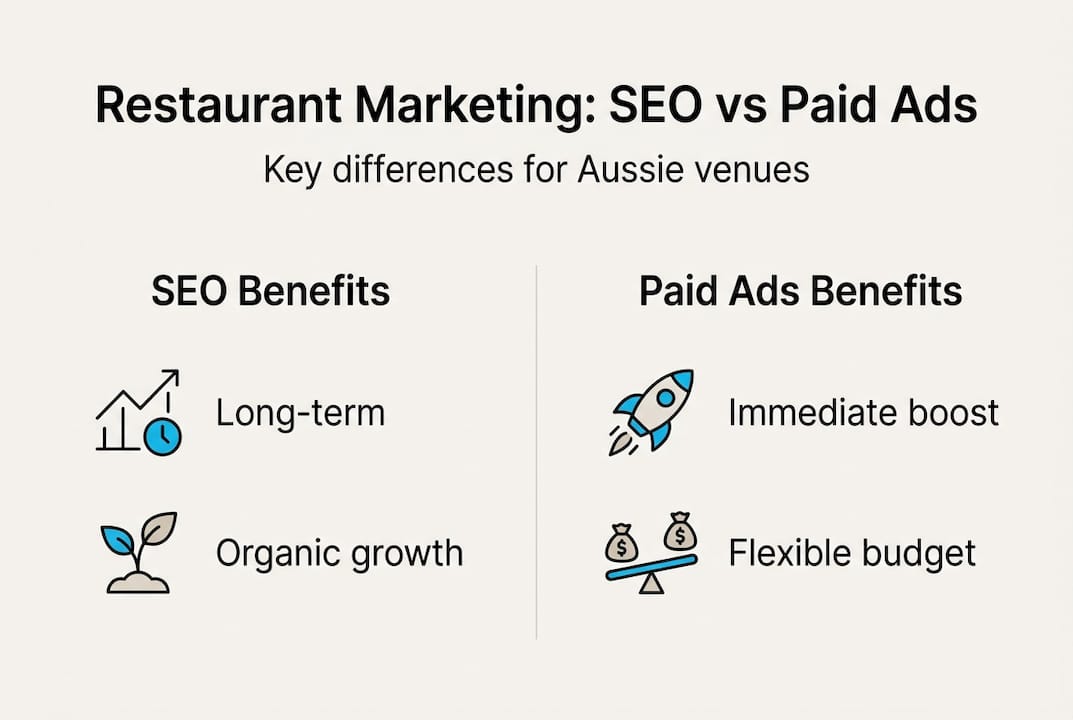
| Factor | SEO | Paid ads |
|---|---|---|
| Speed of results | Slow (3 to 6+ months) | Immediate |
| Cost over time | Reduces as rankings build | Ongoing spend required |
| Traffic when budget stops | Continues | Stops immediately |
| Trust level with diners | High (organic results) | Lower (labelled as ads) |
| Best use case | Long-term growth | Launches, events, quiet periods |
SEO is long-term and sustainable, typically delivering meaningful results after three to six months of consistent work. Once you rank well, that traffic keeps coming without you paying per click. Paid ads deliver instant exposure, which is useful for a new venue launch or a Valentine’s Day promotion. But the moment you stop spending, the visibility disappears.
For most Australian restaurants, the smartest approach is a hybrid model. Use SEO as your foundation for steady, ongoing traffic. Layer paid ads on top during peak seasons, special events, or when you need to fill tables quickly.
Pro Tip: If your budget is limited, start with SEO. The compounding returns over 12 months will outperform a short-term ad campaign in almost every case. Once your SEO is generating consistent traffic, redirect a portion of that revenue into paid ads for targeted boosts. This is the core of a sustainable restaurant marketing strategy.
Why most restaurant SEO fails — and what actually works
Having compared SEO and ads, let’s get candid about why restaurant SEO underperforms for most venues.
The most common failure is treating SEO as a one-time task. Owners set up a Google Business Profile once, upload a PDF menu, and assume the work is done. It is not. Google rewards businesses that stay active. An outdated profile, a menu that has not changed in two years, and zero review responses all signal neglect to the algorithm.
What actually moves the needle is consistent, unglamorous maintenance. Update your menu every time it changes. Respond to every review within 48 hours. Check your NAP details quarterly. Ensure your website loads in under three seconds on mobile. Add schema markup so Google understands your business clearly.
We have seen restaurants with genuinely excellent food struggle online simply because their digital presence was stale. Meanwhile, venues with average food but sharp SEO practices fill seats consistently. The lesson is clear: improving your local search rankings is not about a single big campaign. It is about steady, deliberate effort over time. That is what separates venues that grow from those that plateau.
Elevate your restaurant’s online presence with expert support
If you are ready to put these strategies into practice and outpace the competition, the right support makes a significant difference. Sustained SEO improvements require consistent effort, technical know-how, and an understanding of how Australian diners search and decide.
Partnering with an experienced team fast-tracks your results and helps you avoid the common pitfalls that stall most restaurant SEO efforts. At Titan Blue, we offer professional restaurant SEO services tailored to the hospitality industry, along with SEO marketing for small businesses and website design and development built for performance. Get in touch today and let’s build your restaurant’s digital presence the right way.
Frequently asked questions
How quickly can SEO deliver results for a restaurant?
Meaningful improvements typically arrive within 3 to 6 months when you apply restaurant SEO strategies consistently. Patience and ongoing effort are essential.
What are the biggest SEO mistakes restaurants make?
The most common mistakes are neglecting the Google Business Profile, using PDF menus, having a slow website, and failing to respond to online reviews and core mechanics.
Should I use paid ads or focus only on SEO for my restaurant?
A hybrid strategy is best: build SEO as your long-term foundation and use paid ads for special occasions or quick boosts, as combining both approaches delivers the strongest overall return.
Why is having my menu as HTML (not PDF) important?
HTML menu pages are indexable by Google, which means your dishes appear in specific food and cuisine searches that PDF files simply cannot reach.
Recommended
- Boost Your Business with SEO for Small Businesses – Titan Blue Australia
- Unlocking Growth With Smart SEO Web Designs
- Why use SEO for business: boost growth and visibility
- A Guide to Local SEO for Restaurants to Boost Bookings
Make Titan Blue a preferred source in Google
One click tells Google to surface our articles more often in Top Stories, AI Overviews and AI Mode.

ChatGPT GPT-6 Search Upgrade: What It Means for Australia
OpenAI rolled out GPT-6 to ChatGPT on 7 October 2026 with faster search. Here is…
Best Dental Website Design Agencies in Australia: 7 Compared
Best dental website design agencies in Australia 2026: seven compared on dental proof, booking, AHPRA…

Childcare Centre Website Design Australia: The 2026 Guide
Childcare centre website design Australia: show hours, ages and enrolment as text so parents and…