


Your phone should ring when people in your area need what you sell. If you're a plumber on the Gold Coast, that means someone with a burst pipe finds you before they find the next operator. If you run a restaurant in Broadbeach, it means a couple searching for dinner tonight lands on your menu, your reviews, and your booking link.
When that doesn't happen, most owners blame the wrong thing. They think the problem is price, seasonality, or that “everyone just uses social media now”. Usually, the problem is simpler. You're not visible when local buyers are ready to act.
That’s where seo for local businesses stops being a vague marketing term and becomes a practical sales channel.
Why Your Competitor Is Getting All the Local Calls
The business down the road might not be better than you. They might just be easier to find.
That matters more than most owners realise. In Australia, 46% of all Google search queries exhibit local search intent, according to this 2025 local SEO statistics roundup. If you serve a suburb, a city, or a defined service area, nearly half of the search behaviour happening around you has local intent baked into it.
For a Gold Coast plumber, that intent looks like “hot water system repair Mermaid Waters”. For a Broadbeach restaurant, it looks like “best seafood Broadbeach” or “restaurant near me open now”. For a solar installer, it’s often suburb-led, service-led, and urgent enough that the customer won’t scroll forever.
Visibility beats being “pretty”
A lot of businesses invest in branding before they’ve fixed discoverability. Nice logo. Nice signage. Nice website hero image. But if your Google presence is weak, your location signals are vague, and your reviews are stale, you won’t win the click that becomes the call.
Practical rule: In local search, the business that gets found first usually gets considered first.
This is why local SEO has to be treated like operational work, not campaign work. It’s not something you “do once”. It’s the ongoing job of making your business easy for Google, Maps, AI search tools, and real customers to understand.
If you want a clearer view of why another business keeps appearing ahead of you, start with a simple audit. A structured review like this competitive analysis template helps you compare categories, reviews, pages, content gaps, and local signals without guessing.
The fix usually starts with two assets. Your Google Business Profile, and the local search terms your customers already use.
Master Your Digital Front Door
Your Google Business Profile is often the first thing a customer sees before they ever visit your site. For many local searches, it’s the entire first impression. If it’s incomplete, outdated, or thin on detail, you’re telling both Google and the customer that your business might not be the best answer.

Get the basics right first
Owners often skip straight to “advanced SEO” while the fundamentals are still broken. Start here:
- Business name: Use your real trading name. Don’t stuff it with extra suburbs or service keywords.
- Primary category: Choose the closest fit to your core service. A plumber should be a plumber, not a generic contractor if plumbing is the main work.
- Phone and address: Keep these consistent with your website and every major listing.
- Hours: Update them properly, including holiday changes.
- Services: List real services individually so Google gets a clearer picture of what you do.
- Service areas: Add the actual suburbs you serve if you travel to customers.
- Business description: Write for clarity, not keyword stuffing. Say what you do, where you do it, and what makes your process easy.
This profile is your digital front door. If the handle is loose and the lights are off, people move on.
The fields most businesses neglect
The difference between an average profile and a strong one often sits in the details most owners leave blank.
Fill out the Q&A section with common pre-sale questions. Add fresh photos that show your team, your vehicles, your venue, your completed work, or your dining space. Publish posts when you have something useful to say, such as new services, seasonal menus, booking availability, or common job advice.
Your visuals matter as well. If you want a practical guide to optimizing your Google Business Profile cover photo, that resource is useful because it focuses on presentation, cropping, and how the image appears in Google’s interface.
A neglected profile doesn’t just look old. It looks risky.
For hospitality businesses, profile freshness affects booking confidence. For trades, it affects whether someone trusts you enough to call from a mobile search result without opening a second option.
Build suburb-level keyword maps
Keyword research for local businesses is where many agencies and owners become too generic. They chase broad phrases and ignore how real local buying intent works.
The bigger opportunity is often smaller. As noted in this piece on why small businesses can’t ignore local SEO, there’s very little practical guidance for identifying and competing for micro-local terms when volume tools show little or no data. That’s exactly the situation many Gold Coast businesses face.
A smarter local keyword map looks like this:
-
Start with core services
Write down what you sell. Not broad industry language. Real services. “Blocked drain repairs”, “emergency plumber”, “breakfast restaurant”, “solar panel installation”, “roof leak detection”. -
Layer in geography
Add your city, then your suburbs, then any nearby areas you actively service. Broadbeach. Southport. Robina. Burleigh Heads. Nerang. -
Add buyer modifiers
Include terms like “near me”, “open now”, “same day”, “after hours”, “family friendly”, “commercial”, or “installation”. -
Use your own customer language
Check enquiry emails, phone call notes, quote forms, reviews, and front desk questions. Customers often use better keywords than keyword tools do. -
Group by intent, not just phrase
“Broadbeach breakfast spot” and “breakfast restaurant Broadbeach” may belong on the same page. “Emergency plumber Gold Coast” is different and deserves its own page or section.
What works and what doesn’t
What works:
- Service plus suburb pages that match real buying intent
- Google Business Profile services aligned to the same language used on your website
- Review responses that naturally reference completed services and locations
- FAQs built from real customer questions
What doesn’t:
- Creating one thin page for every suburb with almost identical wording
- Chasing only high-volume city-wide terms
- Stuffing suburb names into paragraphs with no context
- Publishing blog posts that have nothing to do with local buyers
If you want to see the local search environment in action before changing your own setup, watch this quick overview and compare it against your current presence.
Connect your profile to future AI search
Many local businesses still lag in this area. They optimise the listing for Maps, but not for how AI-powered results pull answers together.
A well-built profile helps because AI systems lean on clarity. They look for clean business information, consistent services, credible reviews, and supporting website content. If your profile says one thing and your website says another, you create uncertainty. If both say the same thing, you become easier to surface in summaries, recommendations, and answer-style search experiences.
The practical takeaway is simple. Treat your Google Business Profile as a structured data source for humans and machines, not just a business card.
Turn Your Website Into a Local Magnet
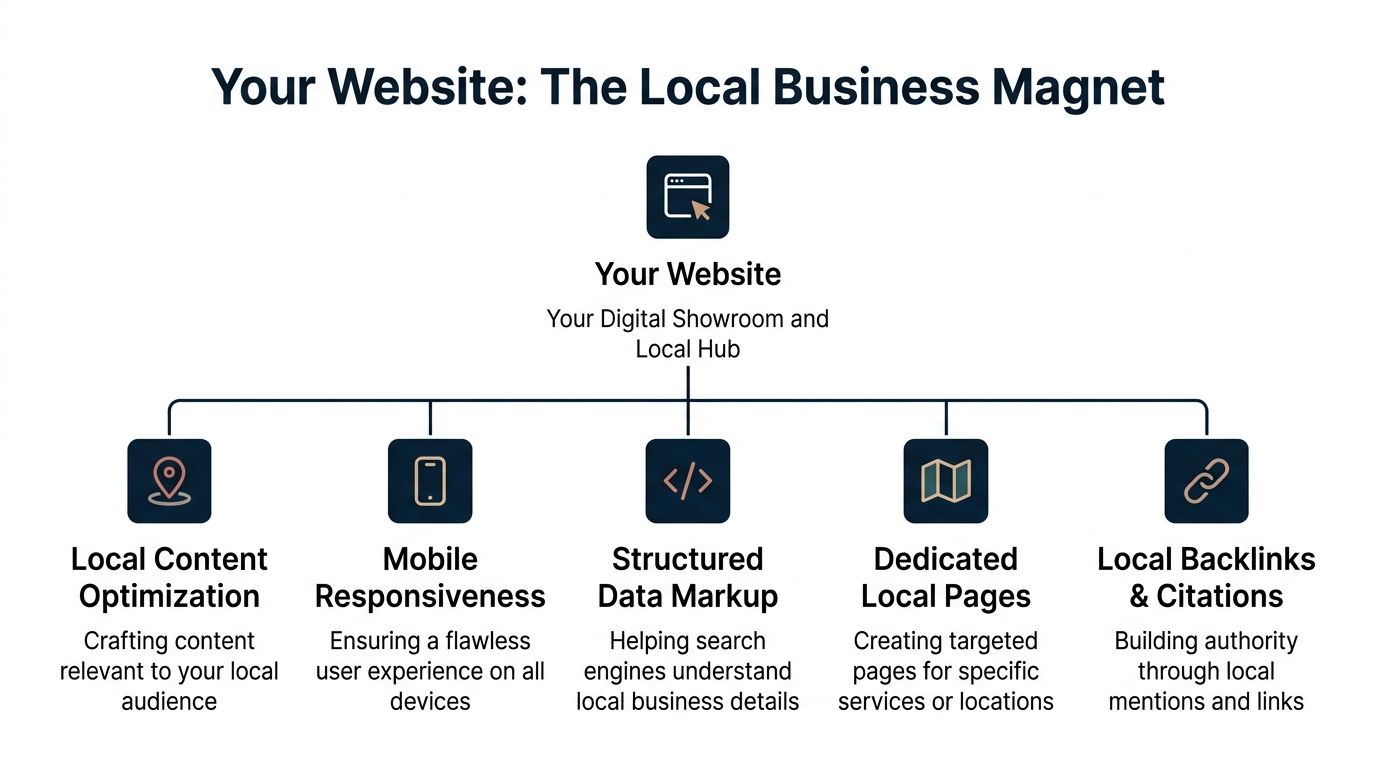
Your website shouldn’t be a brochure that sits there looking respectable. It should act like the central hub of your local presence, supporting your Google profile, reinforcing your suburbs and services, and making it easy for visitors to contact or book.
Build pages for real locations and real intent
One generic services page rarely does enough for local visibility. A service business covering multiple areas usually needs more specific landing pages. A restaurant with a physical venue needs pages that support cuisine terms, booking intent, menu relevance, and local landmarks. A construction or solar company often needs service pages tied to application types and areas served.
The key is relevance. A page for “hot water repairs Gold Coast” should not read like a page for “blocked drains Broadbeach” with a few words swapped.
Use each location or service page to include:
- Clear service description: Explain what the job or offer includes.
- Local relevance: Mention the suburbs, nearby landmarks, common property types, or practical service realities of the area.
- Trust signals: Show testimonials, project photos, FAQs, or process details.
- Contact path: Add a visible phone number, form, booking option, or quote button.
- Supportive internal links: Connect related services and nearby service areas.
If your current pages look thin or disconnected, local-focused SEO web page design can help align structure, content, and conversion paths so the site supports search properly instead of fighting it.
Use schema to remove guesswork
Schema markup helps search engines understand what your business is, where it operates, and which services belong to it. It doesn’t replace strong content, but it does reduce ambiguity.
For local businesses, useful schema usually supports details such as business name, address, phone number, opening hours, service areas, and frequently asked questions. If you’ve ever wondered why one result looks cleaner and more informative than another, structured data is often part of the answer.
Search engines rank what they can understand confidently.
That matters for current search results and future AI discovery. Answer engines favour pages that make facts easy to parse. If your address, service areas, opening hours, and key FAQs are buried in design elements with no structure, you’re making the machine work harder than it should.
Mobile and speed are not optional
Most local customers aren’t sitting at a desktop doing research for fun. They’re on a phone, often on the move, often comparing options quickly.
If your website loads slowly, buttons are hard to tap, menus are cluttered, or the phone number isn’t obvious, you lose trust before you even get a chance to sell. For local search, a mobile-first build is practical, not cosmetic.
Focus on these issues first:
- Clickable contact details: Make your number tap-to-call and your address easy to open in maps.
- Fast-loading pages: Compress large image files, especially photo galleries and banners.
- Simple page layout: Keep forms short and calls to action visible.
- Readable content: Don’t make visitors zoom in to understand your services.
- Location cues above the fold: Make it obvious where you operate.
Write for answers, not just rankings
Traditional SEO asked, “Which keywords do we want to rank for?” That still matters. But local websites also need to answer short, direct questions cleanly because AI summaries and answer engines are increasingly built around extracting useful responses.
That changes how you should write local content.
A plumber page should answer practical questions like whether you handle after-hours jobs, which suburbs you cover, what kinds of leaks you repair, and how customers can request service. A restaurant page should answer whether bookings are recommended, what cuisine you serve, whether there are takeaway options, and where parking is easiest.
Good answer-ready content usually has:
- Direct question headings
- Short, plain-English answers
- Consistent location references
- Clear service definitions
- Updated business details
This isn’t about writing for robots. It’s about removing friction for the customer and for the systems deciding which business deserves visibility.
Build Authority Across Your Local Web
A strong website helps. It doesn’t prove everything on its own.
Google and other search systems look for supporting evidence across the web. They want to see that your business exists consistently, belongs in its local market, and is referenced by other relevant sites. That’s why off-site local SEO still matters. Not as old-school directory chasing, but as legitimacy building.
Clean citations before you chase links
A citation is any listing or mention of your business name, address, and phone number on another site. The core rule is consistency. If your phone number differs between platforms, your suite number is written three different ways, or your business name changes across listings, you create confusion.
Start with an audit.
Look at your Google Business Profile, your website footer, your contact page, your social profiles, and your main directory listings. Make sure they all use the same version of your details. That includes abbreviations, spacing, and old phone numbers that might still be floating around.
A simple clean-up plan works best:
- Check your canonical business details: Decide on the exact format for your trading name, address, and phone.
- Fix major profiles first: Focus on your website, Google, key directories, and social platforms.
- Remove duplicates where possible: Duplicate listings split trust and create mixed signals.
- Update changes everywhere: If you move premises or change numbers, treat citation updates as urgent work.
Local links carry a different kind of weight
A backlink from a relevant local organisation often tells search engines more about your place in the community than a random generic link ever will.
For a Gold Coast restaurant, useful local links might come from event pages, tourism listings, venue guides, or partnership pages. For a plumber, they might come from local suppliers, community sponsorships, trade associations, or local property-related websites. For a solar installer, they might come from industry bodies, builders, sustainability groups, or local business networks.
A local link works best when it makes sense without SEO. If a real person would click it, it’s probably the right sort of link.
That’s the filter many businesses need. Stop asking, “How many links can we get?” Start asking, “Which local sites are relevant to our work?”
What authority building looks like in practice
Here are a few methods that tend to hold up well:
- Community involvement: Sponsor a club, a fundraiser, or a neighbourhood event if it fits your brand and gets a relevant mention online.
- Supplier and partner pages: Ask trusted suppliers or collaborators whether they list trade partners, installers, venues, or preferred businesses.
- Useful local content: Publish resources that local organisations may reference, such as area service guides, venue information, or process explainers.
- Industry memberships: Keep your profiles on professional associations up to date.
- Local media opportunities: Share useful commentary, not self-promotion, when journalists or publishers need expert input.
If you’re building this systematically, local link building services are one way to manage outreach, prospecting, and relevance checks without turning the job into guesswork.
The trade-off is time. Authority building is slower than tweaking a headline or uploading a photo. But it compounds better, and it’s much harder for weaker operators to fake.
Cultivate Trust Through Online Reviews
A customer hears about you, sees your listing, opens your profile, and then pauses at the reviews. That pause is where a lot of local decisions are made.
According to the 2025 Rio SEO local search consumer behaviour study, 84% of consumers search for local businesses online daily, and 75% read at least 4 reviews before deciding. That makes reviews part of the sales process, not just a reputation extra.

How the review journey actually works
A Broadbeach diner searches for a place to eat. They don’t know you yet. They scan photos, opening hours, and rating sentiment. Then they read enough reviews to answer practical questions.
Is the service consistent. Do people mention the meals they care about. Is the room noisy. Can you trust the booking experience.
A homeowner looking for a plumber does the same thing, only with different questions. Did the tradie turn up on time. Was the quote explained properly. Was the work tidy. Did the business solve the issue fast.
Reviews do two jobs at once:
- They help customers choose
- They help search platforms understand trust and relevance
Ask properly and ask consistently
Most businesses don’t have a review problem. They have an asking problem.
They wait for reviews instead of building a simple process. The best time to ask is when the customer has just had the positive experience, not three weeks later when the moment has gone cold.
Use a repeatable method:
-
Choose the right moment
Ask after a completed job, a successful install, a positive dining experience, or a resolved support issue. -
Make it easy
Send a direct review link by SMS or email. Don’t make customers hunt for it. -
Keep the wording simple
Ask for an honest review, not a perfect one. -
Train staff to prompt naturally
Front-of-house teams, account managers, and field staff should know when and how to ask. -
Follow up once
A polite reminder is fine. Pestering isn’t.
Good review generation feels like customer service follow-up, not marketing pressure.
Respond in a way future customers will notice
Review responses are public. You’re not only replying to one customer. You’re showing every future customer how your business behaves.
For positive reviews, thank the person, acknowledge the specific service or experience, and keep it human. For neutral reviews, address the issue calmly and show that you’ve listened. For negative reviews, don’t argue in public. Clarify, apologise where appropriate, and offer a path to resolve it offline.
A practical response framework looks like this:
- Positive review: Thank them, mention the service, invite them back or to contact you again.
- Mixed review: Acknowledge what went right, address what didn’t, and show what you’ll improve.
- Negative review: Stay professional, don’t get defensive, and move the resolution into a direct conversation.
If your team needs a process for difficult feedback, this guide to managing negative comments and reviews online is a useful starting point.
Don’t outsource your voice completely
Templates help. Robotic replies hurt.
Customers can spot copy-paste responses instantly, especially in hospitality and service businesses where tone matters. It’s fine to use a framework, but each reply should still sound like it came from a real business that read the review.
The businesses that handle reviews well usually do one thing better than everyone else. They treat reviews as part of operations. Not as a once-a-month tidy-up task.
Track Adapt and Win in Future Search
Local SEO work should produce business signals you can see. More calls. Better-quality enquiries. More direction requests. More bookings from the right suburbs. If you can’t connect the work to outcomes, you’ll either stop too early or keep doing tasks that don’t matter.

Watch the signals that tie to real enquiries
A local campaign doesn’t need a bloated reporting deck to be useful. It needs a short list of metrics that relate to customer action.
For most local businesses, that means checking things like:
- Google Business Profile activity: Calls, website clicks, direction requests, photo engagement, and search visibility trends
- Website behaviour: Which location pages attract visitors, which service pages lead to enquiries, and where users drop off
- Lead quality: Whether the calls and forms match the work you want
- Suburb trends: Which areas are producing enquiries and which need stronger visibility
- Review flow: Whether your review profile stays current and credible
The point isn’t to stare at dashboards. The point is to learn which actions are connected to results. If a service area page starts attracting calls from a suburb you want more work in, that’s worth expanding. If a page gets traffic but no enquiries, the issue might be offer clarity, proof, or conversion design rather than rankings.
Adapt instead of “set and forget”
Local search changes because your business changes, your customers change, and Google changes. A page that worked a year ago may now be too thin. A suburb you barely serviced may become a growth area. A restaurant’s seasonal offering may shift what local customers search for.
That means maintenance is part of strategy.
Use a practical review cycle:
-
Check your profile data
Confirm your hours, services, photos, and Q&A still reflect reality. -
Review page intent
Make sure your main local pages still match how customers search and how your business sells. -
Expand where evidence exists
Add depth to pages and topics that already show traction. -
Tighten weak pages
Remove fluff, add FAQs, strengthen calls to action, and improve proof. -
Keep reviews and citations current
Trust decays when the public-facing picture looks stale.
If you want a plain-language refresher on how local pack visibility works, Local SEO for Small Business: A Beginner's Guide to the Map Pack is a helpful companion read.
Prepare for AI search while doing today’s work
This is the part many local businesses still miss. They treat AI search as something separate from local SEO, when it’s really changing what good local SEO looks like.
As explained in this guide on local SEO and generative AI search, there’s still minimal guidance for local businesses on optimising for generative AI search tools and answer engines, even though those tools are reshaping how people find services and information online. Businesses that optimise now for AI Overviews are putting themselves in a stronger position.
That doesn’t mean chasing gimmicks. It means strengthening the same foundations that make a business easier to trust and easier to summarise:
- Clear business facts across your site and profile
- Structured FAQ content that answers real buyer questions
- Consistent service-area language across all key assets
- Strong review signals that support credibility
- Useful location pages that explain what you do in plain English
AI systems tend to reward clarity, consistency, and evidence. If your local presence is messy, vague, or contradictory, you’re less likely to be surfaced as a confident answer. If your business information is organised and repeated consistently across the right places, you become easier to recommend.
That’s why future-proofing doesn’t sit in a separate strategy document. It belongs inside the everyday work of seo for local businesses.
For businesses that want to go deeper into this shift, AI search optimisation services focus on making content and business information more discoverable in LLM-driven search environments as well as traditional search.
The local businesses that win over the next few years won’t just rank. They’ll be easy to verify, easy to understand, and easy to choose.
If your business needs a clearer local SEO strategy, Titan Blue Australia works with Gold Coast and Australian businesses on website design, SEO, answer engine optimisation, and digital strategy built around real customer discovery. If you're a plumber, restaurant, solar installer, or service business trying to turn local searches into calls and enquiries, it’s worth having your current visibility reviewed properly.
Make Titan Blue a preferred source in Google
One click tells Google to surface our articles more often in Top Stories, AI Overviews and AI Mode.

How to Make Your Website AI Friendly: The 2026 Step-by-Step Guide
How to make your website AI friendly: a step-by-step 2026 guide to getting crawled, structured…

Web Design for AI Search Optimisation: The 2026 Build Guide
Web design for AI search optimisation: crawlable HTML, clear architecture, accessible UX and trustworthy content…

AEO Web Design: How to Build Websites AI Can Cite
AEO web design creates websites that AI systems can find, understand and cite through clear…