

Last updated:
You’re probably doing the hard part already. You answer the phone, do solid work, deliver good service, and rely on word of mouth. Yet a weaker competitor keeps showing up first on Google, collecting the calls, quote requests, and bookings that should’ve been yours.
That isn’t bad luck. It’s poor visibility.
The importance of search engine optimisation comes down to one blunt truth: if people can’t find you when they’re ready to buy, your business loses revenue. For Australian small businesses, especially in trades, hospitality, construction, and service industries, SEO isn’t a nice extra. It’s the baseline for staying competitive now, and it’s becoming even more critical as AI changes how people search.
Why Your Business is Invisible Without SEO
A lot of business owners still think search visibility is optional. It isn’t.
If someone needs an emergency plumber, a local restaurant, a solar installer, or a builder, they don’t flick through a directory. They search. In Australia, Google handles about 90 to 93% of online queries, 68% of online experiences begin with a search engine, and 53% of website traffic comes from organic search, according to this SEO data roundup. That’s where buyer intent lives.
If your site isn’t ranking, your business is effectively hidden from the market that’s actively looking for what you sell.
Visibility decides who gets the enquiry
Being “online” is not the same as being visible. A website that sits on page two or three may as well be a brochure locked in a drawer. Search users click what they can see, and they usually decide fast.
That’s why so many small businesses ask why they’ve gone quiet when nothing inside the business has changed. The work quality is still there. The service is still there. The problem is discovery. If this sounds familiar, start with why your business isn’t showing up on Google.
Practical rule: If your ideal customer has to know your business name before they can find you, your SEO isn’t doing its job.
Google is the front door to demand
For most SMBs, Google is the main gateway between local demand and local revenue. That applies whether you run a café in Broadbeach, a plumbing business on the Gold Coast, or a solar company servicing Brisbane.
SEO matters because it puts you in front of buyers at the exact moment they’re looking for help. Not when they’re scrolling aimlessly. Not when they’re being interrupted by an ad. When they have intent.
That’s the difference. Intent changes everything.
A person searching for your service is already closer to action. If you’re absent from those results, someone else gets the call. They get the form submission. They get the booking. Over time, that gap compounds into lost leads, weaker brand recognition, and a business that looks smaller online than it really is offline.
What SEO Actually Means for Your Business
SEO gets overcomplicated by people who want to sound technical. The simpler explanation is better.
Your website is a shopfront. Without SEO, it’s tucked down a side alley with no signage, poor lighting, and no clear path in. With SEO, it’s placed where buyers are already walking, and everything about it tells them they’re in the right place.

SEO is the process of making your site the most useful, relevant, and trustworthy answer to a customer’s question. It’s not about gaming Google. It’s about removing friction so Google can understand your business and users can choose you quickly.
Your digital shopfront has to make sense
If you run a plumbing business, your website should make it obvious where you work, what services you offer, and why someone should contact you now. The same applies if you run a restaurant, hotel, construction firm, or solar installation business.
That means your site needs clear service pages, location relevance, fast load times, accurate business information, and content that answers real customer questions.
A good starting point is getting familiar with the language and moving parts. This essential SEO terms guide for Australian SMBs helps strip out the jargon.
SEO is about being the best answer
Google’s job is to serve the best result. Your job is to become it.
That usually comes down to a few plain requirements:
- Clarity: Your pages must say exactly what you do and where you do it.
- Relevance: Your content has to match what customers are searching for.
- Trust: Your site should show proof that you’re credible, experienced, and legitimate.
- Usability: People must be able to use your website easily on mobile and desktop.
A well-optimised site doesn’t confuse visitors. It helps them decide.
SEO is not one trick
Business owners often ask whether SEO means keywords, blogs, backlinks, technical fixes, or Google Business Profile work. The answer is yes. SEO is the combined effort of making your site easier to find, easier to understand, and easier to trust.
When done properly, it aligns your website with buyer behaviour. That’s why the importance of search engine optimisation goes well beyond rankings. Rankings are only useful if they bring in the right people and turn visits into enquiries.
The Tangible Business Benefits of SEO
SEO only matters if it improves business outcomes. Rankings without revenue are vanity. Traffic without leads is noise.
The strongest case for SEO is that it attracts people who are already searching for a solution. That’s why the lead quality is usually stronger than channels built on interruption.

For Australian businesses, 57% of B2B companies report getting more leads from search engines than any other source, and over 60% of marketers say inbound strategies like SEO produce the highest-quality leads for sales teams, based on Seosherpa’s SEO statistics collection.
That should change how you think about SEO. It’s not a branding exercise. It’s a lead generation channel.
Better traffic beats more traffic
A lot of marketing creates attention from people who weren’t looking for you. SEO works differently. It captures demand that already exists.
A person searching “commercial plumber Gold Coast” or “best lunch Broadbeach” is giving you a direct signal. They want something now. If your website answers that search clearly, you’re not convincing a cold prospect to care. You’re helping an active buyer choose.
That usually means:
- More qualified enquiries: Visitors arrive with a defined need.
- Stronger conversion intent: They’re further along in the buying process.
- Less wasted spend: You’re not paying to interrupt people who may never need your service.
Trust drives action
Search visibility carries trust. People assume Google has filtered the field. If your business appears prominently, users often treat that position as a signal of legitimacy.
That trust matters for service businesses where the stakes are high. Nobody wants to hire the wrong tradie, choose the wrong installer, or book the wrong venue. Strong SEO helps remove doubt before a customer ever contacts you.
If you want to connect SEO work more directly to commercial outcomes, this breakdown of how SEO boosts online sales is worth a read.
A short explanation of that process is below.
SEO keeps paying after the work is done
Paid ads stop the moment you stop paying. SEO doesn’t work like that.
It takes time and effort up front, but once your pages are ranking and bringing in enquiries, they can keep producing value without the same constant media spend. That doesn’t mean SEO is passive. It needs maintenance, updates, and strategy. But it does mean the long-term economics are usually stronger than channels that reset to zero every month.
Business takeaway: The goal isn’t more clicks. The goal is more profitable enquiries from people already looking for your service.
For small businesses with limited budgets, that matters. You don’t need endless campaigns. You need a system that keeps putting you in front of high-intent buyers.
The Core Components of a Modern SEO Strategy
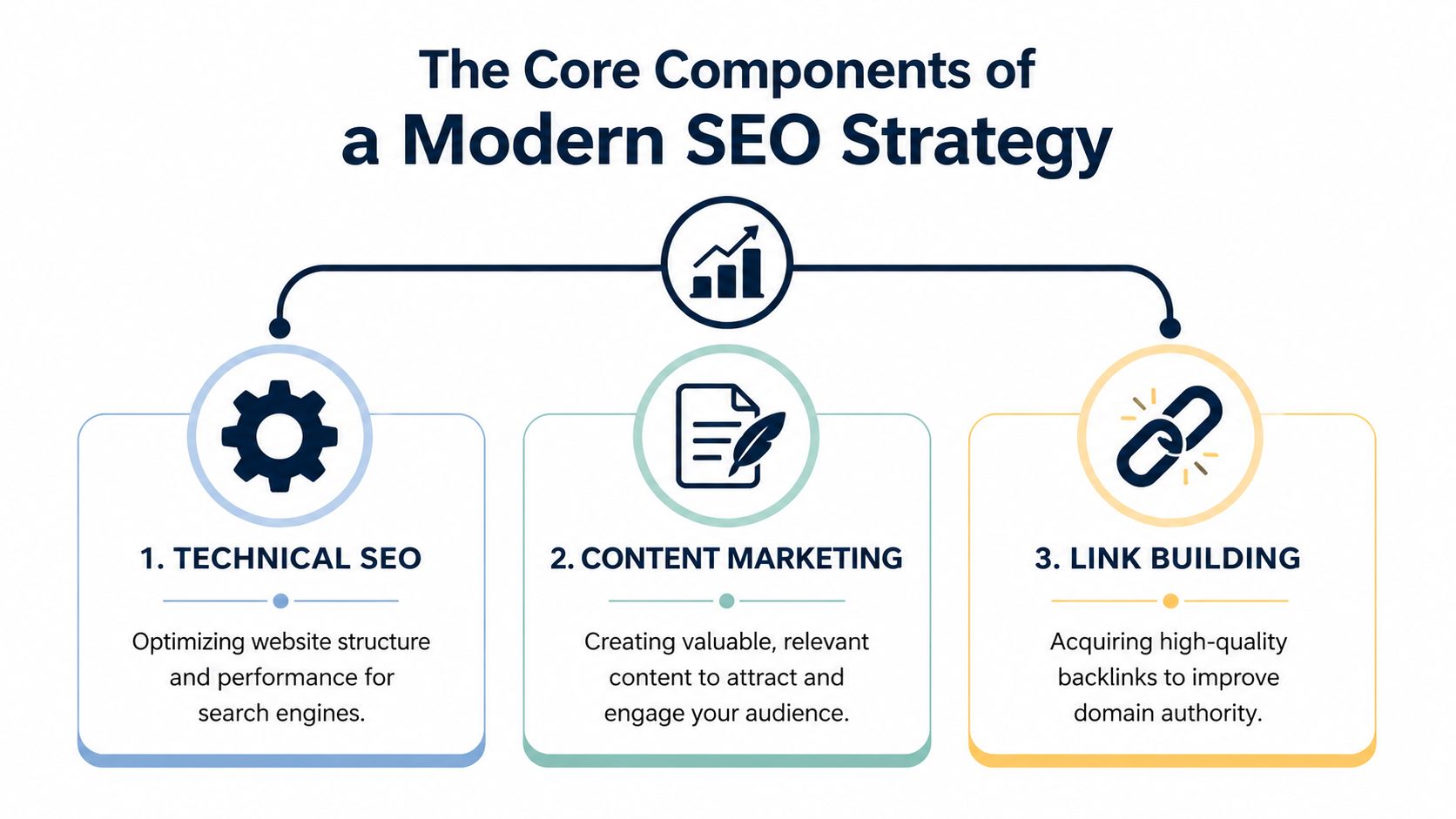
Most SEO problems come from one of three failures. Your website is technically weak, your content is thin or vague, or your authority is too low to compete. Fixing only one of those rarely works.
A modern strategy needs all three pillars aligned.
Technical SEO
Technical SEO is the infrastructure. If it’s weak, everything else underperforms.
That includes page speed, mobile usability, crawlability, internal linking, site structure, schema markup, and clean code. It’s not glamorous, but it’s essential. According to this article on SEO benefits for small businesses, Core Web Vitals compliance can deliver up to a 25% uplift in Australian organic rankings, and sites that meet Google’s performance standards can see stronger dwell time and conversions from high-intent queries.
For an SMB, that means practical work such as:
- Improve speed: Compress oversized images, reduce heavy scripts, and check performance in Google Lighthouse.
- Fix mobile issues: Most local searches happen on phones. Your site has to work cleanly on small screens.
- Help search engines understand the site: Use structured headings, sensible navigation, and schema where relevant.
If your website takes too long to load or breaks on mobile, your SEO campaign is being sabotaged by your own platform.
Content and on-page SEO
Content is where you prove relevance. On-page SEO is how you make that relevance obvious.
A good service page doesn’t just say “we offer plumbing”. It explains the service, location, urgency, process, and next step. A good article doesn’t chase fluff. It answers a real question your customer is asking before they call.
For businesses writing content in-house, Humantext.pro's article writing guide is a useful reference because it focuses on creating pages that are readable, structured, and aligned with search intent.
Your content should do one job well. Answer the search clearly enough that the visitor doesn’t need to keep looking.
Authority and local signals
Authority still matters. Google wants evidence that your site deserves visibility.
That includes backlinks from relevant websites, strong business citations, review signals, and a properly optimised Google Business Profile. For local businesses, these efforts often result in the fastest wins. If you serve a defined area, you need pages and profile signals that connect your services to those locations.
This is also the one place where businesses often need outside help. Building the technical foundation, tightening service pages, improving local SEO, and preparing for AI search usually requires specialist implementation. Titan Blue Australia offers SEO, local SEO, and AI search support for businesses that need that work handled properly.
Future-Proofing Your SEO for AI and Voice Search
The old SEO mindset was simple. Rank on Google, get the click, win the lead.
That model is changing.
AI Overviews, chatbot answers, and voice-driven search are reducing the number of times users need to click through to a website. If your strategy is built only around traditional rankings, you’re preparing for the last version of search, not the next one.

SEO alone is no longer enough
For Australian SMBs in trades and hospitality, 68% rely on local searches, but only 22% are optimised for AI and LLM visibility. The same source says a hybrid AEO-SEO approach can boost conversions by 2.1x for businesses such as Gold Coast trades. That data comes from this article on why search engine optimisation matters.
That gap is where a lot of businesses are about to get caught out.
AEO, or Answer Engine Optimisation, means structuring your content so AI systems can extract, summarise, and cite your information accurately. It overlaps with SEO, but it isn’t identical. You need clear answers, strong entity signals, structured information, and content written in natural language that matches how real people ask questions.
What future-proofing looks like
If you want your business to stay visible as search changes, do these things:
- Write answer-first content: Use direct language that solves specific questions quickly.
- Strengthen structured data: Help search engines and AI systems interpret your business details.
- Build topic depth: Don’t rely on a single homepage to rank for everything.
- Optimise for spoken queries: Voice searches are more conversational than typed searches.
A practical way to test how your pages may appear in AI-driven search is to use a tool like the free ai seo checker, which can help identify visibility gaps.
If you want to understand this shift in more detail, AI search strategy is the right place to start.
Businesses that only optimise for blue-link rankings will miss the next wave of visibility.
Practical First Steps for Australian SMBs
Most small businesses don’t need a giant SEO program on day one. They need to stop neglecting the basics.
If you run a local service business, there are a few actions that usually have immediate strategic value because they improve how clearly your business appears to both Google and potential customers.
Start with your Google Business Profile
This is the easiest place to tighten your local visibility. For Australian SMBs, local SEO optimisation can deliver a 3x higher conversion rate for service-area queries, and a verified Google Business Profile with a 4.5+ star rating can see map pack ranking boosted by 42%, according to this article on why SEO matters for small businesses.
That means your profile needs to be complete, accurate, and active.
Check these first:
- Business details: Make sure your name, phone number, address or service area, hours, and website are correct.
- Service coverage: List the specific suburbs or regions you serve.
- Service categories: Choose categories that match what you do.
- Photos and updates: Keep the profile current so it doesn’t look abandoned.
If your profile is half-finished, you’re making it harder for Google to trust your local relevance.
Ask for reviews like it matters
Because it does.
A lot of businesses say they’re “bad at asking”. That’s not a strategy. Build it into your workflow. After a completed job, booking, or install, ask. Use SMS or email. Keep it simple. Train staff to do it consistently.
A plumber, for example, should finish the job, confirm the customer is happy, and send a review request that same day. A solar installer should do the same after handover. This isn’t awkward. It’s operational discipline.
Build pages around service plus location
Don’t expect one generic services page to rank for every suburb and every service.
If you offer solar installation on the Gold Coast, create well-written pages for the core services and the locations that matter. If you run a restaurant, create pages that support branded search, menu intent, booking intent, and local discovery. If you’re a tradie, target the combinations people search, such as service plus suburb or emergency service plus area.
Here’s a simple weekly priority list:
- Claim and verify your Google Business Profile
- Collect and respond to reviews
- Create or improve your main service and location pages
If you need a broader framework around this work, this guide to small business digital marketing offers a useful overview.
Partnering for Long-Term Growth with Titan Blue
SEO isn’t a one-off fix. You don’t “do SEO” once, then move on.
Search changes. Competitors improve. Websites age. Customer behaviour shifts. AI keeps rewriting the way visibility works. If you want stable lead flow from search, you need an ongoing process of improvement.
That’s why choosing the right partner matters more than choosing the cheapest one. You need a team that can handle the technical work, the content strategy, local optimisation, and the AI search layer without reducing everything to generic reports and recycled tactics.
Titan Blue has been in the industry for more than 25 years, working from Broadbeach and serving businesses across the Gold Coast and Australia. That kind of longevity matters because SEO rewards consistency, judgement, and the ability to adapt without chasing every fad.
If you’re comparing providers, start with this guide on how to choose an SEO company in 2026. It’ll help you filter out the noise and focus on what drives results.
The importance of search engine optimisation hasn’t gone down. It has gone up. The businesses that treat it seriously will keep winning visibility, leads, and market share. The ones that delay will keep wondering why quieter competitors look bigger online.
If your business isn’t showing up where customers are searching, it’s time to fix that. Titan Blue Australia helps Australian businesses improve search visibility through SEO, local SEO, and AI search strategy built for real commercial outcomes. If you want a clearer path to more qualified traffic, better enquiries, and long-term growth, talk to their team.
Make Titan Blue a preferred source in Google
One click tells Google to surface our articles more often in Top Stories, AI Overviews and AI Mode.

ChatGPT GPT-6 Search Upgrade: What It Means for Australia
OpenAI rolled out GPT-6 to ChatGPT on 7 October 2026 with faster search. Here is…

Best Dental Website Design Agencies in Australia: 7 Compared
Best dental website design agencies in Australia 2026: seven compared on dental proof, booking, AHPRA…

Childcare Centre Website Design Australia: The 2026 Guide
Childcare centre website design Australia: show hours, ages and enrolment as text so parents and…