


Last updated:
You’re probably busy enough already. The phone rings, quotes need chasing, a staff member calls in sick, and by the end of the week you’ve worked flat out but the bank balance still doesn’t reflect the effort. That’s the point where many plumbing businesses stall. The owner is a strong technician, the workmanship is solid, but the business still depends on one person holding the whole thing together.
That plateau is common in trade businesses because being good on the tools and being good at building a company are not the same job. One fixes leaks and installs systems. The other sets pricing, designs workflow, builds demand, hires properly, and makes sure each extra job adds profit instead of stress.
There is real room to grow. The Australian plumbing industry reached approximately AUD 6.5 billion in 2025, driven by steady demand and population growth in urban centres like Queensland, and some firms have achieved 75% revenue growth through scalable operations and subscription-based maintenance programs, according to this Australian plumbing growth analysis. If your website still looks like a brochure instead of a booking tool, that’s often one of the first fixes to make, especially for owners reviewing website design for plumbers.
Growth doesn’t start with “more jobs”. It starts with building a business that can handle more jobs without breaking.
From The Tools To The Office
A lot of plumbing owners start the same way. You build a reputation, buy a ute, get referrals, and keep saying yes. For a while, that works. Then the work gets heavier. Admin piles up at night, quoting gets delayed, customers wait too long for a call back, and hiring another person feels risky because the business still runs through your phone and your memory.
That’s the shift from tradesperson to operator. It’s not a mindset cliché. It’s a practical handover of responsibility. If every schedule change, pricing decision, customer complaint, stock question, and late invoice comes back to you, you haven’t built capacity. You’ve only built pressure.
The real bottleneck
The bottleneck usually isn’t effort. It’s structure.
You can be fully booked and still underperform because the business has no reliable pricing model, no lead handling system, no clean handover from office to field, and no repeatable process for turning first-time customers into long-term accounts.
Practical rule: If you can’t take a day off without jobs slowing down, the business still relies on labour, not systems.
Owners often think the answer is more advertising or another van. Sometimes it is. More often, growth stalls because the office side hasn’t caught up with the field side.
What changes when you start acting like a business
The businesses that grow stop treating every job as a one-off transaction. They package services better. They tighten quoting. They define who they want to work for. They track where leads come from. They create a smoother customer experience so the next job is easier to win than the first.
That’s how to grow a plumbing business without turning it into chaos. Not by doing everything yourself faster, but by deciding which parts must become standard.
Building Your Growth Blueprint

Most plumbing businesses don’t have a growth problem first. They have a clarity problem. They’re taking work from too many directions, quoting with inconsistent logic, and hoping volume will fix margin. It won’t.
A proper blueprint starts with a few decisions. Who do you want more of? Which jobs are worth repeating? What services create the least friction and the strongest return? Before you spend more on marketing or payroll, you need a sharper operating model. If you haven’t done that kind of planning before, start with a simple framework for how to conduct market research so your decisions are based on your market, not assumptions.
Pick a lane before you scale it
Not every plumbing business needs to chase every type of work.
Some owners are strongest in residential service. Others build a cleaner operation around maintenance, renovations, strata, or light commercial. The mistake is trying to serve everyone with the same message, same pricing style, and same workflow. That creates messy quoting, confused marketing, and weak job selection.
A stronger approach looks like this:
- Choose a core customer type. Homeowners, property managers, builders, body corporates, or commercial operators all buy differently.
- Define your best-fit work. Emergency call-outs, hot water systems, blocked drains, leak detection, maintenance, and project work all need different handling.
- Write a simple value proposition. Fast response, tidy workmanship, clear pricing, maintenance reliability, or specialist capability. Pick what you can deliver consistently.
That doesn’t mean refusing all other work. It means knowing which work deserves priority.
Fix pricing before you add more volume
Underpricing is one of the fastest ways to stay busy and poor.
Sustainable growth starts with knowing your true hourly cost, including vehicles, tools, insurance, and overhead. Australian benchmarks put that figure at around $50 to $70 per hour, and the guidance is to apply flat-rate pricing with a 20% to 25% net profit margin target. The same source notes that businesses with formal planning grow 30% faster, and moving to flat-rate pricing can lift revenue by 15% to 25%, according to this plumbing business KPI guide.
That’s why hourly billing often becomes a trap as a business grows. It rewards time spent, not value delivered. It also creates awkward conversations when a straightforward job takes less time than the customer expected.
Flat rate versus hourly
Hourly pricing still has a place, especially for uncertain fault-finding or work where scope changes rapidly. But for many service jobs, flat-rate pricing is easier to sell, easier to train, and easier to scale.
Here’s the practical trade-off:
- Hourly pricing works when the scope is unclear and you need flexibility.
- Flat-rate pricing works when you’ve done the job often enough to know labour, parts, and margin.
- Hybrid pricing works when you use a call-out and diagnostic structure upfront, then quote the repair as a fixed price.
A customer doesn’t mind paying properly. They mind not knowing what they’re agreeing to.
Flat-rate pricing also makes delegation easier. Your technicians don’t have to improvise every price in the driveway. They follow a defined price book.
Build recurring revenue into the model
Job-by-job income is unstable. Great one week, thin the next.
That’s why maintenance agreements matter. They reduce dependence on last-minute demand and give the business a base level of recurring work. In practice, that can mean annual inspections, priority scheduling, discounted service rates, or planned maintenance for repeat clients.
The strongest programs are simple to explain and easy to administer. The weak ones are overloaded with features and forgotten in the field.
A good maintenance offer usually has these traits:
- Clear customer benefit. Priority booking, service reminders, reduced friction.
- Simple internal rules. Staff can explain it in plain language.
- Operational fit. It suits the kind of work you already do well.
- Retention value. It gives customers a reason to call you first next time.
Use planning to stop reactive growth
If you want to know how to grow a plumbing business properly, start by removing guesswork.
A working blueprint should answer these questions:
- What jobs are most profitable for us
- Which customers do we want more of
- How are we pricing those jobs consistently
- What recurring revenue can we build
- What margin are we protecting
That’s the difference between a business that grows on purpose and one that just gets busier.
Mastering Your Digital Presence and Lead Generation
Digital marketing for plumbers doesn’t need to be flashy. It needs to be measurable, local, and built around intent. When someone searches for a plumber, they usually have a problem now, not in six months. Your digital presence has one job. Make it easy for the right customer to trust you and get in touch quickly.
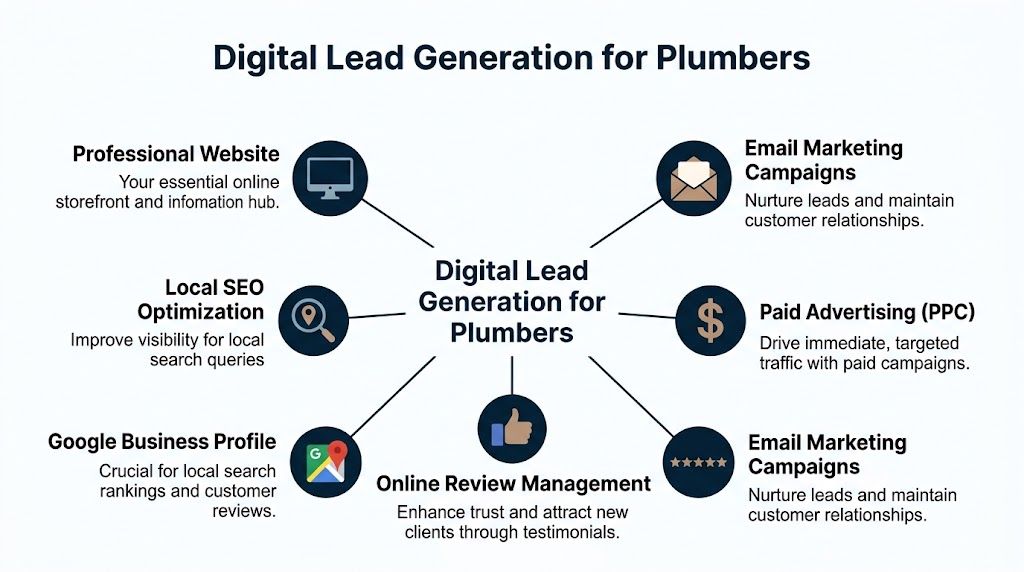
If you want consistent inbound work, local search matters most. That means your website, your Google Business Profile, your reviews, your location signals, and your service pages need to work together. That’s the foundation behind strong local SEO for tradies.
Start with the search terms buyers actually use
Plumbers often overcomplicate this. Customers don’t search for brand slogans. They search for problems and locations.
That usually means terms built around:
- Service plus suburb such as blocked drain Gold Coast
- Urgent need such as emergency plumber near me
- Specific system such as hot water repairs
- Commercial intent such as strata plumber or maintenance plumber
Your site structure should reflect those searches. One generic services page is rarely enough. Separate pages for core service lines and service areas give search engines and customers a clearer path.
Your Google Business Profile does heavy lifting
For local service businesses, the Google Business Profile often creates the first impression before the website does.
Keep it current and practical:
- Service categories should match your real work
- Business description should explain what you do and where you work
- Photos should show vehicles, staff, completed work, and premises if relevant
- Opening hours need to be accurate
- Review responses should be consistent and professional
Reviews are not just a reputation layer. They support conversion. They help the next customer feel safer choosing you.
If you’re asking for reviews only when you remember, you don’t have a review system. You have good intentions.
Build the ask into your closeout process. When the technician finishes the job, the customer should receive a simple follow-up that requests feedback while the experience is still fresh.
What a plumbing website actually needs
Many trade websites look decent but don’t convert. They’re heavy on stock phrases and light on proof.
A high-converting plumbing site should make a few things obvious within seconds:
- Who you help
- Where you work
- What services you offer
- How to contact you
- Why someone should trust you
That trust usually comes from practical elements, not marketing language. Clear service pages, suburb coverage, recent reviews, licence details where appropriate, visible phone numbers, fast mobile load times, and strong calls to action matter more than decorative design.
The home page should not try to explain everything. It should direct visitors to the right next step.
Paid search is useful when you know your economics
SEO builds over time. Google Ads helps capture demand now.
Paid campaigns work best when you’re disciplined about intent. Don’t send every click to the home page. Match the ad to the service. A blocked drain ad should lead to a blocked drain page. An emergency ad should land on a fast, urgent booking page.
Before increasing spend, check these basics:
- Is the landing page relevant
- Are calls being answered quickly
- Are form submissions being followed up fast
- Are you tracking which services produce better jobs
You don’t need dozens of campaigns to start. A tighter campaign around a few profitable services is easier to manage and usually easier to improve.
Lead generation breaks when follow-up is weak
A lot of owners think they have a traffic problem when their problem is a response problem.
If a customer calls and gets voicemail, fills out a form and waits too long, or asks for a quote and hears nothing back, that lead didn’t fail because of SEO. It failed because the handoff inside the business was loose.
A stronger lead handling process usually includes:
- Clear ownership. Someone owns incoming enquiries.
- Fast triage. Urgent, quote, maintenance, and commercial leads don’t all get handled the same way.
- CRM logging. Every lead goes into a system, not a sticky note.
- Follow-up sequences. Quotes and missed calls need consistent follow-up.
- Reporting. You should know what channels are driving booked work.
Use content to build authority locally
Content still matters, but only when it matches local intent. A plumbing business doesn’t need endless generic blogs. It needs useful pages that answer common buyer questions and support local visibility.
That can include:
- Service explainers for common jobs
- Location pages for priority suburbs
- FAQ content on pricing approach, response times, or common issues
- Case-based examples without inflated claims or gimmicks
AI can help speed up drafts and organise topic gaps, but it should not replace local knowledge. The strongest content still sounds like it came from people who understand plumbing jobs, customer hesitation, and the way local buyers search.
Build a channel mix, not a single dependency
Word of mouth is valuable. It’s just not enough on its own if you want predictable growth.
A balanced plumbing lead engine usually includes:
- Local SEO for compounding visibility
- Google Business Profile for map presence and trust
- Paid search for immediate demand
- Review generation for conversion support
- Email follow-up for quote chasing and repeat work
- Website conversion work so traffic turns into calls
That mix gives you control. If one channel slows, the whole pipeline doesn’t collapse.
Implementing Systems and Software For Efficiency
Leads are only useful if your business can absorb them cleanly. If the office is buried, scheduling is messy, and invoicing is late, more marketing just feeds disorder.
That’s why software matters. Not because it’s trendy, but because manual admin limits growth long before demand does.

A systems-led roadmap is one of the clearest ways to grow. Deploying Field Service Management software such as Simpro can eliminate 20% to 30% of manual errors and increase job capacity by 15% to 25% without hiring more staff. The same source says planned Australian businesses using these systems grow 30% quicker and can hit $1M revenue twice as fast, according to this field service growth roadmap.
The three systems that matter most
Plumbing businesses don’t need a bloated tech stack. They need a connected one.
The core setup usually includes:
- CRM to hold customer history, quote status, follow-ups, and communication records
- FSM software for scheduling, dispatching, quoting, job notes, mobile field access, and invoicing
- Accounting software to keep cash flow, reporting, and reconciliation clean
When those tools are disconnected, the business starts retyping information. That creates delays, errors, and missed revenue.
What manual operations really cost
A whiteboard, text messages, and spreadsheets can work when the business is small. The problem is they don’t fail loudly. They fail imperceptibly.
Jobs get booked without enough detail. Technicians turn up missing information. Parts don’t get ordered in time. Quotes aren’t followed up. Invoices go out late. Nobody can see where the job slipped because the process lives in too many places.
Operational warning: If staff need to ask the same questions more than once, the system is weak, not the person.
That’s where field software earns its keep. The value isn’t just faster admin. It’s fewer dropped balls.
Use software to standardise before you hire more
Hiring into a messy operation makes the mess more expensive.
Before adding more field staff, make sure a new technician can step into a process that already exists:
- Job information is complete before dispatch
- Quote templates are consistent
- Customer history is accessible
- Photos and notes are captured properly
- Invoices are generated without chasing paperwork
For businesses doing more quoting work, a dedicated estimating tool can also help tighten pre-job accuracy. If you’re reviewing options, Exayard plumbing estimating software is a useful example of the kind of specialist platform that can support cleaner estimate workflows.
For broader operational visibility across construction and trades, it also helps to understand where construction project management software fits versus job-level service software. They solve different problems, and choosing the wrong category creates frustration fast.
Better systems improve cash flow, not just efficiency
Most owners notice the scheduling benefits first. The cash flow gains matter just as much.
A cleaner workflow helps you:
- Send quotes faster
- Approve work with less delay
- Invoice closer to job completion
- Record variations properly
- Reduce disputes because notes and photos are attached
That leads to fewer gaps between work done and money received.
This short video gives a useful overview of the broader shift from manual trade management to a more systemised model:
Don’t buy software for features you’ll never use
One practical caution. Software only helps if your team uses it.
The best platform for your business is not necessarily the one with the longest feature list. It’s the one your office and field staff can adopt quickly, use consistently, and build process around. Simpler, fully used systems beat powerful, ignored systems every time.
Building a High-Performing Plumbing Team
No plumbing business scales for long on owner effort alone. At some point, growth depends on who you hire, how you train them, and whether good people want to stay.
That’s harder in the current market. Australia’s plumbing sector faces a reported deficit of 22,000 qualified plumbers in 2025, with 35% of plumbers over 55, and businesses that invest in training and retention are positioned better for growth, with top operators achieving 20%+ net margins, according to this Australian plumbing labour and margin analysis.

Hiring starts before the job ad
Good hires are easier when your business looks organised from the outside.
That means candidates can see:
- What kind of work you do
- What standards you expect
- What support they’ll receive
- How the role can grow
If you’re moving from solo operator to employer, get the basics right early. This guide to sole trader employer responsibilities is a practical place to start if you’re hiring for the first time.
A messy employer brand pushes away capable people. Skilled plumbers don’t want to walk into confusion any more than customers do.
Recruit for fit, not just availability
When owners are overloaded, they often hire reactively. That creates expensive mistakes.
A better interview process checks two things. First, can the person do the work you need? Second, can they operate inside your standards? Technical skill matters, but so do communication, documentation habits, punctuality, and attitude with customers.
Useful interview checks include:
- Work examples from similar job types
- Scenario questions about customer communication
- Discussion of workflow such as notes, photos, and job closeout
- Expectations on presentation and team behaviour
A strong technician who refuses process can still damage margin.
Onboarding needs structure
Most trade onboarding is too loose. Someone gets shown the vans, introduced to the team, and sent out. Then the business acts surprised when inconsistency appears.
A stronger onboarding process covers:
- How jobs are booked and handed over
- How pricing is handled
- How notes and photos are recorded
- How customer communication should sound
- How quality issues are raised early
New hires shouldn’t have to guess how your business works. If they’re guessing, you’re training by accident.
Systems and team building often overlap. The software matters, but the process wrapped around it matters more.
Retention usually comes down to friction
People leave for pay sometimes. They also leave because the day-to-day experience is harder than it should be.
Plumbers stay longer in businesses where:
- The schedule is organised
- Jobs are scoped properly
- Tools and stock are managed
- Managers communicate clearly
- There’s a visible path forward
That path doesn’t need corporate language. It just needs to be real. Apprentice to qualified plumber. Qualified plumber to lead tech. Lead tech to supervisor or estimator. When good staff can see progression, they’re less likely to drift.
Incentives should support the behaviour you want
Not every incentive needs to be a bonus on raw sales. In fact, that can backfire if it drives rushed advice or poor fit upsells.
Better incentive structures reward the outcomes that protect the business:
- Quality documentation
- Low callbacks
- Strong customer communication
- Reliable attendance
- Contribution to team standards
Some businesses also build recognition around mentoring apprentices, maintaining vehicle standards, or helping improve workflow. That works because it reinforces culture, not just output.
A high-performing team is not a group of heroes. It’s a group of people who know the standard and can deliver it without constant rescue from the owner.
Scaling With KPIs AI And Customer Retention
The businesses that scale well stop managing by feel alone. They still trust instinct, but they back it with numbers. That’s the shift from operator to CEO. You stop asking “Are we busy?” and start asking “Which parts of the business are producing profitable growth?”
A practical scorecard usually includes financial, marketing, operational, and retention measures. The exact setup varies, but the principle doesn’t. If you don’t track the few numbers that shape margin and capacity, you’ll make decisions too late.
The KPIs that actually matter
Not every metric deserves your attention.
For a plumbing business, the most useful KPIs usually sit around:
- Net profit margin
- Cost per lead
- Lead conversion rate
- Average job value
- Quote follow-up performance
- Technician utilisation
- Customer retention
- Receivables ageing
Track them weekly or monthly depending on the number. Don’t build a dashboard full of vanity metrics you’ll ignore.
Where AI fits in a plumbing business
AI isn’t a replacement for trade judgement. It’s a tool for speed, visibility, and consistency.
Used properly, AI can help with:
- Scheduling support by reducing admin time and improving job sequencing
- Call handling support through better enquiry tagging and summaries
- Content production for service pages, FAQs, and location-specific drafts
- Review and sentiment analysis so issues get flagged faster
- Internal search and knowledge so staff can find process answers quickly
The mistake is treating AI like magic. It’s only useful when it plugs into a real system with clear inputs and clear ownership.
Retention is the cheapest growth lever most plumbers underuse
Many plumbing businesses spend too much effort chasing the next customer and not enough maintaining the last one.
Your existing customer base is where repeat work, referrals, maintenance uptake, and stronger lifetime value sit. That’s why retention needs process. Not good intentions.
A useful retention engine often includes:
- Maintenance offers
- Service reminders
- Quote follow-up
- Post-job communication
- Review requests
- Seasonal education emails
- Fast rebooking for existing clients
If you’re reviewing that side of the business, these customer retention strategies are a helpful reference point for building a more deliberate follow-up system.
The easiest customer to win is often the one who already knows your name and had a good experience last time.
Make the numbers lead the next decision
KPIs, AI, and retention only matter when they change behaviour.
If conversion is weak, fix call handling before increasing ad spend. If utilisation is poor, review dispatch before hiring. If repeat work is low, improve aftercare before chasing new suburbs. If receivables are stretching out, tighten invoicing and payment workflow before blaming the market.
That’s how to grow a plumbing business in a way that compounds. Measure what matters. Use technology where it removes friction. Keep customers longer so every dollar spent on acquisition works harder.
Your Path to a Million-Dollar Plumbing Business
A bigger plumbing business is not built by accident. It’s built when pricing is deliberate, marketing is measurable, operations are systemised, staff are supported properly, and decisions are made from clear numbers instead of guesswork.
That’s the fundamental shift from a hard-working trade business to a durable company. You stop relying on memory, hustle, and last-minute fixes. You start building assets. A strong website. A reliable lead pipeline. Documented systems. A team that can perform without you hovering. A customer base that comes back.
Start with the next fix that removes the most friction. For some owners, that’s pricing. For others, it’s software, review generation, or finally putting structure around lead handling. Don’t wait until the pressure forces the decision.
A million-dollar plumbing business doesn’t come from doing more of the same. It comes from building a business that can grow without taking your life with it.
If you want help turning these ideas into a practical digital growth plan, Titan Blue Australia works with Australian businesses to improve websites, SEO, AI search visibility, and lead generation systems that support real commercial growth.
Make Titan Blue a preferred source in Google
One click tells Google to surface our articles more often in Top Stories, AI Overviews and AI Mode.

ChatGPT GPT-6 Search Upgrade: What It Means for Australia
OpenAI rolled out GPT-6 to ChatGPT on 7 October 2026 with faster search. Here is…

Best Dental Website Design Agencies in Australia: 7 Compared
Best dental website design agencies in Australia 2026: seven compared on dental proof, booking, AHPRA…

Childcare Centre Website Design Australia: The 2026 Guide
Childcare centre website design Australia: show hours, ages and enrolment as text so parents and…