


Last updated:
You check your own business in ChatGPT, Perplexity, or Google’s AI results. You type something close to what a customer would ask. “Best lunch spot near Broadbeach.” “Reliable plumber Gold Coast.” “Solar installer for a Queensland home.”
Your business doesn’t appear. A bigger brand does. Sometimes a directory does. Sometimes an answer mentions businesses you know aren’t stronger than yours.
That’s the new frustration behind the question why isn't my brand showing up in AI search. It feels personal, but usually it isn’t. In most cases, the business itself isn’t the problem. The problem is that AI tools are building a picture of your brand from scattered signals, and that picture is often incomplete, inconsistent, or hard for machines to trust.
After more than 25 years working with Australian businesses, one pattern keeps repeating. Good operators often lose visibility not because they lack quality, but because the web doesn’t describe them clearly enough. A restaurant can have a packed dining room and still look vague to an AI. A plumber can have years of local trust and still be invisible if core details conflict across the web.
The upside is that this is fixable. AI visibility isn’t magic. It’s a practical mix of structure, consistency, and third-party trust.
The New Invisibility Problem for Australian Businesses
A Gold Coast café owner can do everything right in their physical business. Good food. Loyal regulars. Strong reviews. A clean website. Then they ask an AI tool for nearby recommendations and get a list that skips them entirely.
That moment matters because customer behaviour is shifting. People aren’t only clicking ten blue links anymore. They’re asking for direct recommendations. They want one answer, a shortlist, or a quick comparison. If your business isn’t part of that shortlist, you’re not even getting considered.
For many Australian SMBs, this change has created a new kind of blind spot. Traditional search rankings still matter, but AI tools aren’t just ranking webpages. They’re forming an opinion about which business they trust to recommend.
A lot of owners assume, “I’ve got a website, a Google Business Profile, and some reviews. That should be enough.” In older search patterns, it often got you into the game. In AI search, it often doesn’t.
Practical rule: If an AI tool can’t confidently identify who you are, where you are, and why you’re credible, it will recommend someone else.
That’s especially relevant for local service businesses and hospitality operators. A Broadbeach plumber, a Burleigh café, or a Queensland accommodation business isn’t just competing on service anymore. They’re competing on machine-readable trust.
If you’re seeing that gap now, it’s worth understanding how AI search visibility works in practice. The businesses that adapt early tend to become the names AI tools keep returning to.
How AI Search Actually Recommends a Brand
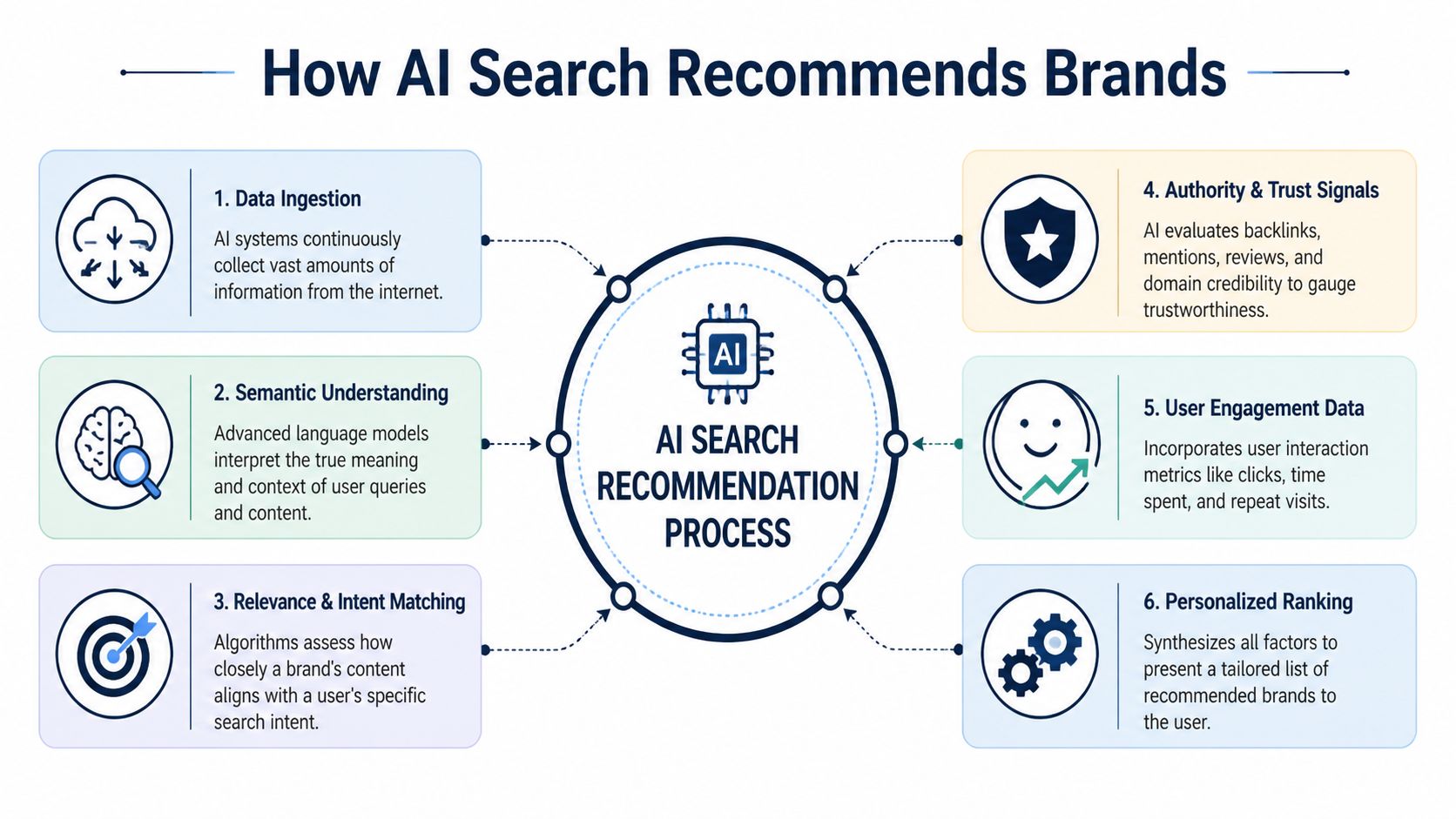
Think of AI search as a digital concierge. A good concierge doesn’t recommend a business because the owner says, “We’re excellent.” They recommend the places they can verify. They look for consistency, proof, reputation, and relevance to the question being asked.
That’s how tools like ChatGPT, Perplexity, and Google’s AI-generated answers behave. They piece together a business profile from multiple sources, then decide whether your brand fits the user’s request.
Your business is an entity
In plain English, an entity is your business as a recognised thing. Not just a webpage. Not just a logo. A real-world business with a name, location, services, contact details, reviews, and relationships to other trusted sources.
If AI sees “Ocean View Café”, “Oceanview Cafe”, and “Ocean View Broadbeach” across different places, it may not be sure whether that’s one business or several. If your address differs between your website and a directory listing, confidence drops further.
AI tools prefer clean identity signals because they need to answer quickly. They don’t have time to act like a patient human researcher.
Signals shape the recommendation
These systems gather signals from several places:
- Your website content. Service pages, FAQs, headings, contact details, and structured business information.
- Directories and business profiles. Google Business Profile, local directories, and industry listings.
- Reviews and reputation signals. Review platforms, mention context, and recurring sentiment.
- Third-party mentions. Articles, features, local media coverage, and other sites talking about your business.
- Technical structure. Schema markup, page hierarchy, and whether key facts are easy for machines to extract.
This is why the old habit of relying on a homepage plus a contact page falls short. You may know exactly what your business does. The AI may only see a vague brochure.
The businesses most often recommended by AI are usually the ones that are easiest to identify, easiest to verify, and easiest to summarise.
That’s also why there’s growing interest in the difference between traditional optimisation and AI-focused optimisation. If you want a useful breakdown, SEO for AI overviews vs SEO is a good companion read because it shows how recommendation-driven search changes the rules.
For Australian businesses trying to improve that machine-readable profile, generative engine optimisation is the practical layer that connects your site, your reputation, and your visibility in AI answers.
Diagnosing Foundational Gaps in Your Digital Footprint
When a mechanic opens a bonnet, they don’t start by repainting the car. They check whether the engine is communicating properly with the systems around it. AI visibility works the same way. Before you chase mentions and media, make sure your own digital foundations aren’t broken.

Schema is the translator most SMB sites still lack
A major problem across Australian SMB websites is that the site may look fine to a person but remain unclear to a machine. According to a 2025 Semrush Australia report, only 22% of Australian SMB websites feature proper schema markup, and a 2024 audit found 88% of non-visible SMBs in Queensland had broken or absent FAQ/Organization schema, causing AI systems to reduce recommendation confidence by 72%.
That matters because schema tells machines what something is. This is the business name. This is the phone number. This is the service area. This is the FAQ. Without that translation layer, AI often has to infer meaning from page layout and copy alone.
For a trade business, that can mean your emergency callout number is just seen as loose text. For a restaurant, your opening hours may not be interpreted cleanly. For a hospitality venue, your booking details may be visible to people but not structured for machine understanding.
Structure beats clever writing
A lot of small business websites are built like glossy brochures. They use sliders, oversized hero sections, long paragraphs, and vague lines such as “customized solutions for every client”. That style may satisfy a designer. It doesn’t help an AI extract answers.
Machines do better with pages that are clearly segmented and easy to scan. Good examples include:
- Service-specific headings such as “Blocked Drain Repairs in Broadbeach”
- Short answer sections that explain what you do, where you work, and who you help
- FAQ content that mirrors real customer questions
- Consistent contact details in footer, contact page, and business profile
If you’ve ever tried to get a quick answer from a staff member who talks in circles, you know the problem. AI reacts the same way to bloated content.
If you’re troubleshooting why your content isn’t being surfaced in AI tools, this guide on troubleshooting ChatGPT content access is worth reading because it explains several common technical and accessibility issues in plain language.
NAP consistency is not admin. It is trust
Your Name, Address, and Phone number need to match across your website, Google Business Profile, and major directory listings. Not mostly match. Match.
A small difference that seems harmless to a human can confuse an AI model. Suite number added in one place but not another. Old phone number on a directory. Different business naming convention in the footer. These all weaken confidence.
Use this quick check:
- Open your website footer and contact page.
- Compare them with your Google Business Profile.
- Check key directories where your business appears.
- Fix every mismatch before you do anything more ambitious.
Workshop shortcut: If the core facts of your business disagree across the web, every other optimisation effort becomes less efficient.
For businesses that want a practical starting point, an AI-ready website checklist helps identify where structure, schema, and consistency are holding visibility back.
Evaluating Your Brand's Authority and Trust Signals
Even if your website is well organised, AI still won’t take your word for everything. That’s sensible. Any business can claim it’s trusted, experienced, or highly rated. AI tools look for evidence outside your own website before they repeat those claims back to users.
That’s where digital word-of-mouth comes in.

Why third-party validation matters more than self-description
If your site says you’re a trusted Gold Coast electrician, that’s a claim. If your business is also mentioned in local directories, reviewed on Australian platforms, and referenced by other relevant sites, that becomes corroboration.
That distinction matters because AI tools often lean heavily on external confirmation. According to 2025 AU SEO audits cited by Found, AI systems like ChatGPT prioritise earned media from region-specific authoritative sources such as ProductReview.com.au, and only 22% of Queensland SMBs had more than 5 third-party backlinks from .au domains, correlating with 45% lower AI visibility scores.
The practical meaning is simple. If almost no trusted Australian sites mention your business, AI has less reason to recommend you confidently.
What good authority looks like for a local SMB
Authority doesn’t mean you need national press every month. It usually starts with strong local and category relevance.
Useful trust signals include:
- Australian directory coverage that matches your real business details
- Review presence on platforms your customers use
- Local media or community mentions that connect your brand to your area
- Industry associations or certifications published on trusted sites
- Relevant backlinks from Australian domains tied to your field or region
A Broadbeach plumber doesn’t need the internet to think they’re famous. They need the internet to understand they’re real, active, local, and trusted for plumbing work in that area.
Reviews help, but context matters
A pile of reviews with no supporting web presence can still leave gaps. The strongest profile usually combines reviews, business listings, content clarity, and third-party mentions.
Freshness matters too. If the web still carries outdated details about your location, services, or trading status, AI may treat your business as uncertain. That’s one reason review management and citation updates belong in the same workflow.
AI tends to trust what other reputable sources can verify about you, not just what you publish about yourself.
If you want a useful non-promotional read on how systems reduce bad outputs by relying on stronger source signals, practical strategies for AI accuracy offers a helpful frame. The same logic applies to brand visibility. Clearer evidence usually leads to more confident answers.
For local businesses building those off-site trust signals, answer engine optimisation sits somewhere between SEO, citation management, digital PR, and content design. It’s less about chasing vanity rankings and more about becoming a brand that machines can verify.
Your Prioritised Action Plan for AI Visibility
Most business owners don’t need a giant checklist. They need the right order. If you try to do everything at once, you’ll waste time on lower-value tasks while foundational issues stay broken.
Start with the actions that increase clarity fastest.

Quick wins for this week
A practical first sprint should focus on fixes you control directly.
- Clean up core business details. Make your business name, address, and phone number identical everywhere you own a listing.
- Review your main service pages. Replace vague copy with direct descriptions of service, suburb, and customer need.
- Add or repair basic schema. Start with Organisation, LocalBusiness, FAQ, and service-related markup where relevant.
- Check page readability. Break long paragraphs into headings, short sections, and direct answers.
- Update your Google Business Profile. Keep hours, categories, services, and contact details current.
These aren’t glamorous jobs. They work because they remove ambiguity.
A good benchmark for urgency comes from Search Engine Land benchmarks cited by AIS Media. 62% of Gold Coast hospitality and trades sites fail AI interpretability tests due to buried answers in bloated paragraphs, and a 2026 study found that implementing schema and refactoring to scannable H2/H3 summaries can make sites appear 3.2x more in AI Overviews.
That lines up with what many agencies see in practice. The businesses that answer basic questions clearly tend to become easier for AI systems to cite.
Strategic projects for this quarter
Once the site itself is cleaner, move to authority-building work.
First, create pages that answer commercial questions directly. Not fluffy blog posts. Real pages such as “Emergency plumber in Mermaid Waters”, “Gluten-free lunch in Broadbeach”, or “Solar installation for small commercial properties”. Each page should be useful, location-aware, and written in a way that a customer and a machine can both understand.
Second, build third-party validation deliberately. Ask where your business should reasonably be mentioned online, then close the gaps. That might mean industry directories, local sponsorship pages, chamber listings, review platforms, or media opportunities.
Third, assign ownership. Someone needs to check your listings, reviews, and content updates routinely. AI visibility falls apart when everyone assumes someone else is handling it.
Later in the quarter, video and explanatory content can help support that effort.
What to delegate and what to keep in-house
Keep these in-house if possible:
- Service knowledge. You know the actual customer questions better than any external writer.
- Review responses. Customers can tell when replies are generic.
- Business updates. Changes to hours, locations, or service areas should happen immediately.
Consider outside help for:
- Schema implementation
- Technical audits
- Citation cleanup at scale
- AI-focused content restructuring
If you need a specialist option for that technical layer, Titan Blue’s AI search engine optimisation service is one example of a service built around improving visibility in AI-driven discovery, rather than only chasing traditional rankings.
Industry-Specific Tips for AI Search Success
The fixes look different depending on what you sell. A restaurant, a plumber, and a small accommodation venue don’t send the same trust signals. AI tools need details that match the buying decision.
Restaurants and cafés
A restaurant owner often assumes photos and atmosphere are the main online job. They matter to people. For AI, the basics often matter more.
If someone asks for “best lunch spot near me with vegetarian options”, your website should make those facts easy to find. Menu pages shouldn’t be hidden inside PDFs if you can help it. Opening hours should be current. Booking links should be obvious. Dietary options should be written in plain text, not buried in image graphics.
A strong restaurant page usually includes:
- Current opening hours
- Menu categories in crawlable text
- Booking or call-to-book options
- Suburb or precinct references
- FAQ content covering parking, dietary needs, and trading days
If your café changed its trading hours six months ago but old listings still show the previous schedule, AI may hesitate to recommend it confidently for immediate intent searches.
Plumbers, electricians, and service trades
Trade businesses often lose visibility because they describe themselves too broadly. “Quality plumbing solutions for all your needs” sounds polished but says very little.
AI needs practical specifics. Do you offer emergency callouts? Which suburbs do you cover? Do you handle blocked drains, hot water systems, leak detection, or commercial maintenance? Are those services each explained on separate pages?
For trades, clear service-area signalling is critical. A 2024 study found that 78% of Gold Coast-based SMBs lack consistent NAP data, which led AI tools to assign 65% lower confidence scores for local queries, and businesses with mismatched profiles appeared in only 12% of AI-generated answers according to Matt Elliott’s analysis.
That explains why a capable local plumber can disappear from AI responses while a larger brand or directory gets named instead. The machine is choosing the business it can identify with confidence.
For a trade business, clarity beats cleverness. “24-hour plumber in Broadbeach” is more useful than “trusted solutions delivered with integrity”.
Hotels, motels, and hospitality venues
Hospitality businesses sit in an awkward middle ground. They need strong local signals like any SMB, but they also need product-style detail.
If your venue wants to show up for prompts such as “family-friendly accommodation near Broadbeach” or “boutique stay with pool and parking”, the site needs those details in plain language. Amenities should be easy to locate. Room types should be clearly described. Booking paths should be clean. Contact details and location references should match every platform.
This category also benefits from FAQ content that answers practical concerns before a guest asks. Late check-in, parking, walkability, nearby attractions, pet policy, and cancellation terms all help machines assemble a fuller summary of your offer.
Monitoring Progress and Future-Proofing Your Brand
AI visibility isn’t a one-off project. It’s more like maintaining a shopfront on a busy street. If the signage fades, trading hours are wrong, and half the references point to an old location, customers get confused. Machines do too.
The simplest monitoring method is to ask relevant AI tools the same kinds of questions your customers ask. Use local intent, service intent, and comparison intent. Then review what appears. Don’t obsess over a single answer. Look for patterns in whether your brand shows up, how it’s described, and which sources seem to support that description.
Keep an eye on practical signals:
- Branded search impressions
- Referral traffic from AI or discovery tools where visible
- Changes in enquiries after content and listing updates
- Accuracy across directories and business profiles
- Whether new reviews and mentions are appearing regularly
A business becomes easier to recommend when its digital footprint stays current, consistent, and supported by other trusted sources.
The bigger point is this. AI search will keep changing. Models will evolve. Interfaces will shift. The businesses that stay visible won’t be the ones chasing every new buzzword. They’ll be the ones that maintain strong fundamentals, publish useful content, and keep their online identity organised.
Frequently Asked Questions about AI Search Visibility
How is AI search different from traditional SEO
Traditional SEO focuses heavily on helping pages rank in search results. AI search still uses many of the same ingredients, but the end product is different. The system may not send a user to a list of links first. It may summarise, compare, and recommend directly.
That means your business has to be easy to identify, verify, and summarise. Rankings still matter, but they’re no longer the whole game.
Can I pay to be included in AI search answers
Not in any simple or guaranteed way. Paid ads still exist in broader search ecosystems, but organic AI recommendations rely on the system’s confidence in your relevance and trustworthiness.
If your business lacks clear signals, no shortcut fixes that for long. Paid visibility and AI recommendation visibility are not the same thing.
How long does it take to see results
There isn’t one universal timeframe. Some changes, such as fixing business details or improving page structure, can help quickly because they remove obvious confusion. Authority work usually takes longer because third-party trust builds over time.
The better question is whether your site and brand are becoming easier for machines to understand. That’s the leading indicator.
Do I need to be technical to improve this
Not entirely. Many of the most important fixes are operational and editorial. Clear service pages, accurate business information, updated profiles, and useful FAQs don’t require advanced technical skills.
Schema and deeper technical implementation often do. That’s where many businesses bring in a developer or agency support.
What’s the most common mistake small businesses make
They assume visibility comes from one channel. A website alone won’t carry the whole load. Neither will reviews alone. Neither will a Google Business Profile in isolation.
AI tools form a view from multiple sources. If those sources are weak, disconnected, or inconsistent, your visibility suffers.
Should I rewrite all my content for AI
No. Rewrite the parts that are vague, bloated, or hard to scan. Good AI-ready content is usually just good customer-ready content with stronger structure.
If a customer can land on your page and immediately understand what you do, where you do it, and how to contact you, you’re moving in the right direction.
What should I fix first if I’m short on time
Start with three things:
- Your NAP consistency
- Your core service pages
- Basic schema and FAQ structure
Those three areas usually remove the biggest trust and clarity gaps first.
If your business has a strong presence offline but missing from AI answers, Titan Blue Australia can help assess the signals holding you back and map out practical next steps. Learn more at Titan Blue Australia.
Make Titan Blue a preferred source in Google
One click tells Google to surface our articles more often in Top Stories, AI Overviews and AI Mode.

Shopify Website Design Australia: The 2026 Guide
Shopify website design Australia: product pages, collections, delivery info and product data that win sales,…

Cleaning Company Website Design Australia: The 2026 Guide
Cleaning company website design Australia: the pages, quote forms and schema that win jobs, plus…

Is AI Search Just Google? What the Numbers Say for Australian Businesses (2026)
Is AI search just Google? Google reports 2.5B+ monthly AI Overviews users. Sourced figures, our…