


Last updated:
If you're running a restaurant, plumbing business, building company or solar firm, you've probably felt this already. Enquiries don't vanish overnight, but the pattern changes. A customer who used to Google "emergency plumber near me" now asks ChatGPT who to call. A family deciding where to eat on the Gold Coast asks for a shortlist instead of scrolling through ten websites. Your site may still rank, but fewer people are reaching it the old way.
That's where ChatGPT SEO services come in. They aren't a gimmick and they aren't a replacement for solid digital marketing. They're the practical work of making sure AI tools can find, understand and cite your business when buyers ask service-based questions in natural language.
The New Search Landscape for Australian Businesses
Friday afternoon on the Gold Coast, a family asks ChatGPT where to book dinner near Broadbeach with kids. At the same time, a property manager asks for a roofer who can handle storm damage fast. In both cases, the businesses that get mentioned have usually done more than basic SEO. They have made their services, locations, proof, and reputation easy for AI systems to interpret.
That shift is already affecting Australian small businesses. I see it in accounts where core rankings still look stable, but enquiry patterns change. Website clicks soften. Phone calls become more specific. Buyers arrive with a shortlist in mind because an AI tool has already filtered the options for them.
For a plumber in Southport, a builder in Burleigh, or a restaurant in Surfers Paradise, the issue is simple. You need to be present at the recommendation stage, not just somewhere in a list of blue links.
What changes in practice
Old SEO still matters. Your site needs strong local pages, accurate service information, fast load times, and authority signals. But AI-driven discovery puts more weight on whether your business can be clearly understood across your website, your Google Business Profile, local citations, reviews, and third-party mentions.
That creates a few practical changes for owners and managers:
- Traffic can flatten while leads stay mixed because some prospects get their answer before they ever click through.
- Calls sound different because the customer already knows your service area, pricing style, or opening hours.
- Service-specific questions matter more because AI tools respond to full prompts, not just short keywords.
- Brand clarity matters more because vague wording makes it easier for AI to confuse you with a competitor or directory listing.
This is especially relevant for trades and hospitality. A generic home page will not do much if someone asks, "Who fixes blocked drains after hours in Helensvale?" or "Which Gold Coast restaurant is good for a casual family dinner near the beach?" AI systems look for clear service pages, suburb relevance, supporting evidence, and consistent business details.
A useful way to monitor this shift is to review specialist AI SEO Tracker resources, which focus on AI search visibility rather than only traditional ranking positions. That gives business owners a better question to ask. Not just where they rank, but whether they appear when AI tools assemble an answer.
Practical rule: If your business depends on local discovery, AI needs to describe what you do, where you do it, and why a customer should trust you.
For businesses that want a clearer view of the difference, our guide to AI search strategy for Australian businesses explains what to fix first. The businesses that win more visibility now are usually the ones that make themselves easy to verify, easy to classify, and easy to recommend.
What Are ChatGPT SEO Services
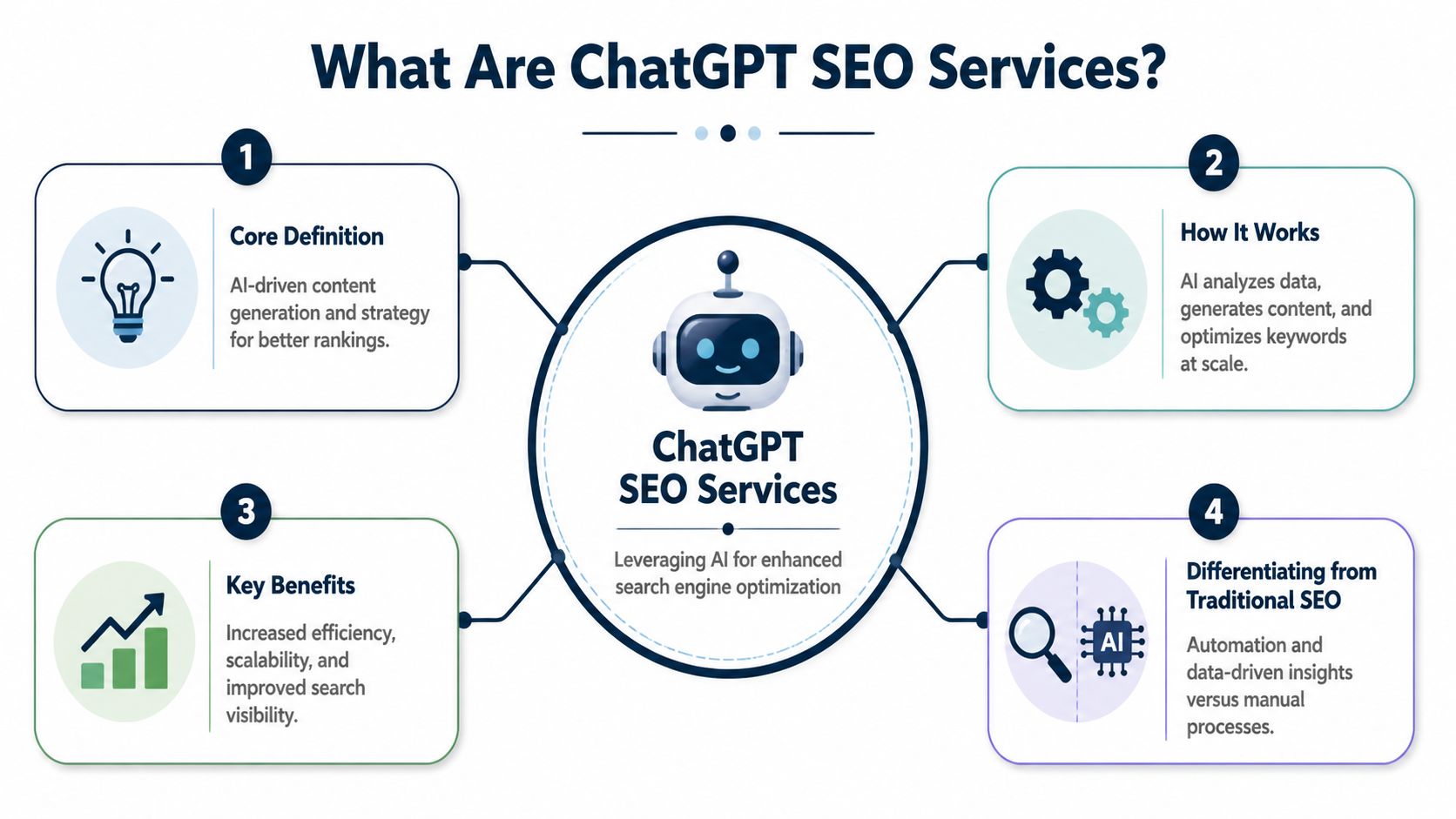
Traditional SEO helps your website appear in a list of results. ChatGPT SEO services help your business appear correctly in a conversation.
That difference matters. With standard SEO, you optimise pages, titles, internal links, metadata and topical relevance so Google can rank you. With ChatGPT SEO, you still need those basics, but you also need content and structure that help large language models understand your expertise, service areas, proof points and the kinds of questions you answer better than anyone else.
Think conversation, not catalogue
The easiest analogy is this. Traditional SEO is like preparing your business for a directory. ChatGPT SEO is like briefing a smart assistant so it can recommend you in plain English.
That means the work shifts from just "insert target keyword" to questions like:
- Can the model identify what you do without confusing you with a competitor or directory listing?
- Can it match your business to real buyer intent such as urgent plumbing, family dining, after-hours electrical work or solar installation advice?
- Can it find enough trustworthy context around your brand to mention you with confidence?
A strong search engine optimisation service still matters because technical SEO, crawlability and content quality remain foundational. But AI search adds another layer. It rewards businesses that publish clear, experience-based answers instead of generic filler.
The core parts that matter
In practice, ChatGPT SEO services usually include four working parts.
- Topical content design. This means building pages and articles around real questions customers ask, not just broad keywords.
- Entity clarity. Your business name, services, locations, specialties and credentials need to appear consistently so AI doesn't blur them.
- Authority signals. Mentions, supporting content and source consistency help AI systems decide whether to include your brand.
- Structured formatting. Content has to be easy to parse, quote and summarise.
AI tools don't reward vague marketing language. They respond better to direct answers, service detail and clear proof of expertise.
A lot of business owners assume this is just "using ChatGPT to write blogs". It isn't. In fact, that approach often fails because it produces thin copy with no original insight. Good ChatGPT SEO services use AI carefully, but the strategy itself is about making your business more understandable and more citable.
If you want a plain-English primer on the systems behind all this, large language model basics are worth understanding. You don't need to become technical. You do need to know why these platforms choose some businesses to mention and ignore others.
Our Workflow for AI-Powered SEO Success
The work starts with diagnosis, not content production. If a site already has useful service pages, suburb pages, FAQs and location signals, the goal isn't to throw it out and start again. The goal is to find where AI systems are likely to get confused, miss context or skip the business entirely.

Step one is an answer-gap audit
Most sites have content gaps that don't hurt them badly in old SEO but do hurt them in AI search. The business may have a service page for "plumbing services" but nothing that explains blocked drains in older suburbs, after-hours callouts, hot water replacements or insurance-related repairs. That's a problem because AI tools work best when they can map specific prompts to specific answers.
The first pass usually looks for:
- Missing question coverage tied to real buying intent
- Weak service definitions where pages describe outcomes poorly
- Thin location context that doesn't support local recommendation
- Inconsistent brand references across the site
Many DIY attempts often fail. Owners publish broad, polished copy that reads well enough to a person but says very little to a machine.
Step two is rebuilding content for citation
Once the gaps are clear, the content needs to become citation-ready. That doesn't mean robotic. It means structured, specific and trustworthy.
Useful content tends to include:
- Direct answers early so the main point isn't buried
- Clear service boundaries so AI can tell what you do and don't do
- Location relevance for suburbs, regions or service zones
- Original expertise based on actual jobs, processes or customer concerns
A lot of teams also benefit from studying how to build a content engine that drives ROI because AI visibility isn't built from one blog post. It comes from a body of useful content that reinforces the same expertise from different angles.
Field note: The best-performing AI content usually sounds less like advertising and more like a skilled operator answering a real customer question.
Step three is technical structure that AI can read
Schema becomes far more important. According to Salt Agency's analysis of ChatGPT Atlas and technical SEO, AI browsers such as ChatGPT Atlas use schema markup as an additional signal to interpret context and generate accurate summaries with proper citations. That directly affects how business information appears in AI-generated answers.
For service businesses, that means using the right structured data to support pages such as:
- Service pages for core offerings
- FAQ content that answers common pre-sale questions
- How-to resources where practical guidance supports expertise
- Article content that expands depth around the main service themes
Without this layer, a good page can still be misunderstood. AI may miss the key answer, cite the wrong section or fail to connect the content to your business entity.
Step four is testing in live AI environments
This part is often skipped. It shouldn't be.
After updates go live, the next job is to test real prompts across AI tools, compare the answers, review citations, tighten weak pages and improve consistency. You don't optimise once and walk away. You check what the model says, where it sourced the answer, what details it missed and whether your site gave it enough context to do better.
For businesses assessing whether their current site is ready for this layer, an AI readiness review is a practical place to start. The point isn't to chase every trend. It's to make sure your digital assets can still earn visibility as search behaviour changes.
Real-World Benefits for Australian Industries
The value of ChatGPT SEO services becomes obvious when you look at real buying situations. People don't open AI tools because they want more options. They use them because they want faster judgement. They want a shortlist, a recommendation or a clear next step.

According to a 2025 SE Ranking study focused on Australian markets, brands featured in ChatGPT AI answers achieved a 2.5x higher click-through rate and stronger buyer trust, as summarised by Bitbinders' overview of ChatGPT SEO in 2025. That makes sense in service categories where trust decides who gets the call.
For restaurants and hospitality venues
A restaurant isn't just competing for "best restaurant Gold Coast". It's competing for nuanced prompts such as "best family-friendly dinner with a view", "quiet date night near Broadbeach" or "where to eat after a conference".
If the venue's content only lists menu items and opening hours, AI has very little to work with. But when the site clearly describes atmosphere, booking types, dietary options, nearby landmarks and the kinds of occasions the venue suits, the business becomes easier to recommend.
The practical benefit isn't abstract. Better matching means:
- More qualified booking traffic from people already aligned with your offer
- Fewer wasted clicks from diners looking for something you don't provide
- Stronger brand perception because the recommendation feels informed
For plumbers and trade businesses
Trade buyers often ask urgent, detailed questions. They don't just search for a plumber. They ask about burst pipes, leaking taps, blocked drains, old homes, emergency response, gas fitting or hot water systems.
A plumbing site built for AI answers gives clear help on these use cases. It explains common causes, service limits, suburbs covered, response process and when a job is urgent. That kind of content doesn't just rank. It reassures.
A tradie site wins more trust when it sounds like the person who'll do the work, not like a template written for everyone.
That trust matters because local service decisions happen quickly. If AI summarises your experience well, the customer reaches your site with fewer doubts and a stronger intent to call.
A short explainer on how AI-led discovery is changing customer behaviour can help make that shift more concrete:
For solar and construction businesses
Solar and construction projects involve longer research cycles. Buyers ask comparative, high-consideration questions. They want to know what system suits their property, what installation involves, how roof type affects planning, and what to ask before signing a quote.
Generic landing pages don't answer enough of that. Helpful, layered content does. A solar company that explains process, site suitability, common objections and practical project considerations becomes easier for AI to surface as a credible source.
That produces better commercial outcomes because the lead arrives more informed. Instead of starting from zero, the sales conversation starts with intent, context and trust.
Measuring Success What to Expect from Your Service
A good provider shouldn't ask you to trust vague promises. If someone offers ChatGPT SEO services, they should also show how progress will be tracked. AI visibility can feel fuzzy at first, but the work is measurable when you define the right indicators.

What meaningful reporting looks like
The most useful reports usually include a mix of visibility signals, content performance and business outcomes. Not every metric will sit neatly inside Google Analytics, because AI-assisted journeys often begin before the click.
Useful deliverables often include:
- Citation and mention tracking. This checks whether your business appears in AI-generated answers for target prompts.
- Prompt coverage analysis. This maps which buyer questions your site can answer clearly and which ones still need content.
- Content quality reviews. This shows whether important pages are thin, duplicated, vague or missing key trust signals.
- Lead-source trend analysis. This looks for changes in enquiry quality, phrasing and assisted discovery patterns.
What these metrics mean in plain English
A report is only useful if the client can act on it. "Citation tracking" means checking whether AI tools are naming your business when people ask relevant questions. "Prompt coverage" means reviewing whether your site addresses the language buyers use. "Authority growth" means your business is becoming easier for machines to trust and summarise.
Client-side reality: If reporting doesn't tell you which pages to improve next, it's not reporting. It's decoration.
This is also why expectations matter. AI visibility doesn't move on a fixed timetable. Some improvements happen quickly after content and structure are cleaned up. Others depend on how often platforms revisit, retrieve and cite your material. Anyone serious about this should set realistic checkpoints, which is the same reason traditional businesses still ask how long SEO takes to work. The answer in both cases is that meaningful results build through consistent improvement, not one-off tweaks.
What to watch for beyond rankings
The strongest signs often appear before a major traffic spike. Sales teams may notice better-informed leads. Phone calls may contain more specific service language. Customers may mention they "found you through AI" or arrive with fewer early-stage questions.
Those are not soft signals. They usually mean the content is doing its job earlier in the buyer journey.
Our ChatGPT SEO Packages
Most businesses don't need the same level of service. A local venue with a compact site has a different brief from a multi-location trade company or a solar installer targeting several regions. The right package depends on how broad your service footprint is, how competitive your category is, and how much authority your current site already has.
Foundation package
This suits smaller operators who need the basics done properly.
It typically focuses on core service pages, location clarity, essential FAQ content, technical clean-up and early AI visibility tracking. The goal is simple. Make sure the business can be understood correctly and has a realistic chance of being cited for its main commercial queries.
Growth package
This is for businesses that already have some SEO traction and want stronger visibility in conversational search.
The work usually expands into deeper prompt mapping, supporting content around common questions, stronger internal linking, broader schema coverage and routine testing across AI platforms. This tier is often a fit for established plumbers, builders, hospitality groups and specialist service firms.
Dominator package
This level is built for businesses that want category leadership.
The focus is broader authority building, advanced content clusters, tighter entity consistency, ongoing optimisation from live prompt testing and reporting that links AI visibility back to enquiry quality. It's the right fit when your market is crowded and you don't want to be merely present. You want to be the business AI tools repeatedly prefer to cite.
If you're comparing options, reviewing small business SEO package structures can help clarify the level of support that matches your goals. The smart move isn't choosing the biggest package by default. It's choosing the one that fits your growth target, site maturity and competitive pressure.
Frequently Asked Questions About AI SEO
Will ChatGPT SEO services replace traditional SEO
ChatGPT SEO services work best as an extension of solid SEO, not a substitute for it.
If a tradie site is slow, hard to crawl, vague about service areas or thin on real service detail, AI visibility will stay patchy. The core work still matters. Technical fixes, clear page structure, useful copy, local relevance and authority signals are what give AI systems something reliable to reference.
How long does it take to see results
That depends on what you're starting with.
A Gold Coast electrician with a clear site, strong service pages and accurate suburb signals can usually make progress faster than a hospitality venue running on outdated pages and duplicated content. In practice, early gains often come from fixing clarity first, then testing how AI tools interpret the business.
This is not a quick prompt trick. It is an ongoing process of improving content, structure, trust signals and local specificity.
Is AI-generated content enough on its own
Usually, no.
AI can help produce drafts faster, organise FAQs and surface missing topics. On its own, it rarely produces the detail that wins trust from a real customer comparing local providers. A plumber needs to explain callout areas, job types and after-hours availability. A restaurant needs accurate menu context, booking details and venue specifics. That kind of specificity is what separates useful pages from generic copy.
Is there a risk AI tools use my content without credit
Yes.
Some AI platforms cite sources clearly. Some summarise without sending much traffic back. That is one of the trade-offs in this shift. The practical response is to make your content easier to attribute and harder to misread by using clear page structure, schema, strong entity signals and original local detail.
Why act on this now
Because search behaviour is changing before many local operators have adjusted.
As noted earlier, analysts are projecting more AI-first discovery behaviour over the next couple of years. You do not need to wait for a traffic drop to respond. For Australian trades and hospitality businesses, the better move is to prepare while competition is still uneven, especially in local markets like the Gold Coast where many sites are still underdeveloped.
Is this mainly for big brands
No.
Smaller local businesses often have an edge because they can be more specific. A Gold Coast builder who clearly explains council area experience, project types and service suburbs can be more useful to an AI system than a large national competitor with broad, generic pages. The same applies to cafés, restaurants, sparkies, pest control firms and other service businesses where local context matters.
Titan Blue Australia helps businesses across the Gold Coast and wider Australia adapt to AI-driven discovery with practical strategy, strong technical foundations and content built for real buyers. If you want a clearer plan for your business, visit Titan Blue Australia.
Make Titan Blue a preferred source in Google
One click tells Google to surface our articles more often in Top Stories, AI Overviews and AI Mode.

ChatGPT GPT-6 Search Upgrade: What It Means for Australia
OpenAI rolled out GPT-6 to ChatGPT on 7 October 2026 with faster search. Here is…

Best Dental Website Design Agencies in Australia: 7 Compared
Best dental website design agencies in Australia 2026: seven compared on dental proof, booking, AHPRA…

Childcare Centre Website Design Australia: The 2026 Guide
Childcare centre website design Australia: show hours, ages and enrolment as text so parents and…