


Last updated:
A lot of Australian business owners are seeing the same pattern right now. Website traffic feels less predictable. Enquiries still come in, but not always from the channels that used to carry the load. A customer might still find you on Google, but they might also ask ChatGPT who to hire, where to eat, or which local provider looks most trustworthy before they ever click a website.
That changes the job of digital marketing.
If you run a plumbing business, a restaurant, a solar company, or a construction firm, learning how to rank in ChatGPT isn’t a gimmick. It’s part of being discoverable in the way people now research. The businesses that adapt early tend to become easier for AI systems to understand, cite, and recommend. The ones that keep relying on broad service pages and thin directory listings often disappear from these answers entirely.
Why Your Business Needs to Care About ChatGPT
A couple books a venue tour on the Gold Coast. Before they call, they ask ChatGPT for a wedding florist that can handle native arrangements, deliver on short notice, and has strong local reviews. Your business might be the right fit and still miss that shortlist if your online presence is patchy or hard to verify.

That matters because AI tools now sit earlier in the buying journey. People use them to narrow options before they compare websites, call businesses, or read every review. For a small business owner, that means visibility can drop before a normal search click ever happens.
I see this most often with trades, hospitality venues, and local service businesses. They have a decent website, an active Google Business Profile, and solid word of mouth, but their business details are scattered across directories, socials, and old pages. AI systems are less forgiving of that inconsistency than a human customer is.
The commercial risk is simple. If ChatGPT cannot pull together a clear, credible picture of your business, it is less likely to mention you when someone asks who to hire, where to eat, or which provider looks trustworthy.
For Australian SMBs, this is not about chasing another shiny channel. It is about making sure your existing marketing assets work in a new discovery path without blowing the budget on enterprise SEO projects.
What this looks like in practice
A local restaurant now needs more than a page targeting “best Italian Gold Coast”. AI-driven discovery works better when the business leaves fewer gaps. Clear facts help.
- Location and service area
- Opening hours and booking details
- Cuisine, menu type, and dietary options
- Reviews, mentions, and third-party trust signals
Answer Engine Optimisation, or AEO, is the work of making those signals easy to find, easy to interpret, and easy to trust. For a plumber, that might mean separate pages for emergency callouts by suburb. For a café, it could mean clearly listing gluten-free options, booking links, and current opening hours everywhere they appear online.
There is a trade-off here. Broad branding pages are faster to publish, but they often give AI very little to cite. Specific, well-structured local pages take more effort, yet they give you a better shot at showing up in answers that lead to real enquiries.
Practical rule: If a customer has to piece together what you do, where you work, or whether you are credible, AI will struggle to recommend you with confidence.
If you want a feel for the platforms customers are already testing, it helps to evaluate leading AI tools. If your name rarely appears in AI responses, this guide on why your brand isn’t showing up in AI search will help you diagnose the common gaps.
Understanding How AI Answer Engines Work
A customer asks ChatGPT, “Who fixes leaking hot water systems in Logan and can come today?” The businesses that show up are usually the ones that make the answer easy to assemble. Clear service details, clear locations, clear proof.
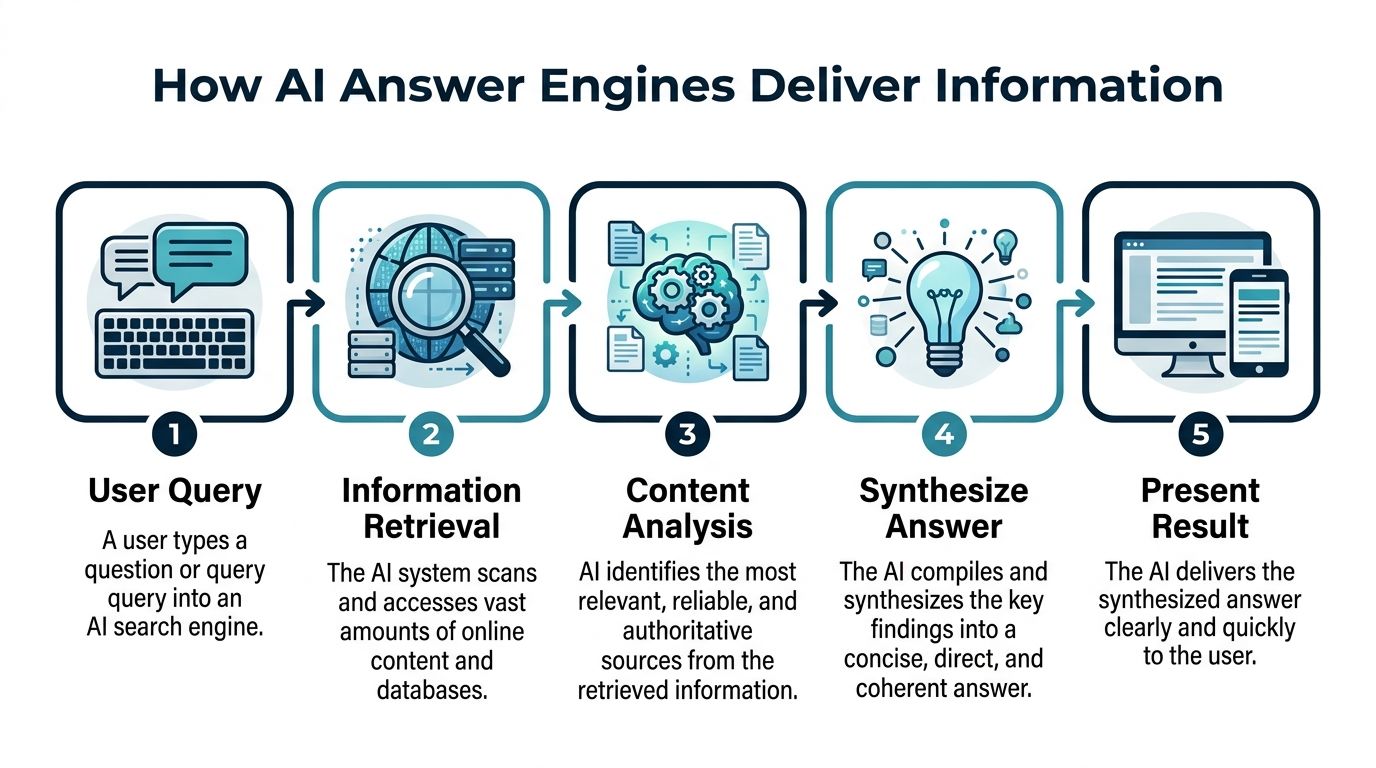
That is the practical shift from classic SEO to answer engine optimisation.
Search engines have long ranked pages. AI answer engines also retrieve passages, compare sources, and assemble a response that sounds complete and low-risk. For a local business, that changes the job. The goal is no longer just getting a page indexed for a keyword. The goal is publishing information an AI system can extract, understand, and trust without guessing.
Citation-worthy beats keyword-heavy
A page packed with service keywords can still underperform if it never answers a real customer question cleanly. A page built around a specific job, suburb, and situation gives the model more to work with.
For example, “We offer plumbing services across the Gold Coast” is weak retrieval material. “Emergency burst pipe repair in Broadbeach, available after hours, with callout times clearly explained” is much easier to cite because the answer is already formed.
This matters even more for Australian SMBs that do not have big brand recognition. A national chain can sometimes ride on authority alone. A local tradie, clinic, café, or venue usually needs stronger on-page clarity and stronger local corroboration.
What the retrieval process looks for
When someone asks, “Who’s a reliable solar installer in South East Queensland?”, the system is trying to reduce uncertainty. It looks for signals such as:
- Direct wording that answers the prompt or a close variation of it
- Clear page structure with headings that separate one topic from another
- Specific context about service area, job type, timing, or constraints
- Trust indicators such as reviews, business listings, and consistent business details
Many small business sites commonly fall short. The copy reads well enough on the homepage, but it stays broad. It talks about quality, service, and experience without spelling out the exact jobs, suburbs, conditions, and customer questions that answer engines need.
AI systems are easier to satisfy than people in one respect. They reward clarity fast. If the answer is buried under brand slogans and vague claims, you lower your chance of being cited.
There is a trade-off. Broad pages are quicker to write and easier to maintain. Specific pages and tightly written sections take more effort, but they give answer engines cleaner material to retrieve, especially for local and high-intent searches.
If you want a plain-English explanation of the technology behind these systems, this guide to what large language models are is a useful starting point. If you’re building an internal tool or a guided customer assistant, tailored AI chat consulting can also help clarify how custom AI experiences differ from public search-style tools.
Creating Content That AI Loves to Cite
Most business websites were built to describe the business. That’s no longer enough. To rank in ChatGPT, your content has to answer the exact questions a customer is likely to ask.

The easiest way to think about this is to stop writing pages as brochures and start writing them as answer libraries.
Write in atomic blocks
ChatGPT’s citation system uses passage-level retrieval, not just page-level judgement. Content with question-based H2 headings achieves citation rates at double the frequency, 18% vs 8.9%, and each paragraph should stand alone as a complete answer (research on passage-level retrieval and heading patterns).
That changes how you should write.
Instead of one long service page on solar installation, break the page into smaller answerable units such as:
- How do solar panels work in Queensland homes
- What size solar system suits a family household
- What’s included in a standard installation
- How long does solar installation usually take
- What maintenance do solar panels need in coastal areas
Each section should answer one micro-question clearly and directly. Don’t warm up for three sentences. Put the answer first.
What works and what doesn’t
Here’s the trade-off many businesses miss.
What usually works
- Question-led headings that match real customer language
- Short paragraphs that can be quoted without extra context
- Specific location references where relevant
- Service explanations written in plain English
What usually fails
- Generic hero copy like “quality solutions suited to your needs”
- Long brand paragraphs with no direct answers
- Pages targeting an entire country when the business serves local areas
- AI-written filler that says a lot but explains very little
A paragraph should make sense even if ChatGPT pulls it out of the page and shows it on its own.
Build pages around real customer prompts
A plumber on the Gold Coast shouldn’t just have a page called “Plumbing Services”. A better content set might include:
- Emergency plumbing repair in Broadbeach
- Blocked drain solutions for older Gold Coast homes
- How hot water system replacement works
- What to do when a pipe bursts after hours
That approach lines up with how people ask AI systems for help. They don’t ask for your sitemap. They ask for a situation-specific recommendation.
This is also where human editing matters. If you use AI to draft content, clean it up so it sounds natural and local. A tool that can humanize chatgpt text may help with readability, but it still won’t replace subject-matter review from someone who knows the service and the region. If you need a stronger baseline for web copy before adapting it for AEO, this guide to content writing for websites is worth reading.
A good visual breakdown of this content style is below.
A simple content pattern to follow
Use this on service pages, suburb pages, and FAQs:
-
Start with the direct answer
If the heading is “How does emergency plumbing repair work in Broadbeach”, answer that in the first sentence. -
Add the local context
Mention the area served, common property types, or local conditions where relevant. -
Include the operational detail
Explain what’s included, what happens next, and how someone gets help. -
Keep each block self-contained
Avoid writing paragraphs that depend on the reader seeing the section above.
That’s the practical core of how to rank in ChatGPT with content. Make every section easy to extract, easy to trust, and easy to understand.
Optimising Your Digital Footprint for AI
Good content on its own won’t carry the whole job. AI systems also need clean business data. If your website says one thing, your profiles say another, and your structured data is missing, you create doubt. AI tools don’t like doubt.

Treat schema like a digital label
Local business schema is the machine-readable layer that tells an AI system what your business is, where you are, what services you provide, and when you operate. Without that layer, your site may look clear to a person but vague to a machine.
Businesses without proper local business schema are described as “invisible” to AI, there’s a 60-70% correlation between ranking high on Bing and being recommended by ChatGPT, and 70% of small businesses with a poor online footprint risk complete exclusion from AI search results (local schema, Bing correlation, and digital footprint findings).
That sounds technical, but the practical fix is straightforward.
The foundational checklist
Make sure your website and profiles clearly define:
-
Business type
Restaurant, plumber, builder, solar installer, florist, and so on. -
Address and service area
Your actual base plus the suburbs or regions you serve. -
Phone number and opening hours
These must match across your website and business profiles. -
Services offered
Not just a broad category. List the actual service lines. -
FAQ data
This helps AI systems pull direct answers from your pages.
If your business details aren’t consistent across the web, AI has no reason to feel confident about recommending you.
Bing matters more than many businesses realise
A lot of Australian SMBs obsess over Google and ignore Bing. That’s a mistake in this context. If Bing visibility correlates strongly with ChatGPT recommendations, then your Bing presence becomes a practical proxy for whether your AEO foundation is healthy.
That means you should claim and complete your business listings, check that pages are indexable, and make sure your site isn’t blocking relevant AI crawlers. Keep the HTML clean, the site fast, and the structure easy to parse.
AEO work also overlaps heavily with local SEO hygiene. Titan Blue Australia offers Answer Engine Optimisation for businesses that need help with prompt testing, content restructuring, and technical implementation, but the core tasks are still the same whether you do them in-house or with an agency.
Low-cost fixes with the biggest impact
For many small businesses, the most useful first moves are not glamorous:
- Tighten your Google Business Profile
- Set up or improve Bing Places
- Add LocalBusiness and FAQ schema
- Create location-specific service pages
- Clean up inconsistent directory listings
This is the scaffolding. It doesn’t feel as exciting as publishing a new article, but without it, your content often won’t get the visibility it deserves.
Building Trust with AI Through Authority Signals
A plumber in Geelong and a café in Newtown can both have decent websites and still get ignored by AI answers if the rest of the web barely confirms they exist. That is the gap many small businesses miss. Your site makes your case. Third-party signals back it up.
AI systems look for repeated signs that your business is real, active, and known in the right circles. That includes reviews, directory listings, association profiles, local media mentions, supplier references, and comparison pages where your business appears in a relevant context. If you want a practical overview of that wider process, Titan Blue outlines it in its guide to AI search engine optimisation.
What authority looks like for an Aussie SMB
For a local business, authority is less about chasing prestige links and more about building a believable pattern.
A restaurant might build that pattern through Google Reviews, TripAdvisor, local tourism directories, and event listings. A sparky might show up across Google Reviews, industry bodies, trade directories, and Chamber of Commerce profiles. A builder might add supplier stockist pages, project mentions, council or community references, and association memberships.
Analysts at Ahrefs found that stronger off-site authority signals and review depth correlate with better visibility in ChatGPT-style results, and that comparison-style pages are cited more often than standard pages in many cases (Ahrefs research on ranking in ChatGPT).
That does not mean a suburban business needs a national PR campaign.
It means AI is more likely to trust a business that shows up consistently in the places a real customer would expect to find it.
What to prioritise first
Start with the signals that are easiest to earn and hardest to fake.
-
Detailed reviews
Ask customers to mention the job, suburb, or service type in their own words. “Installed a new split system in Southport” carries more meaning than “great team”. -
Relevant directories
Focus on industry and regional listings that fit your business. Ten good listings are worth more than fifty weak ones. -
Associations and memberships
Trade bodies, hospitality groups, tourism organisations, and local chambers help confirm category and location. -
Local mentions
Sponsorship pages, community events, supplier pages, and regional news sites can all support credibility if the mention is genuine. -
Comparison pages and roundups
Inclusion helps when the page is useful and relevant to buyers. A “best wedding venues in the Yarra Valley” list is more valuable for a winery than a random national roundup stuffed with affiliate links.
AI reads your website. It also reads what other sites say about you.
The trade-off small business owners should know
A polished website with thin off-site validation often loses to an average site with stronger real-world proof. I see this often with trades and hospitality businesses. Owners spend months refining page copy while reviews are sparse, directory profiles are half-finished, and no one outside their own domain mentions them.
The good news is that authority signals can be built without a big budget. Ask for better reviews after each job. Clean up your key listings. Join the associations that fit your trade or venue. Look for nearby organisations, suppliers, and publications where a mention makes sense.
Cheap link packages create noise. Trusted local signals create confidence. For Australian SMBs, that is usually the better bet.
Practical ChatGPT Ranking Tips for Aussie SMBs
Most advice on how to rank in ChatGPT is written for big brands with content teams, PR budgets, and time to build giant topic clusters. That’s not how most Australian SMBs operate.
Research points to a more relevant path for local businesses. Most guides miss the mark for Australian SMBs, while a significant opportunity lies in hyperlocal content such as suburb-specific guides and stronger local SEO integration through Bing for trades, hospitality, and construction businesses (Australian SMB strategy gap in ChatGPT guidance).
If you want the shortest useful version, do these first.
This week’s quick wins
-
Create one hyperlocal page
Use a real service plus a real suburb. “Emergency hot water repair in Broadbeach” is far more useful than “Quality plumbing services”. -
Add a proper FAQ section
Use questions customers already ask on the phone. Keep answers short, clear, and specific. -
Claim and complete Bing Places
Many businesses skip it. Don’t. -
Check your business details everywhere
Name, address, phone, service area, and hours should match across your site and listings. -
Ask for better reviews
Encourage customers to mention what service you delivered and where.
A sensible monthly rhythm
If you’re time-poor, don’t try to publish everywhere. A manageable pattern is:
- Update one service page.
- Publish one suburb-specific page or article.
- Add a few new FAQs based on real enquiries.
- Request reviews from recent customers.
- Check whether your business appears for a small set of core prompts.
That’s enough to build momentum without turning AEO into a second full-time job.
For businesses that want a broader framework for AI visibility, this guide to AI search engine optimisation gives the bigger picture. But the practical lesson stays the same. Local precision beats generic scale for most SMBs.
Frequently Asked Questions About ChatGPT Ranking
Is AEO just another name for SEO
No. They overlap, but they aren’t identical. SEO still matters because your site needs to be crawlable, relevant, and discoverable. AEO adds another layer. It focuses on whether an AI system can extract, trust, and cite your content in a direct answer.
Do I have to pay to get my business listed in ChatGPT
No paid listing is required to be discussed or cited. What matters is whether your business information is accessible, structured, and supported across the web. For most SMBs, the bigger issue isn’t payment. It’s poor content structure and weak digital footprint.
How long does it take to see results
It varies. Some fixes, like tightening business profiles and adding schema, can improve clarity quickly. Authority-building takes longer because reviews, mentions, and citations accumulate over time. The better mindset is to treat this like local SEO with a new retrieval layer, not as an overnight switch.
Should I focus on ChatGPT instead of Google
No. For Australian businesses, the smarter move is to improve the assets that help both. Strong service pages, local landing pages, structured data, reviews, and directory consistency support visibility across search and AI systems.
Titan Blue Australia helps businesses across the Gold Coast and nationwide improve how they’re found in AI-driven search. If you want help turning service pages, local signals, and structured data into a practical AEO plan, Titan Blue Australia is one option to explore.
Make Titan Blue a preferred source in Google
One click tells Google to surface our articles more often in Top Stories, AI Overviews and AI Mode.

ChatGPT GPT-6 Search Upgrade: What It Means for Australia
OpenAI rolled out GPT-6 to ChatGPT on 7 October 2026 with faster search. Here is…

Best Dental Website Design Agencies in Australia: 7 Compared
Best dental website design agencies in Australia 2026: seven compared on dental proof, booking, AHPRA…

Childcare Centre Website Design Australia: The 2026 Guide
Childcare centre website design Australia: show hours, ages and enrolment as text so parents and…