Stay ahead with the latest tips, trends, and insights from the Titan Blue team , straight from the studio in Broadbeach.



Did you know that 9.8 million Australian households now shop online, contributing to a market valued at approximately $81 billion? You likely feel the pressure of this rapid expansion. Managing fragmented inventory across multiple channels while watching customer acquisition costs climb can make digital growth feel overwhelming. It’s common to fear choosing a platform that won’t scale or encountering technical headaches with local shipping and payment gateways. At Titan Blue, we understand that you need a reliable partner to simplify these complexities.
This guide empowers you to master ecommerce website development australia by building a high-performance store designed for the 2026 landscape. We promise to help you secure a seamless, high-converting customer experience and automated backend operations that free you to focus on your business. We will preview the essential steps to ensure your website ranks in both traditional and AI-driven search engines, transforming your online presence into a bespoke, blue-chip asset that drives measurable results and long-term security for your brand.
Key Takeaways
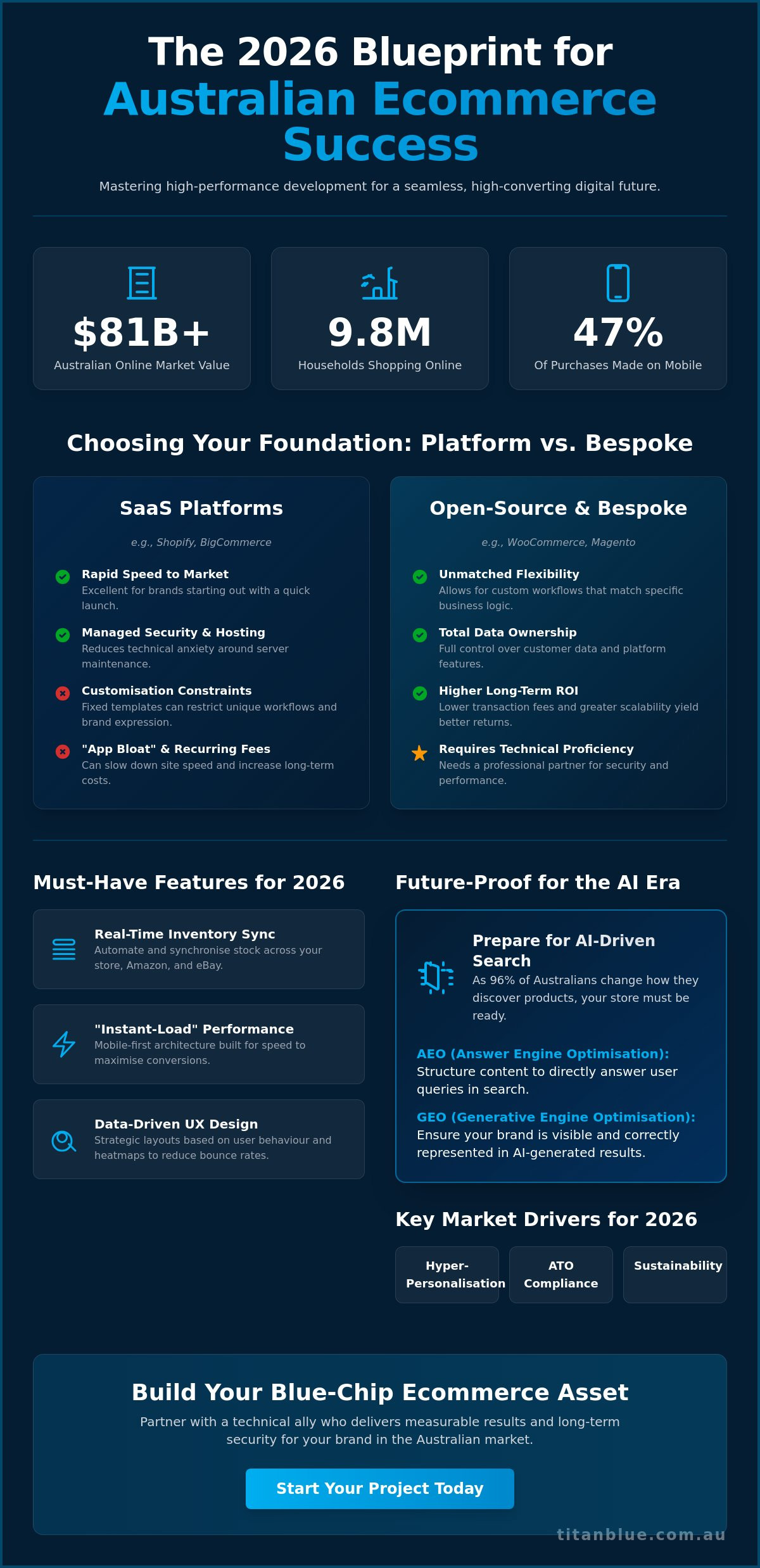
- Understand why mobile-first architecture and “instant-load” speeds are vital for capturing the 47% of Australian shoppers buying on smartphones.
- Learn to choose the ideal foundation for ecommerce website development australia by comparing the rapid speed of SaaS platforms with the bespoke flexibility of open-source systems.
- Discover how to synchronise stock across Amazon, eBay, and your own store using real-time inventory management solutions that automate your backend.
- Identify the critical technical proficiency and local support benchmarks you need to evaluate a development partner effectively.
- Future-proof your digital presence by preparing your store for the next era of search through Answer Engine Optimisation (AEO) and Generative Engine Optimisation (GEO).
The State of Ecommerce Website Development in Australia
In 2025, Australians spent $82.6 billion online, marking a 14% increase from the previous year. This surge has fundamentally changed the requirements for ecommerce website development australia. Modern online stores are no longer simple digital catalogues; they’re sophisticated engines of growth. Successful local brands are moving away from generic templates that offer limited flexibility and slow performance. Instead, they’re investing in bespoke, data-driven design to combat rising customer acquisition costs. By analysing user behaviour and heatmaps, we implement strategic layouts that significantly reduce bounce rates. This ensures your marketing spend translates into tangible revenue rather than wasted clicks.
High performance is non-negotiable for the modern consumer. With 47% of all online purchases in Australia now occurring on mobile devices, a mobile-first architecture is the baseline for success. Customers expect “instant-load” speeds. Even a one-second delay can lead to a measurable drop in conversions and brand trust. This technical rigor is central to the evolving landscape of E-commerce in Australia, where shoppers demand efficiency and reliability. Choosing a professional partner for ecommerce website development australia means looking beyond aesthetics to find a full-service technical ally who prioritises site speed and mobile responsiveness.
The Shift Toward Intelligent Digital Ecosystems
Your website shouldn’t exist in a vacuum. It must act as the central node of an integrated sales environment. As generative AI changes how 96% of Australians discover products, your store needs to be optimised for Answer Engine Optimisation (AEO) and Generative Engine Optimisation (GEO). We act as your Trusted Navigator, helping you integrate complex inventory systems and local payment gateways. This approach ensures your backend operations are as smooth as your frontend user experience, creating a stable foundation for long-term scale.
Key Market Drivers for 2026
Hyper-personalisation is the dominant trend for 2026. Australian consumers want deals and product recommendations tailored to their specific needs. Beyond marketing, regulatory compliance is critical. With new legislation requiring marketplace operators to report seller data to the Australian Taxation Office (ATO), your platform must be secure, transparent, and compliant. We also see sustainability becoming a core design pillar. Modern brands are choosing managed hosting and development processes that reflect their commitment to environmental responsibility, a value held by 9.8 million Australian households shopping online.
Platform vs. Bespoke: Choosing Your Ecommerce Foundation
Selecting the right architecture is the most critical decision in your digital journey. You need a foundation that supports current sales while allowing for the 8.2% projected annual growth in the local market through 2029. For many businesses, SaaS platforms like Shopify or BigCommerce offer a rapid path to market. These are excellent for brands starting out, but they often come with long-term customisation constraints. As your requirements grow, you might find yourself restricted by fixed templates and recurring subscription fees. Every additional plugin can lead to “app bloat,” which slows down your site and negatively impacts your search rankings.
Open-source solutions such as WooCommerce or Magento provide significantly more control. They allow for custom workflows that match your specific business logic and warehouse operations. However, they require a higher level of technical oversight to maintain security and performance. This is where a professional approach to ecommerce website development australia becomes essential. We help you weigh the Total Cost of Ownership (TCO) beyond just the initial build. While SaaS has lower upfront costs, the long-term investment in a bespoke system often yields a higher ROI through lower transaction fees and total data ownership. When calculating your budget, remember that business loan rates for secured finance in Australia currently start at 7.49% per annum, making a high-quality, scalable build a strategic capital investment.
Standard Platforms: Pros and Cons
Hosted environments offer security and speed, which alleviates significant technical anxiety for many owners. You don’t have to worry about server maintenance or core security patches. But you don’t own the underlying platform. Recent Australia eCommerce market analysis shows that as brands scale, the need for a unique brand identity often outstrips what a standard template can provide. If you rely solely on third-party apps, you risk performance degradation that can drive up your customer acquisition costs.
Bespoke Development: Why Strategy Matters
For businesses with complex product configurations or unique logistics, a bespoke headless architecture is often the superior choice. This separates the frontend display from the backend logic, allowing for unparalleled speed and flexibility. It’s a blue-chip solution that ensures your site remains agile in a fast-moving market. By integrating custom ecommerce development strategies, you ensure your store isn’t just another shopfront, but a high-performance asset. If you’re unsure which path fits your 2026 goals, we can help you map out a strategic digital roadmap tailored to your specific business needs.
Essential Features: Integrating Inventory Management Solutions
A high-converting storefront is only half the battle. If your digital shopfront isn’t perfectly synced with your warehouse, you risk overselling, shipping delays, and a damaged reputation. In the context of ecommerce website development australia, integrating real-time inventory management is a strategic necessity rather than an optional extra. When you sell across your own site, Amazon, and eBay, manual updates become impossible. You need an automated system that adjusts stock levels across every channel the moment a sale occurs. This synchronisation prevents the frustration of “out of stock” notifications appearing after a customer has already paid.
We focus on building robust API integrations that connect your storefront directly to your ERP and CRM systems. This creates a unified data stream that empowers you to make informed decisions. By automating stock alerts and purchase orders, you eliminate the risk of human error during peak seasons. According to The State of Ecommerce in Australia, efficiency in logistics and backend operations is a primary differentiator for successful local retailers. This technical synergy ensures your business remains agile as you scale, allowing you to manage complex logistics without increasing your administrative burden.
Streamlining Backend Operations
Centralising your data reduces manual entry and the inevitable errors that come with it. When your inventory management is baked into the development process, you gain a clear view of your performance reporting. This transparency is vital for maintaining customer trust. If a shopper sees that an item is “in stock,” they expect it to be ready for dispatch. Accurate data helps you manage these expectations, which is essential for long-term retention in a competitive market. It’s about building a reliable infrastructure that supports your brand promise.
Conversion-Focused Front-End Features
The backend logic must translate into a seamless experience for the user. We implement intelligent search and filtering tools that help customers find exactly what they need within large product catalogues. This reduces friction and keeps bounce rates low. We also prioritise local payment gateway optimisations, including integrations with CommBank, Afterpay, and Zip. Dynamic pricing models can also be integrated, allowing you to remain competitive as market conditions shift. These features don’t just look good; they’re functional tools designed to drive measurable results and secure your position as a market leader.
Evaluating Your Development Partner: A Buying Checklist
Choosing a partner for ecommerce website development australia isn’t just about finding a team that can build a pretty site. You need a navigator who understands the local regulatory environment, including the 10% GST application and the A$75,000 registration threshold for cross-border businesses. A local agency ensures that your shipping integrations with providers like Australia Post or StarTrack are seamless and that your payment gateways are optimised for Australian banks. Local support means you’re never waiting for a different time zone to respond when a technical issue arises. This proximity fosters a sense of shared goals and security, which is essential for a long-term partnership.
When evaluating ecommerce website development australia providers, technical proficiency must go deeper than a visual portfolio. Ask to see performance benchmarks and case studies where they’ve solved complex business logic. You should also understand their pricing structure. Fixed-price models provide budget certainty, which is helpful for businesses managing cash flow in an environment where the average business loan interest rate is approximately 17.20% per annum. Hourly models offer flexibility for evolving projects but can lead to budget creep. Regardless of the model, ensure that post-launch support, including managed hosting and regular maintenance, is part of the agreement to protect your digital investment.
The Discovery and Strategy Phase
A professional digital strategy workshop is non-negotiable for success. This phase defines measurable KPIs before any coding begins, ensuring the project aligns with your growth objectives. It’s about ensuring your partner understands the Australian consumer psyche, where 96% of shoppers expect a friction-free experience. We focus on your specific journey, empowering your brand to meet these high expectations through a collaborative partnership. This structured methodology moves you from curiosity to trust, building confidence in the project’s long-term potential.
Technical Due Diligence
Don’t skip the technical details that impact your bottom line. Review code quality, site speed, and SEO readiness from the start to avoid expensive fixes later. Verify that the site is mobile-responsive, as 47% of AU online purchases happen on smartphones. Ask about security protocols and daily backup procedures to ensure your data remains secure and compliant with local privacy laws. If you’re ready to build a high-performance store with a partner that values measurable results over empty promises, book a strategy session with Titan Blue to start your journey.
Future-Proofing: AEO, GEO, and Strategic Digital Excellence
By 2026, the traditional search landscape has evolved into an ecosystem driven by artificial intelligence. Simply ranking on page one of Google is no longer the sole metric of success. Your ecommerce website development australia must now account for how AI models parse and recommend your products. This requires a sophisticated implementation of structured data, or Schema, which acts as a technical translator between your shopfront and generative engines. Without this technical layer, your brand risks becoming invisible to the next generation of shoppers who rely on AI assistants to find the best deals and discounts.
We believe in Digital Excellence, a philosophy that views your online store as a living asset rather than a static project. As the Australian market is projected to grow at a compound annual rate of 8.2% through 2029, your infrastructure must remain agile. This means moving beyond standard SEO to embrace a proactive strategy that secures your visibility across all digital touchpoints. Our role as your Trusted Navigator is to ensure your technical foundation is robust enough to handle these shifts, providing the security and stability your business needs to thrive in a high-speed environment.
Optimising for AI-Driven Search
Content must now be structured to answer direct consumer queries with precision. It’s about understanding the intent behind the search. By leveraging generative engine optimisation, we ensure your brand mentions and product attributes are clearly understood by AI crawlers. This is particularly vital for the future of voice search in Australian ecommerce, where 96% of shoppers demand immediate and accurate answers. We help you build a store that doesn’t just wait to be found but actively participates in the AI-driven discovery process.
The Long-Term Growth Partnership
A “set and forget” mentality is the fastest way to lose market share. Success in ecommerce website development australia requires continuous optimisation based on real-time performance data. We integrate PPC management to drive immediate traffic while your organic visibility builds through our strategic AEO and GEO efforts. This balanced approach empowers your brand to achieve measurable results while building a legacy through bespoke brand identity design. We’re here to walk this path with you, ensuring every digital decision serves your long-term vision for growth and excellence.
Secure Your Digital Legacy
Building a high-performance store in 2026 requires more than a standard template; it needs a strategic foundation that scales with the 8.2% annual growth projected for the local market through 2029. Success hinges on bridging the gap between a seamless frontend experience and automated backend efficiency. Mastering ecommerce website development australia means choosing a partner who understands local regulatory requirements while preparing your brand for the shift toward AI-driven product discovery. You’ve learned how bespoke architecture and integrated inventory management protect your margins and build customer trust.
Titan Blue brings over 20 years of digital experience to your partnership, acting as a steady hand in a fast-moving landscape. We are specialists in AEO and GEO strategy, ensuring your products remain visible as search engines evolve into generative answer engines. Our comprehensive managed hosting and security solutions provide the stability you need to scale with confidence. Empower your brand with a bespoke ecommerce solution from Titan Blue Australia. We’re ready to help you navigate this complexity and transform your online presence into a blue-chip asset. Your journey toward digital excellence starts with a single strategic step.
Frequently Asked Questions
What is the average cost of ecommerce website development in Australia?
Cost varies based on complexity, but a professional build factors in bespoke design, technical integrations, and compliance with the 10% GST. While basic setups start at lower tiers, a strategic solution designed for 2026 scalability requires an investment in backend automation and custom workflows. This ensures your store isn’t just a digital catalogue but a high-performance asset that delivers a measurable return on investment.
How long does it take to build a custom ecommerce store?
A custom ecommerce project usually takes between 12 and 18 weeks from the initial strategy phase to the final launch. This timeline accounts for the discovery workshop, bespoke design, technical development, and rigorous testing for mobile responsiveness. We prioritise a structured methodology to ensure every feature, from local payment gateways to inventory sync, functions perfectly before your site goes live to the 9.8 million Australian households shopping online.
Which platform is best for Australian small businesses?
The best platform depends on your specific business logic and growth goals. For rapid deployment, Shopify and BigCommerce are popular choices for brands making up the 24% of total retail spending online. However, WooCommerce offers superior customisation for brands requiring bespoke workflows. We help you choose a foundation for ecommerce website development australia that balances ease of use with the long-term flexibility needed to scale your brand identity.
Do I need a separate inventory management system for my online store?
You don’t necessarily need a separate system if your platform is built with integrated inventory management from the start. We specialise in connecting your storefront directly to ERP and CRM systems via robust API integrations. This centralises your data across Amazon, eBay, and your own store. It prevents the recent 14% increase in online spending from overwhelming your manual operations, ensuring stock accuracy remains high.
How do I ensure my ecommerce site is secure for Australian shoppers?
Security requires a multi-layered approach including SSL certificates, PCI-DSS compliance, and adherence to Australian privacy regulations. Since 96% of Australians shop online, maintaining their trust is paramount. We implement daily backup procedures and advanced security protocols to protect sensitive customer data. This provides the reliability and stability your customers expect when they commit to a purchase on your platform.
What is the difference between AEO and traditional SEO for ecommerce?
Traditional SEO focuses on ranking for specific keywords in search results, while Answer Engine Optimisation (AEO) structures content to provide direct answers for AI assistants and voice search. AEO is critical for the 2026 landscape where generative AI influences product discovery. We combine both strategies to ensure your brand appears in traditional lists and as the primary recommendation in conversational search queries.
Can I migrate my existing store to a new platform without losing SEO rankings?
Yes, you can migrate platforms without losing your search rankings by following a strict technical SEO protocol. This involves mapping every old URL to its new equivalent using 301 redirects and ensuring your metadata remains consistent. Our role as your Trusted Navigator is to manage this transition seamlessly. We protect your existing authority while upgrading your infrastructure for better performance and future growth.
How often should I update or maintain my ecommerce website?
You should perform technical maintenance at least once a month to ensure security patches and plugin updates are current. However, performance monitoring should be a daily priority. In a fast-moving market where mobile devices account for 47% of purchases, regular optimisations prevent site speed degradation. Continuous improvement beats a “set and forget” approach, keeping your store agile and competitive in the ecommerce website development australia sector.
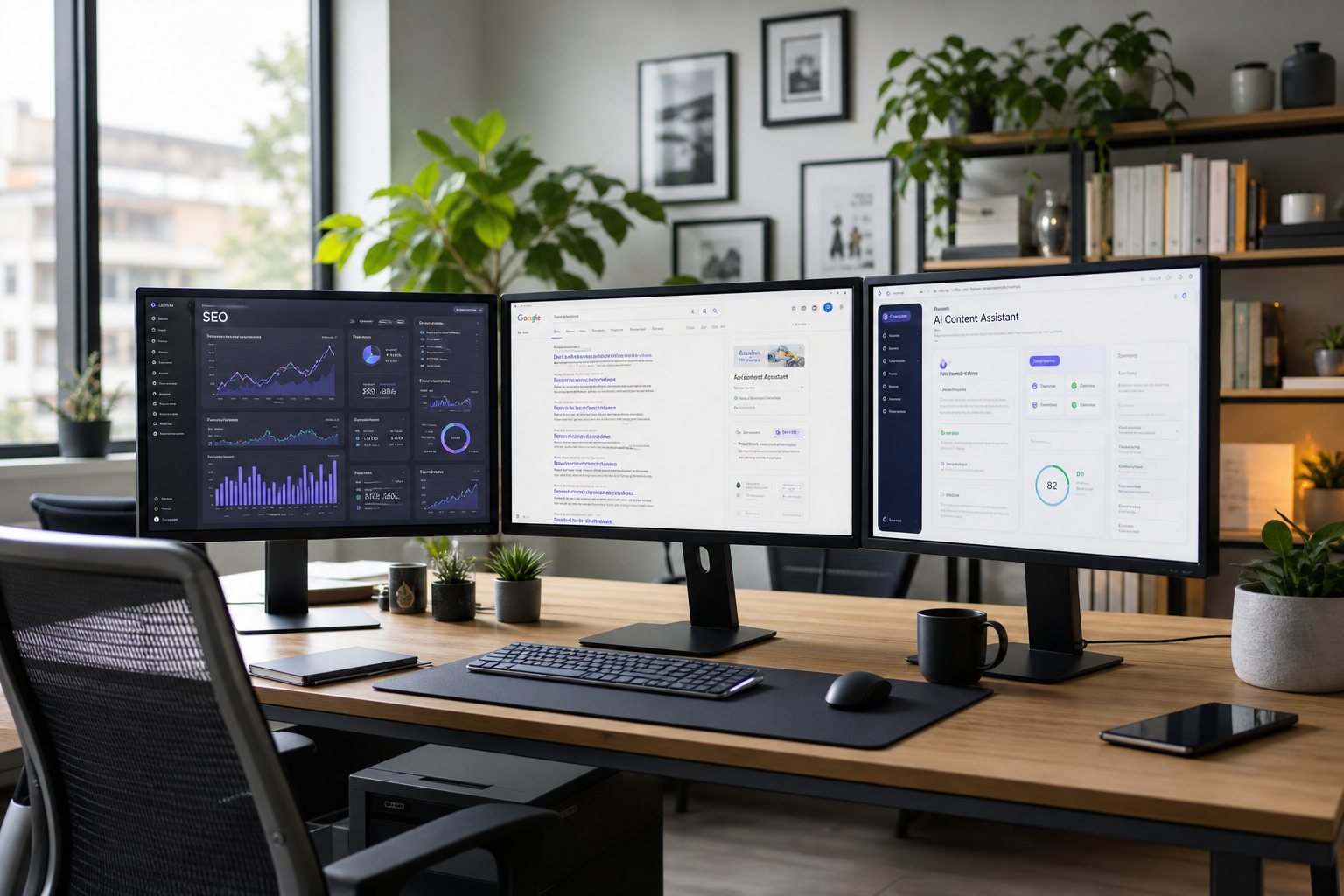
SEO vs AEO vs GEO: What’s the Difference and Which Does Your Australian Business Need?
SEO, AEO, and GEO are three distinct but complementary disciplines. This guide explains each one,…

The Complete AI SEO Glossary: Every Term Australian Businesses Need to Know in 2026
Plain-English definitions of every AI SEO, AEO, and GEO term — from RAG and entity…
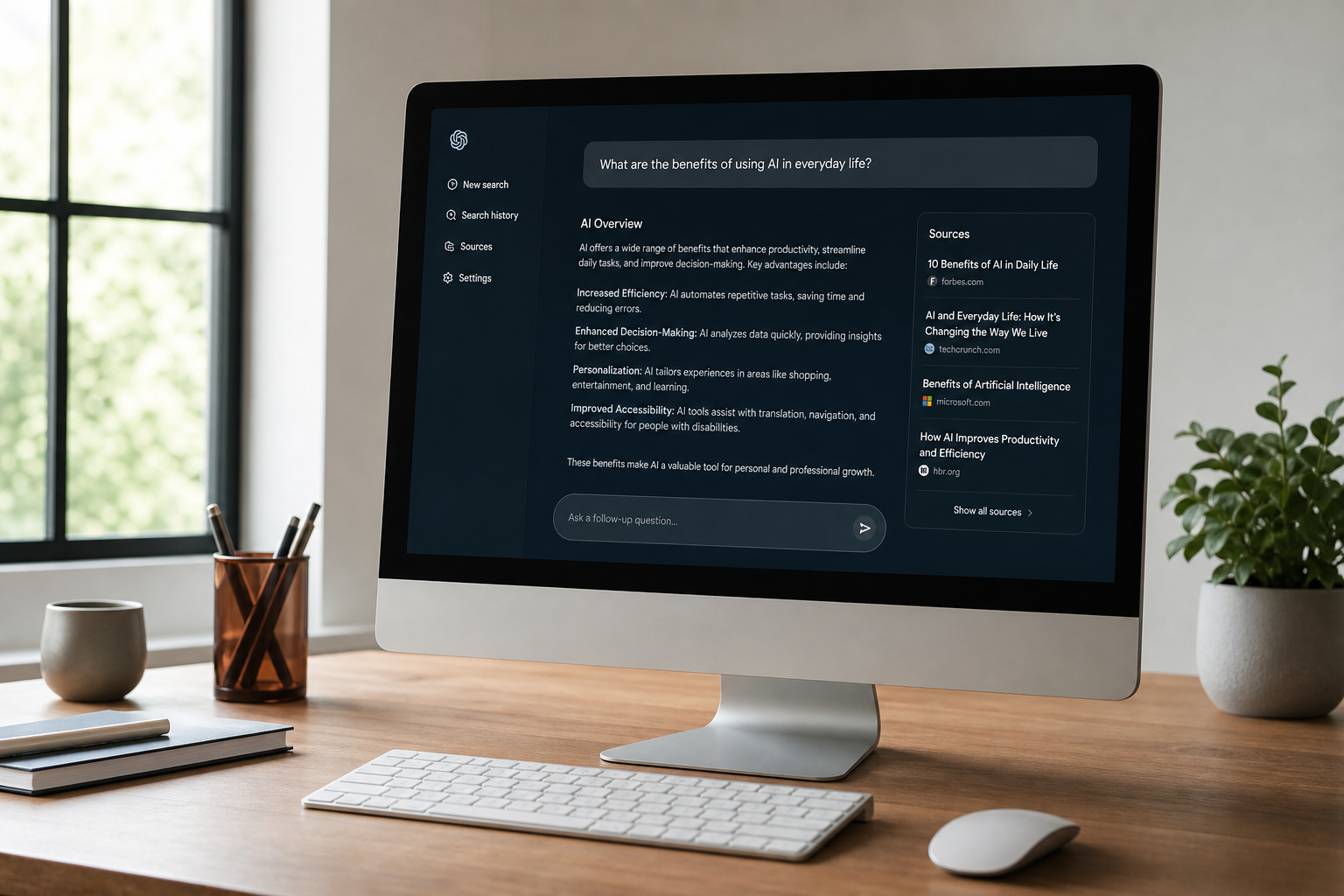
How AI Search Engines Work: The 5-Stage Pipeline Behind ChatGPT, Perplexity, and Google AI Overviews
AI search engines use a five-stage pipeline — fan-out, retrieval, passage scoring, LLM synthesis, and…