


TL;DR:
- Effective SEO for Australian SMEs involves layered strategies targeting technical performance, content relevance, off-site authority, and local visibility to generate consistent enquiries. Search engines discover, understand, and rank your site through crawling, indexing, and ranking processes, which require ongoing optimization. Future SEO success depends on building trust, producing valuable content, earning backlinks, and adapting to AI-driven discovery methods.
Most business owners assume search engine optimisation is simply about showing up at the top of Google. That assumption costs them time, money, and customers. Effective SEO is a layered strategy covering technical performance, content relevance, off-site authority, and local visibility. For Australian small to medium enterprises, getting this right can mean the difference between a website that quietly collects dust and one that consistently delivers enquiries. This guide walks through each layer clearly, so you understand exactly what to focus on and why.
Table of Contents
- What is search engine optimisation and why does it matter?
- How search engines interpret your site: Crawl, index, and rank explained
- The three pillars of effective SEO: Technical, on-page, and off-page
- Local SEO: Reaching more nearby customers online
- Measuring SEO success: Analytics beyond rankings
- A fresh perspective: Why the future of SEO means adapting, not just optimising
- Ready to boost your online presence?
- Frequently asked questions
Key Takeaways
| Point | Details |
|---|---|
| SEO is multi-faceted | Effective SEO involves technical, on-page, off-page, and local strategies working together. |
| Local SEO drives real leads | Businesses that optimise local signals can significantly increase foot traffic and online enquiries. |
| Measure beyond rankings | True SEO success is tracked by conversions, organic traffic, and site health rather than position alone. |
| Stay adaptable | Ongoing changes in search and AI mean businesses should view SEO as a long-term, evolving investment. |
What is search engine optimisation and why does it matter?
Search engine optimisation is not a single task. It is an ongoing process that shapes how easily potential customers can find your business online. As the HubSpot SEO Guide explains, “SEO is the process of improving a website so it appears higher in search engine results for relevant topics, with the goal of increasing visibility in organic (non-paid) search.”
That definition matters. The phrase organic search is key. Organic visibility is earned, not purchased. Unlike paid ads that stop the moment your budget runs out, SEO compounds over time and continues delivering results with ongoing effort.
Why does this matter so much for your business? Because your potential customers are searching for what you sell right now. SEO places you directly in front of them at exactly that moment of intent. That kind of timing is what turns a visitor into a paying customer.
Here is what strong SEO for small businesses actually delivers in practical terms:
- Increased website traffic without paying per click
- Greater credibility, because people trust organic results more than ads
- More qualified leads, because visitors are already searching for your service
- Better return on investment compared to many paid channels over the long term
- A stronger local presence, helping you compete with larger brands in your area
Think about it this way. When someone in Brisbane searches “electrician near me” at 7pm on a Tuesday, they need help now. If your site appears in those results, you get the call. If it does not, your competitor does.
How search engines interpret your site: Crawl, index, and rank explained
Understanding what SEO is opens up another vital question: how do search engines actually work with your website’s information?
Before a search engine can recommend your site, it needs to find it, understand it, and decide where it sits relative to millions of other pages. This happens in three stages. As outlined in the SEORAF Beginner SEO Guide, “effective SEO relies on three core stages: crawling (discovery), indexing (understanding/storing content), and ranking (deciding which indexed results best satisfy a query).”

Here is how each stage works in practice:
| Stage | What happens | What you can do | Business benefit |
|---|---|---|---|
| Crawling | Search engine bots scan your site and follow its links | Create a sitemap, fix broken links | Your pages get discovered faster |
| Indexing | Content is stored and categorised in the search engine’s database | Write clear, structured content; avoid duplicate pages | Your business appears for relevant searches |
| Ranking | The algorithm decides which pages best match a search query | Build authority, improve relevance, earn backlinks | Higher positions mean more clicks and enquiries |
Here is a simple numbered walkthrough of how a new page on your site earns visibility:
- You publish a new service page on your website.
- A search engine bot follows links and discovers your new page.
- The bot reads the content, structure, and any supporting data.
- The page is stored in the index alongside millions of other pages.
- When someone searches a related term, the algorithm compares your page against others.
- Based on relevance, authority, and technical quality, your page is assigned a position.
- That position shifts over time as competitors change and your site evolves.
Following solid local SEO growth tips alongside a thorough guide to SEO for small business helps you take action at every stage, not just ranking.
The three pillars of effective SEO: Technical, on-page, and off-page
With a clear picture of how search engines process your website, it is time to examine what you can control: the three pillars of SEO.
According to the Semrush Technical SEO Guide, “SEO is typically operationalised as three complementary pillars: technical SEO (making content crawlable/indexable and performant), on-page SEO (optimising page content/structure for relevance), and off-page SEO (improving authority via signals outside the site, such as backlinks).”
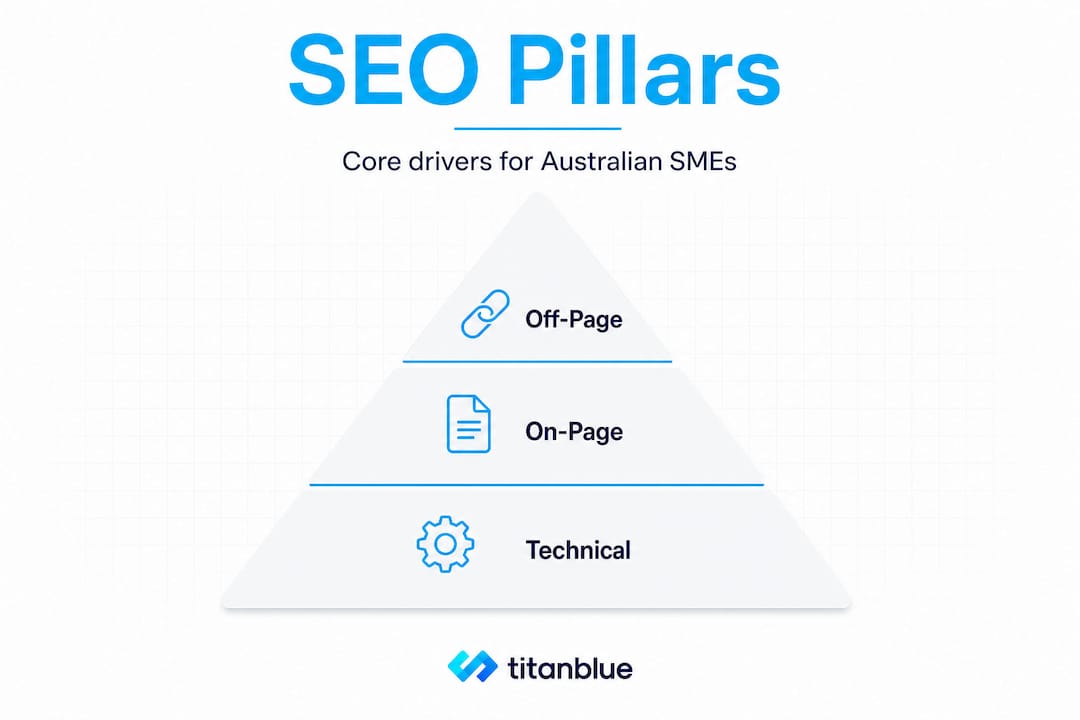
Breaking these down for a practical SME context matters enormously.
Technical SEO covers everything under the surface of your site. Most business owners do not see these issues, but search engines do. Common technical problems include:
- Slow page load times on mobile devices
- Missing or incorrect meta titles and descriptions
- Broken internal links that confuse bots
- Poor mobile responsiveness
- Pages accidentally blocked from being crawled
- Duplicate content across multiple URLs
On-page SEO is about the content on each page. This means writing clearly for your target audience, using relevant terms naturally, structuring pages with proper headings, and including accurate meta descriptions. Every page should have a clear purpose and answer a specific question your customer is asking.
Off-page SEO is about what the rest of the internet says about you. Backlinks from credible sites signal to search engines that your business is trustworthy and authoritative. Local business citations, reviews, and mentions in industry directories all count here too.
| Pillar | Example SME tactics | Typical outcome |
|---|---|---|
| Technical | Improve page speed, fix mobile display, set up sitemap | Better crawlability, fewer ranking penalties |
| On-page | Write keyword-relevant service pages, optimise headings | Higher relevance scores, more organic traffic |
| Off-page | Earn local backlinks, manage reviews, list in directories | Improved authority, stronger local rankings |
Your SEO marketing guide can help you match each tactic to your current stage of growth and available resources.
Pro Tip: If you are just starting out, prioritise technical SEO first. A fast, mobile-friendly, error-free site is the foundation everything else depends on. Content and backlinks deliver far less impact if the technical base is broken.
Local SEO: Reaching more nearby customers online
Of all the ways to focus your SEO efforts, local SEO is a game changer for many SMEs. Targeting nearby clients works differently to broader national SEO and often delivers faster, more tangible results.
Google’s local search results, particularly the Local Pack (the map results showing three businesses at the top of a search page), are governed by three core signals. As noted by SpotlightLocal, for SMEs “a practical definition of SEO should include local visibility where relevant, because local intent drives discovery.” Those three signals are relevance, distance, and prominence.
- Relevance: How well your Google Business Profile matches what someone is searching for
- Distance: How close your business location is to the searcher
- Prominence: How well known and trusted your business appears online, based on reviews, backlinks, and overall visibility
Understanding the importance of local SEO is the first step. Here is a practical checklist for getting your local presence in order:
- Claim and fully complete your Google Business Profile
- Choose accurate business categories that reflect what you actually do
- Add your correct address, phone number, and trading hours
- Upload genuine photos of your business, team, and work
- Actively request reviews from satisfied customers
- Respond professionally to every review, positive or negative
- Ensure your business name, address, and phone number are consistent across all directories
Boosting local search visibility also means building local relevance into your website content. Mention your suburb, city, and region naturally within your service pages. Use location-specific headings where they make sense.
Mobile search behaviour makes local SEO even more important. Studies show that a significant majority of local mobile searches result in a visit or purchase within 24 hours. That is a direct link between local SEO effort and revenue.
Pro Tip: Review management is one of the highest return activities in local SEO. A consistent flow of genuine, positive reviews signals both to Google and to potential customers that your business is active, credible, and worth contacting.
Measuring SEO success: Analytics beyond rankings
Maximising the impact of your local and overall SEO means knowing what is working. Too many business owners check their keyword rankings and stop there. Rankings are just one data point.
As outlined by Semrush SEO Analytics, “SEO analytics is not just rank tracking; it is the ongoing tracking of search performance KPIs and translating them into decisions (e.g., using metrics like organic conversions and site health).”
The metrics that matter most for SMEs are:
- Organic traffic: How many visitors arrive via search each week or month
- Conversion rate: What percentage of those visitors take an action (call, form submission, purchase)
- Bounce rate: Are visitors staying to read your content, or leaving immediately
- Page speed and Core Web Vitals: Technical health indicators that affect both rankings and user experience
- Local pack appearances: How often your business shows in map results
- Click-through rate: What percentage of people who see your listing actually click it
Here are the numbered steps to set up basic SEO tracking for your business:
- Install Google Analytics 4 (GA4) on your website if you have not already.
- Link Google Search Console to your site and verify ownership.
- Set up conversion goals in GA4, such as form completions or phone link clicks.
- Review your top landing pages weekly to see what is driving organic visits.
- Check Search Console monthly for errors, indexing issues, and keyword performance.
- Track your local visibility by searching your own business terms from different devices.
Investing in local SEO pays off more when you can see exactly which efforts are producing enquiries and which need adjustment.
Pro Tip: Monitor your site’s technical health at least monthly. Silent issues like crawl errors, slow load times, or pages suddenly removed from the index can quietly damage your visibility without any obvious warning.
A fresh perspective: Why the future of SEO means adapting, not just optimising
After covering measurement, it is worth looking ahead to where SEO for SMEs is truly heading.
The landscape is shifting. Fast. Standard keyword rankings still matter, but they are no longer the whole story. Artificial intelligence is changing how users discover information. Tools like AI-powered search experiences now answer questions directly, often without the user clicking through to any website at all.
This is not a reason to panic. It is a reason to think differently. According to ROI.com.au’s guide to AEO in Australia, “some agencies argue SEO must increasingly be integrated with AI/answer ecosystems, often discussed under terms like AEO/GEO (Answer Engine Optimisation and Generative Engine Optimisation), because visibility may shift from ‘rank and click’ to being cited or selected in AI-generated responses.”
What does this mean for a small business in Gold Coast or anywhere else in Australia? It means your reputation, trustworthiness, and consistent online presence are becoming more valuable than ever. Being cited by AI tools requires the same foundation as traditional SEO: accurate information, genuine expertise, and a credible brand.
Our view is this. Do not chase every algorithm tweak. Focus on building a business that genuinely deserves to rank. That means producing helpful, relevant content. It means earning reviews and backlinks from real relationships. It means keeping your technical house in order.
The business owners who succeed with SEO marketing for small business over the next five years will be those who treat SEO as part of a broader digital reputation strategy, not a box to tick. AI and local signals are reshaping discovery. The businesses that are cited, trusted, and visible across multiple channels will win.
Ready to boost your online presence?
You now have a solid understanding of what SEO involves, how search engines process your site, and how to measure real results. The next step is applying it. That is where having the right support makes a genuine difference.
At Titan Blue, we offer tailored Titan Blue SEO services designed specifically for Australian small and medium businesses. Whether you need an SEO web page design that ranks and converts, or a full SEO marketing for small businesses strategy built around your goals, our Gold Coast team is ready to help. We focus on results you can see and measure. Get in touch with us today to start building visibility that lasts.
Frequently asked questions
Is SEO really necessary for small businesses in Australia?
Yes, SEO increases your site’s visibility and helps attract local customers who are more likely to convert. As local intent drives discovery, small businesses without an SEO presence miss a significant volume of ready-to-buy local searches.
How is local SEO different from regular SEO?
Local SEO focuses on attracting customers near your business and optimising for Google Business Profile and location-based searches. Google’s local results are based on relevance, distance, and prominence combined, making it a distinct strategy from broader national search optimisation.
What is the most important first step for improving my site’s SEO?
Start by ensuring your site is technically sound, loads quickly, and is mobile friendly before optimising content and claiming your Google Business Profile. Technical SEO means making your content crawlable, indexable, and performant, which underpins all other optimisation efforts.
Can I measure SEO success without tracking keyword rankings?
Yes, measure success by tracking organic website traffic, conversions, and business key performance indicators, not just rankings. SEO analytics is the ongoing tracking of search performance KPIs and translating them into actionable decisions for your business.
How is SEO changing with new technologies like AI?
SEO now includes strategies for being referenced by AI answer engines and building overall online authority, not solely focusing on ranking. Some agencies argue SEO must be integrated with AI/answer ecosystems to ensure your business is cited in AI-generated responses rather than simply ranked in traditional results.
Recommended
- Effective SEO for Small Business Australia | Boost Your Online Presence – Titan Blue Australia
- What SEO means for small business success in Australia
- Top SEO Services for Small Businesses in Australia – Titan Blue Australia
- Search engine optimisation explained for Australian businesses
Make Titan Blue a preferred source in Google
One click tells Google to surface our articles more often in Top Stories, AI Overviews and AI Mode.

AEO Website Design Checklist 2026: The Complete Build Guide
A practical AEO website design checklist for 2026 covering crawlability, schema markup, content structure, Core…

How to Make Your Website AI Friendly: The 2026 Step-by-Step Guide
How to make your website AI friendly: a step-by-step 2026 guide to getting crawled, structured…

Web Design for AI Search Optimisation: The 2026 Build Guide
Web design for AI search optimisation: crawlable HTML, clear architecture, accessible UX and trustworthy content…