


Last updated:
You're probably seeing it already.
Your rankings look fine. Your site still shows up in Google. Your reviews are decent. But enquiries feel softer, website traffic isn't doing what it used to, and customers are arriving with shorter decision cycles because they've already asked ChatGPT, Google's AI Overview, Gemini, or Perplexity who to call.
That shift is why so many solid local businesses feel like they're disappearing in plain sight. A plumber in Broadbeach, a restaurant in Burleigh, a solar installer in Southport. They're still online, but they're no longer being surfaced where people are making shortlist decisions.
AI search has changed the game from “can your page rank?” to “does the machine trust your brand enough to mention it?” That's a different problem. It needs a different fix.
Why Your Business is Becoming Invisible Online
A lot of local owners describe the same pattern. They've spent years building up their website, polishing service pages, asking for reviews, and keeping SEO moving. Then the phone starts to wobble. Not collapse. Just enough to notice.
What changed is where discovery happens.
In Australia, AI Overviews can reduce traditional website click-throughs by up to 50%, and the same Australian analysis found median year-on-year AI-referred sessions surged by +1,200% by September 2025 according to the ITBrief report on AI-driven brand visibility. If your business isn't appearing inside those AI answers, you're missing the stage before the click even happens.
That's why a business can still “rank” and still lose ground.
A customer doesn't always type “plumber Gold Coast” into Google and compare ten blue links anymore. They ask, “Who's the best plumber near me for a burst pipe?” or “What's a good date night restaurant in Broadbeach?” AI tools then summarise, recommend, and narrow options before your website gets a chance.
Practical rule: If AI doesn't mention you, many searchers won't investigate you.
For trades and hospitality businesses, that's brutal because so much buying intent is local and immediate. People want a trusted answer, not a research project. AI search behaves more like word-of-mouth at scale. It pulls from your website, your reviews, your directory details, your service pages, and every other public signal it can stitch together.
If those signals are inconsistent, thin, or generic, you fade out.
That is why an AI visibility audit matters now. It is not a trendy extra. It is a reality check on whether your business is being seen in the places customers increasingly rely on.
Understanding AI Brand Visibility Services
Traditional SEO was mainly about helping a page rank for a query. AI visibility is broader. It's about helping your business become the answer.
Think of old-school SEO like getting listed in the phone book. Useful, but passive. AI brand visibility services Australia are closer to briefing the city's most informed concierge so they recommend your business when someone asks for help.
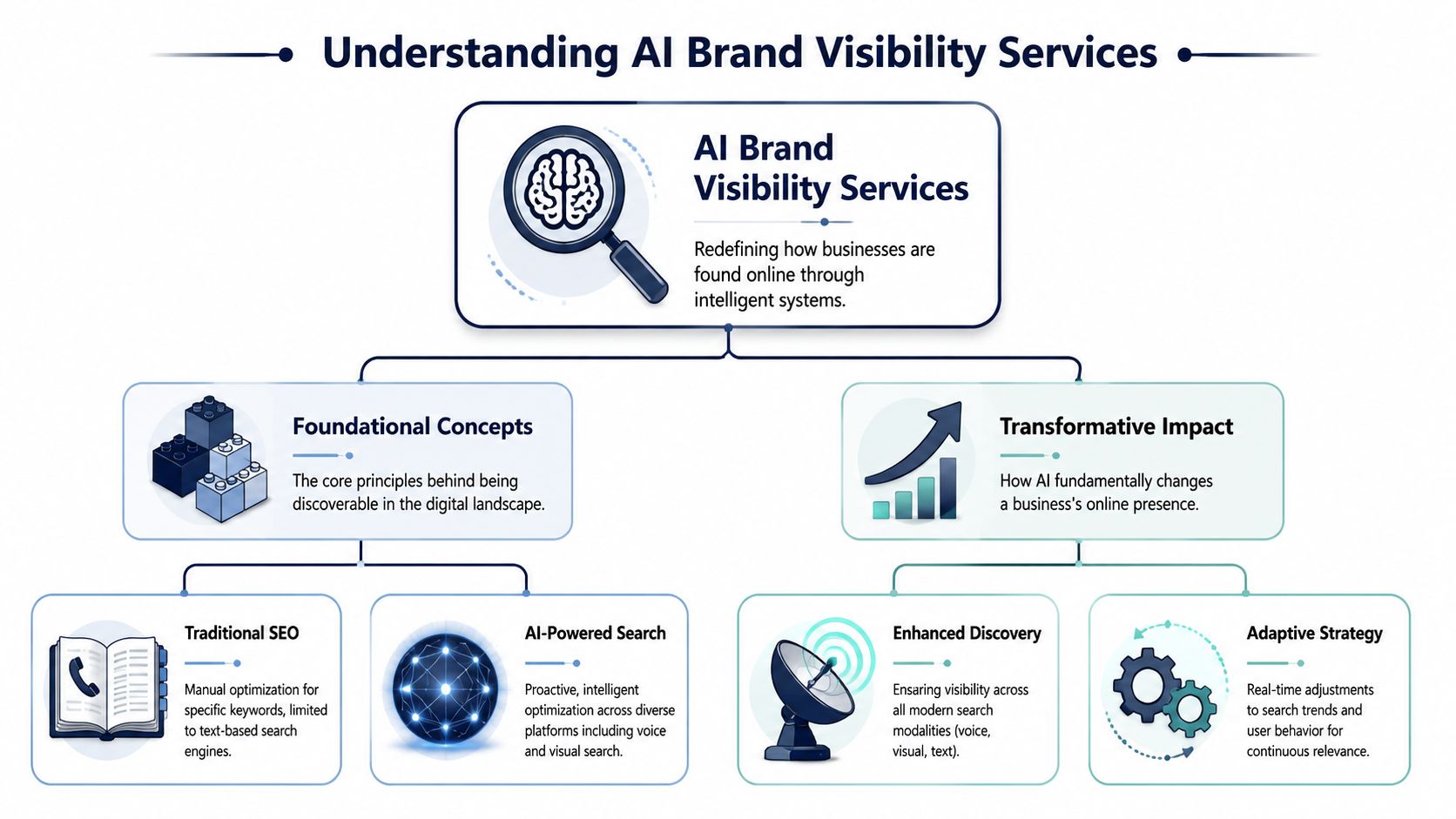
What AI is actually looking at
AI systems don't judge your business from one page alone. They build a view from multiple sources, including:
- Your core website content. Service pages, location pages, FAQs, contact details, and proof points.
- Business identity signals. Your business name, address, phone details, categories, and structured data.
- Third-party validation. Reviews, directory listings, mentions, articles, and references elsewhere online.
- Topical clarity. Whether your site clearly explains what you do, where you do it, and who you help.
That's why a business with a good homepage can still be invisible in AI. The machine isn't only asking, “Is this page relevant?” It's asking, “Is this brand credible, specific, and easy to retrieve across the web?”
What these services do in practice
A proper AI visibility service usually sits between technical SEO, content strategy, local optimisation, and brand governance.
It often includes work such as:
- Entity clean-up. Making sure your business details are consistent and machine-readable.
- Content restructuring. Rewriting vague service pages so they answer real customer questions directly.
- Local relevance improvements. Tying services to actual suburbs, service areas, and use cases.
- Mention tracking. Monitoring whether AI platforms cite, name, or ignore your brand.
Semrush's AI Visibility reporting is built around this idea. It tracks brand mentions across platforms such as ChatGPT, Google AI Overviews, and Gemini, helping teams see where their brand appears and where it doesn't, as described in this overview of AI search strategy.
AI visibility isn't a replacement for SEO. It's what SEO needs to become when search engines start answering instead of only ranking.
What it is not
It's not stuffing “best plumber Gold Coast” into every paragraph.
It's not publishing dozens of thin blog posts written for robots.
It's not chasing one platform while ignoring your reviews, listings, and local signals.
AI brand visibility works when your business is easy to understand, easy to verify, and easy to cite.
The Four Pillars of a Strong AI Presence
Most business owners hear “AI optimisation” and imagine some mysterious technical service. In practice, the work breaks into a few clear parts.

AI search optimisation
This is the layer that helps your business appear in AI-generated search summaries, especially for local and service-led queries.
The practical work often includes improving service-page depth, tightening location relevance, fixing business details, and adding schema. That last part matters. Implementing JSON-LD schema markup for entities like “Plumber” or “SolarPanelInstaller” boosts retrieval likelihood in AI, and Semrush benchmark data cited by BeKonstructive shows that 70-80% of unoptimised Australian brands have zero AI mentions despite strong traditional rankings in this analysis of Semrush AI search data and visibility.
For a local electrician, that means AI can more easily connect “emergency switchboard repairs”, “Gold Coast”, and your business identity into one coherent answer.
LLM optimisation
Search optimisation helps with AI summaries inside search engines. LLM optimisation focuses on tools like ChatGPT, Gemini, Claude, and Perplexity.
These platforms often pull from a spread of sources and form an entity-based view of your business. They're less obsessed with one page ranking first and more interested in whether your business is consistently associated with the right topics.
A restaurant, for example, needs more than a menu page. It needs clear signals around cuisine, suburb, booking experience, occasions, reviews, and authority. If an AI tool is asked for “the best quiet date night restaurant near Broadbeach”, it's piecing together that recommendation from many fragments.
AI-ready content creation
Most businesses get lazy at this stage.
They publish pages that say things like “quality service”, “trusted team”, and “customer-focused solutions”. AI systems can't do much with fluff. They need clear answers.
Useful AI-ready content tends to include:
- Direct service explanations. What you do, who it's for, and when someone should contact you.
- Question-based sections. Real customer questions written in plain language.
- Local specificity. Service areas, suburbs, and job types, not generic statewide wording.
- Proof signals. Qualifications, certifications, awards, reviews, and concrete process detail.
If you're distributing updates or announcements, it also helps to understand optimizing press releases for search. That's one of the cleaner ways to create additional structured references around your brand without resorting to spam.
The best AI content doesn't sound clever. It sounds clear.
Measurement and AI mention tracking
If you can't see where you're being mentioned, you can't improve it.
This pillar covers monitoring prompts, citations, brand mentions, and the kinds of questions that trigger your competitors instead of you. It's also where sentiment matters. A mention isn't automatically a good mention.
At this level, businesses often use platform reporting, prompt testing, and specialist services such as answer engine optimisation to connect the dots between visibility, citations, and commercial intent.
What doesn't work is guessing. What works is seeing where the model already associates your brand with the right topics, then strengthening those associations.
Tangible Benefits for Your Australian Business
Most owners don't care about AI terminology. Fair enough. The central question is whether this work brings in better enquiries, more bookings, and stronger trust.
For local businesses, it usually does that in a very specific way. It shortens the gap between discovery and decision.

Better local lead quality
A weak lead often starts with broad browsing. A strong lead starts with a recommendation.
That's what AI visibility changes. If a customer asks for “a solar installer who can explain rebates clearly” or “a plumber near me who handles emergency hot water issues”, and your business is surfaced in that answer, the lead arrives warmer. They're not starting from zero. They're already halfway convinced.
Local service businesses do not require infinite traffic. They need high-quality leads.
A 2025 Sensis Social Media Report indicated that 68% of Australian SMBs in trades and hospitality depend on AI-driven searches for 40% of their leads, yet only 22% have implemented AI visibility audits, creating a gap for businesses that move early, as noted by Intesols on AI SEO for Australian businesses.
More authority before the first click
Good AI visibility makes your business feel known before the customer even lands on your site.
That's powerful for restaurants, builders, electricians, roofers, and hospitality operators because trust is often built before contact. If an AI tool mentions your business in the same breath as the right service categories, suburbs, and strengths, you've gained borrowed authority.
Here's the practical effect:
- Restaurants get considered earlier for occasion-based searches like date night, family dinner, or waterfront dining.
- Trades get shorter sales cycles because customers ask for a provider, not just a quote.
- Construction and solar firms get better-fit enquiries from people searching for specific project types, not vague browsing.
Stronger visibility across fragmented platforms
Customers don't use one platform anymore. They bounce between Google, maps, AI chat tools, review sites, and social content. A business that only optimises for traditional rankings leaves too much to chance.
That's why AI brand visibility is as much about consistency as it is about search. Your name, services, reviews, Q&A content, and off-site mentions all need to support the same story.
If you want a feel for how one AI-specific channel fits into that broader picture, this overview of Perplexity optimisation services shows how visibility can be shaped on platforms people increasingly use for recommendation-style searches.
A short explainer helps here:
Protection against becoming generic
The businesses losing ground in AI search usually share one trait. They sound interchangeable online.
If your site says the same things every other local operator says, AI tools have no strong reason to pull you into the answer. You need identifiable signals. Clear service descriptions. Specific locations. Real expertise. Trusted mentions.
If your online presence could belong to any plumber or restaurant in Queensland, AI will often treat it that way.
That's the upside of doing this properly. You stop looking like a category entry and start looking like a recommendation.
How Local Businesses Are Winning with AI
The businesses doing well with AI visibility usually aren't the flashiest. They're the clearest.
Take a local plumbing business. Before optimisation, their website might have one generic services page, scattered suburb references, and old directory listings with slightly different contact details. AI tools see a blurry brand. After clean-up, the business has dedicated pages for blocked drains, hot water repairs, leak detection, and emergency work, each tied to local service areas and supported by FAQs, reviews, and consistent business details. That's the kind of setup AI can confidently retrieve.
A hospitality example
A restaurant has a different problem. It may have strong visuals and a nice menu, but AI still struggles to understand when to recommend it.
What changes that is specificity. Pages and supporting content that clearly describe dining style, booking occasions, dietary options, location context, nearby landmarks, and what makes the experience distinct. Once those signals are aligned, the business is more likely to appear when someone asks for a romantic dinner spot, a family-friendly lunch, or somewhere good before a show.
A construction or solar example
These businesses often have expertise, but they explain it poorly online.
They talk in company language instead of customer language. The AI-facing fix is usually not “more content” but better-structured content. Pages that answer common project questions, explain processes plainly, and connect qualifications, certifications, and service areas in one place are easier for AI systems to cite.
That's also where local intent matters. A broad “Queensland services” page is weak. Detailed suburb, region, and project-type relevance is stronger.
The winners in AI search aren't always bigger. They're easier to verify.
Why local context beats generic SEO pages
A lot of generic SEO content was built for volume. Local AI search rewards relevance.
If someone asks, “Who should I call for solar installation on the Gold Coast?” the answer is more likely to favour businesses with strong local identity, clear service definitions, and a credible footprint across the web. That's the core of why focused local work often outperforms broad, thin optimisation.
For businesses expanding beyond one suburb or city, location-led planning becomes even more important. A localised service approach such as AI brand visibility in Brisbane makes more sense than treating every market with the same template.
Choosing the Right AI Visibility Partner in Australia
A lot of agencies have added “AI” to their services. That doesn't mean they know how to make your business visible in AI search.
The easiest way to sort genuine operators from the buzzword merchants is to ask blunt questions.

Questions worth asking
Use these in your first meeting:
- How do you measure AI visibility? If they can't explain mention tracking, prompt testing, citation analysis, or platform differences, they're guessing.
- How do you handle factual accuracy? AI can repeat outdated or inconsistent business information if no one is managing it.
- What do you change first? Strong partners usually talk about entity clarity, site structure, business details, and service-page precision before they talk about content volume.
- How do you separate AI visibility from traditional SEO? They should understand the overlap, but also the differences.
- What platforms are you checking? At minimum, they should be thinking beyond one search engine.
What a weak service looks like
Be careful if the proposal is mostly about pumping out articles, sprinkling AI keywords through your site, or selling a vague “AI package” with no explanation of retrieval, citations, or brand signals.
That usually means they've renamed content marketing and moved on.
A more useful partner will discuss how AI systems form opinions from combined signals and how to reduce inconsistency across your site, listings, and public mentions. That matters because a survey of Australian marketing leaders found 84% report fragmented AI visibility ownership, while only 31% of AI mentions are positive, which raises clear misinformation and reputation risks according to Tangible's analysis of AI visibility for brands.
Look for cross-channel thinking
A proper AI visibility strategy doesn't stop at your website. It also considers the channels that shape public brand understanding.
That includes reviews, directory profiles, FAQs, and social content. If your provider ignores those touchpoints, they're only doing half the job. For businesses working on that broader presence, guides on optimizing social media using AI can be useful because social content often feeds the wider credibility layer around your brand.
Ask for process, not promises.
What a good engagement usually includes
A strong provider should be able to map the work into practical stages, such as:
- Audit first. Check current mentions, citations, and visibility gaps.
- Fix the foundation. Clean up business details, schema, page structure, and service clarity.
- Expand evidence. Add FAQs, proof points, and supporting off-site signals.
- Track and refine. Review mentions, prompts, and missing commercial opportunities.
Titan Blue Australia is one example of a local agency offering AI search, GEO, and AEO services for Australian businesses, with work centred on improving visibility across AI platforms rather than only traditional rankings.
That kind of clarity is what you want. Not hype. Not mystery. Just a partner who can explain what gets changed, why it matters, and how it will be monitored.
Take Your First Step Towards AI Visibility
If your business relies on local discovery, this shift isn't optional anymore.
Customers are asking AI tools who to book, who to trust, and who to call. If your business isn't being surfaced in those answers, your old rankings won't save you on their own. You're still online, but you're harder to find at the exact moment buying decisions happen.
The good news is this problem is fixable.
Most local businesses don't need a complete rebuild. They need cleaner signals, stronger service-page clarity, better local relevance, and a more consistent digital footprint. That's what AI systems can retrieve, verify, and recommend.
Start simple.
Check whether your business details are consistent. Review whether your service pages answer real customer questions. Look at your reviews, FAQs, and suburb relevance. Then test what AI tools say about your brand today. The gap between what you think the market sees and what AI surfaces is often where the work begins.
Businesses that move now have an advantage because many local competitors still haven't adapted. They're waiting for their traffic reports to get worse. By then, they're already behind.
If you want a clear view of where you stand, the next step is a practical assessment, not another generic marketing pitch.
If you want a straightforward read on how your business appears in AI search, book a conversation with Titan Blue Australia. We can help assess your current visibility, identify where AI platforms are missing or misreading your brand, and outline practical next steps for local search discovery.
Make Titan Blue a preferred source in Google
One click tells Google to surface our articles more often in Top Stories, AI Overviews and AI Mode.

Bing Topics Portfolio: What It Means for Australian Sites
Microsoft Bing launched Topics Portfolio in AI Performance. What it shows, whether it reaches Australia,…

Best Medical Practice Website Design Agencies in Australia: 7 Compared
Best medical practice website design agencies in Australia, compared: seven picks, what each page shows,…

Shopify Website Design Australia: The 2026 Guide
Shopify website design Australia: product pages, collections, delivery info and product data that win sales,…