


You're probably seeing it already.
Your rankings look decent. Your website hasn't vanished. You still show up for the searches that used to matter. But traffic feels softer, phone calls are less predictable, and some customers now arrive saying, “I found you through ChatGPT” or “Google answered it before I even clicked.”
That's not a blip. It's the new search environment.
If you run a restaurant, plumbing business, construction company, solar installation firm, or any local service business in Australia, the old game of “get on page one and wait” isn't enough anymore. An AI search optimisation agency exists for one reason. To help your business become the source that AI tools pull from, cite, summarise, and recommend.
The New Search Reality for Australian Businesses
A local business owner told me something I'm hearing more often. “We're still ranking, so why are enquiries uneven?” That question used to point to conversion issues, weak offers, or seasonal demand. Now there's another reason sitting right in front of us.
Google is answering more searches itself.
AI Overviews now appear in up to 47% of Google search results, with over 1.5 billion users exposed to them monthly. When those summaries appear, traditional organic click-through rates can drop from 15% to 8% according to this AI search data roundup. If you're not adapting, you can lose a huge slice of attention even while your rankings look fine on paper.
That's why businesses need a different playbook, not just more of the old one. Traditional SEO still matters, but now you also need content and site structure that help AI systems understand who you are, what you do, where you operate, and why your business should be mentioned in the answer itself. If you want a practical overview of that shift, Titan Blue's page on AI search services lays out how this sits alongside standard SEO work.
If your business is only competing for blue links, you're fighting yesterday's battle.
What this looks like on the ground
For a restaurant, it means AI tools may summarise cuisine style, suburb, booking details, and standout dishes before a customer ever reaches your menu page.
For a plumber, it means an urgent “blocked drain near me” search might surface a short AI summary with service area, emergency availability, and review sentiment pulled from multiple signals.
For a solar installer, it means educational content can influence early research queries long before the customer fills out a form.
Why local businesses feel this fast
Big brands can absorb some lost clicks because they've got national awareness and huge budgets. Local operators don't have that luxury. They need visibility that turns into bookings, calls, and quote requests.
That's why this shift matters now. Not next year. Now.
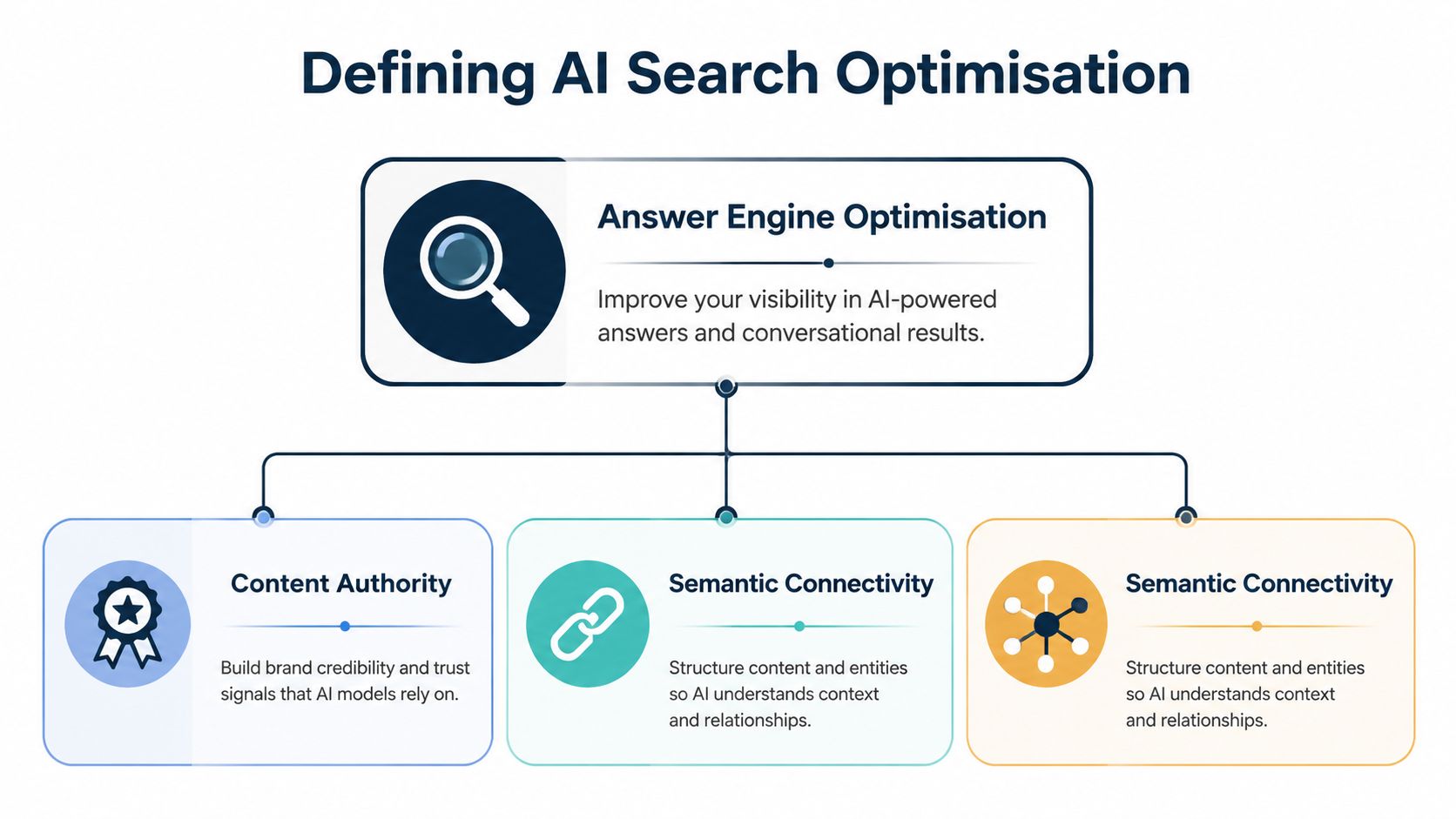
Defining AI Search Optimisation
An AI search optimisation agency helps your business show up inside AI-generated answers, not just in the list of links underneath them.
The easiest way to think about it is this. Traditional SEO is like getting your business listed in the phone book. Answer Engine Optimisation, or AEO, is like becoming the business the operator recommends when someone asks, “Who should I call right now?”
What changes in practice
With traditional SEO, you're mostly trying to rank a page.
With AI search optimisation, you're trying to make your information:
- Easy to extract so an AI system can find a direct answer quickly
- Easy to trust so your brand can be cited or paraphrased confidently
- Easy to connect so your services, locations, reviews, and expertise all make sense together
That means page structure matters differently. Question-based headings matter more. Consistent business entities matter more. Structured data matters more. So does technical access for crawlers that don't behave like Googlebot.
Why this traffic matters more than many owners realise
This isn't just a visibility exercise. The commercial value is strong.
Traffic from LLMs converts at 15.9% for ChatGPT and 10.5% for Perplexity, compared with Google organic at 1.76% according to Position Digital's AI SEO statistics roundup. That tells you something important. People using these tools often aren't browsing casually. They're closer to a decision.
The best AI traffic behaves less like window shopping and more like a customer walking in with a shortlist.
That's why I don't treat AI optimisation as a shiny add-on. I treat it as commercial search strategy.
AEO and GEO are related, but not identical
You'll hear two terms a lot.
AEO is about getting your business selected as an answer.
GEO, or Generative Engine Optimisation, is about improving visibility across AI platforms such as ChatGPT, Perplexity, Gemini, and AI-enhanced search experiences. If you want the formal service view, Titan Blue also outlines this in its Generative Engine Optimisation offering.
In plain English, both come down to one job. Make your business the cleanest, clearest, most trustworthy source in your local market.
Core Services for AI Visibility
An AI search optimisation agency shouldn't be selling mystery. The work is practical. Technical in spots, yes, but still practical.
These are the core services that move the needle for AI visibility.

LLM ready content
Most business websites still write like brochures. AI tools prefer content that answers real questions cleanly.
That means service pages need to do more than say “quality workmanship” and “friendly team”. A plumber's page should answer what jobs you handle, where you go, what counts as an emergency, what the process is, and when someone should call. A restaurant page should clarify cuisine, location, booking options, dietary considerations, and what makes the venue suitable for different occasions.
A good agency rewrites key pages so they're conversational without becoming fluffy. The content needs to sound natural to humans and be easy for AI systems to slice into usable answer fragments.
Structured data and entity signals
This is the part many businesses skip because it sounds technical. It matters.
Schema markup is like labelling everything in your storeroom so a robot can find the right item without guessing. If your website clearly marks your business as a LocalBusiness, your service types, FAQs, and location details, AI systems have less room to confuse you with another operator.
In Australia, websites using JSON-LD structured data such as LocalBusiness schema see 35% higher mention rates in Perplexity AU responses for local queries. Creating an llms.txt file to whitelist AI crawlers such as GPTBot can contribute to a 22% citation uplift when combined with conversational content, based on Australian-focused AI search optimisation analysis.
A proper agency should be doing things such as:
- Adding JSON-LD markup for LocalBusiness, Service, FAQ, and other relevant entities
- Clarifying service areas so your geography is machine-readable, not implied
- Implementing llms.txt thoughtfully where it suits the site and content strategy
One example of this kind of work is Titan Blue's AI visibility audit, which focuses on how a site is understood across AI-driven environments.
Technical readiness
Many AI systems are less patient than Google. If your website relies heavily on scripts, hides key details in awkward layouts, or delivers bloated pages, your content becomes harder to extract.
That's why technical work still matters. Strong crawlability, clean HTML, logical heading structure, stable layouts, and fast page delivery all improve your odds of being included in AI answers.
Practical rule: If a customer can't find the answer quickly, an AI crawler probably won't either.
Prompt tracking and visibility testing
This is the missing layer in many SEO retainers.
You need ongoing testing of the prompts your customers are using. Not vanity prompts. Real buyer prompts. Things like “best emergency plumber in Southport”, “family dinner Broadbeach gluten free”, or “solar installer for large roof Queensland”.
An agency should monitor whether your brand appears, how it appears, which competitors or directories are cited instead, and what content gaps are stopping inclusion. That's not guesswork. It's modern search intelligence.
How AI Optimisation Drives Growth for Local Trades and Hospitality
The technical side only matters if it changes the business outcome. More calls. Better bookings. Stronger enquiries. Clearer buying intent.
That's where local AI optimisation becomes useful, especially for trades and hospitality.

A Broadbeach restaurant that needs direct bookings
A restaurant owner usually isn't asking for “more impressions”. They want tables filled without giving away margin to third-party platforms.
For AI search, that means the website and business profile need to make certain facts obvious. Cuisine type. suburb. booking method. opening hours. dietary options. occasion fit. If those signals are buried in PDFs, image text, or scattered social posts, AI tools struggle to present the venue properly.
There's another local wrinkle. For Australian businesses, review signals from Google My Business can carry up to 35% more weight in local AI pack rankings than for global counterparts, according to local AI search analysis focused on Australian conditions. So if you run hospitality, your reviews aren't just social proof. They help shape AI visibility.
A smart agency will tighten menu and venue content, align business data across platforms, and make review signals part of the search strategy, not an afterthought.
A Gold Coast plumber who needs the right calls
A plumbing business doesn't win by getting every click. It wins by getting the urgent, local, high-intent call.
When someone asks an AI tool who handles burst pipes, blocked drains, hot water failures, or after-hours call-outs in a specific area, the tool looks for clarity. If your site waffles, hides service areas, or never states what you do, you lose visibility to someone more explicit.
That's why good AI optimisation for trades is blunt and useful. It spells out suburbs served, emergency categories, response expectations, and the exact jobs you take on.
Clear service language beats clever copy every day of the week.
Review this short explainer if you want to see how AI-led search behaviour is shifting:
A solar installer who needs better quality leads
Solar is different again. Customers often start with detailed questions. Battery sizing. roof suitability. payback concerns. panel quality. installation process. rebates. long-term reliability.
That's exactly where AI search can help a serious operator. If your educational content is strong, the AI system can use your material to answer comparison-style and research-style questions. That positions your brand before the quote stage.
The key is not writing generic blog fluff. It's publishing useful pages that address the questions buyers ask your sales team. When your content handles those questions clearly, you start showing up for intent that sits earlier in the journey but leads to better qualified enquiries later.
Why the Australian angle matters
A lot of overseas advice is too broad for local operators. Australian businesses need location precision, review management, and entity consistency that reflect how people search here. Broadbeach isn't Brisbane. Queensland intent isn't Sydney intent. A local campaign has to respect that.
That's why I'd rather see a business own its service area properly than chase generic national traffic that never converts.
A Practical Checklist for Choosing Your Agency
Most businesses won't get burned by bad intentions. They'll get burned by vague promises, recycled SEO language, and reporting that tells them nothing useful.
If you're hiring an AI search optimisation agency, ask harder questions.

Questions that separate strategy from sales talk
-
How do you define success beyond rankings? If the answer is only traffic, keep looking. You want reporting tied to calls, bookings, quote intent, AI mentions, and business visibility in real prompts.
-
What's your process for local entity optimisation? They should talk about business data consistency, schema, reviews, service area clarity, and how your brand is represented across platforms.
-
How do you test AI visibility? A credible agency should have a method for tracking prompts, spotting citation gaps, and identifying which pages are being ignored by AI systems.
-
How do you handle technical access for AI crawlers? You're listening for practical knowledge around crawlability, page structure, rendered versus non-rendered content, and clean information architecture.
-
Can you show experience with businesses like mine? A restaurant, plumber, builder, or solar installer doesn't need the same search strategy as a software company.
What a weak answer sounds like
Be cautious if you hear things like:
- “AI is just normal SEO.” That's incomplete. Traditional SEO is part of it, but AI answer selection changes how content gets discovered and cited.
- “We use AI tools for content.” That's not the same as optimising for AI search.
- “We'll get you more impressions.” Impressions don't pay wages.
What a good partner should be willing to discuss
They should be comfortable talking through trade-offs. For example, whether your money should go first into technical fixes, service-page rebuilds, review operations, or local landing page consolidation. They should also be able to explain the work in plain English.
If an agency can't explain the plan simply, they probably don't understand it deeply enough.
If you're comparing firms, it helps to review broader local capability as well, not just AI language. This guide to local SEO agencies is useful context because the fundamentals of local search still support everything AI builds on top.
Understanding Pricing for AI Search Optimisation
Let's deal with the question business owners usually ask after the meeting. What does this cost?
In Australia, AI SEO agency fees can range from $5,000 to $15,000 per month, based on this market pricing overview. That same source also notes that many SMBs report unclear ROI, which is exactly why pricing on its own is the wrong question.
The better question is this. What are you paying for?
What pushes pricing up or down
A straightforward local campaign costs less than a messy one. If your site already has solid service pages, clean business information, and decent technical health, the work is lighter. If your content is thin, your locations are muddled, your reviews are unmanaged, and your site needs redevelopment, the scope expands quickly.
Pricing is also shaped by:
- Market complexity such as overlapping service areas or crowded local categories
- Content depth required for services, FAQs, location pages, and authority pieces
- Technical remediation when the site structure gets in the way of AI and search crawlers
- Measurement and reporting if you want prompt-level visibility tracking, not just monthly keyword charts
What to insist on before you sign
Ask the agency exactly how it will report progress. Not in abstract marketing language. In business language.
You want a clear view of whether the work is improving your presence in AI answers, strengthening qualified traffic, and creating better lead quality. If they can't explain that, the retainer will feel expensive very quickly.
A useful starting point is understanding the broader economics of search investment. Titan Blue's page on SEO services cost gives context for how scope and business goals shape monthly spend.
My view on budget
For most local businesses, this should be treated as infrastructure, not a campaign gimmick. If search behaviour is shifting and your customers are using AI-assisted discovery, your visibility stack needs to keep up. The right spend isn't the cheapest quote. It's the one tied to a credible plan, a local strategy, and reporting that tells you whether the work is paying off.
Take the Next Step to Future-Proof Your Business
Search has changed. That part isn't up for debate.
If your business depends on local discovery, you can't afford to rely on old SEO assumptions while customers move toward AI answers, AI summaries, and AI-assisted recommendations. The businesses that win won't necessarily have the biggest websites. They'll have the clearest, most trusted, most machine-readable presence.
That's why choosing the right AI search optimisation agency matters. You need a partner that understands local intent, understands how Australian businesses are found, and knows how to connect technical work to real commercial outcomes.
After more than 25 years in digital, I can tell you this much. Every major shift creates two groups. Businesses that wait until the drop in leads becomes obvious, and businesses that adapt while there's still an advantage to claim.
Choose the second group.
Start with a simple assessment of where you stand now. Are AI tools understanding your services properly? Are they citing you, skipping you, or confusing you with someone else? Is your site helping or hurting your visibility?
If you want a practical next step, contact Titan Blue Australia and ask for an AI Visibility Audit. It's a straightforward way to see how your business is positioned for AI search, where the gaps are, and what to fix first.
Make Titan Blue a preferred source in Google
One click tells Google to surface our articles more often in Top Stories, AI Overviews and AI Mode.

Solar Installer Website Design Australia: The 2026 Guide
How solar installer websites in Australia should show CEC accreditation, real install proof and AI-ready…

Hotel & Hospitality Website Design Australia: 2026 Guide
Hotel and hospitality website design in Australia explained: booking flow, schema, AEO and what actually…

Restaurant Website Design Australia: The 2026 Guide
What a restaurant website in Australia needs: HTML menus, bookings, GBP sync, schema, and AI-ready…