


Last updated:
A lot of local business owners are in the same spot right now. The work is solid, the team answers the phone, the service is good, and existing customers are happy. But when someone nearby searches for a plumber, restaurant, builder, electrician, or solar installer, another business shows up first.
That gap usually isn’t about quality. It’s about visibility at the exact moment a customer is ready to act.
Local seo agencies exist to fix that problem. The good ones don’t chase vanity rankings or flood you with jargon. They make sure your business appears where local buyers are already looking, your details are consistent, your reputation is visible, and your website supports the search intent behind real enquiries.
For Australian businesses, especially in hospitality, trades, and service categories, local search has moved from “nice to have” to core sales infrastructure. If your competitors are easier to find, easier to trust, and easier to contact, they’ll keep winning business that should have been yours.
Why Your Local Business Is Invisible Online
A common scenario looks like this. A Gold Coast restaurant serves great food, has good word of mouth, and still has quiet weeknights. Or a Perth plumber has vans on the road every day but sees inconsistent inbound leads because the phone only rings when referrals happen.
That’s what online invisibility looks like in practice. You’re operating a real business, but in local search you barely exist.
The urgency is easy to understand when you look at customer behaviour. In Australia, 92% of consumers use the internet to discover local businesses daily or weekly as of 2025, yet only 42% of Australian SMBs have a formalised local SEO strategy according to local SEO statistics for Australia. That gap is where local growth sits.
The problem usually isn’t your business
Most local businesses don’t disappear online because they’re bad at what they do. They disappear because search engines and map platforms can’t confidently connect three things:
- Who you are
- Where you operate
- What you want to be found for
If those signals are weak, Google fills the space with businesses that send clearer signals.
A local SEO agency’s role is to close that gap. Not with tricks. With structured, practical work that makes your business more findable and more credible.
Practical rule: If a customer in your suburb can’t find you within a few seconds on search or maps, your marketing problem isn’t awareness. It’s discoverability.
Why this matters more for SMBs
Large brands can absorb inefficiency. Small and mid-sized businesses usually can’t. Missed visibility means missed bookings, missed calls, and quieter trading periods.
That’s why local SEO matters most in businesses where buying decisions happen quickly. Think “best breakfast near me”, “emergency plumber Broadbeach”, or “solar installer Gold Coast”. Search intent is immediate, local, and commercial.
If you want a simple primer on the basics before choosing an agency, this guide on local SEO for small businesses is a useful starting point.
When local seo agencies are doing their job properly, they don’t just improve rankings. They help local customers find you at the exact moment they’re ready to book, call, visit, or enquire.
What a Local SEO Agency Actually Does
Think of a local SEO agency as your digital shopfront manager. Not a general marketer. Not a vague “online growth partner”. A specialist that makes sure your business is visible, accurate, and convincing wherever local buyers check before making contact.
That work has real commercial value. The Australian local SEO market was valued at AUD 1.2 billion in 2025, and local pack rankings drive a 44% click-through rate, according to Australian local SEO market data. That matters because the local pack is often where customers make their shortlist before they even reach standard organic results.
The modern shopfront is spread across search
Years ago, your shopfront was your premises. Now it’s split across several touchpoints:
- Google Business Profile
- Google Maps
- Your website
- Online directories
- Review platforms
- Mobile search results
If any of those are weak, the whole experience weakens.
A good agency treats these as one system. Your listing can’t say one thing, your website another, and a directory something else. That mismatch creates friction for customers and uncertainty for search engines.
For a straightforward overview of that ecosystem, what local SEO is and how it works covers the core mechanics well.
What local seo agencies manage day to day
The work usually falls into three responsibilities.
First, they manage visibility. That includes your core business categories, service descriptions, business details, map relevance, and location signals.
Second, they manage credibility. That means cleaning up inconsistent business details, improving review quality and response workflows, and reducing trust gaps.
Third, they build authority. This involves website content, local relevance, and supporting links.
If your digital shopfront is messy, Google hesitates and customers bounce.
What they shouldn’t be doing
Good local seo agencies don’t bury you in reports full of metrics that never translate into enquiries. They don’t focus only on broad keywords with no local intent. They don’t promise instant domination because local search doesn’t work that way.
The strongest agencies prioritise outcomes that match how local customers behave. Can people find you? Do they trust what they see? Is the next step obvious?
A useful way to judge agency quality is to ask how they’d handle these real-world situations:
- A service business with no public office
- A restaurant with changing seasonal offerings
- A trade business covering multiple suburbs
- A business with duplicate or outdated listings
- A company with strong reviews but weak website location pages
If the answers are generic, the strategy probably will be too. Local SEO works best when it reflects the way your business operates on the ground.
The Three Pillars of Local Search Dominance
Most local campaigns that fail don’t fail because of one fatal issue. They fail because the basics are half done everywhere. The listing is incomplete, the business details vary from site to site, and the website barely mentions the areas the business wants to service.
That’s why strong local SEO is built on three pillars. Each one supports the others.
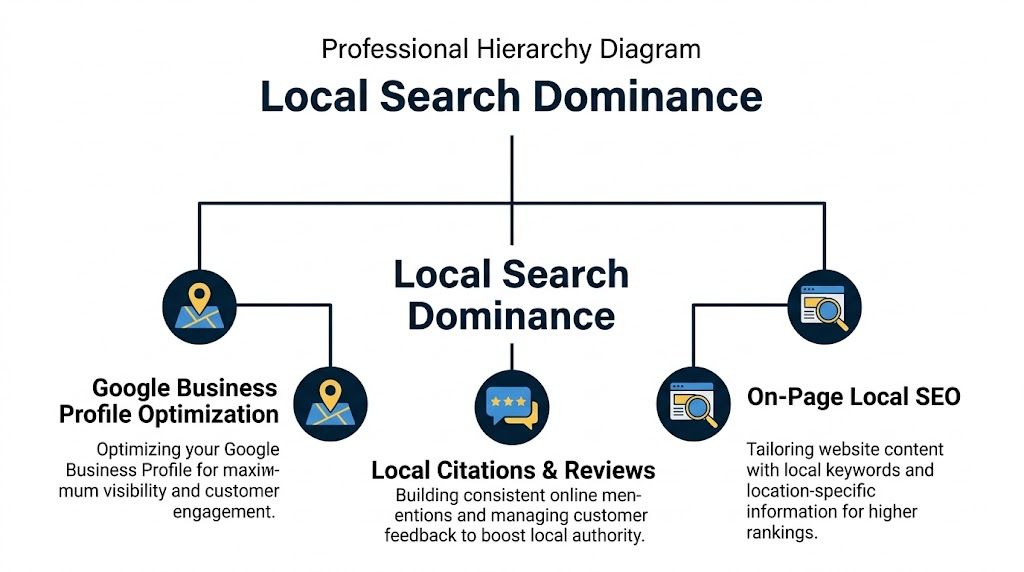
Google Business Profile optimisation
Your Google Business Profile is your digital front door. For many local searches, it gets seen before your homepage.
If this profile is weak, everything else has to work harder.
The practical work here includes:
- Choosing the right primary category so Google understands your main service.
- Setting accurate service areas or location details so you appear for the areas that matter.
- Writing clear business descriptions that reflect your services without stuffing keywords.
- Keeping hours current including holiday trading changes.
- Uploading strong real-world photos of your premises, team, jobs, menu items, or completed projects.
- Using services and products fields properly so customers can see relevance quickly.
For a hospitality venue, that might mean accurate dining categories, booking options, menu-related content, and current trading hours. For a plumber, it means service clarity, emergency availability, and suburb relevance.
A common mistake is treating the profile as a set-and-forget listing. It isn’t. Profiles need upkeep because the market changes, services change, and customer expectations change.
Local citations and review signals
A citation is any online mention of your business name, address, and phone details. Search engines use those mentions to cross-check whether your business is real and reliable.
Think of citations like identity documents. If one says your surname is Smith, another says Smyth, and a third has the wrong birth date, the system stops trusting the file. Business data works the same way.
What good citation work looks like:
- Consistent business details across major directories and industry listings
- Removal or correction of duplicates
- Matching formatting for address, phone number, and trading name
- Review monitoring and responses across the platforms that matter
Reviews do more than reassure customers. They also help shape how your business appears in local search. But volume alone isn’t the goal. Relevance, recency, and response quality matter.
Operational insight: Don’t outsource review replies to someone who has never spoken to a customer. Generic responses weaken trust instead of building it.
A well-run review process sounds human, answers concerns directly, and reinforces what the business does well. For hospitality, that might mean acknowledging service, atmosphere, or specific dishes. For trades, it often means confirming punctuality, workmanship, and communication.
On-page local SEO and content
Your website needs to back up the local signals your listings are sending. If your profile says you serve Burleigh, Southport, and Robina, but your website only has a generic services page, there’s a disconnect.
On-page local SEO comes into play.
Useful local content often includes:
- Service pages tied to real search intent
- Location pages for genuine service areas
- Project or case content linked to specific suburbs
- FAQs based on local buying questions
- Contact pages with clear local relevance
For example, a solar installer shouldn’t rely on one broad page about solar installation. It’s usually stronger to build out practical pages around the services and locations customers search for, then support them with project content that shows local delivery.
Many businesses commonly overdo it. They spin up thin suburb pages with only the location name swapped out. That doesn’t help users, and it rarely holds up over time.
Good local content answers a local question. It shows local experience. It gives a customer a reason to believe you work in that area.
When these three pillars line up, local visibility becomes much more stable. When one is missing, the rest lose force.
Advanced Tactics to Outrank Your Competition
Once the basics are in place, the gap between one business and another usually comes down to execution quality. Plenty of businesses have a profile, a few reviews, and a website. Far fewer have a local search setup that helps search engines interpret the business with precision.
That’s where advanced work starts to matter.

Schema helps search engines read the business properly
Schema markup is structured data added to your site. In plain terms, it’s a cleaner way of labelling what your business is, where it operates, what services it offers, and how customers can contact you.
Think of it as a translation layer. Your website already says things for humans. Schema helps machines process those details with less ambiguity.
For local businesses, that often means marking up details such as:
- Business name
- Location information
- Service areas
- Opening hours
- Review-related information
- Relevant service pages
This isn’t magic code that guarantees rankings. But it helps reduce confusion, and local SEO often improves when confusion is removed.
Review strategy is more than “get more reviews”
A mature review strategy has three parts.
The first is timing. Ask at the point of satisfaction, not weeks later when the job is forgotten or the meal is a distant memory.
The second is routing. Different teams need a process for who asks, how they ask, and where they send customers.
The third is response quality. Review management isn’t admin work. It’s reputation work.
A few practical habits make a difference:
- Ask consistently after completed jobs or positive visits
- Make the review path easy on mobile
- Reply to both praise and complaints
- Use negative reviews as service feedback, not just PR issues
- Track recurring complaints and fix the root cause
Businesses that treat reviews as a by-product usually get inconsistent results. Businesses that treat them as an operating process build stronger visibility and stronger trust.
Local link building still separates serious players
Many businesses avoid link building because they think it means spammy outreach or low-value directory blasts. That isn’t the kind of local authority that lasts.
Useful local links usually come from real local participation. Community sponsorships, supplier relationships, industry associations, event pages, tourism mentions, and local media coverage all fit here.
That’s also where digital PR can support local search. If you want a practical look at how publicity can support authority, this guide on leveraging press releases for SEO to boost authority and rankings is worth reading.
Good local link opportunities often come from work the business is already doing:
- Supporting a local event
- Partnering with complementary businesses
- Contributing expert commentary
- Launching a local initiative
- Publishing useful community or industry resources
AI search is changing the competitive layer
Advanced local optimisation now needs to account for generative search and answer-style interfaces, not just blue-link rankings. Businesses need clean data, strong service pages, trustworthy brand signals, and content that answers questions clearly.
That shift is part of why generative engine optimisation has become relevant for local businesses, not just large publishers.
The takeaway is simple. Basic local SEO helps you participate. Advanced local SEO helps you pull ahead.
Tailored SEO Strategies for Australian Industries
Generic local SEO advice breaks down fast when it hits real operating models. A restaurant doesn’t need the same structure as a solar installer. A plumber covering several suburbs doesn’t behave like a clinic with one fixed address. A regional business on the Gold Coast has different search patterns from a city-centre retailer.
That gap matters because there is a critical lack of local SEO guidance for multi-location trades and service businesses in regional Australia, especially around NAP consistency, hyperlocal content for multiple service areas, and location-specific service radius searches, as noted in this overview of the regional service-area SEO gap.
Hospitality businesses need booking-focused visibility
Restaurants, cafes, bars, and venues live or die on discoverability and confidence. Searchers often decide quickly. They want the menu, hours, booking pathway, location, photos, and social proof without digging.
That changes the local SEO priority list.
For hospitality, the high-value tasks are usually:
- Keeping trading hours accurate
- Making booking actions obvious
- Aligning menu content with search intent
- Using fresh, real venue photography
- Answering practical questions on parking, dietary options, and group bookings
A common failure point is splitting the customer journey. The listing looks current, but the website is outdated. Or the site has the menu, but mobile booking is awkward. Local SEO works better when the handoff from search to action is frictionless.
Trades and construction businesses need service-area precision
Trades often get the worst generic advice. Many don’t operate from a customer-facing location, and many serve multiple suburbs with different demand patterns. If the strategy assumes one storefront and one suburb, it’s built on the wrong model.
A stronger approach for tradies includes:
- Clear service pages by trade category
- Suburb and region pages based on real coverage
- Project galleries tied to actual locations
- Lead forms that qualify job type and area
- Google Business Profile settings that reflect service reality
For a construction or plumbing business, photos of completed work carry weight. So do pages that explain the scope of work, service types, emergency response, and suburb coverage without padding every page with repetitive wording.
If your business operates across multiple service areas, local SEO for tradies is a useful reference point for structuring that kind of campaign.
A service-area business shouldn’t pretend to be a shopfront in every suburb. It needs a structure that proves coverage without manufacturing locations.
Later in the process, video can support trust and local relevance when it answers the same questions customers ask before they call.
Multi-location businesses need governance, not just optimisation
Many local SEO agencies struggle. Optimising one listing is manageable. Coordinating several locations or service zones requires systems.
The core issues aren’t glamorous:
- Who controls naming conventions
- How phone numbers are assigned
- Whether addresses are formatted consistently
- How reviews are monitored across locations
- Which pages support which branches or service areas
For regional businesses, this gets harder because suburbs can blur together operationally while behaving differently in search. One area might search by suburb name, another by broader region, and another by service-plus-near-me intent.
The solution isn’t to create a hundred shallow pages. It’s to build a clean hierarchy. One location or service-area page should have a clear reason to exist, distinct supporting content, and a defined role in the customer journey.
For regional Australia, that level of precision is often the difference between broad online noise and reliable lead flow.
Choosing a Partner and Measuring Real-World Results
Most businesses don’t need another SEO pitch. They need a way to tell whether an agency will actually improve enquiries, bookings, and visibility where it counts.
That starts with measurement. If the reporting is all rankings and impressions, you’re only seeing part of the picture.
Track business actions, not just search positions
Rankings matter, but they’re not the whole job. Local SEO should be tied to customer actions.
Useful indicators usually include:
- Phone calls from search visibility
- Direction requests
- Website contact form submissions
- Booking actions
- Quote requests
- Traffic to location and service pages
- Review trends and response quality
A business can rank for a term and still lose because the listing looks weak, the site loads poorly on mobile, or the enquiry path is clumsy. That’s why outcome tracking matters more than isolated keyword charts.
Pricing models matter less than scope clarity
Most local seo agencies work on either a monthly retainer or a project-based arrangement. Either can work. The main issue is whether the scope matches the business.
A simple single-location venue has different needs from a service business covering multiple regions. A business with a messy digital footprint may need upfront cleanup before monthly growth work makes sense.
Ask practical questions:
- What gets fixed first
- What gets worked on each month
- What reporting will look like
- Who does the work
- How local strategy changes for service-area businesses
- What happens if the website also needs changes
If the proposal sounds broad but says little about execution, that’s a warning sign.
Buyer filter: A good agency can explain its process in plain English. If it hides behind jargon, it may be hiding a thin strategy.
Red flags that usually lead to disappointment
Some warning signs show up again and again.
- Guaranteed rankings. No credible agency controls search results that way.
- No questions about your operations. Local SEO depends on how the business really works.
- Reports with no business context. Data without decisions isn’t useful.
- One-size-fits-all packages. Local campaigns vary too much for cookie-cutter delivery.
- No access or transparency. You should know what’s being changed and why.
- Tactics that ignore reviews, listings, or location pages. That usually means the agency is doing generic SEO, not local SEO.
What a good partner sounds like
A strong agency usually talks more about process, prioritisation, and trade-offs than hype.
For example, they might tell a hospitality venue to focus first on profile completeness and booking friction before expanding content. They might tell a regional trade business to clean up location structure before building new suburb pages. They might explain that momentum takes time and point you to a realistic overview of how long SEO takes to work.
That’s the right tone. Mature local SEO isn’t about promising miracles. It’s about doing the right work in the right order and measuring whether it changes real customer behaviour.
The Future of Local Search Is Already Here
Local search is no longer just a contest for ten blue links and a map listing. Search engines are moving towards direct answers, AI summaries, and conversational results that decide what information gets surfaced before a user even clicks.
That changes what local businesses need to optimise for.

AI search rewards clarity and trust
When AI systems generate answers about local businesses, they pull from signals across listings, websites, reviews, structured data, and brand mentions. If your information is fragmented, thin, or inconsistent, you’re harder to trust as a source.
That makes the old habit of treating your website as a brochure even riskier. AI-driven search tends to favour businesses that publish clear, well-structured, specific information.
In practice, that means your business should have:
- Accurate structured business details
- Clear service and location pages
- Consistent identity across the web
- Strong review and reputation signals
- Content that answers real local questions directly
Answer engines change where discovery happens
A user may no longer search, compare, and click through five websites. They may ask a question and get a synthesised answer with only a few cited businesses. That compresses the consideration phase.
For local businesses, this creates a new layer of competition. You’re not only trying to rank. You’re trying to become the most reliable source for a local answer.
That doesn’t make classic local SEO obsolete. It makes it more important. The businesses best positioned for AI search are usually the ones that already have disciplined fundamentals.
Search is moving towards recommendation, not just retrieval. Businesses with cleaner signals are easier to recommend.
Local strategy now needs to be AI-ready
The practical response isn’t to panic or chase every new platform. It’s to tighten the assets you control.
Audit your core business details. Improve weak service pages. Publish content that reflects real customer intent. Keep reviews active. Use structured data properly. Treat every local touchpoint as part of one connected trust system.
That’s also why AI search strategy for business visibility is becoming part of the local search conversation. The future version of local SEO is broader than maps optimisation alone.
Businesses that adapt early won’t just hold rankings. They’ll be easier for both search engines and answer engines to understand, trust, and surface.
Titan Blue Australia has spent more than 25 years helping businesses build visibility that lasts. If you want a practical local SEO strategy for hospitality, trades, service-area businesses, or multi-location growth, talk to Titan Blue Australia.
Make Titan Blue a preferred source in Google
One click tells Google to surface our articles more often in Top Stories, AI Overviews and AI Mode.

Best Dental Website Design Agencies in Australia: 7 Compared
Best dental website design agencies in Australia 2026: seven compared on dental proof, booking, AHPRA…

Childcare Centre Website Design Australia: The 2026 Guide
Childcare centre website design Australia: show hours, ages and enrolment as text so parents and…

Electrician Website Design Australia: The 2026 Guide
Electrician website design Australia: what to build, what we found on eight Gold Coast electrician…