


TL;DR:
- Most small businesses struggle with disorganized SEO efforts due to skipped measurement and planning steps. A structured, repeatable SEO workflow links keyword research, content creation, technical fixes, and tracking to build long-term visibility. Titan Blue offers tailored SEO services to help Australian businesses implement and maintain effective SEO systems for sustainable growth.
Without a clear process, SEO feels like guessing. You publish content, wait, and wonder why rankings never move. Most small business owners in Australia face exactly this problem — scattered tasks, no clear order, and no way to measure what is working. A proper step by step seo workflow changes that. It connects keyword research, content creation, technical fixes, and performance tracking into one repeatable system that builds visibility and drives qualified leads over time.
Table of Contents
- Understanding SEO workflow essentials
- Preparation phase: keyword research and content briefing
- Execution phase: content creation and technical optimisation
- Verification phase: publishing, indexing, and ongoing optimisation
- Why many SEO workflows fail and how small businesses can avoid common pitfalls
- How Titan Blue can help with your SEO workflow
- Frequently asked questions
Key Takeaways
| Point | Details |
|---|---|
| Structured SEO workflows | Transform SEO into a repeatable process that aligns keyword research, content, technical SEO, and performance tracking. |
| Preparation is vital | Audit existing content, map keywords to business goals, and create detailed content briefs before writing. |
| Content quality matters | Develop helpful, people-first content following E-E-A-T principles to satisfy both users and search engines. |
| Technical SEO ensures discoverability | Implement schema, update sitemaps, and verify crawlability using tools like Google Search Console. |
| Track and iterate | Monitor rankings and traffic regularly to update and optimise content for sustained organic growth. |
Understanding SEO workflow essentials
An SEO workflow is simply a defined sequence of steps that guides every SEO task you do. Instead of jumping between keyword research one day and fixing broken links the next, a structured workflow ensures each action builds on the last. That consistency is what separates businesses that get results from those that stay stuck on page three.
For small businesses doing SEO, the most common problem is not lack of effort. It is lack of coordination. You might have good content but no technical foundation. Or solid technical SEO with content that targets the wrong keywords. A workflow solves this by making sure every component gets attention in the right order.
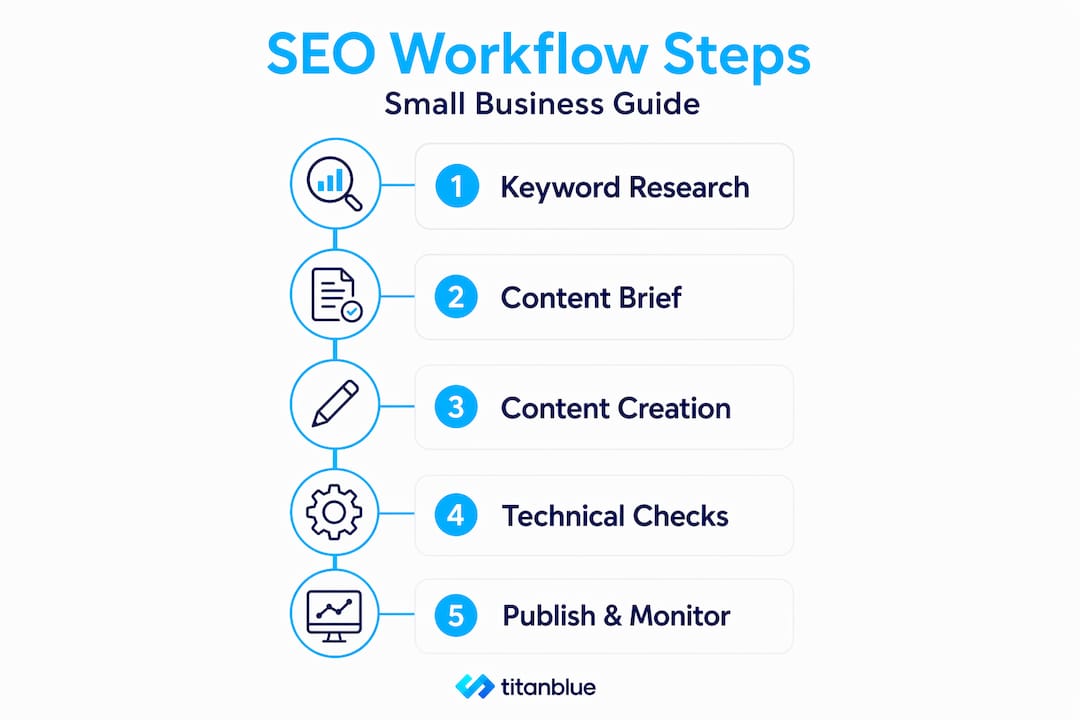
A repeatable SEO sequence covers keyword research tied to business goals, content briefs, technical SEO, QA checks, and performance tracking, then loops back to improve based on data. That loop is what makes SEO compound over time rather than plateau.
The core elements of any solid SEO workflow include:
- Keyword research and mapping aligned to what your customers are actually searching
- Content briefing that defines structure, intent, and SEO requirements before writing begins
- Content creation focused on being genuinely helpful and authoritative
- Technical SEO checks covering page speed, crawlability, sitemaps, and schema
- Quality assurance before every page goes live
- Performance tracking and scheduled content reviews
For small business SEO marketing, these elements do not need a large team. They need a clear order and consistent execution.
Preparation phase: keyword research and content briefing
This is where most small business SEO efforts either succeed or fall apart before they start. Rushing into content creation without proper preparation means writing content that targets the wrong audience, misses real search intent, or duplicates what you already have.
Effective SEO preparation means auditing what you already have, building a keyword map based on business value, and creating a content brief before writing a single word. Here is how to do it step by step:
-
Audit your existing content. Catalogue every page on your site. Note which pages rank, which get traffic, and which are underperforming. This prevents duplication and shows you where to improve rather than create from scratch.
-
Build a keyword map. Group keywords by topic clusters tied to your core services. For example, a Gold Coast plumber might cluster keywords around “emergency plumber Gold Coast,” “blocked drain repair,” and “hot water system replacement.” Each cluster feeds a pillar page supported by related posts.
-
Define search intent for every target keyword. Are searchers looking for information, comparing options, or ready to buy? Intent shapes everything from your headline to your call to action.
-
Create a content brief before writing. A brief is a one-page document covering target keyword, secondary keywords, suggested headings, recommended word count, audience, intent, and competitor content gaps. Think of the content brief’s SEO impact as your quality contract. It aligns the writer, the business owner, and the SEO goal before any work starts.
A well-structured SEO workflow maps keyword research to business goals first, then creates data-driven content briefs as the second step. Skipping this order is one of the main reasons content fails to rank.
Pro Tip: Use a simple spreadsheet as your keyword map. Columns for keyword, monthly search volume, intent, target page, and status. Update it every 90 days as your business goals evolve.
| Brief component | Why it matters |
|---|---|
| Target keyword | Keeps the entire page focused on one primary term |
| Search intent | Determines page format, depth, and call to action |
| Competitor gaps | Reveals what your competitors miss that you can cover |
| Suggested headings | Builds structure before writing, saving editing time |
| Word count target | Sets expectations and ensures sufficient topic depth |
For a fuller picture of how content briefing fits into your broader marketing, the digital marketing checklist for small business is worth reviewing alongside this process.
Execution phase: content creation and technical optimisation
With your briefs ready, execution becomes much faster. The brief does the thinking so writing becomes straightforward. But execution is not just about producing content. Technical SEO must happen in parallel.

Writing people-first content
Google’s Helpful Content system actively demotes content written primarily for search engines. Recovery from a helpful content demotion takes time and it is painful. The fix is simple: write for your reader first.
Follow E-E-A-T principles, which stand for Experience, Expertise, Authoritativeness, and Trustworthiness. This means demonstrating genuine experience and real trust signals throughout your content — not just ticking keyword boxes. Cite sources, use real examples, and write with authority on your topic.
Technical SEO checklist before publishing
Poor technical foundations waste good content. Run through these checks for every new or updated page:
- Sitemap updated to include the new page
- Canonical tags set correctly to avoid duplicate content issues
- Page speed tested. Slow pages hurt both rankings and conversions
- Schema markup added where relevant, such as local business, FAQ, or product schema
- Robots.txt reviewed to confirm the page is not accidentally blocked from crawling
- Meta title and description written with the target keyword and a clear benefit
Web design and SEO must work together. A beautifully designed page that loads in five seconds, lacks schema, or has broken meta tags will underperform every time.
Pro Tip: Run every page through Google’s PageSpeed Insights before publishing. A score below 70 on mobile is worth fixing before the page goes live, not after you have waited three months for rankings that never came.
Quality assurance before publishing
QA is the final gate. It checks that content matches the brief, all internal links work, technical elements are in place, and the page reads well. Many businesses skip QA to publish faster. That shortcut costs you later.
Verification phase: publishing, indexing, and ongoing optimisation
Publishing is not the finish line. It is the starting gun. What you do in the days and weeks after publishing determines whether your content ranks or disappears into Google’s index.
-
Submit your XML sitemap. After publishing, submit your sitemap to Google Search Console to flag the new content for crawling. Do this within 24 hours of publishing.
-
Use URL Inspection to request indexing. For important pages, go into Google Search Console, paste the URL, and hit Request Indexing. This does not guarantee instant indexing but it prioritises the crawl.
-
Set up rank tracking. Track your target keyword, traffic volume, click-through rate, and average position in Search Console. This data tells you whether your content is gaining traction or needs adjustment.
-
Schedule content reviews every 90 days. Tracking rankings and iterating based on data is what separates SEO that compounds from SEO that flatlines. Review each page quarterly. Update statistics, expand thin sections, improve internal linking, and refresh headings where needed.
| Action | When to do it | Tool to use |
|---|---|---|
| Sitemap submission | Within 24 hours of publishing | Google Search Console |
| Request indexing | Same day for priority pages | Google Search Console URL Inspection |
| Rank tracking setup | Within one week of publishing | Search Console or rank tracker |
| Content review | Every 90 days | Analytics plus manual review |
| Performance deep dive | Every six months | Search Console plus analytics |
Monitoring SEO performance consistently is what allows you to identify which pages need improvement and which to replicate. Without this step, you are flying blind.
Pro Tip: Check the 10 essential SEO steps after launch to make sure your post-publishing process covers everything from internal linking to Google Business Profile updates.
Why many SEO workflows fail and how small businesses can avoid common pitfalls
Here is the honest reality: most small business SEO workflows do not fail because of bad content or poor technical skills. They fail because of what gets skipped. And the most commonly skipped step is measurement.
Businesses publish content, declare the work done, and move on to the next page. Weeks pass. Rankings stay flat. Nobody goes back to look at why. Without a feedback loop, every piece of content becomes a one-off effort rather than part of a compounding system. The biggest failure point in SEO workflows is skipping the gate between content creation and measurement. Quality briefs and QA prevent wasted publishing, but performance tracking is what turns SEO into long-term growth.
The second failure point is treating the content brief as optional. When a business skips the brief and jumps straight to writing, they often produce content that is too broad, targets the wrong keyword, or fails to match what the searcher actually needs. That content rarely ranks, no matter how well it is written.
The third, and arguably the most damaging, is treating SEO as a one-time project. You cannot optimise a page in January and expect it to hold position in December. Competitor content improves. Search intent shifts. Google updates its algorithm. The guide to SEO marketing for small businesses makes this clear: SEO is a long-term commitment requiring consistent attention, not a campaign with a defined end date.
Small businesses that succeed with SEO build review cycles into their schedule the same way they schedule invoicing or staff meetings. It becomes a business process, not a marketing afterthought. That mindset shift is what makes the difference between page one and page three.
How Titan Blue can help with your SEO workflow
Building and maintaining an SEO workflow takes time, knowledge, and consistency. Many small businesses simply do not have the bandwidth to do it properly in-house. That is where we come in.

At Titan Blue, our SEO services are built specifically for Australian small businesses that want measurable organic growth, not vague promises. We handle everything from keyword research and content briefs through to technical audits and performance reporting. Our SEO web page design approach ensures your pages are built to rank and convert from day one. Whether you are starting from scratch or need to fix a workflow that has stalled, our team understands the local market and knows what it takes to get you visible online. Explore our web design and SEO services on the Gold Coast and let’s build a system that works for your business.
Frequently asked questions
What is a step-by-step SEO workflow?
A step-by-step SEO workflow is a repeatable process that guides small business owners through keyword research, content creation, technical optimisation, publishing, and performance tracking to improve search rankings and generate more traffic.
How long does it take to see results from an SEO workflow?
SEO results typically take three to six months of consistent effort before meaningful ranking improvements appear. Google’s reassessment of content is an ongoing process, so sustained effort compounds over time rather than delivering overnight results.
Do I need technical skills to implement a step-by-step SEO workflow?
Basic familiarity with tools like Google Search Console helps, but technical execution through checklists covering schema, sitemaps, and page speed can be managed with professional support, making it accessible even for non-technical business owners.
How important is content quality in the SEO workflow?
Content quality is non-negotiable. Google demotes content created primarily for search engines, so every page must be genuinely helpful, reliable, and written for real people rather than just targeting keywords.
Recommended
- SEO Marketing for Small Businesses Guide – Titan Blue Australia
- SEO Marketing for Small Businesses Guide – Titan Blue Australia
- Boost Your Business with SEO for Small Businesses – Titan Blue Australia
- Your Ultimate Small Business SEO Guide – Titan Blue Australia
Make Titan Blue a preferred source in Google
One click tells Google to surface our articles more often in Top Stories, AI Overviews and AI Mode.

Solar Installer Website Design Australia: The 2026 Guide
How solar installer websites in Australia should show CEC accreditation, real install proof and AI-ready…

Hotel & Hospitality Website Design Australia: 2026 Guide
Hotel and hospitality website design in Australia explained: booking flow, schema, AEO and what actually…

Restaurant Website Design Australia: The 2026 Guide
What a restaurant website in Australia needs: HTML menus, bookings, GBP sync, schema, and AI-ready…