

Last updated:
TL;DR:
- In 2026, local businesses must focus on AI citations and brand mentions rather than traditional rankings for visibility.
- Technical SEO evolves to include AI-specific policies like llms.txt and schema markup to enhance AI recognition.
Search engine optimisation has crossed a line. In 2026, the biggest SEO trends are no longer about climbing to page one. They are about being cited inside AI-generated answers. When someone in Brisbane asks their AI assistant for a local plumber or Gold Coast café recommendation, no traditional ranking is involved. An AI synthesises an answer from multiple sources and names businesses it trusts. If your business is not being cited, you are essentially invisible to a growing portion of your potential customers. Understanding what SEO in 2026 actually looks like is not optional for local business owners. It is survival.
Table of Contents
- How AI is transforming SEO visibility
- Technical SEO and bot policy in 2026
- Consumer search behaviour and the rise of AI recommendations
- Content strategies to win in the AI search landscape
- Measuring SEO impact beyond rankings
- Our perspective: stop chasing rankings and start building trust signals
- Ready to adapt your SEO for 2026?
- Frequently asked questions
Key Takeaways
| Point | Details |
|---|---|
| AI-driven SEO shift | Visibility now depends on being cited in AI-generated answers more than traditional rankings. |
| Technical SEO policies | Robots.txt and new llms.txt increasingly control AI crawler access and content visibility. |
| Consumer verification | Consumers trust AI recommendations but verify them via Google and reviews. |
| Content design | SEO content must be modular, clear, credible, and focused on entity clusters. |
| New SEO metrics | Measure success with AI citations, branded demand, and engagement quality over clicks alone. |
How AI is transforming SEO visibility
The shift is significant and it is already happening. AI search engines like Google’s AI Overviews and ChatGPT Search do not simply return a list of links. They read multiple sources, synthesise information, and generate a single answer. Visibility depends more on brand citation in AI-generated responses than on page rank. That changes everything.
Think about what this means practically. A customer searches “best accountant in Surfers Paradise.” An AI generates a summary mentioning three businesses by name. Those three businesses get the enquiry. The rest get nothing, regardless of where they rank in traditional results. This is the new competitive reality for local business owners across Australia.
To be cited by AI systems, your content and online presence must meet a higher standard. AI-driven search visibility now favours businesses whose information is accurate, consistent, and easy for AI to extract and verify. Here is what that means in practice:
- Accurate NAP data (Name, Address, Phone) across every directory and listing
- Clear, factual content that answers specific questions without ambiguity
- Brand mentions across credible sources, not just your own website
- Structured content with headers and concise answers that AI can pull cleanly
- Consistent entity information so AI systems can confidently associate content with your business
Your AI search engine optimisation strategy in 2026 must shift from “how do I rank higher” to “how do I become a trusted source AI systems cite repeatedly.”
Technical SEO and bot policy in 2026
Technical SEO is not dying. It is evolving. And some of the changes are ones most local businesses have never even heard of yet.

The robots.txt file has been a standard part of websites for decades. It tells search engine bots which pages to crawl and which to ignore. In 2026, robots.txt is evolving into a broader policy surface, controlling access for AI crawlers specifically, not just traditional search bots. Businesses are using it to decide whether their content feeds AI training models or stays reserved for direct traffic.
A newer development is the llms.txt file. This is a plain-text file placed on your website that explicitly guides large language model (LLM) crawlers. Think of it as a set of instructions written specifically for AI systems that want to learn about your business. Adoption is still relatively low, but it is growing. Early adopters are gaining a small but meaningful advantage in how AI systems interpret and reference their content.
Structured data (also called schema markup) remains one of the highest-return technical investments you can make. It labels your content so AI systems know exactly what each piece of information means, whether that is a business address, a product price, a review rating, or a FAQ answer. Here is what your technical SEO checklist should include in 2026:
- Review and update your robots.txt to account for AI bot behaviour
- Consider implementing an llms.txt file with clear business information
- Add or audit schema markup across your key pages (LocalBusiness, FAQPage, Review, Product)
- Ensure site speed and mobile performance remain strong
- Fix crawl errors and broken links that reduce AI extractability
Pro Tip: If you are unsure where to start with schema markup, focus on LocalBusiness schema first. It directly communicates your business name, location, hours, and contact details to AI systems in a format they trust.
Pairing these technical foundations with the right content approach is where the real gains are. Our local SEO tips cover how these technical elements connect to visibility for small businesses. The role of AI in marketing more broadly is also reshaping how businesses need to think about their entire digital footprint.
Consumer search behaviour and the rise of AI recommendations
Here is something worth paying attention to. 47% of adults used AI to find local businesses recently, with trust levels high among higher-income groups. That number is only growing. But what happens after they get an AI recommendation is equally important.
Most people do not simply act on what an AI tells them. They verify. They Google the business. They check reviews. They look at your website. This multi-step behaviour means your SEO strategy needs to hold up at every stage of that journey, not just the first one.
Here is how the typical AI-influenced discovery journey plays out for an Australian consumer in 2026:
- Discovery via AI. The customer asks an AI assistant for a recommendation and gets a named business.
- Verification on Google. They search the business name directly to confirm it is legitimate and local.
- Review check. They scan Google reviews, looking for recent ratings and responses from the business owner.
- Social media scan. They check Instagram or Facebook for visual proof of quality and recent activity.
- Website visit. They assess professionalism, pricing signals, and contact ease before making a decision.
What this means for your business is clear. You need to be present and credible at every one of those stages. Your local business SEO playbook needs to account for all five steps, not just the first.
Key actions to focus on:
- Keep your Google Business Profile updated with current hours, photos, and services
- Actively request reviews from satisfied customers and respond to every one
- Maintain active social media with recent posts that reflect your current business activity
- Ensure your website loads fast and clearly communicates what you do and where you operate
Content strategies to win in the AI search landscape
Content is still the backbone of SEO in 2026. But the way you write it needs to change. AI synthesisers do not reward waffle. They reward clarity, credibility, and specificity. Prioritise modular, easily extractable content with strong E-E-A-T and entity clusters to earn AI citations.
E-E-A-T stands for Experience, Expertise, Authoritativeness, and Trustworthiness. It is a framework Google and AI systems use to evaluate whether a source deserves to be cited. For a local business, this means:
- Writing content that reflects real, direct experience in your field
- Including specific local references (suburbs, landmarks, local regulations)
- Earning mentions and links from credible third-party sources
- Being transparent about who you are and what qualifications back your claims
Entity clusters are the other major content shift. Rather than targeting isolated keywords, you build clusters of related content that together prove you are a genuine authority on a topic. A Gold Coast electrician, for example, would not just have a homepage. They would have pages covering safety inspections, switchboard upgrades, EV charging installation, and local council compliance. Together, those pages tell AI systems that this business genuinely understands its field. Engineering content for clarity and credible sourcing increases AI visibility significantly.
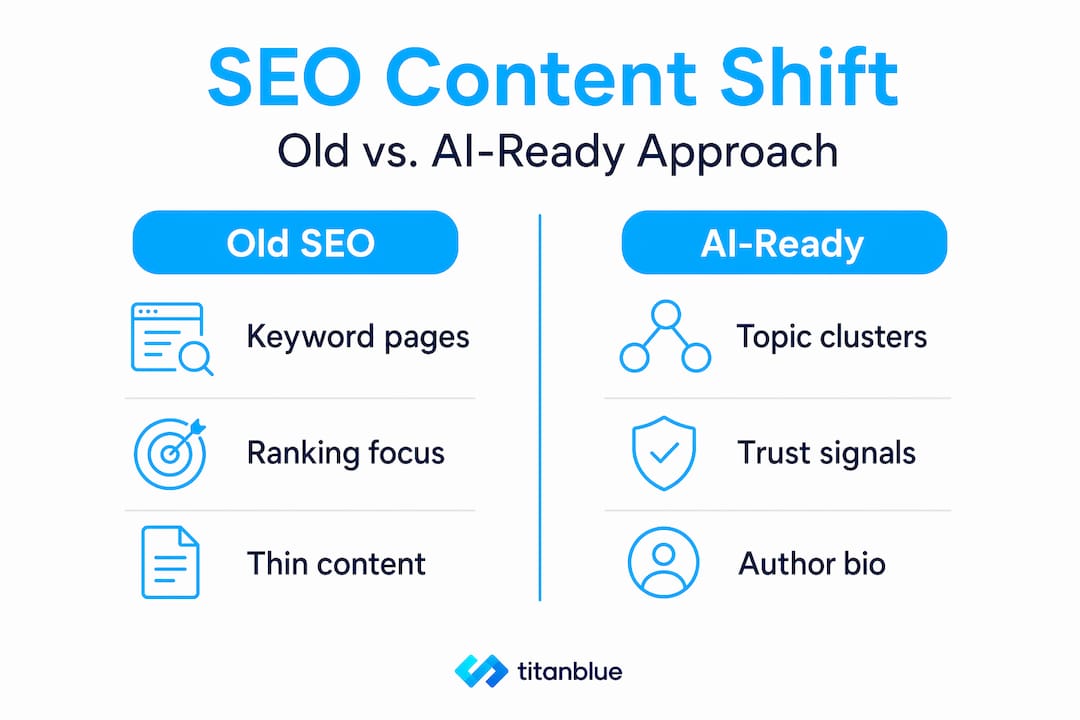
Here is a comparison of old versus new content approaches:
| Old SEO content approach | New AI-ready content approach |
|---|---|
| Keyword-stuffed pages | Topic-focused, question-answering content |
| Long-form articles for word count | Modular content chunks that extract cleanly |
| Generic service descriptions | Specific, experience-backed explanations |
| Backlinks as primary authority signal | Entity mentions and E-E-A-T signals |
| Targeting broad keywords | Building entity clusters around core topics |
Pro Tip: Add an author bio with real credentials to your key service pages. AI systems weight authorship signals when deciding whether to cite a source. Even a two-sentence bio with relevant experience makes a difference.
One more thing worth stating plainly. Human-authored, original content continues to outperform generic AI-generated text in AI citation rates. If your content sounds like every other business in your category, it will not be chosen. Specificity wins. Learn more about our approach to AI search engine optimisation and how we help businesses build content that earns real AI visibility.
Measuring SEO impact beyond rankings
If you are still measuring SEO success by where you rank on page one, you are measuring the wrong thing. Rankings still matter, but they are no longer the complete picture. In 2026, new SEO KPIs include AI citations, LLM referrals, and branded demand.
Here is what you should be tracking instead:
- AI citation frequency. How often does your business appear in AI-generated answers when you prompt AI tools with questions your customers ask?
- LLM referral traffic. Platforms like ChatGPT and Perplexity now show up in website referral reports. Watch these numbers grow.
- Branded search volume. If your brand name is being searched more often, it usually means AI is surfacing you and people are verifying. That is a strong signal.
- Session quality. Time on site, pages per visit, and conversion rate all indicate whether the traffic you are getting is genuinely interested.
Setting up a simple monthly review process takes 30 minutes. Follow these steps:
- Check Google Search Console for branded query growth month on month
- Review referral traffic in Google Analytics and look for AI platform sources
- Manually prompt two or three AI tools with questions relevant to your business and location
- Track your Google Business Profile views, calls, and direction requests
- Note any changes in review frequency as a proxy for incoming traffic quality
You can see how these measurement shifts connect directly to business results in our breakdown of AI in SEO measurement. Getting this right turns SEO from a cost into a measurable growth driver.
Our perspective: stop chasing rankings and start building trust signals
Here is the uncomfortable truth most SEO articles will not tell you. Businesses obsessing over keyword rankings in 2026 are doing the digital equivalent of polishing a fax machine. It is not that rankings are worthless. It is that they are now a secondary outcome, not a primary goal.
What AI systems trust, and by extension what earns you citations, is not technical trickery. It is genuine credibility. A business with 200 recent Google reviews, consistent NAP data across 40 directories, real experience documented in their content, and mentions from local news sites will almost always outperform a technically optimised site with thin content. The fundamentals of real trust have always mattered. AI just made them impossible to fake.
We see this every week working with local businesses across the Gold Coast and greater Australia. The ones adapting fastest are not the ones with the biggest budgets. They are the ones who take their online presence as seriously as their physical one. They update their Google Business Profile like they update their shopfront. They treat reviews like customer service, not just marketing. That mindset shift is worth more than any single technical fix.
The future SEO strategies that will define 2026 and beyond are built on reputation, clarity, and consistency. Start there.
Ready to adapt your SEO for 2026?
The SEO trends in 2026 are clear: AI is reshaping how local businesses get found, and the rules of visibility have genuinely changed. If you are not sure where your business stands with AI citations, structured data, or Google Business Profile optimisation, now is the time to find out.
At Titan Blue, we work with local businesses across Australia to build SEO strategies that account for AI search, entity authority, and the full consumer verification journey. Our services cover everything from AI search engine optimisation to local SEO and content strategy. We do not offer generic fixes. We look at your specific situation and build a plan that delivers measurable results. Get in touch with our team today and let’s talk about what your business needs to stay visible in 2026 and beyond.
Frequently asked questions
What is the biggest SEO change for local businesses in 2026?
Visibility depends more on brand citation in AI-generated responses than page rank, meaning local businesses must now optimise for AI citation rather than just traditional search rankings. This requires a different approach to content, technical setup, and brand authority.
How important are Google Business Profile reviews in 2026?
Review signals dominate the purchase decision and verification of AI recommendations, making a strong review profile essential for converting the growing number of customers who discover you through AI tools before verifying on Google.
Should local businesses use llms.txt files?
llms.txt represents a new decision layer for AI crawler control, with adoption increasing but still relatively low. Local businesses should consider their bot policy carefully and explore whether guiding AI crawlers with this file suits their content strategy.
How can I measure AI’s impact on my website traffic?
New SEO KPIs include AI citations, LLM referrals, and branded demand, so track these alongside session quality and Google Business Profile engagement rather than relying solely on traditional rankings or click volumes.
Recommended
- Master SEO for Local Businesses in 2026
- Local SEO Tips for Small Businesses 2025
- SEO for Australian SMBs: 748% ROI in 2026
- How To Choose Local SEO Agencies In 2026
Make Titan Blue a preferred source in Google
One click tells Google to surface our articles more often in Top Stories, AI Overviews and AI Mode.

Best Dental Website Design Agencies in Australia: 7 Compared
Best dental website design agencies in Australia 2026: seven compared on dental proof, booking, AHPRA…

Childcare Centre Website Design Australia: The 2026 Guide
Childcare centre website design Australia: show hours, ages and enrolment as text so parents and…

Electrician Website Design Australia: The 2026 Guide
Electrician website design Australia: what to build, what we found on eight Gold Coast electrician…