

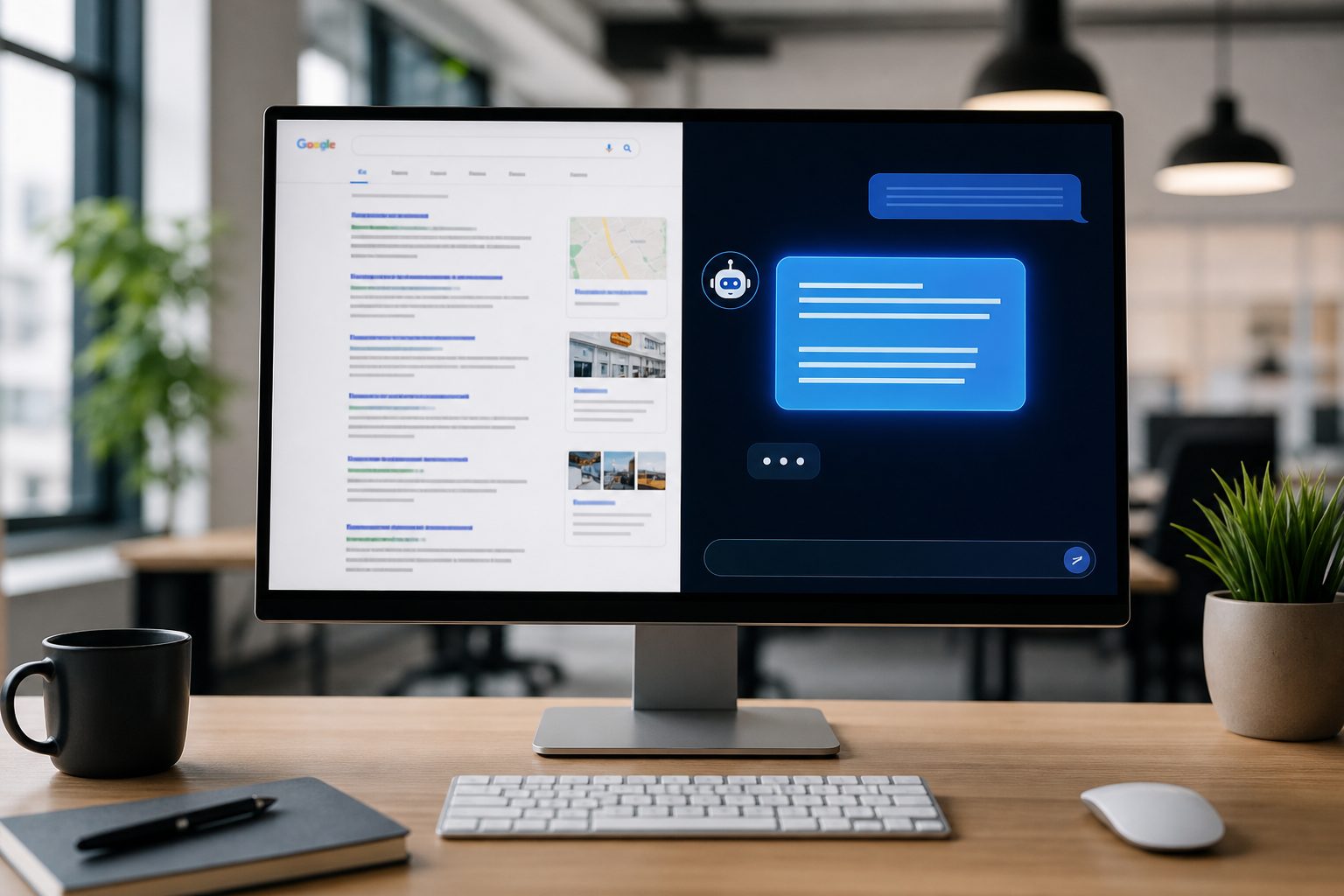
Traditional SEO and AI SEO are two distinct but complementary approaches to online visibility — and Australian businesses need both in 2026. Traditional SEO focuses on ranking your website on Google’s classic blue-link results page through keyword optimisation, backlinks, and technical foundations. AI SEO (also called AEO or GEO) goes further, optimising your content to be retrieved, understood, and cited by AI-powered platforms like ChatGPT, Perplexity, Google AI Overviews, and Gemini. The goal has shifted: it’s no longer just about earning the click — it’s about earning the citation and the mention inside an AI-generated answer that millions of Australians now see before they ever scroll to a search result.
The Landscape Has Changed — Here’s the Data
This isn’t a slow transition. The numbers are stark:
- Google AI Overviews now reach 2 billion users monthly
- Roughly 60% of searches on traditional search engines yield no clicks at all
- When an AI summary appears in search results, only 8% of users click the traditional links below it — versus 15% when no AI summary appears
- AI search traffic grew 527% year-over-year from 2024 to 2025
- AI search traffic is projected to surpass traditional search traffic by 2028
- The average AI search visitor is worth 4.4x more than a traditional organic visitor
These figures don’t mean traditional SEO is obsolete — they mean it’s no longer sufficient on its own. The businesses that win in 2026 are the ones running both strategies in parallel.
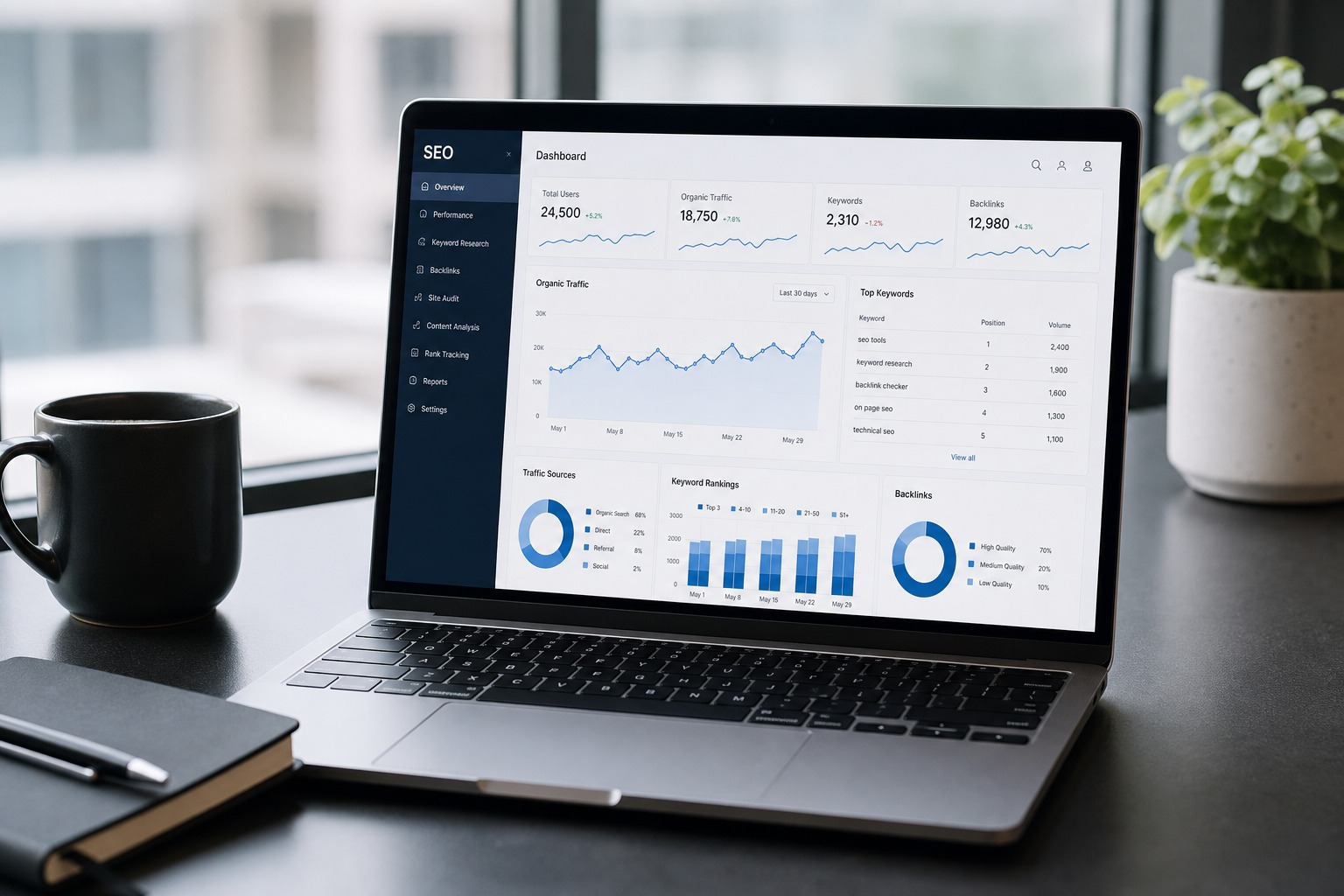
What Is Traditional SEO?
Traditional SEO is the practice of optimising your website to rank on page one of Google’s classic search results. It has three core pillars:
1. Technical SEO
Technical SEO ensures search engines can crawl and index your site efficiently. This includes site speed, Core Web Vitals, mobile responsiveness, clean URL structures, XML sitemaps, and structured data markup. Without a technically sound site, no amount of content or link building will compensate.
2. On-Page SEO
On-page SEO optimises individual pages for target keywords. This covers title tags, meta descriptions, header hierarchy (H1/H2/H3), keyword placement, internal linking, image alt text, and content depth. The goal is to signal to Google exactly what each page is about and why it deserves to rank.
3. Off-Page SEO
Off-page SEO builds authority through backlinks from reputable websites, brand mentions, and digital PR. Google interprets links from high-authority domains as votes of confidence. The more credible sites that link to yours, the more Google trusts your content.
Traditional SEO works exceptionally well for transactional and local queries — searches like “plumber Gold Coast”, “buy running shoes online”, or “accountant Brisbane”. These searches drive high-intent traffic from people ready to act. For these keywords, AI Overviews rarely appear, and organic rankings still directly drive clicks and revenue.
What Is AI SEO?
AI SEO — also called Answer Engine Optimisation (AEO) or Generative Engine Optimisation (GEO) — is the discipline of optimising your content and digital presence so that AI-powered platforms understand, trust, and cite your business when generating answers.
Instead of optimising for a ranking position, you’re optimising to become the source an AI model references. The win state is fundamentally different:
- Traditional SEO win: User sees your blue link and clicks it
- AI SEO win: AI cites your content in its answer — with or without a click
AI SEO optimises for a different set of signals than traditional SEO. It emphasises:
- Semantic clarity: Writing that directly answers specific questions in plain language
- Entity recognition: Consistently naming your business, services, location, and people so AI models build an accurate entity graph around you
- Topical authority: Deep coverage of a topic cluster so AI engines trust you as an authoritative source
- Structured content: FAQ sections, numbered lists, definition boxes, and schema markup that AI engines can extract and reproduce
- Citation signals: Being mentioned alongside authoritative brands, earning links from trusted sources, and maintaining consistent NAP (Name, Address, Phone) data across the web
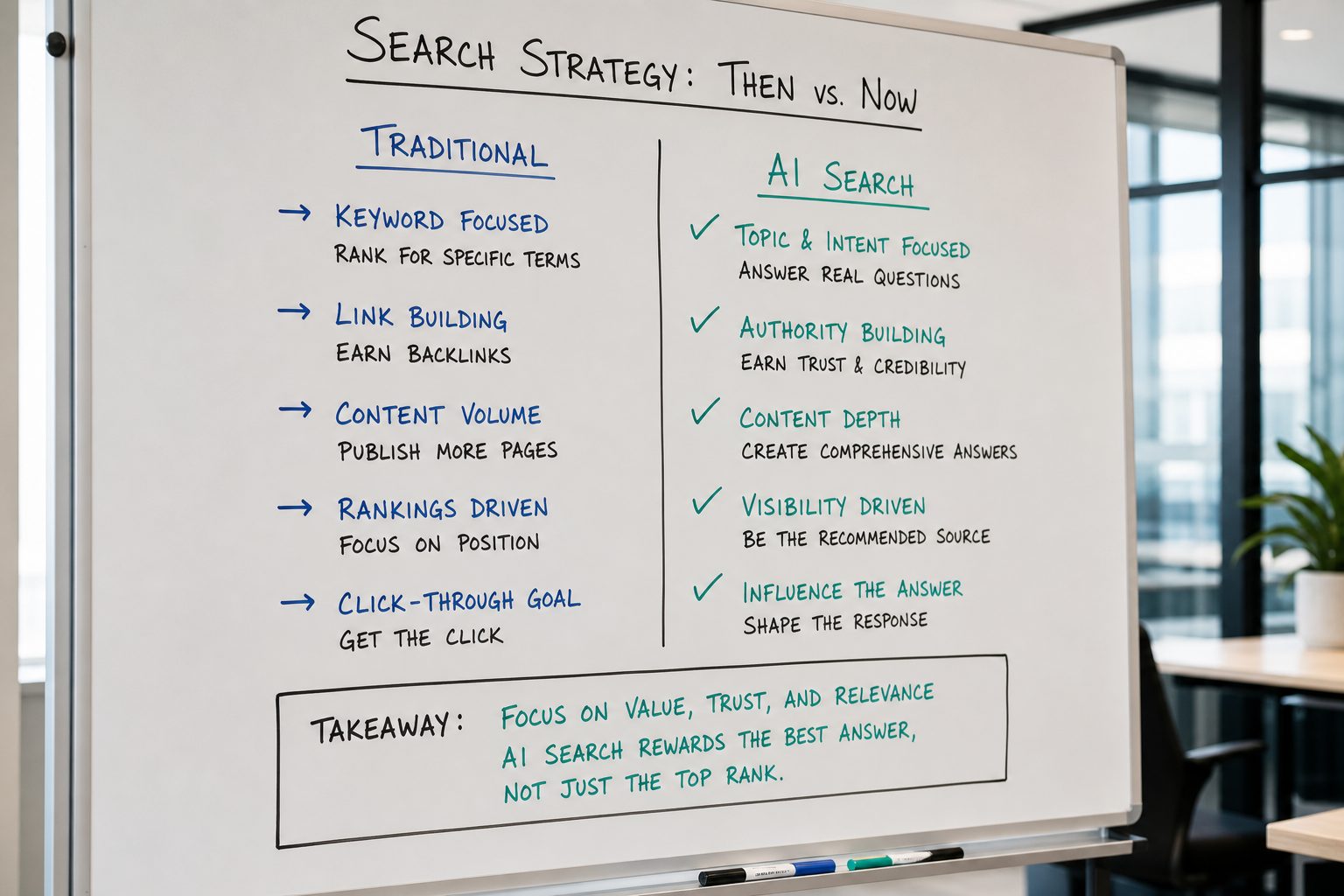
Traditional SEO vs AI SEO: Head-to-Head Comparison
Understanding where the two approaches diverge — and where they overlap — is essential for building the right strategy.
Goal
Traditional SEO: Rank on page one of Google and earn organic clicks.
AI SEO: Be cited or mentioned in AI-generated answers, summaries, and responses.
Primary Success Metric
Traditional SEO: Keyword rankings, organic click-through rate, and organic traffic.
AI SEO: AI citation frequency, brand mention share, and zero-click impressions.
Content Approach
Traditional SEO: Keyword-focused content optimised for a target term. Breadth of coverage across many keywords.
AI SEO: Question-focused content that directly answers user queries. Depth of coverage on specific topics, with fan-out query architecture that anticipates the sub-questions AI engines ask.
Links and Authority
Traditional SEO: Backlinks from high-authority domains are the primary off-page signal.
AI SEO: Backlinks still matter, but brand mentions, entity associations, and third-party citations in trusted sources carry additional weight.
Keyword Strategy
Traditional SEO: Target high-volume keywords with clear search intent.
AI SEO: Target conversational, long-tail, and question-based queries — even low-volume ones, since over 68% of AI Overview-triggering terms get 100 or fewer monthly searches.
Technical Requirements
Traditional SEO: Core Web Vitals, mobile responsiveness, clean crawl paths, XML sitemaps.
AI SEO: All of the above, plus structured data (FAQ, HowTo, Article schema), semantic HTML, and entity markup that helps AI systems understand what your content is about.
Where Each Works Best
Traditional SEO: Local and transactional queries (service businesses, ecommerce, local directories). Google AI Overviews rarely appear for these searches, so organic rankings still drive direct traffic.
AI SEO: Informational and research queries. Over 88% of AI Overview-triggering queries have informational intent — comparisons, how-tos, explanations, and industry questions where AI answers are now the first thing users see.
Where Traditional SEO and AI SEO Overlap
The most important insight for Australian businesses: AI search depends on traditional SEO to function. AI engines don’t invent information. They pull from indexed web content, authority signals, structured data, and trusted sources to generate answers.
Research shows that 97% of AI Overview citations come from pages already in the top 20 organic results. This means:
- If your pages don’t rank organically, they almost certainly won’t be cited by AI
- Traditional SEO is the foundation — AI SEO is the layer on top
- Investing in one strengthens the other
Both disciplines share the same core requirements:
- High-quality, expert-written content — thin or generic content fails in both traditional and AI search
- Technical health — crawlable, fast, mobile-optimised sites perform better across all search types
- E-E-A-T signals (Experience, Expertise, Authoritativeness, Trustworthiness) — Google and AI engines both reward demonstrated expertise
- Consistent brand presence — authoritative brands rank better and get cited more
5 Practical Differences That Change Your Day-to-Day Strategy
1. How You Structure Content
Traditional SEO rewards comprehensive, keyword-rich content. AI SEO adds a requirement: every section must directly answer a specific question in its opening sentence. AI engines decompose a query into sub-queries (they “fan out”), so your H2/H3 headings should be written as questions — and answered immediately, not after a paragraph of preamble.
2. How You Measure Success
Traditional SEO is measured in rankings and organic traffic. AI SEO requires you to track a new set of metrics: How often does ChatGPT mention your brand? Are you cited in Google AI Overviews for your target queries? Is your brand appearing in Perplexity answers? Tools like Semrush’s AI Toolkit, BrightEdge, and manual citation tracking are becoming essential.
3. How You Think About Keywords
Traditional SEO starts with keyword volume — find what people search for and rank for it. AI SEO starts with questions — what would someone ask an AI assistant about your industry? These conversational, long-tail queries often have very low search volumes in traditional tools, but they’re precisely the queries that trigger AI-generated answers.
4. How You Build Authority
Traditional SEO builds authority through backlinks. AI SEO builds authority through a broader concept: citation worthiness. This includes being mentioned alongside respected brands, having consistent and accurate information across directories and platforms, earning coverage in industry publications, and being cited as a source in other websites’ content.
5. How You Use Structured Data
Traditional SEO uses structured data (Schema.org markup) primarily to earn rich snippets in search results. AI SEO uses structured data to help AI systems understand the entities on your page — who you are, what you do, your location, your credentials. FAQ schema, HowTo schema, and Article schema are particularly valuable for AI citation.
If you’re not sure whether your site is set up for AI search, Titan Blue’s AI readiness assessment identifies exactly where the gaps are.
Do You Need Traditional SEO, AI SEO, or Both?
The honest answer for most Australian businesses is: both, but the balance depends on your business model.
Prioritise Traditional SEO When:
- You’re a local service business (tradie, restaurant, clinic, law firm)
- Most of your revenue comes from transactional searches (“buy”, “near me”, “hire”)
- Your customers are comparing prices or looking for a specific location
- Your Google Business Profile is your primary digital real estate
Prioritise AI SEO When:
- Your business targets informational queries (B2B, consulting, professional services, education)
- You’re building brand authority and want to be known as the go-to expert in your field
- Your customers research extensively before buying
- You want to be mentioned in ChatGPT, Perplexity, and Google AI Overviews responses
Run Both When:
- You serve both local/transactional and informational queries
- You’re a Gold Coast or Australian business competing in a national or multi-city market
- You have the resources to invest in content depth alongside technical foundations
- You want to future-proof against the projected shift of AI traffic surpassing traditional search by 2028
The businesses that are pulling ahead in 2026 aren’t choosing between traditional and AI SEO. They’re running an integrated strategy: strong technical foundations (traditional SEO), deep expert content (serves both), and structured, question-answering content architecture (AI SEO layer). Titan Blue’s SEO services are built around exactly this integration.
The Migration Path: From Traditional to Integrated SEO
If your current strategy is purely traditional SEO, here’s how to evolve it without throwing out what’s working:
- Audit your existing content: Identify your top-performing pages and check whether each one directly answers the question implied by its title. If not, rewrite the opening paragraphs.
- Add FAQ sections: Every informational page should have a FAQ section with 5–8 questions using proper
<h3>tags and concise answers. These are AI-extractable and dramatically improve citation rates. - Implement schema markup: Add FAQ schema, Article schema, and LocalBusiness schema at minimum. For service businesses, add Service schema. This gives AI engines structured signals about your content.
- Build topical clusters: Instead of one-off keyword pages, build interconnected content clusters around core topics. AI engines trust sources with comprehensive, consistent coverage of a subject.
- Track new metrics: Set up monitoring for AI citations. Ask ChatGPT and Perplexity about your industry — are you mentioned? This becomes your new benchmark alongside traditional rankings.
- Strengthen your entity presence: Ensure your Google Business Profile is complete, your NAP is consistent across all directories, and your brand name appears consistently with your expertise signals across the web.
This isn’t a replacement project — it’s an extension. Traditional SEO done well creates the organic authority that AI search draws from. The businesses seeing the best results in 2026 are the ones treating AI SEO as a natural evolution, not a revolution. Need help building this integrated strategy for your Gold Coast or Australian business? Talk to Titan Blue.
FAQ: Traditional SEO vs AI SEO
Is traditional SEO still worth doing in 2026?
Yes. Traditional SEO remains essential, particularly for transactional and local queries where AI Overviews rarely appear. Google’s classic organic results still drive significant traffic for high-intent searches, and 97% of AI Overview citations come from pages already ranking in the top 20 organic results — meaning traditional SEO is the foundation that enables AI visibility.
What’s the main difference between traditional SEO and AI SEO?
Traditional SEO optimises for keyword rankings and organic clicks. AI SEO optimises to be cited or mentioned in AI-generated answers from platforms like ChatGPT, Perplexity, and Google AI Overviews. The goal shifts from “earn the click” to “earn the citation and the brand mention inside the AI answer.”
Do I need to choose between traditional SEO and AI SEO?
No — you need both. AI search depends on traditional SEO infrastructure (indexed, authoritative, well-structured content) to function. AI SEO is the strategic layer you build on top of strong traditional foundations, not a replacement for them.
Which queries are most affected by AI SEO?
Informational queries are most affected — over 88% of AI Overview-triggering searches have informational intent. How-to guides, comparisons, explanations, and industry questions are where AI answers now appear prominently. Transactional and local queries (“buy X”, “near me”) still predominantly show traditional organic results.
How do I measure AI SEO success?
Track AI citation frequency by manually querying ChatGPT, Perplexity, and Google AI Overviews with your target questions and checking for brand mentions. Use tools like Semrush’s AI Toolkit, BrightEdge, or Ahrefs to monitor AI Overview appearance. Brand mention monitoring tools like Mention or Brand24 can capture citations across AI platforms over time.
Does AI SEO require different content than traditional SEO?
It requires additional structure. AI SEO content must answer questions directly in the first 1-2 sentences of each section, include FAQ blocks with concise answers, use schema markup, and be written with enough entity clarity that AI engines can identify who you are, what you do, and where you operate. The underlying quality requirements (expert, accurate, in-depth) are the same.
How quickly does AI SEO work?
AI citations can appear faster than traditional rankings — sometimes within weeks of publishing well-structured, authoritative content. However, sustained AI visibility requires building topical authority over time, which is a 3-6 month minimum investment for most businesses.
Can a small Australian business compete with large brands in AI search?
Yes — and sometimes more effectively than in traditional SEO. AI engines often cite the most clearly structured, directly relevant answer rather than the biggest brand. A well-written, expertly positioned answer from a Gold Coast specialist can outperform a generic national brand’s content if it directly addresses the question with more clarity and specificity.
The Bottom Line for Australian Businesses
The search landscape in 2026 is not a choice between traditional and AI SEO — it’s a both/and strategy. Traditional SEO remains the technical and authority foundation your site needs. AI SEO is the strategic evolution that ensures your brand appears in the AI answers your customers are now seeing first.
Australian businesses that invest in both approaches now are positioning themselves ahead of the projected 2028 inflection point, when AI search traffic is expected to surpass traditional search traffic. The businesses waiting for that shift to happen before they act will already be 18 months behind.
Titan Blue’s digital marketing services are built around this integrated approach — combining the technical SEO foundations that have worked for over two decades with the AEO and GEO optimisation strategies your business needs to stay visible as AI search reshapes how Australians find businesses like yours.
Make Titan Blue a preferred source in Google
One click tells Google to surface our articles more often in Top Stories, AI Overviews and AI Mode.

Structured Data and Web Design Best Practices 2026
Learn how to combine structured data with web design, choose accurate schema, generate maintainable JSON-LD,…

AEO and GEO for Australian Businesses: How to Get Recommended by ChatGPT and Google AI Mode
A field guide to getting recommended by AI answer engines in Australia, built on our…

Web Design Mistakes Killing Your AI Visibility (2026)
The web design mistakes killing your AI visibility in 2026, and how to fix each…