


Last updated:
You’ve probably felt it already.
A customer used to search “emergency plumber Burleigh Heads” or “best breakfast Broadbeach”, click your site, and either book or call. Now they get an instant answer from Google, a map pack, an AI summary, and sometimes enough information to make a decision without ever visiting your website. Your rankings might look steady, but enquiries feel softer. Bookings dip. Calls become less predictable.
That’s where AI SEO Gold Coast stops being a buzzword and becomes a business issue. For local cafes, restaurants, tradies, builders, solar installers, and hospitality operators, the job isn’t just to rank anymore. The job is to be the business that search engines and AI systems choose to cite, summarise, recommend, and surface when someone asks for help nearby.
Why Your Gold Coast Business Is Disappearing Online
A lot of Gold Coast business owners assume a drop in organic traffic means their website is broken, a competitor has overtaken them, or Google has penalised them. Sometimes it’s simpler than that. Search itself has changed.
In Australia, AI search traffic rose 527% year-over-year, and up to 68% of relevant searches now trigger AI-generated Overviews, which changes how people discover local businesses (Semrush AI SEO statistics). If you rely on website clicks from local intent searches, that shift matters immediately.
A cafe in Surfers Paradise can have strong reviews, a clean site, and solid menu pages, yet still lose visits because Google answers “best cafe near me with outdoor seating” directly. A plumber in Mermaid Waters can still rank, but the customer may call whoever appears most clearly in the summary, map result, or AI-generated recommendation. Visibility now happens before the click.
Ranking isn’t the same as being chosen
Traditional SEO focused heavily on getting your page higher in search results. That still matters, but it’s no longer the full game.
AI-driven search looks for businesses with clear service information, strong location relevance, trustworthy signals, and content that answers real questions in plain language. If your website is vague, thin, or poorly structured, AI systems have less to work with. That often means less exposure even when you technically “rank”.
Practical rule: If your site only works when someone clicks through and reads carefully, it’s already under pressure from AI search.
That’s why many local owners start by asking why traffic is down even though the business itself is still strong. If that sounds familiar, this guide on why your business isn’t showing up on Google is a useful place to diagnose the basics before you change strategy.
There’s also a broader shift in how marketers measure presence. If you want a practical way to think about winning in an AI-driven search world, focus less on blue-link rankings alone and more on whether your brand appears across maps, summaries, citations, and answer engines.
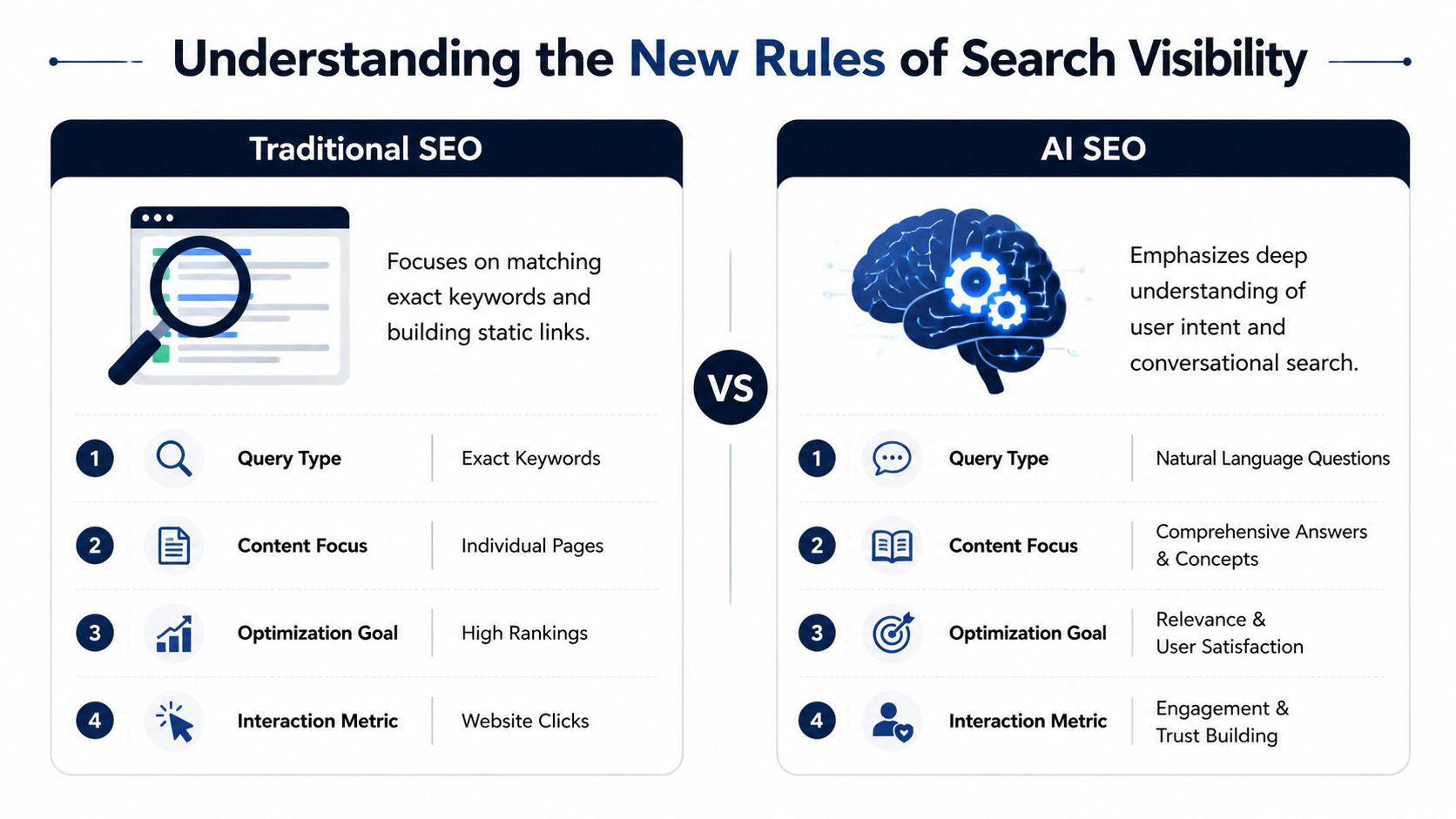
Understanding the New Rules of Search Visibility
Traditional SEO was like giving Google a map to your business. You added keywords, built links, optimised title tags, and hoped your page would rank.
AI SEO is closer to training a knowledgeable local guide. That guide needs to understand what you do, where you operate, which problems you solve, and why someone should trust your business over the next option down the road.
What changed
The old model rewarded exact-match targeting. If someone searched “solar installer Gold Coast”, businesses created a page around that phrase and tried to outrank everyone else.
The newer model still notices relevance, but it also looks at meaning, context, and completeness. AI systems are far better at interpreting natural questions such as:
- “Who installs solar for family homes near Burleigh?”
- “Which Gold Coast plumber handles urgent hot water issues on weekends?”
- “Where can I get a casual dinner in Broadbeach with kids?”
That means your pages need to answer the question behind the keyword, not just repeat the keyword itself.
What works now
Search visibility is moving toward structure, clarity, and authority. In practice, that usually means:
- Clear service pages: One page for one service and one location intent, instead of generic catch-all copy.
- Question-led content: FAQs, service explanations, and booking pages written around actual customer language.
- Strong internal linking: Pages that help Google and AI tools understand how your services connect.
- Structured data: Schema markup that labels your business details in a machine-readable way.
A page that says “we offer quality plumbing solutions” tells AI almost nothing. A page that explains blocked drains, emergency callouts, service areas, response process, and booking options gives it usable context.
For many businesses, the fastest starting point is a proper technical and content review. If you need a practical checklist before making changes, this step-by-step website audit guide is worth reading because it helps separate real structural problems from surface-level SEO tweaks.
The goal has shifted
The goal used to be traffic first. The newer goal is trustworthy visibility first, then qualified traffic.
That’s why AI SEO Gold Coast is really about discoverability across answer engines, not just Google’s old link list. Businesses that want to adapt need content and technical foundations built for generative search, which is why many local operators are now looking at Generative Engine Optimisation alongside standard SEO work.
Why AI Search Matters in a Tourist Hotspot
Friday night in Surfers Paradise, a visitor searches “best pasta near me open now.” At the same time, a Burleigh homeowner searches “emergency plumber leaking hot water system.” Both want a fast answer. Both are ready to act. And in many cases, they will choose from what Google or an AI summary shows before they ever visit a website.

That matters more on the Gold Coast than in a slower local market. Search demand shifts by suburb, season, school holidays, weather, and event traffic. A restaurant in Broadbeach competes for visitors who may never have heard its name. A plumber in Southport or Burleigh competes in high-urgency moments where the first trustworthy option often gets the call.
Local intent decides who gets the job
Local search has always mattered for service businesses and hospitality, but AI search tightens the window. People are not browsing for long. They are comparing a small set of options and making quick decisions based on location, relevance, reviews, opening hours, and how clearly the business fits the request.
On the Gold Coast, that has direct commercial consequences.
A cafe does not need random traffic from interstate readers who will never book a table. It needs to show up for nearby searches with real intent, such as breakfast in Broadbeach, dog-friendly coffee in Mermaid Beach, or dinner before a show in Surfers Paradise. A plumbing company does not need extra impressions for broad DIY queries. It needs calls from people in the right suburb who want help now.
That is why AI-powered search for Gold Coast businesses matters. It changes who gets seen first in the moments that produce bookings, calls, and walk-ins.
Zero-click search is already affecting local buyers
A growing share of searches end without a site visit. The user gets enough from Google Business Profile, map results, review snippets, or an AI-generated answer to make a choice on the spot.
For local operators, that creates a real trade-off. Lower website traffic can look like a loss in a monthly report. But if your business details are clear and consistent, you can still win the enquiry without the click. A diner may tap for directions. A tourist may call straight from the search result. A homeowner with a burst pipe may pick the business that appears closest, most relevant, and easiest to contact.
On the Gold Coast, where visitors often make fast decisions from their phones, that shift is hard to ignore.
Businesses are more likely to be surfaced in these high-intent moments when their information matches the search clearly, especially for queries such as:
- Late breakfast in Surfers Paradise
- Family-friendly dinner near Broadbeach
- Emergency plumber in Burleigh Heads
- Same-day electrician in Southport
- Solar installer for southern Gold Coast suburbs
The commercial point is simple. If search platforms answer the question before the click, your business still needs to be part of that answer. Otherwise, a competitor gets the booking and you pay for a website that stays invisible when demand is highest.
Future-Proofing Your Website for AI Search
At this stage, most businesses either make real progress or waste money.
They hear “AI SEO” and assume they need a flood of auto-written blog posts. They don’t. What they need is a site that answers customer questions clearly, organises information properly, and labels business details so machines can read them.

Success in AI search hinges on Answer Engine Optimisation, which relies on technical implementations like schema markup and a semantic content structure to ensure your business information is machine-readable and selected for AI-generated answers (Answer Engine Optimisation for Gold Coast businesses).
Start with answer-focused service pages
A lot of local websites still use broad pages with generic sales copy. That’s weak for AI search because it doesn’t answer enough.
A better page for a plumber doesn’t just say “professional plumbing services on the Gold Coast”. It answers practical questions:
- What jobs do you handle
- Which suburbs do you service
- Do you offer emergency callouts
- What should the customer do before you arrive
- How can they book or call quickly
A better restaurant page doesn’t just promote atmosphere. It covers cuisine, booking options, location cues, opening hours, dietary info, and what sort of visit the venue suits.
Build content around real customer language
AI tools respond well to content that mirrors how people ask questions. That means conversational headings and direct answers.
Examples that work locally include:
- How quickly can a plumber get to Burleigh Heads
- What size solar system suits a family home on the Gold Coast
- Where to book a casual waterfront lunch near Broadbeach
- What to do when your hot water system stops working
These shouldn’t live only in blog posts. They often belong inside service pages, location pages, and FAQ sections.
Field note: Thin AI-generated copy usually fails because it sounds complete while skipping the details customers and search systems need.
Use schema to remove guesswork
Schema markup helps search engines understand exactly what your page represents. It’s one of the clearest technical wins in AI SEO Gold Coast work because it turns ambiguous website content into labelled data.
For local businesses, useful schema often includes:
- Business details: Name, address, opening hours, phone, and service area
- Service information: What you do and where you do it
- FAQ content: Clear answers to recurring customer questions
- Reviews and menus where relevant: Especially helpful for hospitality and restaurant businesses
For example, a restaurant can mark up menu and review information. A plumbing business can mark up service areas and opening hours. That doesn’t guarantee AI visibility on its own, but it gives systems a much cleaner data layer to work with.
Fix the site architecture
AI visibility doesn’t sit on one page. It depends on the whole site making sense.
That usually means cleaning up navigation, removing duplicate pages, improving internal links, and making sure related topics sit in logical clusters. One service page should support another. One FAQ should reinforce a service. One location page should connect naturally to the core offer.
If your current site feels messy, dated, or hard to expand, this guide on whether your website is AI-ready is a practical place to assess what needs rebuilding first.
One local option in this space is Titan Blue Australia, which offers AI search, content, SEO, and AEO services from Broadbeach. The more important point, though, is the method. The agency or consultant you choose needs to improve clarity, structure, and business outcomes, not just publish more pages.
What to Look for in a Digital Agency in 2026
A lot of agencies still sell yesterday’s SEO with a new label on it. They talk about AI, then deliver keyword reports, light blog content, and ranking screenshots. That won’t be enough for a business trying to protect bookings and leads.
The agency you hire should be able to explain, in plain English, how your business will become easier for search engines and AI systems to understand, trust, and recommend.
Ask how they measure business impact
A strong agency won’t hide behind traffic charts. They’ll connect visibility work to calls, form fills, bookings, quote requests, and revenue quality.
That matters because ROI quantification is a critical service. Australian SMBs facing declining organic visibility need an agency that can build a data-backed business case for AI SEO, not just promise more impressions (why ROI modelling matters for AI SEO).
Ask direct questions:
- How will you track leads, not just rankings
- Can you separate branded traffic from non-branded growth
- What pages are expected to influence enquiries first
- How will you report on AI search visibility qualitatively if the platform data is still imperfect
Look for technical depth, not just content production
If an agency talks endlessly about AI-written articles but says little about schema, internal linking, content architecture, or local entity signals, that’s a warning sign.
High-quality AI SEO work typically involves a mix of technical SEO, structured data, Google Business Profile alignment, better page formatting, and content that is useful. It also requires local judgement. A Broadbeach restaurant, a Southport builder, and a Burleigh plumber should not receive the same template.
The right agency doesn’t just ask what keyword you want to rank for. They ask what kind of enquiry you need more of.
If you want a broader perspective on what agencies should now handle, promptposition’s agency insights provide a useful outside view of how the service model is changing.
Local knowledge still matters
Gold Coast search behaviour has its own rhythm. Tourism, suburb identity, mobile discovery, and service-area intent all shape how people search and choose.
That’s why a local operator should give weight to agencies that understand both classic local SEO and newer AI-search mechanics. If you’re comparing providers, this overview of local SEO agencies helps frame what capability should look like beyond a generic monthly package.
Frequently Asked Questions About AI SEO
Is AI SEO expensive for a small business
It can be, if you pay for the wrong things.
The expensive version is chasing every new AI tool, publishing low-value content at scale, and paying for reports that don’t explain whether enquiries improved. The practical version is tighter. Fix the site structure, improve key service pages, add schema, strengthen your local signals, and build content around common sales questions. That’s usually a more sensible path for a cafe, plumber, builder, or installer.
How long does it take to see results
Some changes help quickly, especially when they clean up weak service pages, improve internal linking, or make key business information easier to interpret. Broader authority gains take longer.
The mistake is expecting instant wins from AI-generated content alone. Search systems still need trust, consistency, and a clear site structure. If your site has years of clutter or thin content, the first gains often come from simplification, not expansion.
Can I do some of this myself
Yes. Many businesses can handle the first layer internally.
You can tighten page copy, answer customer questions more directly, improve headings, add clearer suburb references, and review whether every main service has a proper landing page. If you already know the questions people ask on the phone every day, you’re sitting on valuable content ideas.
When should I bring in an agency
Bring in help when technical changes, schema, tracking, or content architecture start getting beyond your time or skill set. Most owners can spot a weak page. Fewer can design a site-wide information structure that supports AI visibility and lead generation together.
If your team is guessing what to write next, or publishing content without a conversion path, you probably need strategy before you need more content.
Is AI SEO replacing normal SEO
No. It’s changing the standard.
Fast websites, strong local pages, clear metadata, and good internal linking still matter. What’s changed is the output you’re aiming for. You’re no longer optimising only for ten blue links. You’re building a business presence that can be interpreted, summarised, and recommended across search experiences.
Secure Your Digital Future on the Gold Coast
AI search isn’t a future trend for local business. It’s already shaping who gets noticed, who gets cited, and who gets overlooked.

For Gold Coast operators, the pressure is sharper because local intent is immediate. Visitors want somewhere to eat now. Homeowners want a tradie now. Businesses need suppliers now. If your site can’t be read clearly by AI systems and search engines, you lose visibility at the exact moment demand appears.
The answer isn’t panic publishing or chasing every new platform. It’s disciplined work. Clean service pages. Better local signals. Proper schema. Content that answers real questions. Tracking that ties digital visibility back to calls, bookings, and leads.
That investment has a clear upside. Gold Coast businesses implementing effective AI SEO strategies achieved an average 40% improvement in organic traffic within the first quarter, based on hands-on analysis shared in 2025 (AI SEO tool analysis for Gold Coast businesses).
The businesses that adapt early will be easier to find and easier to trust. The ones that cling to old SEO habits will keep wondering why traffic slips while competitors get the calls.
If you run a restaurant, trade business, construction firm, hospitality venue, or service company on the Coast, now’s the time to treat AI SEO Gold Coast as part of your core growth strategy, not an optional add-on.
If you want a practical strategy built around bookings, leads, and local visibility, talk to Titan Blue Australia. From Broadbeach, they work with Gold Coast businesses to improve search presence across traditional SEO, AI search, website structure, and content so your business stays visible where customers look.
Make Titan Blue a preferred source in Google
One click tells Google to surface our articles more often in Top Stories, AI Overviews and AI Mode.

This Week in Australian AI Search: Google’s UGC Data Program
Google's UGC Fresh Data Program and Indexing API quota update, plus our Google AI Mode…

Google AI Mode Adds Official Links: What It Means for Australia
Google is adding more links to AI Mode and testing an official websites section. Here…

Best AEO and GEO Agencies in Australia (2026): 7 Compared
Best AEO agency and GEO agency in Australia, compared: seven agencies, what their own pages…