Digital marketing trends 2026: Australian SMB growth guide
Australian small and medium businesses leveraging AI SEO increase organic traffic by 35% within six months. Yet countless SMB owners remain paralysed by choice, unsure which 2026 trends warrant investment and which waste precious resources. This guide clarifies the most impactful digital marketing strategies for Australian businesses, providing actionable frameworks to select, prioritise, and implement trends aligned with your goals and capacity.
Focused implementation based on business size and goals outperforms adopting every emerging tactic simultaneously
Combining paid and organic channels maximises marketing returns
Integrated digital strategies amplify reach and conversion performance across customer touchpoints
Local market expertise enhances digital effectiveness
Tailored approaches for Australian search behaviour and regional competition improve results
The digital landscape for Australian SMBs in 2026
Digital adoption among Australian small businesses continues accelerating in 2026, yet progress remains uneven across sectors and regions. Many SMBs face persistent obstacles including limited marketing budgets, internal skill gaps, and intensifying local competition.
Artificial intelligence technologies now fundamentally reshape marketing capabilities. Tools that once required specialist knowledge or enterprise budgets have become accessible to businesses with modest resources. This democratisation creates opportunities but also demands strategic selection.
Key challenges confronting Australian SMBs include:
Determining which digital trends deliver measurable ROI versus fleeting hype
Allocating constrained budgets across competing channels and tactics
Building internal capabilities or identifying trustworthy external partners
Competing against larger rivals with greater marketing resources
Adapting strategies to rapidly evolving consumer search behaviour
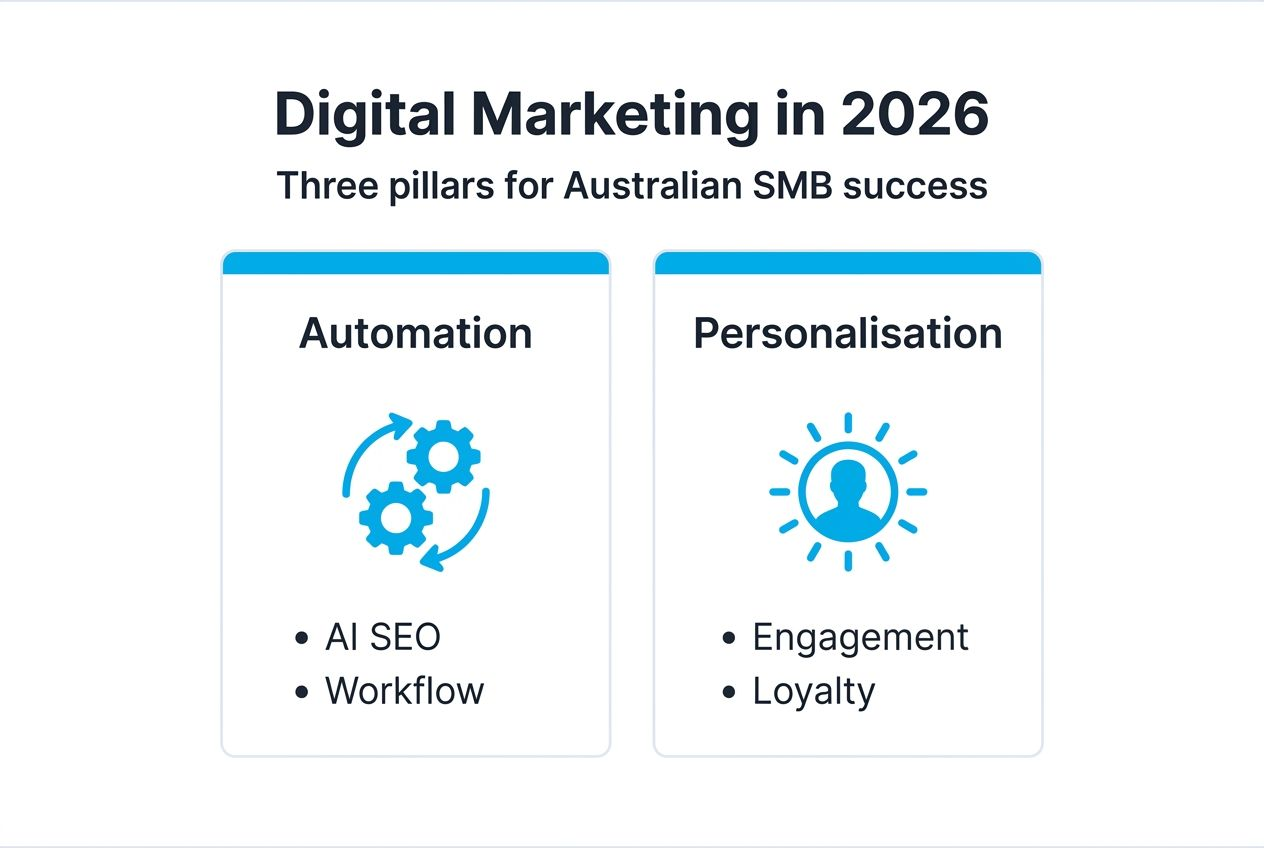
The three pillars of digital marketing for Australian SMBs in 2026 organise this complexity into AI-driven automation, personalised customer engagement, and local search optimisation. Understanding how these pillars interconnect helps you make informed investment decisions. A digital marketing checklist ensures systematic implementation without overlooking foundational elements.
Emerging AI-driven marketing technologies
AI SEO, Generative Engine Optimisation (GEO), and Answer Engine Optimisation (AEO) represent the most significant shifts in organic search strategy for 2026. These technologies enhance how search engines and AI assistants discover, interpret, and recommend your content.
AI SEO applies machine learning to analyse search patterns, predict ranking factors, and optimise content at scale. Generative Engine Optimisation specifically targets how AI systems like ChatGPT, Google Gemini, and Perplexity cite and recommend businesses. AEO focuses on voice assistants and direct answer formats.
Traditional SEO versus AI-enhanced approaches:
Approach
Focus
Primary Benefit
Implementation Complexity
Traditional SEO
Keywords, backlinks, metadata
Proven ranking stability
Moderate, well-documented
AI SEO
Semantic understanding, user intent
Adaptive content optimisation
Moderate, requires tools
GEO
AI system recommendations
Visibility in conversational search
High, emerging best practices
AEO
Voice queries, featured snippets
Local mobile conversions
Moderate, structured data focus
Research confirms AI SEO increases organic traffic by up to 35% within six months when properly implemented. This improvement stems from better content alignment with actual search intent rather than rigid keyword matching.
Effective AI-driven tactics include:
Structuring content to answer specific questions conversational AI systems understand
Implementing schema markup that helps AI assistants extract and cite information
Optimising for topic clusters rather than isolated keywords
Creating FAQ sections that directly address common voice queries
Pro Tip: Start with one AI tool that addresses your biggest visibility gap rather than adopting multiple platforms simultaneously. Master AI search engine optimisation basics before expanding to advanced techniques. This approach balances capability building with manageable costs and learning curves.
For Australian SMBs, SEO for small business combines these AI technologies with local market understanding. Geography-specific optimisation remains crucial even as AI systems become more sophisticated.
Answer engine optimisation for local businesses
Answer Engine Optimisation addresses the fundamental shift in how Australians search for local businesses in 2026. Voice assistants and mobile search increasingly prioritise direct answers over traditional ranked results.
When someone asks their phone “where’s the best cafe near me” or “which electrician in Brisbane has weekend availability”, AI-driven local optimisation dramatically improves conversion rates for businesses properly positioned to answer. AEO ensures your business appears in these high-intent moments.
Best practices for local AEO implementation:
Structure your website content around questions customers actually ask, using natural language rather than keyword-stuffed phrases
Implement local business schema markup that explicitly tells search engines your location, hours, services, and contact information
Create location-specific landing pages that address regional search variations and local competition
Optimise Google Business Profile with complete information, regular updates, and genuine customer reviews
Ensure mobile site speed under two seconds, as voice search users expect immediate information
Build FAQ sections that directly answer common voice queries in your industry
Infrastructure considerations matter enormously for local businesses. Slow mobile experiences cause searchers to move to competitors even when your content ranks well. Voice assistants prioritise sites that load quickly and provide clear, structured information.
Pro Tip: Claim and optimise your business listings across Google Business Profile, Apple Maps, and Bing Places. These platforms feed data to voice assistants and local search features. Consistent information across platforms signals reliability to both users and algorithms.
Strategies for boosting local SEO in competitive markets require understanding regional search behaviour. Local search strategies for Sydney differ from approaches effective in regional Queensland or rural Victoria. Professional SEO services for small businesses navigate these geographical nuances while implementing technical optimisations many SMBs lack capacity to handle internally.
Common misconceptions about digital marketing trends
Several persistent myths about 2026 digital marketing lead Australian SMBs toward inefficient investments and strategic errors. Recognising these misconceptions helps you allocate resources more effectively.
Myth: AI technologies will replace marketing staff entirely. Reality shows AI augments human creativity and strategic thinking rather than eliminating roles. The most successful businesses combine AI tools with human oversight, using automation for repetitive tasks while people handle strategy, relationship building, and creative direction.
Another widespread fallacy suggests adopting every emerging trend simultaneously maximises competitive advantage. This scattergun approach actually dilutes resources and prevents mastering any single tactic. Businesses achieve better results by selecting two or three trends aligned with specific goals and implementing them thoroughly.
Many SMB owners believe traditional SEO has become obsolete in the face of AI advances. This misunderstanding causes businesses to abandon proven fundamentals like metadata optimisation and quality content creation. The truth? AI-enhanced tactics work best when built upon solid traditional SEO foundations.
Common strategic errors include:
Chasing every social media platform rather than focusing on channels where your customers actually spend time
Expecting immediate results from organic strategies that require three to six months to demonstrate impact
Neglecting mobile optimisation despite over 70% of Australian searches occurring on mobile devices
Copying competitor tactics without understanding whether they align with your unique value proposition
Investing in paid advertising before establishing basic organic visibility foundations
Strategic adoption based on your specific business context and customer behaviour delivers far better returns than following industry hype or competitor actions blindly.
The most successful Australian SMBs in 2026 take a measured approach. They assess each trend against their goals, test implementation on a small scale, measure results rigorously, then expand what works while discontinuing what doesn’t. This empirical method prevents costly mistakes whilst building institutional knowledge about what truly drives their business growth.
Conceptual framework and strategic choices for SMBs
Australian small and medium businesses need a structured approach to evaluate and prioritise digital marketing investments in 2026. The three-pillar framework organising AI automation, personalised engagement, and local optimisation provides this clarity.
Each pillar addresses distinct business needs:
Pillar
Primary Value
Best For
Resource Requirements
AI Automation
Efficiency, scale
Businesses with repetitive marketing tasks
Moderate, tool subscriptions plus training
Personalised Engagement
Conversion, loyalty
Customer-facing businesses with repeat transactions
High, requires data infrastructure
Local Optimisation
Visibility, foot traffic
Brick-and-mortar or service-area businesses
Low to moderate, mostly execution time
A Gold Coast retailer might prioritise local optimisation and personalised engagement, whilst a Brisbane consultancy focuses on AI automation and thought leadership content. Neither approach is wrong; alignment with business model determines effectiveness.
Systematic evaluation process for trend selection:
Define your primary business goal for the next 12 months (e.g., increase enquiries by 30%, expand into new service area, improve customer retention)
Assess current digital marketing capabilities honestly, identifying specific skill and resource gaps
Research which 2026 trends directly support your primary goal based on evidence and case studies
Calculate realistic implementation costs including tools, training, and ongoing management time
Select one to three trends that offer the highest probability of achieving your goal within budget constraints
Create a phased implementation plan that allows testing and adjustment before full commitment
Establish clear metrics to measure impact and set review points at 30, 90, and 180 days
Resource allocation requires balancing immediate tactical execution with longer-term strategic positioning. Many SMBs succeed by dedicating 70% of marketing resources to proven tactics whilst experimenting with 30% on emerging trends. This ratio provides stability whilst building new capabilities.
Incremental implementation reduces risk. Rather than overhauling your entire digital presence simultaneously, introduce one new tactic, measure its impact, refine your approach, then add the next element. This measured progression prevents overwhelming your team whilst building confidence through demonstrated results.
Practical applications and case studies
Real Australian SMB examples demonstrate how strategic trend adoption translates into measurable business growth. These cases illustrate principles applicable across industries and business sizes.
A Gold Coast professional services firm implemented Generative Engine Optimisation and Answer Engine Optimisation throughout early 2026. Within five months, they achieved:
42% increase in organic website traffic from conversational search queries
28% growth in qualified enquiries, specifically from mobile and voice search users
35% improvement in enquiry-to-client conversion rates due to better-qualified leads
Reduced cost per acquisition by 23% compared to their previous paid advertising focus
Key lessons from their implementation include starting with thorough content audits to identify optimisation opportunities, investing in proper schema markup implementation, and creating location-specific FAQ content addressing common client questions. They scaled tactics gradually, testing approaches on high-value service pages before expanding across their entire site.
A Brisbane retail business combined AI-driven personalisation with local optimisation strategies. Their results included increased foot traffic from local search, higher average transaction values from personalised product recommendations, and improved customer retention through targeted email campaigns. They discovered that personalisation worked best when informed by actual customer behaviour data rather than demographic assumptions.
Successful Australian SMBs share common characteristics in their approach:
Clear definition of success metrics before implementation begins
Regular measurement and willingness to adjust tactics based on data
Focus on quality execution of selected trends rather than superficial adoption of many
Integration of new tactics with existing marketing activities rather than siloed initiatives
Patience to allow organic strategies adequate time to demonstrate impact
These businesses treat digital marketing as strategic experimentation supported by rigorous measurement. They accept that not every tactic will succeed whilst learning from both wins and failures. This empirical mindset enables continuous improvement and adaptation as market conditions evolve throughout 2026 and beyond.
Balancing traditional SEO and emerging trends
Maintaining solid traditional SEO fundamentals alongside adopting AI-driven trends creates sustainable digital growth for Australian businesses. These approaches complement rather than compete with each other.
Traditional SEO elements that remain crucial in 2026 include title tags optimised for target keywords, meta descriptions that encourage click-through from search results, header tag hierarchy that organises content logically, and internal linking structures that distribute authority throughout your site. These fundamentals still significantly influence search rankings.
How traditional and AI tactics work together:
Traditional keyword research identifies topics customers search for; AI SEO then optimises content to match the intent behind those searches
Conventional backlink building establishes domain authority; GEO ensures AI systems recognise that authority when making recommendations
Classic on-page optimisation makes content accessible to search engines; AEO structures that content for voice assistant extraction
Standard technical SEO ensures site crawlability; AI-enhanced approaches add semantic markup that helps algorithms understand content meaning
Neglecting basics whilst chasing new trends leads to poor ranking performance. Businesses with outdated site structures, slow page speeds, or thin content won’t benefit from advanced AI optimisation. The foundation must be solid before adding sophisticated layers.
Practical integration approaches include dedicating resources to maintain existing SEO for small business fundamentals whilst gradually introducing AI-enhanced tactics. Start by ensuring your current SEO meets baseline standards: mobile-friendly design, reasonable page speed, quality content, proper metadata. Then layer on GEO schema markup, conversational content optimisation, and voice search targeting.
Many successful Australian SMBs allocate their SEO efforts as follows:
40% maintaining and improving traditional SEO fundamentals
30% implementing AI-enhanced content optimisation
20% building local search and AEO capabilities
10% experimenting with emerging tactics and platforms
This distribution ensures stability whilst building new capabilities. You can adjust percentages based on your current SEO maturity and specific business goals. Businesses with weak fundamentals should weight more heavily toward traditional tactics initially, whilst those with solid foundations can invest more aggressively in AI-driven approaches.
Explore Titan Blue’s tailored digital marketing solutions
Navigating 2026 digital marketing trends whilst running your business demands significant time and specialised knowledge. Titan Blue brings both to Australian SMBs seeking growth through strategic online presence.
Our expertise spans the full spectrum of digital marketing needs. We develop SEO marketing for small businesses that balances traditional optimisation with AI-driven techniques like GEO and AEO. Our website design and development services create fast, mobile-optimised platforms that support both user experience and search visibility goals.
For businesses ready to amplify organic efforts with paid channels, our digital advertising services deliver measurable returns across Google Ads, Meta platforms, and emerging channels. We tailor strategies to your specific market, competitive landscape, and budget realities.
Pro Tip: Schedule a consultation to assess which 2026 trends align best with your business goals. We’ll analyse your current digital presence, identify high-impact opportunities, and create a phased implementation plan that fits your resources whilst delivering measurable growth.
Frequently asked questions
What are the most impactful digital marketing trends for Australian SMBs in 2026?
AI-driven automation, personalised customer engagement, and local search optimisation deliver the highest returns for Australian small and medium businesses in 2026. These trends address core challenges around visibility, conversion, and competitive positioning. Specifically, technologies like AI SEO, Generative Engine Optimisation, and Answer Engine Optimisation produce measurable traffic and lead generation improvements within six months when properly implemented.
How can small businesses balance traditional SEO with new AI technologies?
Maintain fundamental SEO practices like metadata optimisation, quality content creation, and technical site health whilst gradually introducing AI-enhanced tactics. Allocate roughly 40% of SEO efforts to traditional fundamentals and 30% to AI-driven optimisation, ensuring your foundation remains solid. Both approaches complement each other; AI tactics work best when built upon proper conventional SEO rather than replacing it entirely.
What common mistakes should SMBs avoid when adopting digital marketing trends?
Avoid attempting to adopt every emerging trend simultaneously, which dilutes resources and prevents mastering any single tactic effectively. Don’t abandon traditional SEO fundamentals in favour of AI-only approaches, as this creates unstable foundations. Focus on two to three trends aligned with specific business goals, implement them thoroughly with proper measurement, then expand based on demonstrated results rather than industry hype.
How important is local search optimisation for Australian SMBs in 2026?
Local search optimisation remains critically important as over 70% of Australian searches occur on mobile devices, with many using voice assistants for local business queries. Answer Engine Optimisation for voice search significantly boosts conversions by positioning your business in high-intent “near me” searches. Proper local optimisation including Google Business Profile management, location-specific content, and schema markup directly impacts foot traffic and local lead generation for brick-and-mortar and service-area businesses.
Titan Blue is your go-to digital partner for smart, results-driven solutions. We blend strategy, creativity and tech to grow your brand and get real results fast.