Essential SEO terms explained: a guide for Australian SMBs
TL;DR:
SEO is a multi-layered system that improves website visibility for search engines.
Understanding key terms like keywords, backlinks, and technical factors enables smarter marketing decisions.
Focusing on foundational aspects like technical setup and Google Business Profile yields quicker, sustainable results.
Most Australian business owners think SEO is simply about stuffing keywords into a webpage. That belief costs time, money, and real growth. Search engine optimisation is a layered discipline, and without understanding its core terms, you are making decisions in the dark. This guide cuts through the confusion. You will learn what SEO actually means, the foundational vocabulary that drives results, the three pillars every site needs, and how to measure what matters. Whether you are just starting out or trying to get more from your existing website, knowing these terms puts you firmly in control of your digital marketing.
Understanding core SEO terms empowers you to make better digital marketing decisions.
Three pillars drive results
Technical, on-page, and off-page SEO all matter for sustainable website growth.
Avoid common traps
Focusing on intent, ethical tactics, and regular reviews helps your rankings and reputation.
Quick wins exist
Australian SMBs gain most from local SEO, technical basics, and clear content.
What is SEO and why does it matter?
SEO stands for search engine optimisation. In plain terms, it is the process of making your website easier for search engines like Google to find, understand, and recommend to users. SEO improves visibility through technical, on-page, and off-page optimisations working together. It is not a single tactic. It is a system.
For Australian small and medium enterprises, the business case is clear. Organic search drives 33 to 43% of ecommerce traffic locally, and Google holds a 94% market share in Australia. That means nearly every potential customer starts their buying journey on Google. If your site is not visible there, you are handing business to competitors.
Here is a quick snapshot of how SEO directly impacts your results:
SEO activity
Business outcome
Optimising page titles and descriptions
Higher click-through rates from search results
Building quality backlinks
Increased domain authority and rankings
Improving site speed and mobile experience
Lower bounce rates and more conversions
Creating relevant, structured content
More qualified organic traffic
SEO for small businesses in Australia is one of the most cost-effective long-term growth channels available. Unlike paid ads, organic rankings keep delivering traffic without ongoing spend per click.
Common myths worth dismissing now:
SEO is only about keywords. False. Keywords are one input among many.
SEO delivers overnight results. False. It builds steadily over weeks and months.
You only need SEO once. False. Algorithms update constantly, and so must your strategy.
Understanding how SEO fuels business growth starts with getting the vocabulary right. Once you know what each term means and why it exists, you can make smarter decisions, ask better questions, and avoid wasting budget on tactics that do not serve your goals. Australian SEO strategies that work are built on this foundation.
The foundational SEO terms every business owner should know
Understanding the big picture of SEO sets the stage for deeper learning. So what are the foundational terms you truly need?
The essential SEO vocabulary includes keyword, backlink, algorithm, bounce rate, CTR, 301 redirect, Alt Text, and canonical URL. Each one plays a specific role in how your site performs. Here is what they mean in plain English:
Term
Plain English meaning
Why it matters for your business
Keyword
The words people type into Google
Helps you create content your audience is actually searching for
Backlink
A link from another website to yours
Signals trust and authority to search engines
Algorithm
Google’s rules for ranking pages
Changes regularly, so staying informed matters
Bounce rate
% of visitors who leave without clicking further
High bounce rate may signal poor content or slow load times
CTR
Click-through rate from search results to your site
Shows how compelling your title and description are
301 redirect
A permanent redirect from one URL to another
Preserves ranking power when pages move or are deleted
Alt Text
Descriptive text added to images
Helps Google understand images and improves accessibility
Canonical URL
The preferred version of a page URL
Prevents duplicate content issues that confuse search engines
Let us look at a practical example. Say you run a plumbing business in Brisbane. Your keyword might be “emergency plumber Brisbane.” A backlink from a local trade directory pointing to your site tells Google you are a legitimate, trusted business. Your CTR improves when your page title clearly states what you offer. And if you ever redesign your site, 301 redirects ensure you do not lose the rankings you have built.
Pro Tip: Before chasing advanced tactics like schema markup or AI optimisation, make sure you have these eight fundamentals working correctly. Skipping the basics is the most common reason SEO efforts stall for small businesses.
Breaking down the three pillars of SEO: technical, on-page, off-page
With the basics under your belt, it is time to see how the main parts of SEO work together.
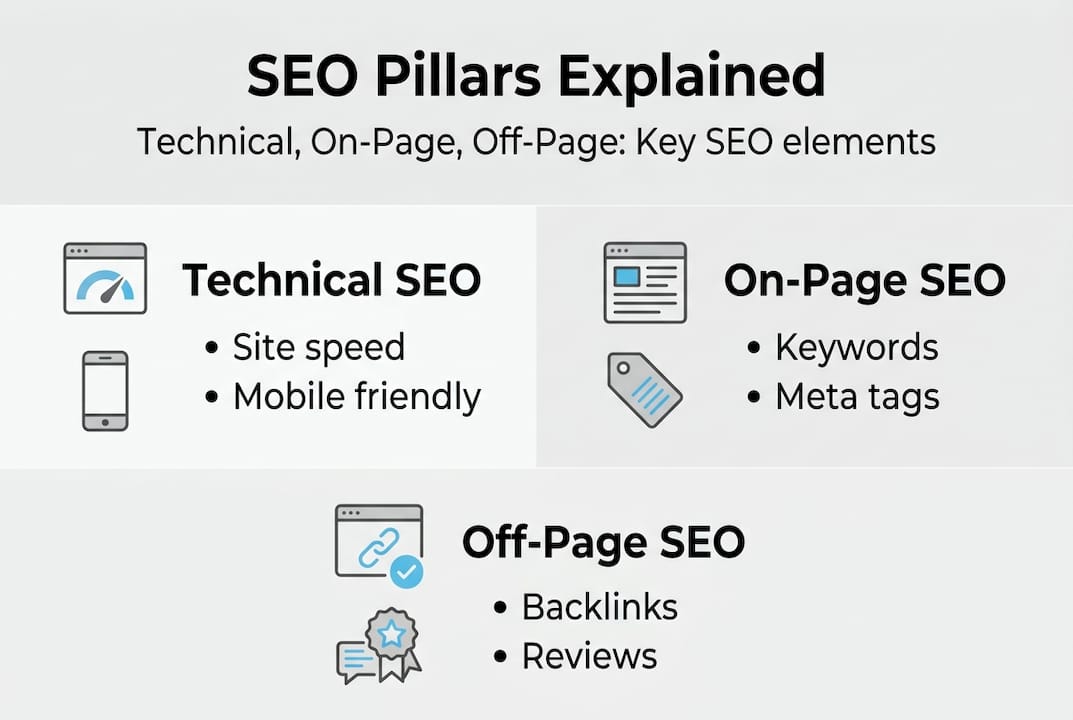
The three SEO pillars are technical, on-page, and off-page. Each one addresses a different dimension of how your site performs in search. Neglect any one of them and your overall results suffer.
Technical SEO covers your site’s infrastructure. Think of it as the foundation. If Google cannot crawl and index your pages properly, nothing else matters.
Technical SEO checklist:
Secure site with HTTPS
Mobile-friendly design
Fast page load speed (under 3 seconds)
Clean site structure and XML sitemap
No broken links or crawl errors
On-page SEO is about what is on each page. It covers your content quality, headings, meta titles, meta descriptions, keyword placement, and internal linking. This is where you communicate directly with both users and search engines about what your page covers. Explore on-page and off-page SEO details to understand how these interact.
On-page SEO checklist:
Clear, descriptive page titles with target keywords
Well-structured headings (H1, H2, H3)
Unique meta descriptions for every page
Alt Text on all images
Internal links to related content
Off-page SEO builds your site’s authority and reputation beyond your own pages. This includes backlinks from reputable sites, local business directory listings, and customer reviews on Google.
Off-page SEO checklist:
Claim and optimise your Google Business Profile
Build citations in local Australian directories
Earn backlinks from relevant, trusted websites
Encourage genuine customer reviews
For Australian SMBs, the quickest wins usually come from fixing technical issues first, then optimising your Google Business Profile. These two actions alone can produce noticeable ranking improvements within weeks.
Pro Tip: Run a free technical audit using Google Search Console before anything else. It will flag the most urgent issues on your site without costing a cent.
Beyond basics: advanced SEO concepts and common pitfalls explained
Now that you know the core pillars, it is vital to understand the nuanced challenges modern SEO brings.
Semantic SEO moves beyond individual keywords. It is about optimising for intent, context, and related topics. Semantic SEO and entity optimisation matter more than targeting isolated keywords because Google now understands meaning, not just words. If your page on “roof repairs” also covers related topics like flashing, gutters, and waterproofing, Google recognises it as genuinely useful and comprehensive.
Artificial intelligence and large language models are also reshaping how Google evaluates content. Structured data (schema markup), clear headings, and well-organised content help both traditional search and AI-driven results understand your pages. Staying current with SEO trends for 2026 is increasingly important as these technologies evolve.
Black hat vs white hat SEO is a distinction every business owner must understand. White hat SEO follows Google’s guidelines: quality content, genuine backlinks, good user experience. Black hat SEO uses shortcuts like buying links, keyword stuffing, or cloaking. Black hat tactics risk site penalties that can remove your site from search results entirely. The short-term gains are never worth it.
Watch out for these common pitfalls:
Keyword cannibalisation: Two or more of your pages targeting the same keyword compete against each other, splitting ranking power and confusing Google about which page to show.
Thin content: Pages with very little useful information that fail to satisfy user intent.
Ignoring mobile users: Over 60% of searches in Australia happen on mobile devices.
Duplicate content: Having the same content on multiple URLs without canonical tags.
The businesses that get penalised are rarely trying to cheat. They often just followed bad advice or used an inexperienced provider. Always ask what methods your SEO partner uses.
Pro Tip: Audit your site for keyword cannibalisation by searching Google for “site:yourwebsite.com.au [keyword]” and checking how many of your own pages appear. If more than one ranks for the same term, consolidate or differentiate them.
Practical SEO: prioritising actions and measuring success
Understanding pitfalls is only half the story. Here is how to put your new SEO knowledge into action for results you can measure.
Start with these priorities in order:
Fix technical issues flagged in Google Search Console
Claim and fully complete your Google Business Profile
Refresh or create content targeting your most important keywords
Build or clean up local directory citations
Review your backlink profile and remove toxic links
Free tools like Google Search Console and GA4 are the right starting point for most Australian SMBs. They show you which pages get traffic, what keywords trigger impressions, and where users drop off. Paid tools like Semrush or Ahrefs add value once you have outgrown the basics.
Here is how key SEO terms translate to real-world actions:
SEO term
What to measure
Action to take
CTR
% of searchers clicking your result
Rewrite page titles and meta descriptions
Bounce rate
% leaving without engaging
Improve page content and load speed
Organic traffic
Visitors from unpaid search
Track monthly in GA4
Keyword rankings
Position in Google for target terms
Monitor weekly in Google Search Console
Backlinks
Number and quality of inbound links
Use free tools to audit monthly
Set up a simple monthly review. Check your top 10 landing pages, note any ranking changes, and identify one or two actions to take. Consistency beats intensity every time.
Exploring the right SEO package guide and using a solid SEO strategy checklist will keep your efforts focused and measurable rather than scattered.
Our take: what most guides miss about SEO for Australian SMBs
Most SEO guides jump straight to advanced tactics. Schema markup, AI content strategies, entity graphs. It sounds impressive. But for the vast majority of Australian small businesses, these things are not the bottleneck.
The real issue is simpler. Many SMB websites have broken technical foundations, incomplete Google Business Profiles, and pages that do not clearly explain what the business does or where it operates. Fixing those three things alone will outperform months of chasing advanced trends.
We have seen it repeatedly. A business spends time learning about semantic SEO while their site still loads slowly on mobile and their NAP details are inconsistent across directories. The fundamentals are unglamorous. They are also where the real gains live.
Clarity about terms matters too. When you understand what bounce rate, CTR, and canonical URLs actually mean, you stop being dependent on jargon and start making informed decisions. That clarity is what separates businesses that grow through SEO from those that stay frustrated by it.
Focus on effective SEO strategies that are proven, not just popular. Small actions done consistently and correctly will always outperform chasing every new ranking fad.
Take the next step with expert SEO solutions
You now have a solid grounding in the essential SEO terms and concepts that drive real results for Australian businesses. Knowledge is the first step. Applying it consistently is where growth happens.
At Titan Blue, we work with Australian SMBs to build SEO strategies that are practical, measurable, and built on the fundamentals that actually move the needle. Whether you need a full managed service or just a clear starting point, our SEO solutions are designed to match where your business is right now. Explore our SEO marketing guide to see exactly how we approach growth for businesses like yours. Get in touch now and let us put your SEO knowledge to work.
Frequently asked questions
What are the top SEO terms every Australian SMB should know?
The essential terms are keyword, backlink, algorithm, bounce rate, CTR, 301 redirect, Alt Text, and canonical URL. Understanding each one helps you make informed decisions about your website and digital marketing.
How does local SEO help my business in Australia?
Optimising your Google Business Profile, maintaining consistent NAP details, and earning local reviews improves your visibility in Google Maps and local search results. This directly drives more foot traffic and enquiries from nearby customers.
What is the difference between technical, on-page, and off-page SEO?
Technical SEO covers site infrastructure, on-page SEO focuses on content and meta tags, and off-page SEO is about building backlinks and external mentions. All three must work together for strong, sustained rankings.
How do I measure my SEO results effectively?
Use Google Search Console and GA4 to track organic visits, keyword rankings, and leads on a monthly basis. Focus on outcomes like enquiries and conversions rather than vanity metrics like impressions alone.
Titan Blue is your go-to digital partner for smart, results-driven solutions. We blend strategy, creativity and tech to grow your brand and get real results fast.