


Last updated:
A lot of Australian business owners are seeing the same pattern. The website still ranks for some familiar terms, the Google Business Profile is active, reviews are coming in, yet enquiries feel less predictable. A customer mentions they found you through ChatGPT. Another says Gemini summarised a few options and yours wasn't included. A regular asks why your opening hours were wrong in an AI answer.
That's the shift. People aren't only searching by typing a few keywords into Google anymore. They're asking full questions, comparing options inside AI tools, and acting on the answer they get without ever clicking through to a website.
For a restaurant in Broadbeach, a plumber on the Gold Coast, or a solar installer servicing South East Queensland, that changes the job of digital marketing. It's no longer enough to rank a page. Your business has to be understood, verified, and repeatable inside AI-generated answers. That's where Generative engine optimisation agency Australia becomes a practical business decision, not just another acronym.
Is Your Business Invisible to AI Search
If you run a local business, the warning signs are easy to miss at first. Website traffic might soften. Calls may come in from lower-intent leads. People ask questions that are already answered on your site, which tells you they never visited it. They got a summary somewhere else.
That “somewhere else” is often an AI interface. ChatGPT, Gemini, Perplexity, and Google's own AI-driven results are shaping which businesses get mentioned first. If your business isn't part of that answer set, you're invisible during a high-intent moment.
What this looks like on the ground
A Gold Coast plumber used to compete for search rankings, local pack visibility, and review volume. Now the customer asks an AI tool something like “Who's a reliable emergency plumber near Broadbeach that handles blocked drains on weekends?” The AI doesn't return ten blue links. It compresses the field and names a few businesses it understands and trusts.
The same applies in hospitality. A family looking for dinner near Surfers Paradise may ask for somewhere child-friendly with easy parking and a menu that suits mixed dietary needs. If the AI can't confidently connect your venue to those details, you won't make the shortlist.
The Cherubini Company on AI websites makes a useful point about how shallow, AI-generated website content can weaken local search visibility. That matters even more in GEO because generic copy gives AI systems very little to anchor to.
Practical rule: If an AI tool can't clearly tell who you are, where you operate, what you do, and why you're relevant to a specific local query, it won't recommend you consistently.
An AI visibility audit is often the fastest way to see the gap. It shows whether your business appears in common AI prompts, whether your services are being described accurately, and whether competitors are easier for AI systems to cite.
What Is Generative Engine Optimisation
Generative engine optimisation, or GEO, is the work of making your business easy for AI systems to understand, trust, and cite in their answers. Traditional SEO helped search engines index and rank your pages. GEO helps AI engines extract the right facts and use them in a response.
Think of it this way. SEO is getting your business onto the map. GEO is giving the AI tour guide a clean, verified script so it can describe your business accurately when someone asks for a recommendation.
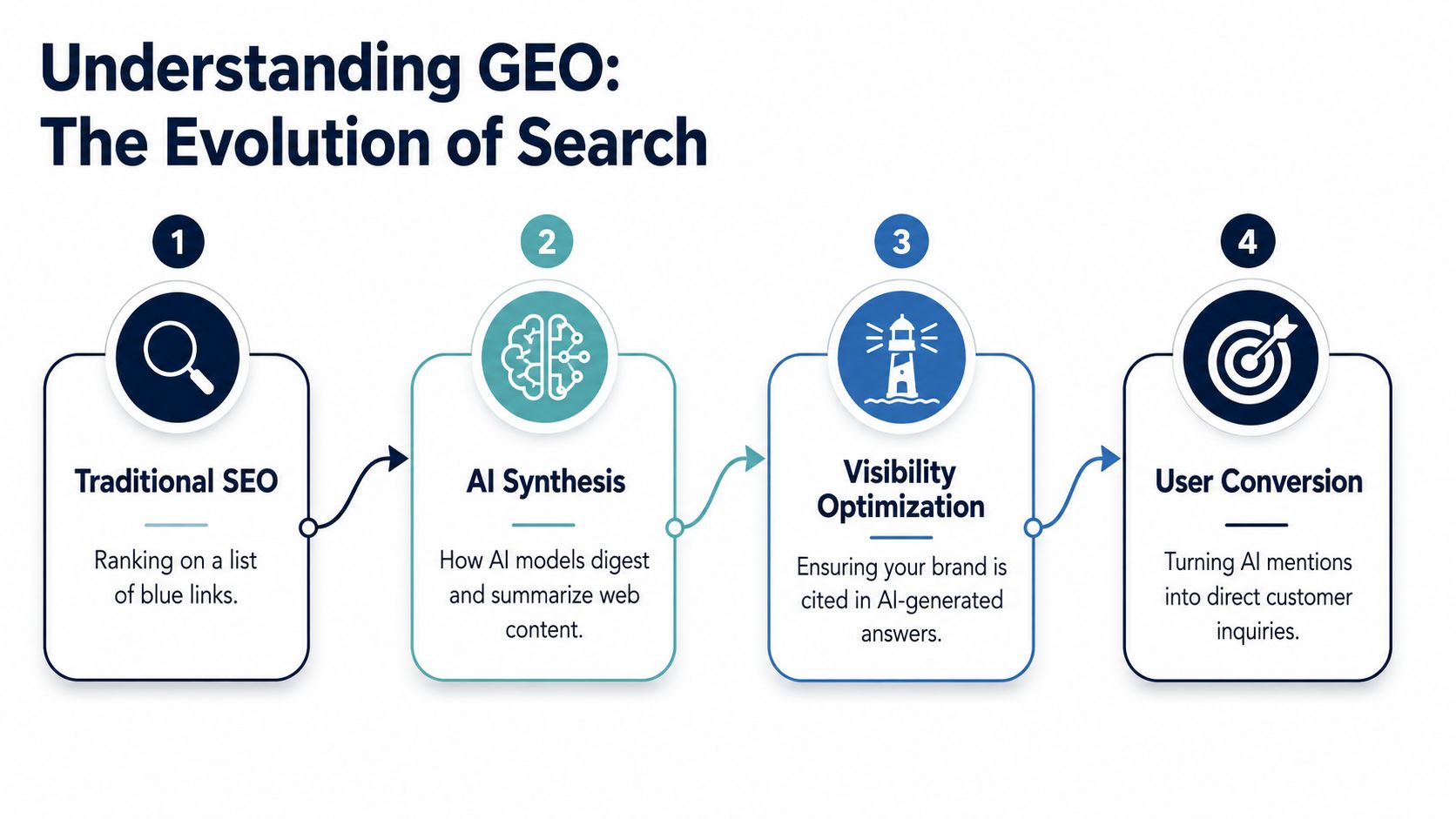
How GEO differs from old-school SEO
With SEO, the usual targets were rankings, clicks, and traffic growth. You'd optimise title tags, build pages around service keywords, improve site speed, and earn links.
GEO shifts the centre of gravity:
- SEO aims for position. You want your page to appear prominently in a list of results.
- GEO aims for inclusion. You want AI systems to pull your business into the answer itself.
- SEO rewards keyword targeting. GEO rewards clarity, structure, and factual consistency.
- SEO often ends with a click. GEO may influence the customer before any click happens.
That doesn't mean SEO is dead. It means SEO alone is no longer enough.
What AI needs from your site
AI tools don't “read” a website the way a person does. They look for signals they can parse with confidence. That usually comes down to a few practical things:
- Clear business identity so your name, suburb, services, and operating area aren't ambiguous
- Structured content with direct answers instead of fluffy marketing copy
- Consistent details across your site and wider web presence
- Pages built around real customer questions such as emergency callouts, pricing concerns, service areas, menus, booking rules, or installation timelines
A proper answer engine optimisation approach usually sits alongside GEO because both disciplines focus on making content usable inside AI-driven discovery.
AI visibility usually improves when businesses stop writing to impress themselves and start writing to remove ambiguity.
For local operators, that means fewer vague slogans and more usable detail. Not “quality solutions you can trust”. Instead, explain the service, suburb coverage, response conditions, booking process, and the exact scenarios you handle.
Why Australian Businesses Urgently Need Local GEO
Australia isn't trailing this shift. It's ahead of it. Australia has emerged as the global leader in AI search adoption, with internal modelling indicating 1.42 AI queries per person as of 2026, and 49% of Australians used generative AI in the past year, with 74% of those users relying on AI tools at work, according to Searchscope's Australian AI search research.
That matters because customer behaviour changes before most businesses update their marketing. By the time many owners notice the impact, AI tools have already become part of how people shortlist providers.
Local context is not optional
A generic overseas GEO playbook usually misses the details that matter in Australian local search. It may understand the broad category, but not the suburb logic, service area language, or customer phrasing used here.
A business in Broadbeach isn't competing in the same context as one in Brisbane's inner suburbs or regional Queensland. Hospitality searches often depend on neighbourhood intent, local landmarks, parking assumptions, and dining habits. Trade searches often hinge on urgency, service radius, licensing expectations, and whether the business handles specific residential or commercial job types.
That's why a local guide to why AEO matters for Aussie businesses and local leads is useful. The principles only work when they're applied to the way Australians search and buy.
What local GEO needs to capture
For Australian SMBs, local GEO works when it builds confidence around specifics such as:
- Service geography including suburbs, regions, and realistic callout zones
- Business category precision so a venue or trade service isn't described too broadly
- Local proof points such as case examples, FAQs, and service scenarios tied to real places
- Operational detail like booking hours, emergency availability, dine-in versus takeaway, installation scope, or compliance-related information
The trade-off is straightforward. Broad, generic content may cover more topics on paper, but it usually gives AI systems weaker local certainty. Narrower, more grounded content often performs better because it answers actual location-based prompts.
If you want to be recommended for “near me” or suburb-level questions, your website has to speak in suburb-level detail.
A Sydney or US-centric strategy can produce technically tidy pages and still fail in Queensland because the local intent layer is missing. GEO for Australia needs to reflect Australian spelling, local service terminology, and the way customers ask practical questions.
Core Services a GEO Agency Provides
A serious GEO engagement isn't just “write some AI-friendly blogs”. It usually combines technical cleanup, entity work, content restructuring, and monitoring. For local businesses, these pieces need to line up. If one is missing, the whole system gets weaker.

Entity optimisation
AI systems need to recognise your business as a distinct entity, not just a website with scattered text on it. That means making your name, business type, location, service scope, and supporting evidence line up cleanly.
For a trade business, this often starts with About pages, service pages, location pages, and contact information that agree with each other. For hospitality, it includes menu signals, venue type, cuisine, opening hours, booking details, and on-site experience cues.
This is also where one option like Titan Blue's LLM SEO service fits, alongside similar specialist work in the market, because the job is less about rank chasing and more about making the business machine-readable.
Schema markup and structured data
This is one of the few areas where the technical work clearly moves the needle. For Australian local service businesses, having clear entity data via schema markup results in a 3 to 5 times higher rate of being cited in AI-generated responses, and implementing LocalBusiness schema with nested service details enables 40% faster entity resolution by AI crawlers, based on That Content Agency's GEO guide for Australian businesses.
In plain terms, schema helps AI connect the dots without guessing.
For SMBs, that usually means:
- LocalBusiness schema for the core business identity
- Service details nested under relevant pages so the AI sees what you provide
- FAQPage markup where buyer questions are answered clearly
- Consistent address and locality references so the business is tied to the correct place
Without this, many sites leave AI tools to infer meaning from plain text. That's where misclassification starts.
Answer-driven content strategy
What works now is content that answers real customer prompts cleanly. What doesn't work is padded copy written to “sound professional” while saying very little.
A good GEO agency will reshape key pages so they handle questions such as:
- For plumbers. Do you offer emergency callouts, blocked drain work, hot water system replacement, or body corporate maintenance?
- For restaurants. Is there outdoor seating, family-friendly dining, dietary accommodation, or online booking?
- For solar installers. Do you handle residential installs, battery options, site assessments, and local compliance considerations?
AI answer monitoring
You can't improve what you don't test. GEO agencies should monitor whether AI tools mention your brand, how they describe your services, and which competitors get cited for valuable prompts.
That means using prompt testing, analytics, and manual review to catch issues such as wrong suburbs, outdated service descriptions, or missed opportunities where your business should appear but doesn't.
How to Choose the Right Australian GEO Partner
A lot of agencies have added GEO to their service list. That doesn't mean they can deliver it in a way that helps a Queensland plumber, a Gold Coast restaurant, or a construction supplier with local demand. The fastest way to sort serious operators from surface-level ones is to ask how they measure the work and how specifically they understand your market.
GEO service demand is growing 42% year-over-year in Australia, yet many agencies still don't offer transparent pricing or ROI metrics. A quality partner should be able to show clear cost structures and KPIs such as AI-visibility scoring, according to Myoho Marketing's GEO analysis.
Questions worth asking before you sign
Don't settle for broad promises about “future-proofing” or “AI readiness”. Ask practical questions.
- How do you define success? If they can't explain KPIs beyond vague visibility language, that's a problem.
- How do you test AI mentions? They should have a repeatable process for prompt tracking and answer review.
- What gets changed on the site? Look for detail around schema, entity alignment, service page structure, FAQs, and location content.
- Have you worked with businesses like mine? Trades and hospitality need very different execution.
- What's included in setup and what's ongoing? GEO usually needs both foundational work and ongoing refinement.
A good answer is specific. A weak answer hides behind jargon.
What transparency looks like
Most SMBs don't need a giant strategy deck. They need a clear view of what the agency is doing, what they're measuring, and where the next gains are likely to come from.
Useful signs include:
- Defined deliverables such as schema rollout, key page rewrites, FAQ development, and AI visibility checks
- Simple reporting that shows whether your brand appears in target prompts and whether descriptions are accurate
- Commercial realism about what can be improved first and what may take longer
- Clear handoff points between web development, SEO, local optimisation, and GEO tasks
There's a useful parallel in buying decisions outside marketing. The checklist in Flascon Construction Group's guide to choosing a custom home builder in Brisbane works for this too. You don't choose on brochure language alone. You look for process, proof, communication quality, and whether the provider understands the realities of your project.
Buyer check: If an agency can't explain GEO in plain English, they probably won't explain your results clearly either.
The trade-off with GEO pricing is simple. Cheap one-off setup work may patch a few technical gaps, but without ongoing prompt testing and content refinement, visibility can stall. On the other hand, an open-ended retainer with no defined reporting isn't much better. The right partner sets a baseline, fixes the structural issues, then monitors how AI platforms respond.
GEO in Action for Trades and Hospitality
The biggest gap in the Australian market isn't awareness. It's application. A 2025 report found that 78% of Australian SMBs in trades and hospitality rely on AI-assisted searches for customer queries, but only 12% report being visible in AI responses, according to ThatWare's Australian GEO market overview. That tells you a lot of businesses know the channel matters, but very few have done the detailed work needed to appear in it.
A plumber who stops sounding generic
Take a local plumbing business that has one broad services page and a contact form. The copy says they offer “quality plumbing solutions” across the Gold Coast. That's fine for a brochure site, but weak for AI retrieval.
After GEO work, the site becomes more explicit. Separate service pages explain blocked drains, burst pipes, hot water systems, and emergency callouts. FAQ content answers suburb-specific questions. Structured data ties the business to its service area and category. The AI now has a clean basis for answering “Who handles emergency plumbing near Broadbeach?” with confidence.
A restaurant that gives AI the right details
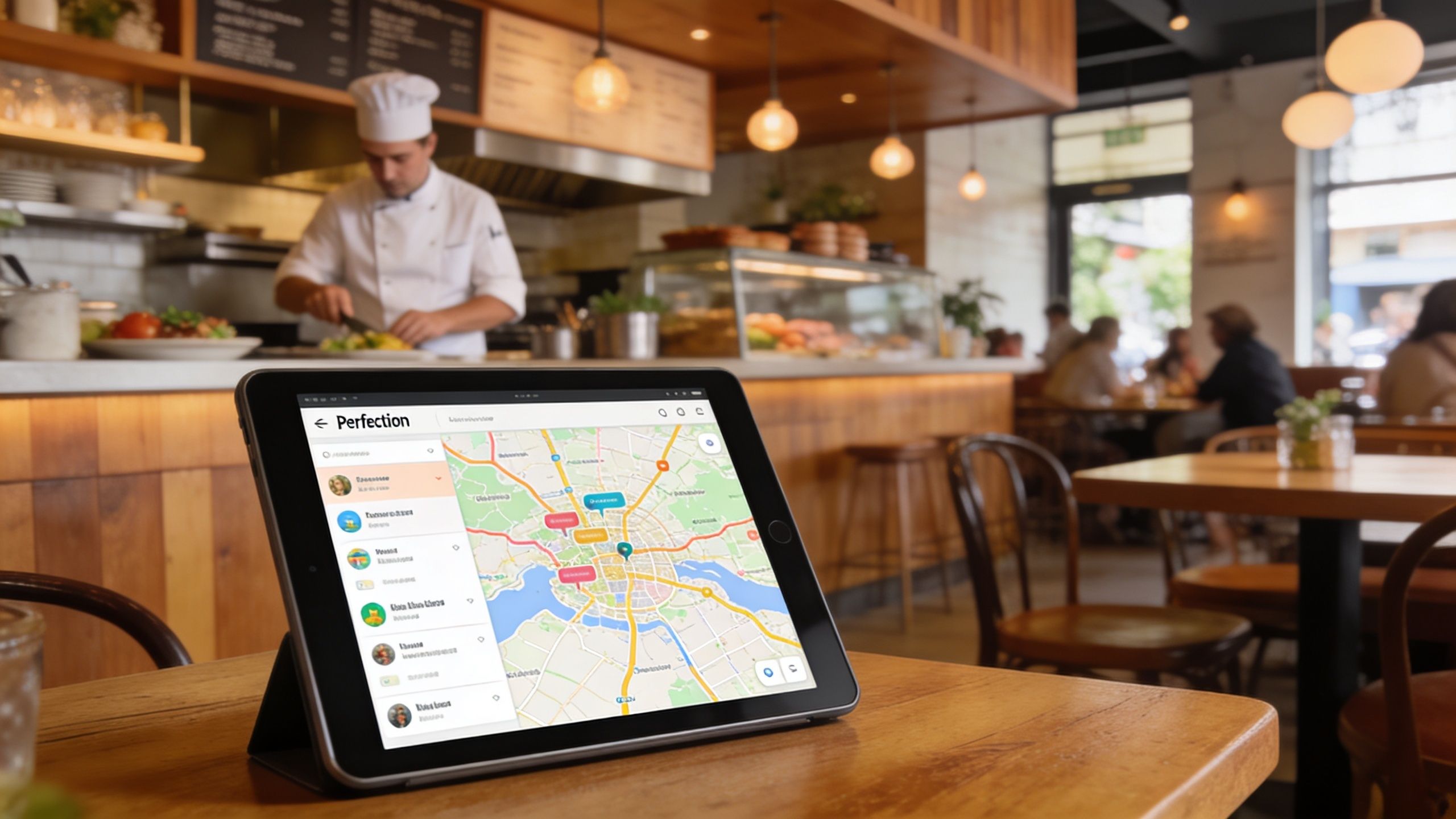
Hospitality businesses often lose visibility because their useful details are buried in PDFs, social posts, or image-heavy pages. Menus are hard to parse. Dietary options aren't stated clearly. Booking conditions sit on a third-party platform.
A stronger setup turns those details into readable website content. Menu highlights, opening hours, family dining information, reservation policies, and nearby location cues all become accessible. That gives AI tools enough clarity to respond to prompts like “Where can I get a family-friendly dinner near Surfers Paradise with easy online booking?”
Here's a useful explainer on the shift in search behaviour and answer engines:
A solar installer that earns trust through specifics
Solar is another category where vague claims hurt. Many sites talk generally about savings and sustainability but say too little about installation types, assessment process, service areas, or what happens after enquiry.
When GEO is done properly, the installer's pages answer the practical questions buyers ask. What sort of properties do you service? What does the quoting process involve? Do you handle battery-ready systems? Which suburbs do you cover? AI tools prefer businesses that reduce uncertainty.
Businesses in trades and hospitality don't need more generic blog content. They need pages that answer the exact questions people ask before they book or call.
The Titan Blue Difference A Local GEO Case Study
Long-running agencies usually see these shifts earlier because they've lived through several versions of search. The lesson is consistent. Platforms change, but businesses that organise their information clearly adapt faster than those relying on trend-chasing tactics.
For a Queensland local service business, the practical GEO work usually starts with three fixes. First, tighten the entity signals so the business name, services, locations, and supporting information align. Second, rebuild key commercial pages around real buyer questions instead of generic sales copy. Third, test AI outputs regularly and correct what the models get wrong.

What a local case looks like in practice
A typical Queensland trade client comes in with decent SEO foundations but weak AI visibility. Their website may rank for some service terms, yet AI tools describe the business vaguely, confuse service areas, or skip them entirely for local recommendation prompts.
The fix isn't flashy. It's disciplined. Service pages are rewritten to reflect the actual jobs customers ask about. Suburb relevance is clarified. FAQs are added to answer pre-enquiry objections. Structured data is implemented so the entity is easier to resolve. Then prompt testing reveals where the business starts appearing and where extra support content is needed.
That kind of work suits a local operator because it reflects how customers search in Queensland. It also avoids the common mistake of treating GEO like content volume. More pages don't automatically help. Better-defined pages do.
Why local experience matters
Titan Blue has been operating in Australia for more than 25 years, which matters because local digital strategy is rarely just about one channel. A business might need website changes, content edits, local optimisation, measurement, and AI search testing to work together. Agencies with broad practical experience can connect those pieces more cleanly.
If you want to assess whether that kind of work matches your business, reviewing Titan Blue's portfolio gives you a sense of the types of websites and local business problems the agency has worked on.
The core point is simple. GEO for Australian SMBs works best when it's grounded in real service areas, real buyer questions, and clean technical implementation. That's especially true for trades, hospitality, and construction-related businesses where local trust signals carry a lot of weight.
If your business isn't showing up in AI answers, the gap usually isn't effort. It's clarity. Titan Blue Australia helps local businesses tighten that clarity across websites, structured data, content, and AI search visibility so they're easier to understand and easier to recommend.
Make Titan Blue a preferred source in Google
One click tells Google to surface our articles more often in Top Stories, AI Overviews and AI Mode.

ChatGPT GPT-6 Search Upgrade: What It Means for Australia
OpenAI rolled out GPT-6 to ChatGPT on 7 October 2026 with faster search. Here is…

Best Dental Website Design Agencies in Australia: 7 Compared
Best dental website design agencies in Australia 2026: seven compared on dental proof, booking, AHPRA…

Childcare Centre Website Design Australia: The 2026 Guide
Childcare centre website design Australia: show hours, ages and enrolment as text so parents and…