


Last updated:
You’re flat out on the tools, quoting after hours, chasing materials, and trying to keep the diary full. Then you check your phone at lunch and there’s barely a call. Meanwhile, another plumber in Southport, an electrician in Werribee, or a builder in Glen Waverley seems to show up every time someone searches.
That gap usually isn’t about who does better work. It’s about who Google can understand, trust, and surface at the exact moment a local customer needs help.
For tradies, local seo for tradies isn’t a side task for “when things slow down”. It’s the digital version of word-of-mouth, signage, and reputation rolled into one. Done properly, it puts your business in front of people who already want the job done and are ready to call.
Why Your Phone Isn't Ringing and How to Fix It
If your phone has gone quiet, the problem often sits upstream from your workmanship. Customers can’t ring a business they never saw.
Most trade searches are urgent, local, and done on mobile. Someone has a leaking hot water system in Hoppers Crossing, a tripping switchboard in Robina, or a blocked drain in Burleigh Waters. They don’t browse for long. They search, compare quickly, and call.

That’s why local visibility matters so much. In Australia, 78% of mobile local searches lead to an offline purchase within 24 hours according to Picasso Media. For a tradie, that “offline purchase” is often a booked job, a site visit, or a call-out.
What local SEO actually fixes
Local SEO fixes three common problems:
- You’re invisible in the map results. If your Google Business Profile is weak, incomplete, or poorly managed, you miss the highest-intent searches.
- Your website says too little. A generic site that says “quality plumbing services” won’t help Google match you to “emergency plumber Broadbeach”.
- Your reputation isn’t showing up clearly. Customers compare reviews, suburbs served, and recent proof of work before they call.
Practical rule: If a customer needs your service today, your business needs to appear clearly on mobile, in the right suburb, with a phone number they can tap immediately.
There’s also a simple operational point here. Better search visibility won’t help much if calls are missed or routed poorly. If you’re tightening up lead handling, a proper effective phone setup can make the enquiry process cleaner, especially when calls need to go to different staff or locations.
The fix is usually practical, not mystical
Busy tradies often assume SEO is technical theatre. It isn’t. Good local SEO is mostly disciplined basics done properly:
- A complete Google Business Profile
- Consistent business details everywhere
- Suburb and service pages that reflect real work
- Strong review collection
- A website that makes it easy to call or enquire
If you’ve ever searched your own business name and wondered why you’re not appearing properly, this breakdown of why your business isn't showing up on Google will sound familiar.
The upside is straightforward. You don’t need to “go viral”. You need to be found by local customers at the right time, in the right suburb, for the right job.
Your Digital Shopfront Mastering Google Business Profile
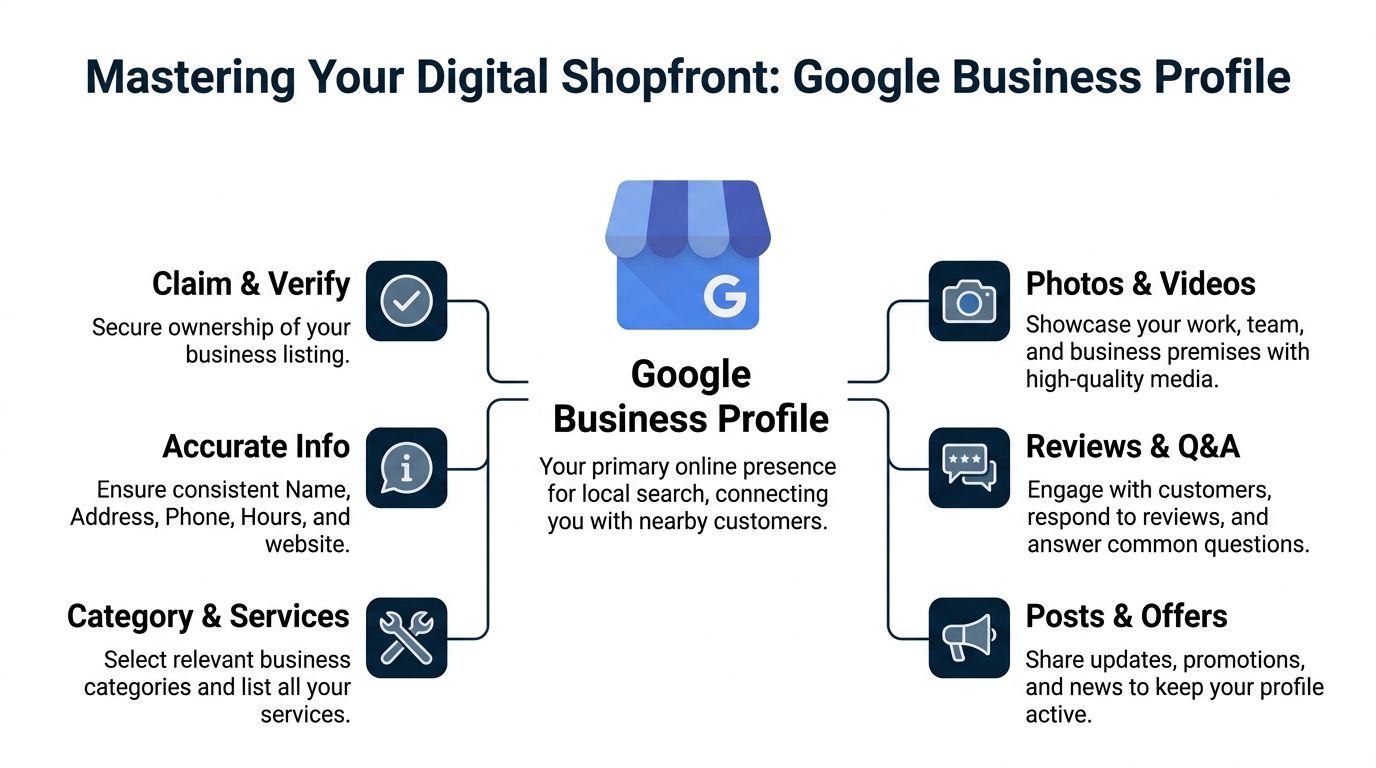
For most tradies, your Google Business Profile is the first thing a customer sees. Before they visit your website, they look at your reviews, service area, photos, opening hours, and whether you look active or neglected.
If this profile is weak, the rest of your local SEO has to work harder.
Start with the setup that actually matters
Claiming the profile is only the beginning. The difference comes from how complete and accurate it is.
Get these parts right first:
- Business name. Use your real trading name. Don’t stuff it with extra suburbs or services.
- Primary category. Pick the closest match to your main service. A plumber should be a plumber first, not a generic contractor.
- Phone number. Use the number you answer.
- Website link. Send traffic to a page that matches the service, not a weak homepage if a better page exists.
- Opening hours. Keep them current, including public holiday changes.
- Service areas. Add the specific suburbs you cover, such as Broadbeach, Mermaid Waters, Varsity Lakes, or Point Cook.
A lot of tradies sabotage this stage by trying to look bigger than they are. Fake addresses, messy categories, and keyword-stuffed names can create more problems than they solve.
Write for clarity, not fluff
Your business description should tell Google and customers three things fast:
- What you do
- Where you work
- Why someone should trust you
A decent description for an electrician isn’t “We are passionate about excellence”. It’s closer to this in structure: licensed residential and commercial electrician, handling switchboard upgrades, fault finding, lighting, and emergency call-outs across suburbs in Melbourne’s east.
That gives Google useful context and gives the customer confidence.
Your profile should read like a real local business, not like an ad written by someone who’s never been on site.
Photos do heavy lifting
Photos are one of the easiest wins in local seo for tradies because they prove you’re active and local. Customers want to see actual jobs, vans, team members, signage, tools, and before-and-after work.
Upload:
- Completed work. Bathroom fit-offs, switchboards, roofing, decking, solar installs.
- Team photos. Real staff beat stock imagery every time.
- Vehicles and branding. Branded vans help reinforce legitimacy.
- On-site context. Show driveways, rooftops, interiors, commercial fit-outs, and suburb-specific work where appropriate.
Geo-tagging photos is often discussed as part of a practical optimisation workflow, and many agencies include it in their local rollout process. More important than the technical detail is this: the photos need to be original, recent, and tied to real jobs.
Use the parts most tradies ignore
A profile that just sits there won’t compete well. Use the built-in features.
Services
List services individually. Don’t stop at “plumbing” or “electrical”. Add the specific jobs people search for, like blocked drains, hot water repairs, smoke alarm installation, switchboard upgrades, roof leak repairs, and deck construction.
Questions and answers
Seed common questions yourself and answer them properly. Examples:
- Do you service after-hours emergencies?
- Do you quote for insurance work?
- Which suburbs do you cover on the Gold Coast?
- Do you handle strata and commercial maintenance?
This helps customers and gives Google more relevance signals.
Posts
Use Google Posts for practical updates:
- storm season readiness
- EOFY service reminders
- recent project showcases
- seasonal maintenance advice
- temporary booking availability
They won’t rescue a weak profile on their own, but they keep the listing active and useful.
Messaging and calls
If you enable messaging, make sure someone monitors it. Fast response matters. The same applies to call handling. A ringing phone nobody answers is not a lead system.
If you want a broader explanation of how Google listings support search visibility, this guide on Google My Business and local SEO is worth a read.
A practical checklist for a strong profile
Before moving on, make sure your profile covers this short list:
- Verification completed
- Correct primary and secondary categories
- Accurate service areas
- Keyword-aware business description
- Full services list
- Regular photo uploads
- Questions answered
- Posts added periodically
- Calls and messages monitored
- Hours, website, and contact details current
For a busy tradie, this profile is your digital shopfront. Keep it clean, active, and believable. That alone can change how often the phone rings.
Building Unbeatable Online Trust and Authority
Visibility gets you seen. Trust gets you called.
A tradie can appear in search results and still lose the job if the profile looks thin, the reviews are old, or the business details don’t line up across the web. Customers notice that quickly.

Research cited by ServiceScale notes that businesses with consistent Name, Address, and Phone details across directories like Yellow Pages and TrueLocal improve their visibility in Google’s Local Pack, and businesses with 10+ positive reviews see a 75% greater chance of client contact.
Reviews need a system, not good intentions
Most tradies don’t have a review problem. They have a process problem.
They finish a job, the customer is happy, and then everyone moves on. A week later the moment is gone. The easiest fix is to ask while satisfaction is fresh.
A simple review workflow looks like this:
- Right timing. Ask once the job is complete and the customer has seen the result.
- Low friction. Send a direct review link by SMS.
- One person owns it. Don’t leave review requests to chance.
- Follow up once. A polite reminder is enough.
A short SMS works well:
- SMS example. Hi Sarah, thanks again for having us out today. If you were happy with the work, would you mind leaving a quick Google review? It really helps local customers find us. [insert link]
Email works too, but SMS usually fits trade businesses better because it meets customers where they already are.
If you want a plain-English read on the commercial value of this, see why customer reviews matter.
What to do with the reviews you get
Don’t just collect reviews. Respond to them.
Short, specific replies help in two ways. They show future customers that you’re active, and they give Google more context about your services and service areas.
Good reply:
Thanks for the feedback, James. Glad we could sort the hot water issue quickly in Palm Beach.
Weak reply:
Thanks.
The first one sounds human and reinforces relevance. The second is wasted space.
After you’ve built a review habit, this broader piece on building a strong online presence is useful for thinking about how reviews support the wider trust picture across your digital footprint.
Citations are boring, but they matter
A citation is any online mention of your business name, address, and phone number. Think Yellow Pages, TrueLocal, StartLocal, industry directories, chambers, suppliers, and trade platforms.
Many tradies often make mistakes in this area. Different abbreviations, old landlines, outdated unit numbers, old addresses, and inconsistent business names all weaken trust signals.
Field note: Google can tolerate some mess. It won’t reward it.
Use this audit approach:
- Check the core details. Name, address, phone, and website.
- Fix duplicates. Old listings can split trust and confuse customers.
- Match formatting. Pick one standard version and use it everywhere.
- Review your service areas. Make sure suburb coverage reflects how the business currently operates.
A plumbing business might be listed one way on Google, another on Yellow Pages, and another on a supplier directory from three years ago. Clean that up before worrying about fancy tactics.
Later in the process, video can help your team understand the local ranking mechanics in a more visual way:
Trust compounds when the signals agree
The strongest local profiles tend to have the same pattern:
- reviews arriving steadily
- replies from the business owner or office
- consistent business details
- active project photos
- a website that matches what the profile promises
That combination makes a tradie look established, responsive, and real. In local search, that’s what authority looks like.
Optimising Your Website to Attract Local Customers
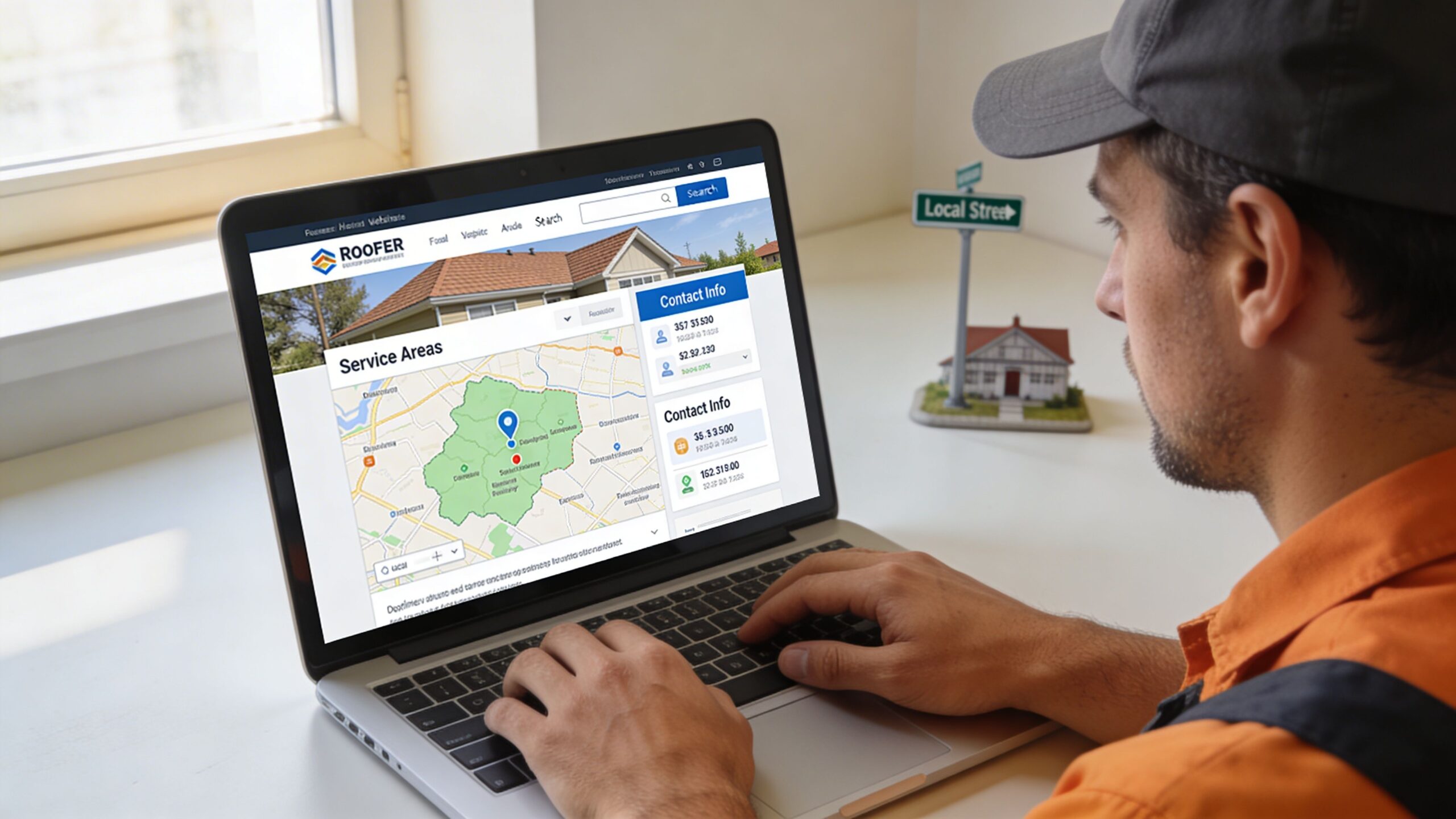
A Google Business Profile can generate calls on its own, but your website still does the heavy lifting for service detail, suburb relevance, and conversion. It’s where customers go when they want to confirm they’ve found the right business.
Too many tradie websites still make one basic mistake. They describe the trade, but not the jobs and locations clearly enough.
Fix the pages that should already be selling for you
Start with the homepage. It should answer these questions immediately:
- what trade you do
- where you work
- what kind of jobs you want
- how to contact you
A vague homepage headline like “Quality solutions you can trust” does nothing. A stronger one tells both the user and Google what’s going on, such as plumbing services for homes and businesses across the Gold Coast.
Then build proper service pages. Not one general “services” page with a bullet list. Separate pages for the work people search:
- emergency plumbing
- hot water repairs
- blocked drains
- switchboard upgrades
- air conditioning installs
- roof repairs
- bathroom renovations
- deck construction
Each page should include real job detail, the problems you solve, signs the customer might notice, and the areas you service.
Add locations naturally
You don’t need to cram suburbs into every sentence. You do need to include them where it makes sense.
Good places for suburb relevance:
- Page titles. Emergency Plumber Broadbeach
- Headings. Electrical Fault Finding in Glen Waverley
- Body copy. Mention common property types, local conditions, and call-out patterns
- Image captions. If they reflect a real job
- Internal links. Send users between service and suburb pages logically
A Melbourne electrician might note experience with older homes in suburbs with ageing switchboards. A Gold Coast roofer might talk about storm damage call-outs in coastal areas. That sort of specificity is useful because it comes from actual work.
Schema helps search engines read your business properly
Local Business schema is structured data added to your site so search engines can interpret key details more cleanly. It’s not magic, and customers won’t see it directly, but it can support your local presence by clarifying information like your business name, contact details, and service type.
For most WordPress sites, plugins like Yoast or Rank Math can help implement the basics without custom development. The important part is accuracy. If the site says one thing and your listings say another, schema won’t rescue the inconsistency.
Ranking in multiple suburbs without a local office
Many tradies either miss opportunities or get into trouble.
If you service from Gold Coast to Brisbane, or across Melbourne’s south-east, you probably want visibility in more than one suburb. Fair enough. The problem is how you build those pages.
A lot of businesses still publish near-identical location pages with only the suburb name swapped. That’s the doorway-page approach, and it’s weak. According to Clicks4Business, Google’s 2025 updates in Australia penalised thin doorway pages, and 60% of multi-location tradie sites lost Map Pack visibility. The same source notes that hyperlocal case studies on service-suburb pages boosted rankings by 35% for QLD tradies.
That tells you what works and what doesn’t.
If you don’t have a physical office in a suburb, don’t pretend you do. Build relevance through service evidence, not fake location signals.
What a strong multi-suburb strategy looks like
A compliant, effective service-area page should be unique and useful. It should not be a spun copy job.
Include things like:
- Real suburb-specific examples. A blocked drain in Ashmore is more convincing than generic copy.
- Photos from nearby work. Use original imagery from actual jobs.
- Local FAQs. Parking access, property type, storm damage patterns, apartment access, strata approvals.
- Travel and availability context. Explain how you service the area.
- Related services. Link logically to the matching service pages.
For example, a solar installer targeting Logan, Coomera, and Redland Bay should not clone one page three times. Each page should reflect real project types, local housing stock, and service considerations.
Pages that help versus pages that hurt
Use this test before publishing any suburb page.
A page helps if:
- it contains original text
- it references real work or real service delivery
- it answers practical local questions
- it has unique images or examples
- it supports the customer’s decision
A page hurts if:
- it only swaps suburb names
- it invents an office location
- it has no unique value
- it exists only to rank, not to inform
- it creates confusion with your Google Business Profile setup
If your current site is too generic, or built without local conversion in mind, this guide on website design for tradies is a solid place to tighten the fundamentals before layering on more SEO work.
Creating Hyperlocal Content That Wins Jobs
The best local content usually starts on the job site, not in a marketing meeting.
A tradie finishes a tricky switchboard upgrade in Robina, solves a leaking box gutter in Elwood, or completes a new deck in Burleigh Heads. Most businesses post one photo to social media, then move on. That’s a missed asset.
Turn one job into three useful pieces of content
Take a real project. A plumber clears a recurring blocked drain in Mermaid Waters.
That single job can become:
- a short case study on the website
- a Google Post with a job photo
- a service-area update linked from the relevant suburb page
The case study doesn’t need to be long. It needs to be specific. What was the issue? What did the customer notice first? What was found on inspection? What was fixed? What should nearby property owners watch for?
That kind of content does two jobs at once. It proves capability, and it gives search engines more confidence about where and how you work.
The suburbs matter when the story is real
A builder working in Melbourne’s east could publish a project summary like “Rear Deck Build in Ringwood for a Sloping Backyard”. An electrician on the Gold Coast could publish “Switchboard Upgrade After Repeated Tripping in Varsity Lakes”.
Those examples work because they’re grounded in actual jobs. They say more than “we offer quality service”.
Customers trust detail. General claims sound like marketing. Real project context sounds like experience.
Content ideas that fit a trade business
Most tradies don’t need a big editorial calendar. They need repeatable content types they can maintain.
Useful formats include:
- Project spotlights. Before, during, after, plus the result.
- Local problem pages. Common roof leaks in coastal suburbs, drainage issues in older areas, switchboard issues in post-war homes.
- FAQ articles. Do I need a switchboard upgrade before installing an induction cooktop? What causes stormwater overflow in this area?
- Seasonal advice. Storm prep, summer electrical load, winter hot water issues.
- Service explainers. What’s involved, what to expect, when to call.
The trick is keeping it local and grounded. If a page could belong to any tradie in any city, it’s not hyperlocal enough.
A simple way to capture content without slowing the crew down
The process doesn’t need to be cumbersome.
After a job, collect:
- the suburb
- two or three photos
- the problem
- the fix
- one practical takeaway for the customer
That’s enough for the office to turn into a useful web page or post. Over time, you build a library of local proof across the suburbs where you want more work.
For local seo for tradies, this is one of the most practical long-term plays. It helps rankings, supports AI visibility, and gives future customers a much clearer reason to choose you.
Measuring Success and Preparing for AI Search
A lot of tradies get stuck because they measure the wrong things. They ask whether traffic is up, but not whether the right jobs are coming in.
The metrics that matter are simpler than most dashboards suggest.
Measure leads, not vanity
Start with the actions that tie directly to work:
- Phone calls from your Google Business Profile
- Website form submissions
- Quote requests
- Bookings for call-outs or site visits
- Ranking movement for your main service and suburb terms
If you’re a plumber servicing Broadbeach, Miami, and Burleigh, the useful question isn’t whether impressions increased. It’s whether more people are calling for the jobs you want in those suburbs.
Use tools you can stick with. For many small businesses, that means a combination of:
- Google Business Profile insights
- Google Analytics
- Google Search Console
- call tracking where appropriate
- a basic spreadsheet or CRM to record enquiry quality
Review this monthly. Not once a year when work dries up.
Watch what kind of enquiries are improving
Better local SEO should improve lead quality, not just lead volume.
Good signs include:
- more suburb-specific enquiries
- better fit jobs
- fewer “are you even in this area?” calls
- more customers mentioning they found you on Google
- stronger conversion from service pages tied to real suburbs
Local SEO becomes operational, not theoretical, in this scenario. If a new page for “emergency electrician Glen Waverley” generates the wrong sort of lead, adjust the content. If a suburb page attracts good call-outs, build more pages with the same depth.
AI search changes the surface, not the fundamentals
Search is shifting toward AI-generated summaries and answer engines. That sounds dramatic, but the preparation is familiar.
AI systems still look for clear entities, trusted businesses, structured information, consistent reputation signals, and detailed content they can understand. The work you’ve already done matters here:
- a complete Google Business Profile
- consistent citations
- strong reviews
- detailed service pages
- local case studies
- useful FAQs
That combination helps machines interpret your business more confidently.
If you want to understand where this is heading, the practical implications of AI search are worth reviewing, especially if your current strategy still assumes users always click through ten blue links.
The businesses that will hold up best in AI-driven search are the ones with the clearest local signals and the strongest proof of real-world service.
For tradies, the takeaway is reassuring. You don’t need a separate “AI strategy” before you’ve done the basics well. Strong local SEO is already the groundwork.
Frequently Asked Questions About Local SEO
How long does local SEO take for a tradie business
It depends on your starting point, your suburb competition, and how much work needs fixing first.
A business with a claimed Google Business Profile, a decent website, and an organised review process will usually move faster than one with inconsistent listings, no suburb pages, and no recent reviews. Local SEO is cumulative. You don’t do it once and walk away.
Can I rank in suburbs where I don’t have a physical office
Yes, but the method matters.
You should use your real service-area settings in Google Business Profile and build useful suburb pages based on real work, service detail, and local examples. Don’t create fake location pages or pretend to have offices you don’t have. That approach often creates weak pages and trust issues.
Should I focus on Google Business Profile or my website first
If your profile is incomplete, fix that first. It’s usually the fastest way to improve visibility for local intent.
After that, your website becomes the priority because it supports broader ranking, suburb relevance, and conversion. The strongest results come when both work together.
How many reviews do I need
There isn’t a single magic number. What matters is building a steady, genuine flow of positive reviews and replying to them properly.
If you’re waiting until you have time to ask later, you’ll almost always get fewer reviews than businesses that make it part of the job completion process.
Is paid advertising better than local SEO
They do different jobs.
Paid ads can generate demand quickly, especially for urgent services. Local SEO builds an asset that keeps supporting enquiries over time. For most tradies, the best setup is using paid search tactically while strengthening organic local visibility in the background.
What’s the biggest mistake tradies make with local SEO
Usually one of these:
- relying on a basic one-page website
- neglecting Google Business Profile
- inconsistent phone and address details
- creating thin suburb pages
- failing to document real jobs as content
- focusing on rankings instead of leads
Do I need new content every week
Not necessarily.
Consistency matters more than frequency. A smaller number of useful, local, job-based updates is better than pumping out generic blog posts nobody reads. If you complete real work every week, you already have raw material.
If your business needs a sharper local SEO strategy, stronger suburb targeting, or a plan for AI-driven search, Titan Blue Australia can help. With more than 25 years in digital, and local knowledge from Broadbeach backed by national reach, the team works with Australian trades businesses that want more than vanity metrics. The focus is simple. Better visibility, better enquiries, and a website and search presence built to generate real jobs.
Make Titan Blue a preferred source in Google
One click tells Google to surface our articles more often in Top Stories, AI Overviews and AI Mode.

This Week in Australian AI Search: Google’s UGC Data Program
Google's UGC Fresh Data Program and Indexing API quota update, plus our Google AI Mode…

Google AI Mode Adds Official Links: What It Means for Australia
Google is adding more links to AI Mode and testing an official websites section. Here…

Best AEO and GEO Agencies in Australia (2026): 7 Compared
Best AEO agency and GEO agency in Australia, compared: seven agencies, what their own pages…