Expert SEO Services for Shopify to Boost Your Store Sales
When it comes to your Shopify store, SEO services aren't just a marketing buzzword. They're a set of professional strategies designed to get your online store seen by search engines like Google, which drives more qualified traffic to your site and creates sustainable sales growth. This is achieved through a mix of technical work, smart content, and building your store's authority, all tailored specifically for the Shopify platform.
Why SEO for Shopify Is Your Most Critical Investment
Imagine you’ve just opened a beautifully designed, fully-stocked shop in a prime city location. The only problem? It’s tucked away in a back alley with no signs pointing the way. That’s exactly what it feels like to run a Shopify store without a proper SEO strategy. You have incredible products, but your potential customers can’t find you.
Professional SEO services for Shopify are the bright, flashing sign and the detailed map that guide shoppers straight to your digital front door.
For Australian businesses—especially in competitive industries like trades, hospitality, and specialised retail—just having an online store isn't enough. You're up against a massive digital marketplace where visibility is everything. SEO is what makes sure that when a potential customer on the Gold Coast searches for "solar panel installation," or a café owner in Melbourne looks for "commercial coffee machines," your business shows up as the right answer.
This goes way beyond just stuffing keywords onto a page; it’s about building a solid foundation for long-term success. Think of it as a strategic investment, not just another marketing expense. Good SEO builds your brand’s credibility over time, creating a valuable asset that keeps delivering results long after a paid ad campaign runs out. For a wider view, it’s helpful to understand the general ecommerce SEO best practices that apply across the board.
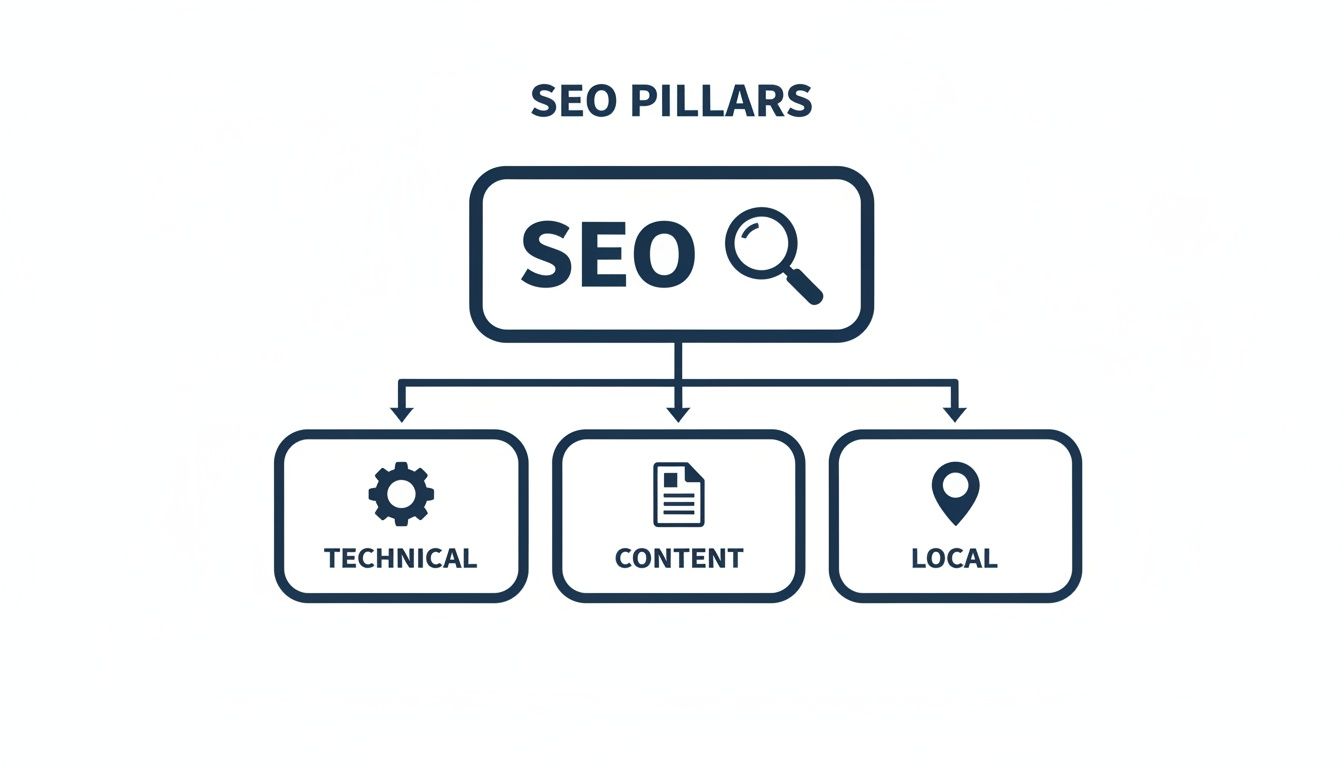
In this guide, we'll walk you through the core pillars of a winning Shopify SEO strategy, breaking down the technical jargon into steps you can actually use. We’ll cover:
Technical Health: Making sure your store’s backend is set up perfectly for search engines.
Content Strategy: Writing product pages and articles that attract shoppers and get them to buy.
Local Dominance: Winning over customers right in your neighbourhood.
AI Readiness: Future-proofing your store for the next wave of search technology.
The diagram below shows how these key SEO pillars fit together to support your entire strategy.
As you can see, a strong SEO campaign needs a balance of technical structure, great content, and local relevance. Each one supports the others, and if you neglect one, the whole thing can fall apart. Getting these areas right is how you turn your Shopify store from a hidden gem into a true market leader. To see how this fits into a bigger picture, you can learn more about our complete approach to ecommerce marketing.
Building a Bulletproof Technical SEO Foundation
Before you can even think about attracting a steady stream of customers, your Shopify store needs a solid technical backbone. It's a lot like building a house—you wouldn't hang pictures on the walls before the frame, plumbing, and wiring are all properly installed. This behind-the-scenes work is exactly what technical SEO does for your online store.
A professional Shopify SEO audit is your building inspection. It’s a thorough health check that finds all the hidden cracks in your site’s structure, the kind of problems that could be quietly costing you sales day after day.
Uncovering Common Shopify Technical Problems
Shopify is a fantastic platform, but it has its own set of technical quirks that can seriously hold back your search performance if you don't know what to look for. An expert providing seo services for shopify knows exactly where these platform-specific issues hide.
One of the most common offenders is duplicate content. Shopify automatically generates multiple URLs for the exact same product if it’s listed in different collections or has variants like size or colour. To you and your customers, it’s just one product. But to Google, it looks like a mess of identical pages competing with each other, which confuses the search engine and waters down your ranking potential.
Another huge hurdle is site speed. While Shopify’s core is fast, the apps you add for extra features can slow your store to a crawl. Research shows that even a one-second delay in page load time can cause a 7% drop in conversions. For a restaurant, that could be a potential diner who gets tired of waiting for your menu to load and books a table somewhere else.
These problems are often linked, as a clunky, poorly optimised site creates a frustrating experience for users. The connection between technical health and good design is critical, something you can explore in our insights on the role of SEO in web design.
Fixing the Foundation for Better Rankings
Once an audit flags these issues, the real work begins. This is where the value of specialised technical SEO services shines. It’s not about just finding the problems; it’s about implementing precise, effective solutions.
Fixing the foundation involves a few key actions:
Implementing Canonical Tags: This simple tag tells Google which version of a product page is the "main" one. It consolidates all your ranking power into a single, strong URL and completely solves the duplicate content headache.
Image and App Optimisation: We compress images so they load instantly without losing quality and audit your apps to get rid of any that are slow or unnecessary. This can dramatically improve your page load times.
Improving Site Architecture: A logical site structure makes it easy for both customers and search engines to find what they need. This ensures a plumber’s critical "Emergency Services Gold Coast" page isn't buried five clicks deep where no one can find it.
Fixing Crawl Errors: We get rid of broken links (404 errors) and redirect old pages to ensure a smooth journey for users. This also stops Google from wasting its "crawl budget" on dead ends.
A clean, technically sound website is non-negotiable. Google’s job is to send its users to sites that are fast, secure, and easy to use. Fixing the technical foundation is the first and most critical step in earning that trust.
By sorting out these technical elements, you're doing more than just tidying up some code. You’re making sure your fantastic products and services are actually visible and accessible to the customers out there searching for them. You’re turning a hidden gem into a high-performing storefront.
Alright, with a solid technical setup, your Shopify store is ready to do what it does best: talk to your customers. This is where your content really steps into the spotlight. Good content isn't just about filling up space on a page; it’s the engine that turns a casual browser into a paying customer. It's time to ditch the generic supplier descriptions and start crafting copy that actually sells.
Think of your content as the bridge connecting your product to your customer's needs. It's the difference between a product page that just lists off features and one that tells a story, solves a real problem, and gives a shopper the confidence to hit "add to cart". This is a massive part of what quality Shopify SEO services deliver.
Writing Product and Collection Pages That Sell
Your product descriptions are basically your 24/7 salesperson. Are they persuasive and focused on solving the customer’s problem? Or are they just a lazy copy-paste job from the manufacturer? If it's the latter, you're leaving a huge amount of money on the table.
To build product pages that actually convert, we focus on a few key things:
Benefit-Driven Copy: Don't just say a drill has a "lithium-ion battery." Explain what that actually means for the customer: "Get hours of uninterrupted work with a battery that lasts all day, so you can finish the job without stopping to recharge."
Keyword Optimisation: We naturally weave your target keywords into page titles, descriptions, and even the image alt text. If your customers are searching for "waterproof work boots for construction," your page needs to speak that exact language.
Engaging Formatting: We use short paragraphs, bullet points for key features, and bold text to make the important benefits pop. This makes your content easy to scan for busy shoppers who are just skimming.
The aim is to answer every single question a potential buyer has before they even have a chance to ask it. If you want to go deeper on this, you might find our guide on writing website content that gets results useful.
Using a Blog to Attract Future Customers
Not everyone who lands on your site is ready to buy right away. A lot of people are still in the research phase, just looking for answers. A well-managed blog is the perfect way to capture this audience, building trust and positioning your brand as the go-to expert long before they’re ready to make a purchase.
Your blog acts as a magnet for people at the top of the sales funnel. For instance, a solar installer on the Gold Coast could write an article called, "A Simple Guide to Queensland Government Solar Rebates." This attracts people who are just starting their research, making your business the first name they see. In the same way, a hospitality supplier could attract café owners with a post like, "How to Choose the Right Commercial Coffee Machine."
This strategy turns your Shopify store from just another online shop into a genuinely valuable resource.
Demystifying Structured Data and Schema
Once you've got great content, you need to help Google understand it in a split second. This is where structured data, also known as schema markup, comes in. Think of it like putting clear, detailed labels on every single item in a massive warehouse. Without them, the staff would have no idea where anything is. With them, they know exactly what an item is, how many are in stock, and where it belongs.
Structured data does the exact same thing for search engines. It’s a layer of code on your site that explicitly tells Google things like the price of your product, its current stock level (in stock or out of stock), customer ratings and the total number of reviews, and who wrote a blog post.
This information allows Google to show "rich results"—like star ratings and pricing—right there on the search page. It makes your listing stand out from the competition and can seriously increase your click-through rates. For a Shopify blog, using Article or BlogPosting schema is essential for showing authority and helping Google verify who created the content.
Dominating Your Local Market with Shopify SEO
For many Aussie businesses, like a plumber in Broadbeach or a restaurant on the Gold Coast, winning over the local neighbourhood matters far more than ranking nationwide. While a solid technical foundation and great content are crucial, the real game-changer for service-based businesses is dominating local search.
This is where professional SEO services for Shopify become your most powerful tool for lead generation.
Popping up at the top for searches like "emergency plumber near me" or "best coffee Gold Coast" can transform your business almost overnight. It's not just about getting more website clicks; it's about getting phone calls, bookings, and foot traffic from customers who need your services right now.
Building Trust with Your Google Business Profile
Think of your Google Business Profile (GBP) as your modern-day shopfront. It's often the very first interaction a potential customer has with your brand online. An incomplete or inaccurate profile is like having a "closed" sign permanently hanging on your digital door.
Optimising your GBP is a non-negotiable first step. It comes down to a few key tasks:
Verifying Your Business: This confirms your physical location with Google and is the ticket to appearing on Google Maps.
Ensuring NAP Consistency: Your Name, Address, and Phone number must be identical across your website and all online directories to build trust with search engines.
Uploading High-Quality Photos: Showcase your work, your team, and your location. For a restaurant, this means mouth-watering food photos. For a solar installer, it's sharp images of clean, professional installations.
Actively Managing Reviews: Responding to all reviews—good and bad—shows you value customer feedback and builds powerful social proof.
You can't afford to ignore local search. A staggering 46% of all Google searches are from people looking for something nearby. For local Aussie businesses, that's a massive pool of ready-to-buy customers you risk missing out on. Even more critically, the first result in local searches grabs a whopping 24.4% of all clicks, giving top-ranked Shopify stores an enormous advantage.
Creating Location-Specific Landing Pages
While your Google Business Profile gets you on the map, you need to reinforce that local authority on your own website. One of the most effective ways to do this is by creating dedicated pages on your Shopify site for each suburb or area you service.
For instance, a plumber covering the wider Gold Coast region should have distinct pages for:
Plumbing Services Broadbeach
Blocked Drains Surfers Paradise
Hot Water Systems Robina
Each of these pages needs to be tailored with locally relevant content, maybe some testimonials from customers in that specific area, and details about the services you offer there. This strategy sends powerful signals to Google that you are a legitimate, active provider in those suburbs, making it much more likely you'll rank for those valuable "service in location" searches. If you're looking to get a better handle on the fundamentals, you can read more about what local SEO involves.
Appearing in the coveted "map pack" for local searches is the ultimate goal. This prime real estate at the top of search results, showing three top local businesses, can quickly become your most valuable source of new leads.
Future-Proofing Your Store for AI Search
The way people search for things online is undergoing a massive shift. We’re moving on from the world of blue links and diving headfirst into direct, conversational answers delivered by AI and Large Language Models (LLMs).
This means future-proofing your Shopify store isn't just a "nice to have" anymore—it's a core part of any effective Shopify SEO services strategy.
Instead of just spitting out a list of websites, search engines are now trying to give the single best answer, right then and there. For your store, this means your content has to be seen as the most reliable and authoritative voice on whatever you sell or do.
From Keywords to Conversational Questions
The old SEO game was all about cramming in specific keywords. The new game is about becoming the answer to your customers' most urgent questions. Your optimisation efforts now need to revolve around providing clear, direct, and factual information that sounds like it came from a real person.
Think about how your customers actually talk. A plumber’s client isn't searching for "hot water system keywords"; they’re asking, "Why is my hot water brown?" or "How much does it cost to fix a leaking tap in Broadbeach?"
Your content needs to answer these real-world questions directly. This means structuring your pages to be crystal clear and to show off your genuine expertise.
Create FAQ-style content: Build out pages or blog posts that directly ask and answer common customer questions. A construction company, for instance, could create a guide called "What Are the Steps for a Home Renovation?" that walks a potential client through the entire process.
Use natural language: Write like you speak. Ditch the corporate jargon and focus on simple, clear language that’s easy for both people and AI to digest.
Focus on factual accuracy: AI models are built to find and present facts. Make sure your product details, service descriptions, and blog posts are accurate, up-to-date, and backed up by evidence whenever possible.
When you position your Shopify store as the definitive source of truth, you dramatically increase the chances that AI search engines will pull from your content to formulate their answers. This is a critical move for staying visible.
The Real-World Impact of AI-Ready SEO
This isn't just a theory; it's already delivering huge results for Australian businesses that are quick to adapt. We're seeing local Shopify brands that have embraced an AI-first SEO approach achieve some pretty remarkable growth.
Furniture and homewares retailers, for example, have reported organic revenue spikes of 30-40% in as little as 90 days. These results are particularly relevant for Gold Coast businesses in sectors like home and garden or construction, where Shopify is a popular choice for stores serving the hospitality and trades industries. To see the data for yourself, you can explore the full report on AI's impact on Shopify brands.
The goal is to become the trusted answer engine for your niche. When an AI is asked a question related to your industry, you want your website’s content to be the source it relies on.
At its core, this approach is all about building authority and trust. To really get your store ready for this new era, it’s worth looking into emerging concepts like Generative Engine Optimization (GEO). This next-level strategy is all about optimising your content so it can be discovered and used by AI models.
Ultimately, getting ready for AI search means creating helpful, people-first content that is so clear and authoritative it becomes the default answer. By focusing on answering questions, providing facts, and structuring your content for clarity, you can ensure your Shopify store doesn't just survive the AI revolution—it thrives in it. If you want to understand more about this topic, you can check out our guide on Generative Engine Optimisation.
Choosing Your SEO Partner and Measuring Real Growth
Picking an agency for SEO services for your Shopify store is a big move. To make sure it's the right one, you have to look past the fancy jargon and focus on what actually grows your business. Forget about vanity metrics like ranking for some obscure keyword nobody searches for; real success is measured by the results that hit your bottom line.
Growth isn’t about climbing a chart for the sake of it. It’s about getting more organic traffic, turning more of those visitors into customers, and, ultimately, making more money. These are the key performance indicators (KPIs) that truly matter for any e-commerce store.
Focusing on Metrics That Matter
When you’re judging the success of an SEO campaign, your attention should be fixed on the numbers that directly link to business growth. A good SEO partner will build their reports around these figures, giving you a crystal-clear picture of your return on investment (ROI).
Here’s what you should be tracking:
Organic Traffic: A steady increase in visitors finding your store through unpaid search results. It’s a clear sign your visibility is on the rise.
Organic Conversion Rate: The percentage of those organic visitors who actually buy something. This tells you if you're attracting the right kind of traffic and how well your site convinces them to purchase.
Organic Revenue: The total sales generated from organic traffic. This is the final word on whether your SEO efforts are paying off financially.
The goal of SEO isn't just to be found, but to be found by the right people—the ones who are ready to buy what you're selling. A solid strategy connects visibility directly to profitability, making sure every dollar you spend is an investment in real growth.
This link between ranking and revenue is incredibly powerful. For Shopify stores in Australia, understanding organic click-through rates (CTR) is vital. That number one spot on Google can grab around 28% of all clicks, but this drops sharply to just 16% for position two and fizzles out to 2-5% by the time you hit positions 6-10.
Think about what this means for a local Gold Coast business like a restaurant or a solar installer, where search drives almost every customer decision. Imagine a keyword with 5,000 monthly searches in Australia. Ranking #1 at a 28% CTR with a 4% conversion rate could bring in 56 sales. If your average sale is $100, that’s $5,600 in monthly revenue from just one term. You can explore this further and learn how to scale it in Shopify Australia's SEO forecasting guide.
Key Questions to Ask a Potential SEO Partner
Choosing the right agency is about finding a partner, not just hiring a supplier. They need to get your business, be transparent about their methods, and build a strategy that fits your goals. Before you sign anything, arm yourself with the right questions to really understand their expertise.
Here’s a practical checklist to guide those initial conversations:
Can you show me case studies from businesses like mine? Look for proof they’ve succeeded with other Shopify stores, especially in trades, hospitality, or similar retail niches. It shows they know your world.
How do you handle Shopify’s specific technical SEO problems? Their answer should touch on things like duplicate content from product variants, canonical tags, site speed, and the quirks of Liquid code. This proves they have genuine platform experience.
What’s your approach to content and building backlinks? A great partner will talk about creating valuable content that earns natural links, not just buying a bunch of low-quality ones. Their strategy should feel tailored to you.
How are you adapting your strategies for AI search? They should have a clear plan for optimising your content for conversational questions and positioning your store as a trusted source for Large Language Models (LLMs). This is crucial for future-proofing your visibility.
What do your reports look like and how often will I see them? Make it clear you want reports that focus on organic traffic, conversions, and revenue. Open communication and clear reporting are hallmarks of a trustworthy agency.
How do you calculate the return on my investment (ROI)? A confident agency won’t hesitate. They’ll have a clear way of connecting their work directly to your sales figures.
By asking these sharp questions, you’re putting yourself in a position to find a partner who is genuinely committed to your long-term success. It’s how you choose an agency that will deliver measurable, impactful results for your Shopify store.
Your Shopify SEO Questions Answered
Stepping into the world of Shopify SEO can feel a bit overwhelming, and it's natural to have questions. Let's cut through the noise and give you some straight answers to the things we hear most often from business owners just like you.
How Long Until I See SEO Results?
This is the big one. Unlike paid ads that give you an instant (but temporary) boost, SEO is about building something that lasts. You'll likely see the first signs of life—like better rankings and more organic traffic—within three to six months.
But for the kind of results that really move the needle on revenue, you're typically looking at a six to twelve-month journey. Think of it like this: the first few months are all about laying the foundations. We're fixing technical glitches, optimising your pages, and building out content. It's the hard work that allows your store to grow strong and stable for years to come.
Can I Do Shopify SEO Myself?
Absolutely. If you run a smaller store and have the time and drive to learn, you can definitely tackle the basics. Writing unique product descriptions, optimising your page titles, and kicking off a blog are fantastic places to start.
Where it gets tricky is the technical side. Things like fixing Liquid code conflicts, supercharging your site speed, or implementing advanced schema aren't really DIY jobs unless you've got the expertise. A specialised agency that offers SEO services for Shopify has been down this road hundreds of times and knows how to sidestep the platform's unique quirks, saving you from headaches and costly mistakes.
What Is a Realistic SEO Budget?
SEO budgets aren't one-size-fits-all. For ongoing, comprehensive work that covers all the bases, most agencies work on a monthly retainer. This can start from a few thousand dollars a month and go up from there, depending on how much ground we need to cover.
If you just need a specific problem solved, like a full technical audit or help with a site migration, then project-based pricing makes more sense. The best way to think about it is not as a cost, but as an investment. You're building a valuable asset that will pay you back in free, high-quality traffic for the long haul.
Ready to stop guessing and start growing? At Titan Blue Australia, we bring over two decades of experience to the table, helping businesses turn their Shopify stores into consistent revenue drivers. Contact us today to get started.
Titan Blue is your go-to digital partner for smart, results-driven solutions. We blend strategy, creativity and tech to grow your brand and get real results fast.